Angi and Thumbtack Alternatives: How Local Pros Get Their Own Leads From Facebook
Shared marketplace leads vs leads you own. 7 alternatives to Angi and Thumbtack (Facebook, Google, referrals, Nextdoor), when each works, with a comparison table.

On Angi and Thumbtack, the homeowner is often comparing several pros at once, and every new lead means paying the platform again. The alternatives below send leads to your business only: your own Facebook and Instagram ads, Google, referrals and Nextdoor. For each one, we cover what it is, when it pays off and when it doesn't.
1. Facebook and Instagram lead ads on your own ad account
You run ads from your own business Page and your own ad account. A homeowner in your service area sees the ad, taps it and fills in a short form with their name, phone number and the job they need. That lead goes to you and to nobody else.
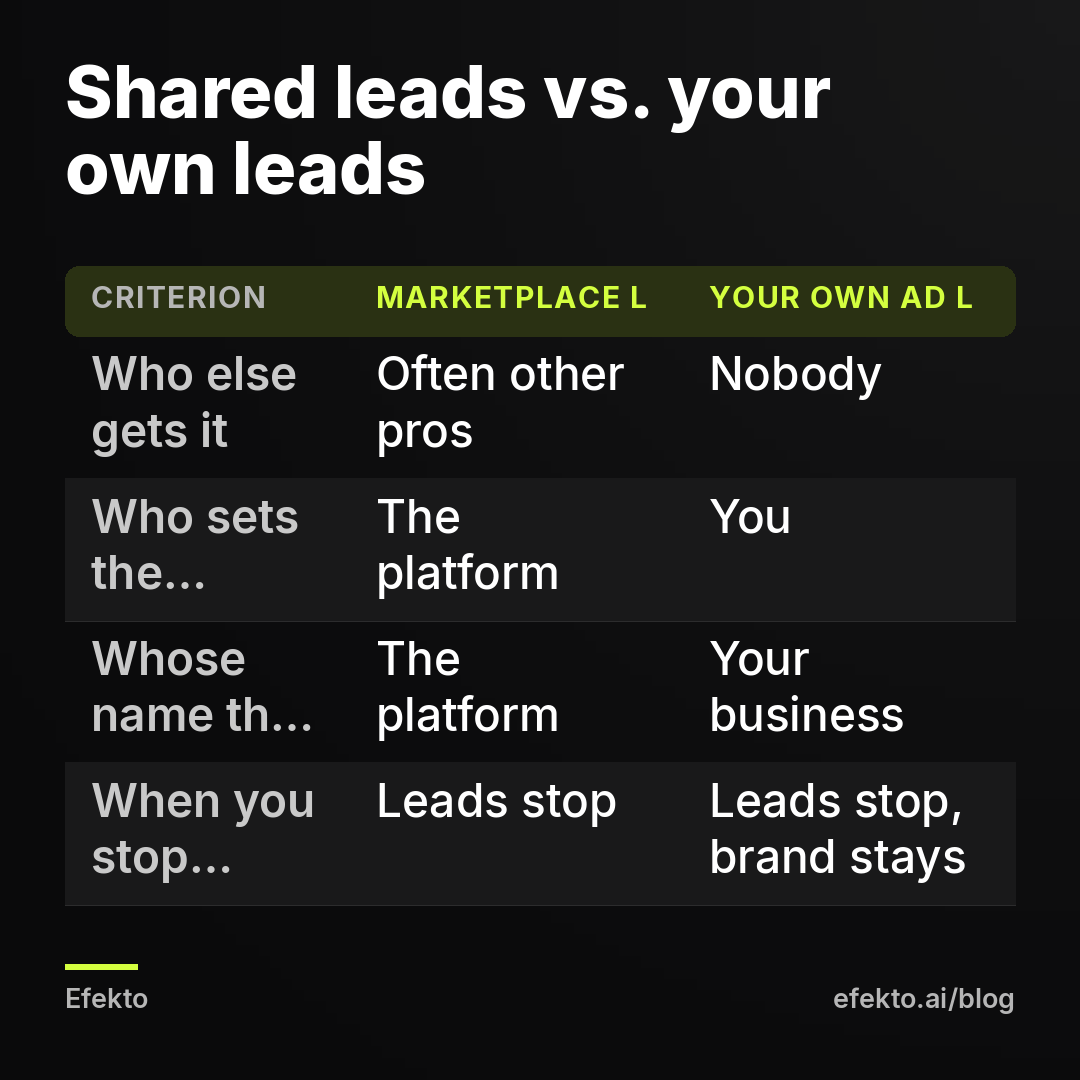
Shared leads vs. leads you generate
Three things change when you stop buying leads and start generating them.
- Exclusivity. On a marketplace, the homeowner posts a request and expects several quotes. With your own ad, they answered your business. Four other contractors aren't calling them in the same 10 minutes.
- Control. You choose the zip codes, the jobs you advertise, the questions on the form, the daily budget and when to pause. If roof replacements pay better than gutter cleaning, you advertise roof replacements and nothing else.
- Brand. Every impression shows your name, your truck and your finished jobs. Someone who saw your ad three times and didn't book still remembers you when a neighbor asks for a recommendation. A marketplace builds the marketplace's brand. That's simply how the model works.
Here's where we stand. Shared leads are a reasonable supplement while you build something you own. They're a weak foundation for a whole business. We should say where our interest lies: we make money running ads on Meta, and the team behind Lemon Agency has worked with over 300 clients. So weigh our opinion knowing that.
When it makes sense: your jobs are worth a few hundred dollars or more, you serve a defined area with enough households, and someone answers the phone the same day.
How we'd set it up:
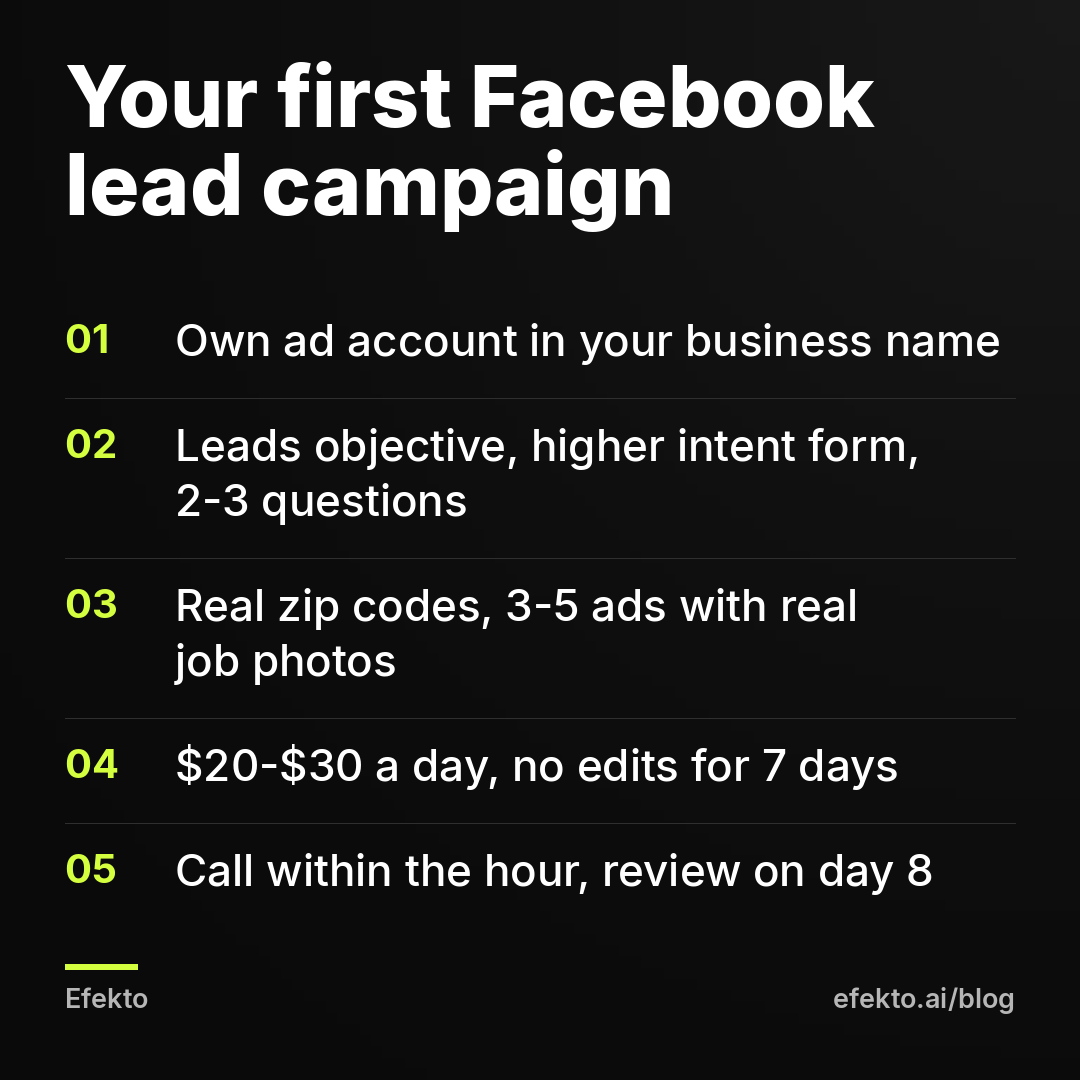
- Own the account. Create the ad account in Meta Business Suite under your business name, with your own card. Never run ads from an account someone else owns and can lock you out of.
- Pick the Leads objective with an instant form. The form opens inside Facebook, so you don't need a website. Choose the "higher intent" form type, which adds a review step before the form is submitted. Ask 2-3 questions that sort out bad fits: zip code, type of job, and when they want it done. These lead form questions for home service businesses are a good starting point.
- Set the location to the zip codes you actually drive to. Don't draw a 50-mile circle because it looks bigger. Leads from 45 miles out cost the same and close worse.
- Run 3-5 ads, not one. Use real job photos, a before-and-after, and a 20-second phone video of you on site explaining what you do. Stock photos of smiling families lose to a photo of your actual crew.
- Start at $20-$30 a day and leave it alone for 7 days. Every edit sends the campaign back into learning. Write your questions down and make all the changes at once, after a week.
- Route leads to your phone. Turn on lead notifications in Meta Business Suite or connect the form to a Google Sheet. Call within the hour. If nobody picks up, text right away.
- Review on day 8. Turn off any ad that spent 2-3 times your target cost per lead without bringing one. Keep the ads that produced leads you could actually book.
For example: here's how the numbers could look in a month. These are made-up figures that show the mechanism, not our results.
| Step | Example number |
|---|---|
| Daily budget | $30 ($900 per month) |
| Cost per form lead shown in Ads Manager | $40 |
| Form leads | 22 |
| Leads with a working number who pick up | 15 (real cost per lead: $60) |
| Booked jobs (1 in 3) | 5 |
| Average ticket | $800 |
| Revenue | $4,000 |
| Ad cost per booked job | $180 |
The $40 is what Meta reports: the cost of a submitted form before anyone has checked it. After you strip out wrong numbers and people who never pick up, the real cost per lead is higher, $60 in this example. Compare that with a shared lead the same way. Say you pay $50 for a lead (a made-up number, not any platform's price) and close 1 in 8 because other pros are calling too. Then the ad cost per booked job is $400. Always divide by booked jobs, not by leads.
From our accounts: On Efekto users' accounts in English-speaking markets (mostly the US), we looked at 12 brands and 189 leads in the 180 days to Nov 15, 2026. 20% of the leads came in after 6 pm. Only 28% arrived on weekdays between 8 am and 4 pm, and 36% came in on weekends. In other words, if your office answers only on weekdays from 8 to 4, about 72% of your Facebook leads arrive while nobody is there. Set up an instant auto-text ("Got your request, we'll call you by 9 am") and have someone check leads on Saturday. A lead that sits until Monday has often hired someone else.
From our accounts: Of the 55 brands that launched a campaign in Efekto in the 180 days to Nov 15, 2026, 33 have already received a lead. The median time from launch to the first lead was 11.4 hours, and 25 of them got one within 24 hours. Facebook can produce a first lead within a day. It isn't guaranteed, though: 22 of those 55 brands hadn't received one yet. Give a new campaign at least a week before you judge it.
When it does NOT make sense:
- Emergency-only work. Someone with a burst pipe at 11 pm searches Google. They don't scroll Instagram. See option 4.
- Very small towns. With only a few thousand households in range, the same people see your ad over and over, and costs rise.
- Low-ticket jobs. On a $90 service, the lead cost can eat the margin.
- Nobody answers the phone. Ads won't fix slow follow-up. They just make you pay for it.
2. Letting an app or an agency run the Facebook ads for you
Same channel, same ownership of leads. The difference is that someone else does the daily work in Ads Manager. An agency charges a monthly fee on top of your ad spend and gives you a person to talk to. Before you sign, make sure the ad account stays in your business's name, so the history and the data leave with you if you leave.
Efekto is the app version of this. Efekto creates ads from your website, publishes them on Facebook and Instagram, and optimizes them every day: it turns off the ones that don't bring results and scales the ones that do. You approve the first batch, and at least 5 ads have to be approved before the campaign starts. It runs on your own Facebook ad account, or on an Efekto ad account with the budget topped up in advance. The minimum daily ad budget is $15. The Starter plan is $149 per month, the first 7 days are free (counted from the launch of your first campaign), and you only add a card when you launch. You can read how Efekto works step by step.
When this option makes sense: you want leads from Facebook without learning Ads Manager, and your time is worth more on jobs than in a dashboard.
When it does NOT make sense: you enjoy running ads yourself and have 3-4 hours a week for it, or you want someone to call your leads for you. Neither an app nor most agencies answer your phone, and that part stays with you.
3. Google Business Profile
This is your free listing on Google Maps and in local search results. When someone searches "HVAC repair near me", the businesses in the map pack get most of the calls. The leads are yours, and the listing costs nothing.
When it makes sense: always. No local service business should skip it, and it's the best channel for urgent jobs where people search instead of scroll.
How we'd set it up:
- Choose the most specific primary category ("Roofing contractor", not "Contractor").
- Set a service area that matches the zip codes you serve. If you don't have a storefront, hide your address.
- Upload 5-10 real job photos, then add new ones every week.
- Text every customer a direct review link on the day you finish the job. A request sent 3 weeks later gets ignored.
- Reply to every review, including the bad ones, within 48 hours.
When it does NOT make sense as your only channel: it can't be turned up in a slow week. Rankings depend heavily on how close the searcher is to you, and building reviews takes months. Use it as the base, not as the tap.
4. Google Local Services Ads
These are the pay-per-lead ads at the very top of Google, shown with a Google verification badge. You pay for leads (calls or messages) rather than clicks, and each lead comes to your business directly. The homeowner does see several verified pros listed next to each other, so you're still compared, but at the moment they choose to contact you, the contact is yours.
When it makes sense: urgent, high-intent work such as HVAC repair, plumbing, locksmiths and roof leaks, where people search the moment something breaks. We compared the two channels in detail in Facebook ads vs. Google Local Services Ads for home service businesses.
When it does NOT make sense: your category isn't available in your area, or you can't get through verification (background checks, license and insurance documents), which can take weeks. You also have little control over how the ad looks, so your brand barely shows. And it only catches demand that already exists. It won't reach the homeowner who'll need a new roof next spring.
5. Google Search ads
These are the classic text ads on keywords like "roof replacement [your city]". You pay per click, write the ads yourself, and send people to your website. The leads are fully yours.
When it makes sense: high-ticket jobs, a website that loads in under 3 seconds on a phone and has a clear call button, and a budget that can buy enough clicks in your trade to learn something within a month.
When it does NOT make sense: you have no website or a slow one, or your budget only buys a handful of clicks a week in a competitive trade. Search ads also take more ongoing work than any other option here: negative keywords, search term reviews and bid changes. If you won't do that or pay someone to, start with Local Services Ads or Facebook.
6. Referrals from past customers
A referred customer arrives already trusting you, because someone they know vouched for you. In our view, these are the easiest leads to close of anything on this list, and they cost almost nothing.
How we'd set it up:
- Ask at the moment the customer is happiest, right after the job is done and they've seen the result.
- Offer a simple reward. For example: a $50 gift card for every referral that books, paid to the referrer.
- Leave a card with your name, phone number and a QR code that links to your review page.
- Every 3-4 months, text your past customers something useful (a seasonal maintenance reminder, not a sales blast) so you stay on their mind.
When it does NOT make sense as the main channel: you're new and have only a few dozen past customers, or you need 10 more jobs next month. Referrals grow at the speed of your customer list, and you can't increase them with money on a slow Tuesday.
7. Nextdoor
Nextdoor is a neighborhood social network. Businesses can have a free page, collect recommendations from neighbors and run paid ads. When a neighbor recommends you in a thread like "Who do you use for gutters?", the lead is yours, and it comes with social proof attached.
When it makes sense: residential trades in suburbs where the neighborhood feeds are active, such as lawn care, cleaning, handyman work, pest control and painting. Ask happy customers who are already on Nextdoor to recommend you there.
When it does NOT make sense: rural areas or neighborhoods where hardly anyone posts, commercial clients, or when you need predictable volume. Recommendations come in waves you can't plan around.
All the options side by side
| Option | Is the lead only yours? | What you control | Time to first lead | Best for |
|---|---|---|---|---|
| Angi / Thumbtack | The homeowner is often comparing several pros | Categories, area, budget | Fast | Filling gaps, very new businesses |
| Facebook and Instagram ads (your account) | Yes | Area, offer, form, ads, budget | Hours to days (median 11.4 hours on our accounts) | Planned jobs worth a few hundred dollars or more |
| App or agency running Facebook ads | Yes, if the account is in your name | Budget, offer, approvals | Similar to running it yourself | Owners with no time for Ads Manager |
| Google Business Profile | Yes | Profile, photos, review replies | Months to build up | Every local business |
| Google Local Services Ads | Yes, though you're listed next to other pros | Budget, hours, job types | Days after verification | Urgent repair work |
| Google Search ads | Yes | Keywords, ads, budget, landing page | Days | High-ticket jobs with a strong website |
| Referrals | Yes | The ask and the reward | Depends on your past customers | Established businesses |
| Nextdoor | Yes | Page, recommendations, ads | Weeks | Suburban residential trades |
What we'd do starting from zero
If we were a local service business that gets most of its work from a marketplace today, we wouldn't quit it on Monday. We'd do this instead:
- Week 1: set up Google Business Profile properly and start texting a review link after every job.
- Week 1: launch Facebook lead ads on our own ad account at $20-$30 a day, using the 7 steps above. You can work out the right amount in how to set your daily budget from the jobs you need.
- Every job from now on: a referral card and a $50 reward (example amount) for referrals that book.
- Every month: count booked jobs and ad cost per booked job for each channel in a simple spreadsheet.
- When owned channels cover your base load: cut marketplace spending down to slow weeks only.
The businesses we'd worry about are the ones where every job still depends on one platform's rules a year from now. Owning your leads won't make them cheaper on day one. What it buys is that the work you put in this month, the reviews, the ad history and the customer list, still works for you next year.
FAQ
Are Facebook leads cheaper than Angi or Thumbtack leads?
Per form, they can cost more or less depending on your trade and area, so comparing price per lead misleads. Compare the ad cost per booked job instead. A lead you don't share with other pros usually closes at a higher rate, which often makes it cheaper per job even when it costs more per lead.
Can I run Facebook ads and stay on Angi or Thumbtack at the same time?
Yes, and that's how we'd recommend making the switch. Keep the marketplace for slow weeks while your own ads and reviews build up, then reduce it once your owned channels bring enough booked jobs.
Do I need a website to get leads from Facebook?
No. Facebook lead ads use an instant form that opens inside the app, so the homeowner never leaves Facebook or Instagram. A website helps people check you out before submitting, but it isn't required to start.
How long before Facebook ads replace marketplace leads?
The first lead often arrives within a day. On our accounts, the median was 11.4 hours for brands that got one. Replacing a steady flow of marketplace jobs takes longer, so plan on 1-3 months of consistent spending and fast follow-up before you cut the marketplace.
If you'd rather have your Facebook and Instagram ads created and optimized every day than learn Ads Manager yourself, you can launch your first campaign on Efekto and judge the first 7 days before you pay.
- Jakub Zwoliński
Founder, Lemon Agency · Efekto · November 17, 2026