Best Questions to Add to a Facebook Lead Form for Home Service Businesses
Ready-to-use qualifying questions for roofing, HVAC, cleaning and remodeling lead forms on Facebook, plus how to tell when your form asks too much.

The best questions for a home service lead form on Facebook are two or three multiple-choice questions that answer three things: what job this is, how soon the person needs it, and whether the address is inside your service area. Facebook fills in name, phone and email from the profile. Every question you add on top of that should change what you say on the callback. If it doesn't, cut it. Budget questions, typed-in answers and "describe your project" boxes either lower the number of people who submit or give you text you can't use.
In short:
- A good qualifying question can be answered in one tap and changes what you do on the callback.
- For most home service businesses, more than three custom questions costs more submissions than it saves in bad leads.
- Budget questions and free-text fields are the two most common ways a lead form stops working.
What makes a lead form question worth asking?
A question is worth asking if it passes four tests.
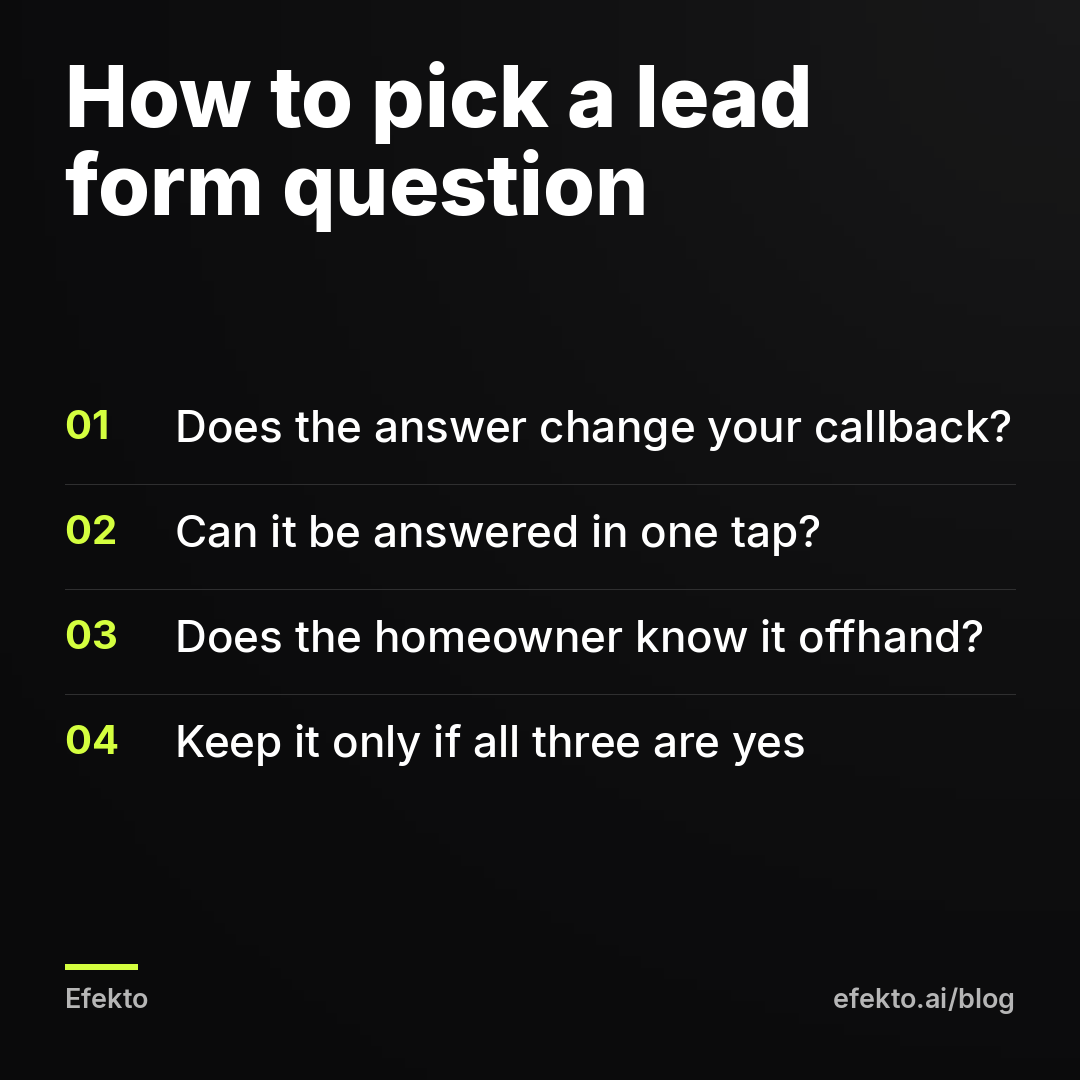
- The answer changes your action. If a roof replacement and a leak repair both get the same call at the same time, you don't need to know which one it is before the call.
- It takes one tap. Multiple choice beats typing on a phone, every time.
- The homeowner knows the answer without checking. "How old is your furnace?" is fine with ranges. "What is the model number?" sends people to the basement, and they don't come back.
- It doesn't feel like an exam. A question that reads like you're screening out poor people gets the form closed.
Here is how the common question types compare on a Facebook lead form:
| Question type | Effort for the homeowner | Quality of answers | Best use | Our verdict |
|---|---|---|---|---|
| Multiple choice | One tap | High, every answer is usable | Job type, timing, property type | Default for almost every question |
| Conditional answers | One tap per step | High | Service area by state, then city or county | Use when you serve several areas |
| Short answer (free text) | Typing on a phone | Low, many junk answers | Optional notes at the very end | Avoid for anything you need to sort leads by |
| Appointment request | Picking a time | Medium, times often change | Cleaning, estimates with fixed slots | Only if someone confirms every booking by phone |
| Budget question | One tap, but a hard decision | Low, people guess or leave | Almost never for homeowners | Remove it |
Which questions should a roofing company ask?
A roofer needs to know whether this is a repair or a replacement, whether there is active damage, and whether an insurance claim is involved. Those three answers decide who calls back and how fast.
We'd set it up like this:
1. What do you need help with?
- Leak or storm damage repair
- Full roof replacement
- Inspection or estimate
- Gutters or siding
2. When do you want the work done?
- As soon as possible, there is active damage
- In the next 1 to 3 months
- Just getting prices for later
3. Are you filing an insurance claim?
- Yes, already filed
- Yes, planning to
- No, paying out of pocket
- Not sure yet
The insurance question is not a filter. Nobody gets rejected for answering it. It tells your estimator what to bring and what conversation to have. A "just getting prices for later" lead is still a lead: it goes into a slower follow-up sequence instead of an immediate call. That is the point of qualifying questions. They sort, they don't block.
What we would not ask: roof size in square feet, number of layers, or the roof material typed in. Homeowners don't know the square footage, and a guess is worse than nothing. If you run Facebook ads for a roofing company, the estimate visit gets you those numbers anyway.
Which questions should an HVAC company ask?
HVAC forms have one job: separate "my system is down" from "I'm thinking about replacing it". These are two different businesses with different margins and different callback speeds.
1. What do you need?
- No heat or no cooling right now
- Repair, system is running but not well
- New system or replacement quote
- Maintenance or tune-up
2. How old is your current system?
- Less than 5 years
- 5 to 10 years
- 10 to 15 years
- Over 15 years or not sure
3. Do you own the home?
- Yes
- No, I rent
The age question is the most useful one on an HVAC form. A system over 15 years old plus a repair request is a replacement conversation waiting to happen, and your technician should know that before he knocks on the door. The ownership question matters only for replacements. If you mostly do repairs, drop it: renters' landlords pay for repairs too, and you don't want to scare those people away.
For emergency calls, a form is the slow option. Someone without heat in January wants to talk to a person now. More on that below, and in our page on Facebook ads for HVAC companies.
What should a house cleaning business ask?
Cleaning is the one category where a form can almost quote the job, because the price depends on a few things the customer knows by heart.
1. What type of cleaning?
- Regular cleaning (weekly or every two weeks)
- One-time deep clean
- Move-in or move-out
- Post-construction
2. How many bedrooms?
- 1 to 2
- 3
- 4
- 5 or more
3. How often would you like cleaning?
- Weekly
- Every two weeks
- Monthly
- Just once
Bedrooms work better than square feet because everyone knows how many bedrooms they have. With these three answers you can call back with a price range, which is what the person actually wants. The frequency question is how you spot recurring customers, and recurring customers are where a cleaning business makes its money. A one-time move-out clean is fine, but it should not get the same follow-up effort as a weekly client.
If you offer fixed time slots, the appointment request option can work here. Treat every booked slot as a request, not a confirmed job, and confirm it by phone or text the same day.
What should a remodeling contractor ask?
Remodeling leads have the longest decision time and the widest range of project size, so the form should tell you the project and the stage the homeowner is at.
1. Which project are you planning?
- Kitchen
- Bathroom
- Basement
- Addition or larger renovation
- Something else
2. Where are you in the process?
- Ready to start, looking for a contractor
- Getting quotes and comparing
- Still planning, starting in 6+ months
3. Do you have plans or a design yet?
- Yes, drawings are ready
- I have ideas and photos
- No, I need help with design
The stage question replaces the budget question that most remodelers want to ask. Someone who is ready to start and has drawings is close to signing. Someone still planning six months out is a nurture lead. Both are worth having, but they deserve different callbacks.
What happens when a form asks too much?
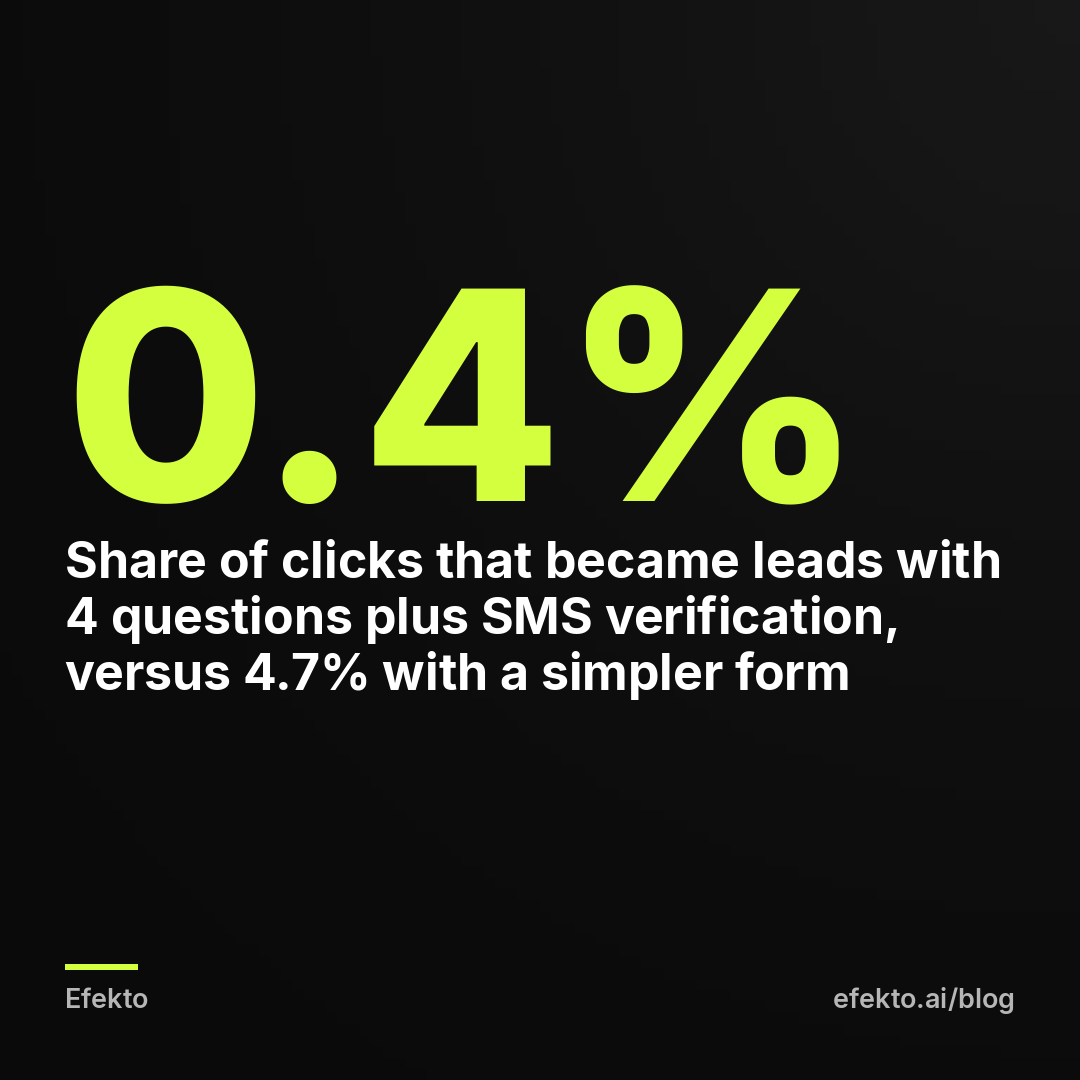
From our accounts: In a business software lead campaign in October 2026, the ad had a 2.19% CTR, which means people clicked. Behind that click sat a form with 4 questions plus SMS verification. Only 0.4% of clicks became leads. A simpler form in a similar campaign converted 4.7% of clicks. Same kind of audience, same kind of offer, and roughly ten times the leads from the same number of clicks. The ad was never the problem.
From our accounts: In a B2B lead campaign in October 2026, a lead form with a budget question was opened 59 times in a day and a half, and nobody submitted it. Not a single lead. People got as far as the budget question and left.
From our accounts: In a mortgage campaign lead form in October 2026, the region question was a free-text field. 22% of leads typed random text into it, so nearly a quarter of the answers could not be used to route the lead. Switching to a multiple-choice list fixed it.
None of these campaigns were home services. We're not going to pretend they were. But the mechanism carries over directly, because a homeowner on a phone behaves like everyone else on a phone. Every extra screen is a chance to close the form. A hard question like budget makes people stop and think, and thinking on a lead form ends in leaving. A typing field gets typed junk.
What this means for you: if your ads get clicks and your form doesn't get leads, look at the form before you touch the ads. Count the questions. Find the one that requires typing or a hard decision. That is usually where people leave.
How many questions is too many on a Facebook lead form?
For a home service business, three custom questions is the ceiling, and two is often better. Name, phone and email are prefilled and cost the person nothing. Each custom question costs a little. A question that requires typing or a hard decision costs a lot.
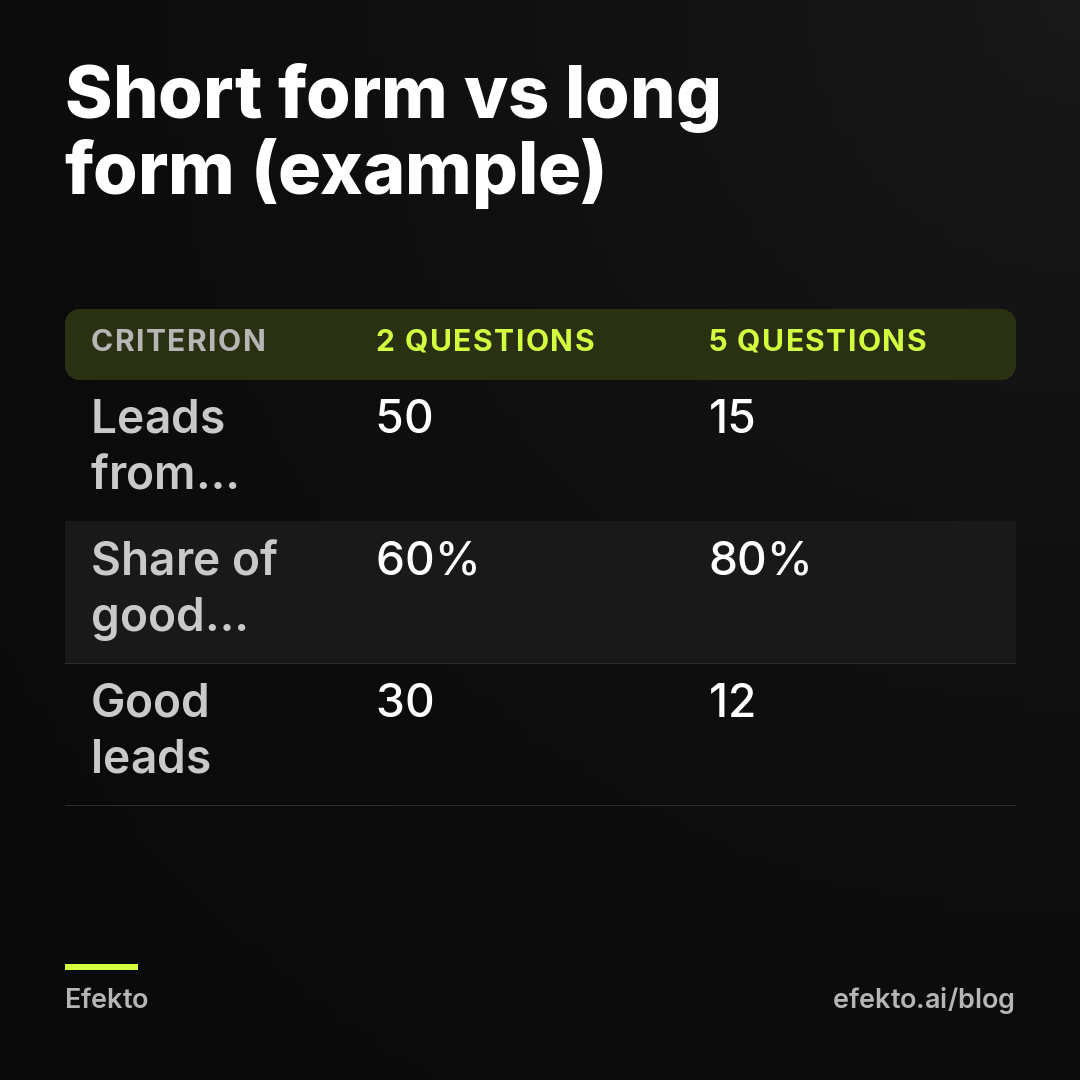
To see why, run the numbers. For example, say your ads bring 1,000 clicks a month to the form.
| Form setup (example) | Clicks | Form completion (example) | Leads | Good leads (example) |
|---|---|---|---|---|
| Contact info + 2 multiple-choice questions | 1,000 | 5% | 50 | 30 at 60% |
| Contact info + 5 questions incl. budget | 1,000 | 1.5% | 15 | 12 at 80% |
These are illustrative numbers, not results from an account. The longer form gives a better share of good leads, 80% versus 60%. It still loses, because 12 good leads is less than 30 good leads. This is the trap: a long form looks like it improves quality, because the percentage goes up. The number of jobs you can actually book goes down.
Signs your form has too many questions:
- Ads Manager shows plenty of form opens but few submissions.
- You can't say which callback decision each question supports.
- Any question needs typing beyond the prefilled contact fields.
- The form has more than one screen of custom questions on a phone.
- You added a question after one bad lead, not after a pattern.
The opposite problem exists too. A form with zero custom questions produces leads you can't sort, and your team calls a "just browsing" lead with the same urgency as a burst pipe. Two well-chosen questions fix that without hurting volume. If you want to see which of those leads turned into paid work, we explain a simple method in tracking Facebook leads to paid jobs without a CRM.
Should you ask about budget on a lead form?
No. For homeowners, a budget question on a lead form is a mistake, and we'd remove it from every home service form we see.
Here is why. Homeowners don't know what a roof, an AC system or a kitchen costs. That is the reason they want a quote. Asking them for a budget is asking them to answer your question before you answer theirs. Some will guess low and look unqualified. Some will guess high to seem serious. Many, as the B2B form above showed, will simply leave. The ones who stay are not necessarily the best customers. They are the ones most willing to fill in forms.
What to ask instead:
- Timing ("When do you want the work done?") separates serious buyers from browsers without making anyone feel judged.
- Project stage ("Do you have plans yet?") tells a remodeler how close the person is to signing.
- Financing interest, as a plain option ("I'd like to hear about financing"), tells you who needs payment options without asking how much money they have.
If price shoppers are your actual problem, the fix is in the ad, not in the form. An ad that leads with "cheapest in town" attracts people looking for the cheapest. A form question will not undo that.
How do you add qualifying questions without hurting the form?
This assumes your form already exists. These are only the steps for the questions themselves.
- Write down your callback decisions first. For example: who calls (owner or estimator), how fast (within 10 minutes or same day), and what to prepare (insurance paperwork, price list). Each question must feed one of those.
- Choose multiple choice for every question. Keep 3 to 5 answer options. Always include a "not sure" or "something else" option, so nobody gets stuck.
- Put the easiest question first. Job type is easy. Timing is second. Anything that requires thought goes last, or goes away.
- Turn service area into a list, not a typed field. If you serve several counties or towns, use conditional answers: state first, then the area. That stops leads you can't serve from reaching your phone, a problem we cover in why Facebook ads bring leads from outside your service area.
- Choose the higher intent form type if you get junk. It adds a review screen where the person confirms their details before sending. It costs some volume. We'd use it when you get many leads with wrong phone numbers, and skip it when volume is already low.
- Preview it on your own phone. If you need to scroll more than once to see all custom questions, cut one.
- Leave it alone for a week. Then compare opens to submissions. If submissions dropped sharply after a change, the last question you added is the suspect.
A word on where we stand: we make money from ads on Facebook and Instagram, so we have every reason to want your forms to produce leads, not form opens. The team behind Lemon Agency has run lead generation campaigns for more than 300 clients, and the forms that work look boring. Two or three questions, all multiple choice.
If you'd rather not build and test this by hand, Efekto creates ads from your website, publishes them, and optimizes them every day: it turns off the ones that don't bring results and scales the ones that do. You still decide what your form asks. The app handles the ads that send people to it.
When does a qualifying lead form not make sense?
A lead form is the wrong tool in three situations, and in each of them more questions make it worse.
Emergency work. Burst pipe, no heat, active roof leak. The person wants a phone call right now, not a callback in an hour. Use a call ad that dials your business directly, and answer the phone. A form with qualifying questions in front of an emergency is a form that sends the customer to your competitor.
Very low volume. If you get three leads a week, you don't need to sort them. Call all three. Qualifying questions exist to help you prioritize, and with three leads there is nothing to prioritize. Keep the form at contact info plus one job-type question.
You don't call back fast. No form question fixes a two-day callback. A lead that answered "as soon as possible" and heard nothing for 48 hours has already booked someone else. Before you add questions, fix the callback time. That change usually beats any form change.
Our position is simple. The form is there to sort leads, not to reject them. When we review a home service form, we remove the budget question, turn every typed field into a list, and cut to the two or three questions that change the callback. Then we look at the ads again.
FAQ
Does Facebook fill in the phone number on a lead form automatically?
Yes, name, email and phone can be prefilled from the person's Facebook profile. The person can edit them before submitting. That is also why some numbers are outdated, and why a quick text or call soon after the lead arrives catches wrong numbers early.
Can I make a lead form question optional?
Custom questions on Facebook lead forms are generally required once added, so you can't count on people skipping them. If a question is only nice to have, remove it instead of hoping people will ignore it.
Should I ask for the full street address on the form?
Not for most home service businesses. A service area list or ZIP code is enough to know if you can take the job, and the full address comes up naturally on the callback. Asking for it upfront adds typing and makes some people hesitate.
How long should I test a new question before judging it?
Give it about a week, or until the form has been opened a few dozen times. Then compare opens to submissions with the period before the change. A sharp drop points to the new question.
If you want ads that send homeowners to a short, well-built form without learning Ads Manager, you can see how it works at efekto.ai.
- Jakub Zwoliński
Founder, Lemon Agency · Efekto · November 16, 2026