How to Write a Facebook Ad Offer for a Local Service Business That People Click
A step-by-step way to build a Facebook ad offer for a local service business: one service, a price or scope, a deadline, your area and a reason to book now.

A Facebook ad offer that local customers click names five things: one specific service, a price or a clear scope, a time frame, the area you serve, and a real reason to book this week instead of someday. "Quality service, free estimates, call today" has none of those, which is why people scroll past it. Build the offer before you touch the image or the copy. If the offer is vague, no design will save the ad.
In short:
- A clickable offer has five parts: one service, a price or scope, a time frame, a service area and a reason to act now.
- "Free estimate" and "20% off" are not offers, because every competitor in your area already says the same thing.
- Judge an offer by booked jobs per dollar, not by clicks or by the cost per lead Meta shows you.
One note on where we stand. We run lead generation campaigns for service businesses, more than 300 clients at Lemon Agency since the start, and we make money when businesses advertise on Meta. What follows is how we build offers by hand in ad accounts. The steps work whether you run ads yourself, hire someone or use an app.
Step 1: Which service should your Facebook ad sell?
Sell one service that a stranger can say yes to in under a minute. Usually that is your smallest paid job, not your full menu.
Most local business owners want the ad to sell the job that makes them the most money. A roofer wants replacements. A med spa wants treatment packages. But nobody commits to a five-figure roof or a multi-session package from a scroll on their phone between two videos. They commit to something small, meet you, and then buy the big thing. We call this the entry service, and it is the single biggest change we make when we take over an account that isn't working.
An entry service passes four checks:
- You can deliver it within 7 days. If the earliest slot is a month out, the reason to click is gone.
- One person can decide alone. If the customer has to ask a spouse, a landlord or a board, the lead goes cold.
- It leads to a bigger job. An inspection leads to a repair. A tune-up leads to a replacement quote. A first facial leads to a series.
- You can describe it in six words or fewer. "Interior detail with pet hair removal" works. "Comprehensive vehicle care solutions" doesn't.
Here is what that looks like across four industries we work with often:
| Industry | Job you want | Entry service for the ad |
|---|---|---|
| Car detailing | Ceramic coating | Full interior detail |
| HVAC | System replacement | AC tune-up before summer |
| Roofing | Full replacement | Roof inspection with photo report |
| Med spa | Treatment package | First-visit facial |
Pick one. Not three in one ad. An ad that says "detailing, ceramic coating, paint correction and window tint" tells the reader you do everything, which reads exactly like you specialize in nothing.
Step 2: Should you put the price in a Facebook ad?
Yes, if the service has a fixed price. If it doesn't, show a starting price or the exact scope of what the customer gets instead.
Hiding the price feels safer, and it isn't. "Call for a quote" filters out nobody, so your phone fills with people who hang up the moment they hear the number. A price in the ad does the filtering before you spend a minute on the call. The people who click already accept the number.
There are three ways to show price, depending on the job:
- Fixed price: "Full interior detail, $249." Best for detailing, tune-ups, cleanings, first visits.
- Starting price: "AC tune-ups from $89." Fine when vehicle size or system type changes the price, as long as most customers actually pay close to the starting number. If 90% pay double, the ad is bait and the reviews will say so.
- Scope instead of price: "Free 20-point roof inspection, with photos of every problem sent to your phone within 24 hours." For jobs like roofing, where nobody can price the work before seeing it.
A word on discounts. "20% off" is the laziest offer in local advertising. It tells the reader nothing about what they get, it trains your market to wait for the next sale, and it pulls in the customers who shop on price alone. If you want to make the offer more attractive, add something to it rather than cutting the price: pet hair removal included, a free filter with the tune-up, a written report with the inspection. That keeps your price and gives the customer a concrete thing to picture.
Step 3: How do you add a deadline without sounding like a scam?
Use a deadline that is actually true: a date, a season, or a number of slots you really have.
Fake countdowns are lying to customers, and people can tell. "Offer ends tonight" on an ad that has run for four months is the fastest way to look like every other spammy contractor in the feed. Worse, the people who do believe it and then see the same ad next week stop trusting anything you say.
Real deadlines come from your actual calendar:
- A date tied to a reason: "Booking tune-ups through May 31, before the summer rush."
- Real capacity: "We have 6 inspection slots open this week." Only if it is true, and only if you update the ad when the number changes.
- A season: "Spring detailing slots, March and April."
If you can't name a true deadline, leave it out and lean harder on Step 5. A missing deadline costs you a little. A fake one costs you trust, which is harder to buy back.
Step 4: How specific should the service area be in a Facebook ad?
Name the town or neighborhoods in the first line of the ad, not just in the targeting settings.
Targeting decides who sees the ad. It doesn't tell the person seeing it that you serve them. Someone in a suburb sees "Roof inspections, free" and assumes it is a national company or a lead seller. The same person sees "Roof inspections for homeowners in Plano and Frisco" and stops, because they recognize their own town. Local readers react to local names.
Naming the area also filters. People outside your area still see ads now and then because targeting is never perfect, and every one of them who fills out a form is a lead you pay for and can't serve.
How to do it:
- Name the 2-3 biggest towns or neighborhoods you serve. Not 15. A list of fifteen towns reads like a phone book.
- Set the targeting radius by driving time to a job, not by a round number of miles. If 25 minutes is your limit, draw the radius at 25 minutes of driving.
- If you serve a big metro, split it: one ad for the north suburbs, one for the south, each naming its own towns.
Step 5: What is a real reason for someone to book now?
Tie the reason to something already happening in the customer's life: weather, a season, an event, or a problem that gets worse if they wait.
This is the part most offers skip, and it is the part that turns "I should do that someday" into a tap on the button. The strongest reasons are honest, because they are things the customer already knows are true.
| Industry | Reason that already exists | How it reads in the ad |
|---|---|---|
| Car detailing | Selling or trading in the car | "Trading in soon? A clean interior is the cheapest way to look after your trade-in offer." |
| HVAC | First hot week of the year | "Tune-ups before the first heat wave, while we still have same-week slots." |
| Roofing | Storm in the area | "Strong winds hit last week. Get a free inspection before small damage turns into a leak." |
| Med spa | Holidays, weddings, events | "Booking first-visit facials for the weeks before the holidays." |
Two cautions. For roofing, a storm reason only works if you actually check for damage and tell people honestly when there is none. Storm chasers have made homeowners suspicious of any roofer who appears after bad weather, and the only way out of that is a real report with real photos. For med spas, keep the reason about timing and the visit itself, not about how someone's body will look afterward. Body and health claims are the most common reason we see med spa ads rejected.
Step 6: How do you turn the offer into ad copy?
Write the offer as one sentence first, then split it into headline, primary text and button. If you can't write the sentence, the offer isn't ready.
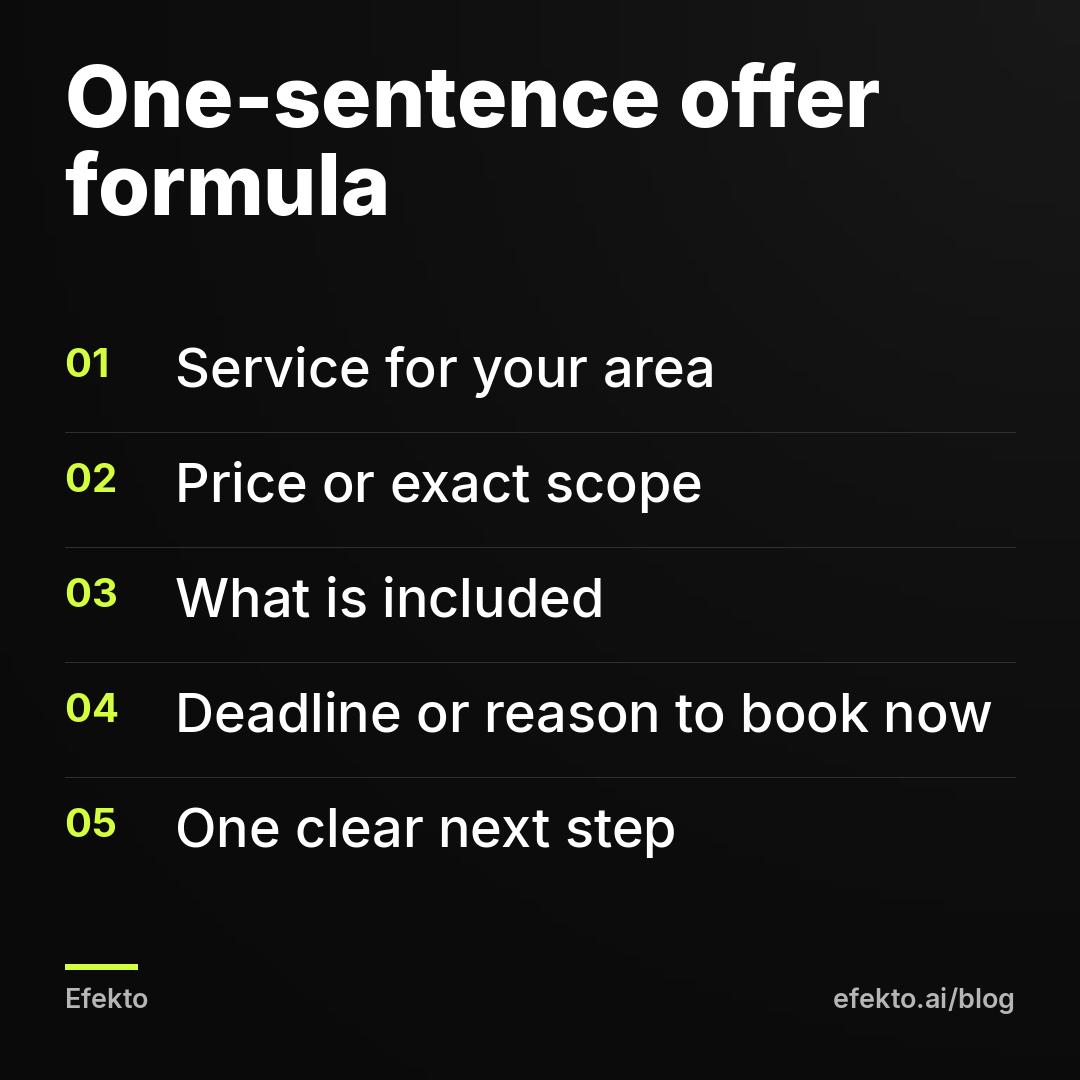
The formula: [Service] for [area]: [price or scope]. [What's included]. [Deadline or reason]. [Next step].
Here it is filled in for an HVAC company:
AC tune-ups for homeowners in Mesa and Gilbert: $89. Includes coil cleaning, refrigerant check and a written report on your system. Booking through May 31, before the summer rush. Pick a time in 30 seconds.
Now split it:
- Headline (the bold line under the image): service plus price. "AC Tune-Up, $89, Mesa and Gilbert."
- First line of primary text (the part people read before "See more"): area plus the reason. "Mesa and Gilbert: tune-ups before the first heat wave."
- Rest of primary text: what's included and who does the work. Two or three short lines.
- Button: match it to what happens next. "Book Now" if they pick a time, "Get Quote" for roofing, "Call Now" only if someone answers the phone every time.
How weak offers become strong ones, in all four industries:
| Industry | Weak offer | Strong offer |
|---|---|---|
| Car detailing | "Professional detailing, quality you can trust" | "Full interior detail in Round Rock, $249, pet hair and seat shampoo included. Open slots this Saturday." |
| HVAC | "Heating and cooling experts, free estimates" | "AC tune-ups in Mesa and Gilbert, $89, written system report included. Booking through May 31." |
| Roofing | "Roof repair and replacement, call today" | "Free 20-point roof inspection in Plano and Frisco, photos of every problem sent within 24 hours." |
| Med spa | "Look your best, 20% off all treatments" | "First-visit facial in Scottsdale, $129, skin consultation included. Booking for the weeks before the holidays." |
All prices and towns above are examples. Use your own numbers.
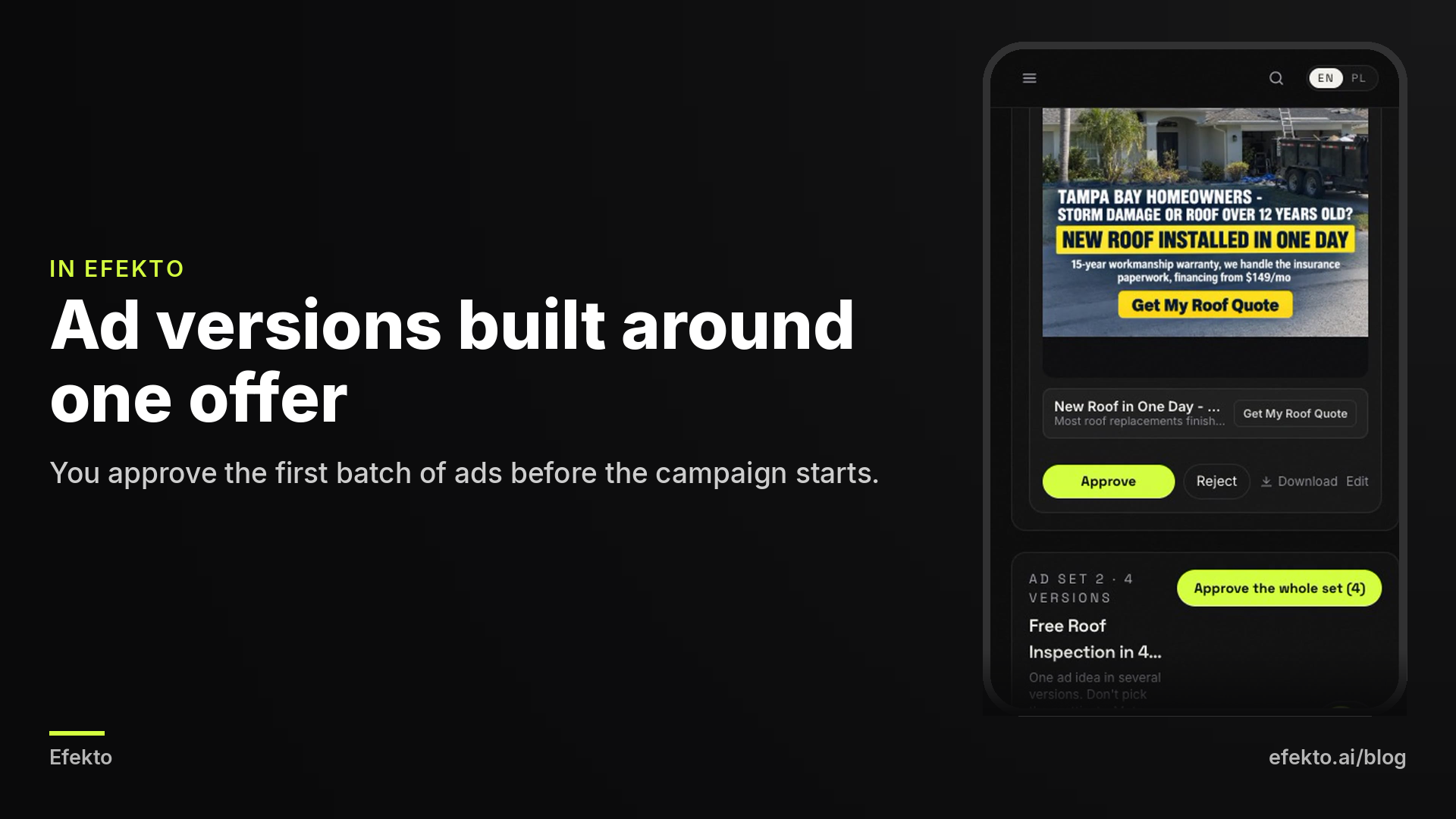
Once you have one strong offer, you need several versions of the ad around it: different images, different first lines, a short video. One ad shown to the same people for weeks wears out. If you'd rather not produce and rotate those versions yourself, this is the part Efekto handles: Efekto creates ads from your website, publishes them, and optimizes them every day: it turns off the ones that don't bring results and scales the ones that do. You approve the first batch before anything goes live, with at least 5 approved ads before the campaign starts, so the offer stays yours. There is more detail on how Efekto works step by step.
Step 7: What should happen after someone clicks the ad?
The form or page must repeat the exact offer and ask only what you need to book the job.
A strong offer that leads to a generic contact form loses most of what it earned. The person clicked "AC tune-up, $89" and lands on a form titled "Contact Us" with eight fields. They wonder whether the $89 still applies, and they leave.
What the form should do:
- Repeat the offer in the title. "AC tune-up, $89, Mesa and Gilbert."
- Ask 3-4 questions, no more: name, phone, zip code, and one question that qualifies the job ("What vehicle?" for detailing, "How old is your roof?" for roofing).
- Ask the zip code. It is the fastest way to spot leads outside your area before you call them.
- Say what happens next. "We'll text you within 1 business hour to pick a time." Then actually do it.
We go deeper into form settings that cut junk submissions in our guide to setting up Facebook lead ads that bring real customers. If your ads already get clicks and the phone still doesn't ring, the problem usually sits between the click and the call, and we cover that in why Facebook ads get clicks but no calls.
One more thing, and it matters more than any wording: call or text the lead the same day. A great offer followed by a callback three days later loses to a mediocre offer followed by a callback in ten minutes.
Step 8: How do you know which offer is working?
Run 2-3 offers side by side for at least two weeks and compare cost per booked job. Not clicks, and not the cost per lead Meta shows you.
The cost per lead in Ads Manager is the cost of a form submission before anyone has checked it. Some of those submissions are wrong numbers, people outside your area, or people who tapped by accident. The cost of a real, reachable lead is always higher than what Meta reports, and the cost of a booked job is higher still. An offer that looks cheap in Ads Manager can be the most expensive one in your bank account.
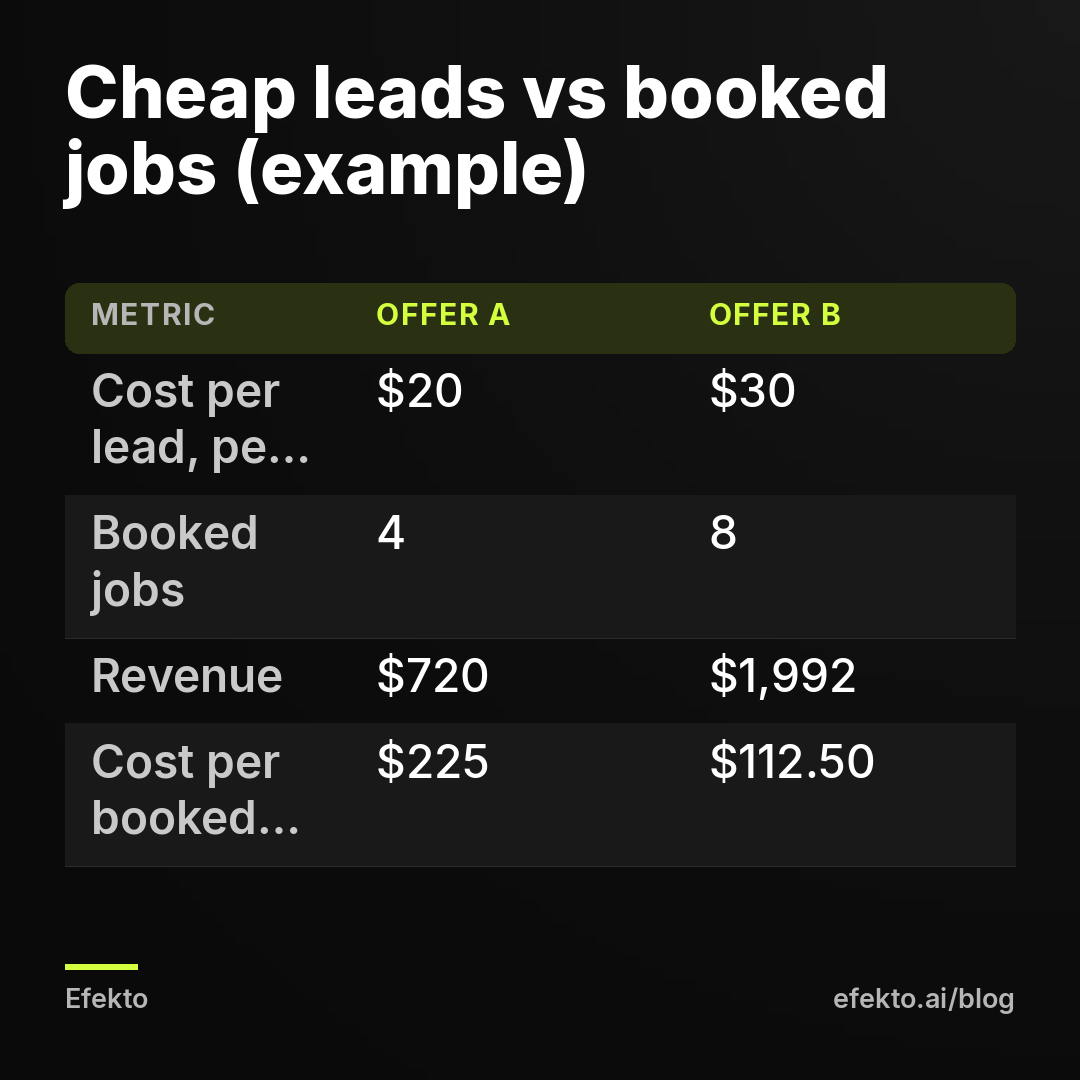
For example, say a detailing shop tests two offers, each with $30 a day for 30 days, so $900 per offer:
| Offer A: "20% off any detail" | Offer B: "Full interior detail, $249" | |
|---|---|---|
| Spend | $900 | $900 |
| Form leads (as Meta counts them) | 45 | 30 |
| Cost per lead, per Meta | $20 | $30 |
| Real, reachable leads after calling | 20 | 18 |
| Cost per real lead | $45 | $50 |
| Booked jobs | 4 | 8 |
| Average job value | $180 | $249 |
| Revenue | $720 | $1,992 |
| Cost per booked job | $225 | $112.50 |
These are made-up numbers to show the mechanism, not results from any account. Offer A wins every number Ads Manager shows you. Offer B wins every number that pays your rent. Discount offers tend to attract people who fill out forms fast and book slowly, while a clear price attracts fewer people who already said yes to the number.
To track this without software, keep a simple sheet: date, name, offer they came from, reached yes or no, booked yes or no, job value. Fifteen minutes a week. If you run a detailing shop, we put together more on offers and creatives for that industry on our page about Facebook ads for car detailing.
How long to wait before deciding: two weeks minimum, and at least 10 real leads per offer. Judging after three days and 4 leads is guessing.
When does a better offer not help?
A better offer won't fix a business that can't take the work, can't answer the phone, or prices far above the local market.
Be honest with yourself about these before you spend on ads:
- You're already booked out. If the earliest slot is three weeks away, more leads mean more people disappointed. Fix capacity first.
- Nobody picks up. If calls go to voicemail and forms sit for two days, every dollar of ad spend leaks out at this step.
- Your reviews are thin or bad. People who click will look you up. A handful of reviews or a recent run of angry ones will undo a strong offer.
- Your price is far above competitors with no visible reason. A clear offer makes the comparison easier, which hurts if the comparison isn't in your favor. Either show what justifies the price or reconsider it.
- The service doesn't fit a quick decision. Some jobs, like large commercial contracts, rarely start from a Facebook ad. Referrals, Google search or direct sales may be the better channel.
The same goes for us. Efekto doesn't make sense if you have no working website, because it creates ads from the site, or if you haven't decided which service and price you want to sell. An app can test and adjust ads every day, but it can't decide your offer for you. Do Steps 1 through 5 on paper first. If you can't, no tool or agency will fix that.
What are the most common Facebook ad offer mistakes?
The most common mistake is advertising the company instead of a service, and the fixes for this and the others are simple.
- Selling the brand, not a job. "Family owned since..." is a nice second line and a bad offer. Fix: lead with the entry service from Step 1.
- Five services in one ad. Fix: one ad per service. If you want to promote three, run three ads.
- "Free estimate" as the whole offer. Every competitor says it. Fix: turn it into scope. What exactly does the estimate include, and when do they get it?
- Discount instead of value. Fix: keep the price and add something concrete to the job.
- Fake urgency. Fix: a true date, true capacity, or no deadline at all.
- No area in the copy. Fix: 2-3 town names in the first line.
- A form that forgets the offer. Fix: repeat the exact offer in the form title and keep it to 3-4 questions.
- Changing the offer every few days. Fix: give each offer two weeks and 10 real leads before you judge it.
- Judging by clicks or Meta's cost per lead. Fix: track booked jobs and revenue per offer in a simple sheet.
The way we build offers in client accounts comes down to this: we don't launch an ad until the offer fits in one sentence with a service, a price or scope, an area and a true reason to book now. Everything else is testing.
FAQ
Should I offer a discount on my first Facebook ad?
Usually no. A clear price with something extra included tends to bring customers who book at full price, while a discount brings people who wait for the next sale. If you do run a discount, attach it to one specific service with a real end date.
Should I put my phone number in a Facebook ad?
Only if someone answers it every time during business hours. A missed call from an ad is worse than a form, because the person often won't try again. If calls can go unanswered, use a form and call back the same day.
Which call-to-action button works best for a service business?
The one that matches what happens next. Use "Book Now" when people pick a time, "Get Quote" when you need to see the job first, and "Call Now" only when the phone is always covered.
Can I use the same offer on Facebook and Instagram?
Yes, the offer itself stays the same. What changes is the format: Instagram leans more on short vertical video and fewer words on screen, so put the service and price in the first second of the video.
How often should I change my ad offer?
Change the offer when the numbers tell you to or when the season changes, not when you get bored of it. Images and first lines need refreshing more often than the offer does, because the same people see them repeatedly.
If you want your offer turned into ads that get tested and adjusted every day, you can start at efekto.ai.
- Jakub Zwoliński
Founder, Lemon Agency · Efekto · October 24, 2026