Efekto vs Madgicx: An App That Runs Your Ads vs a Toolkit for Ad Managers
Efekto vs Madgicx compared: who each tool is for, whether it creates and runs ads, how much Ads Manager knowledge it needs, and a worked cost example.

If you own a local service business and nobody on your team knows Ads Manager, choose an app that runs the ads for you, like Efekto. If you, an employee or your agency already manage Meta campaigns every week and want deeper analytics, automation rules and creative insights, Madgicx is the better fit. The real difference is not which tool is smarter. It is who does the daily work. Efekto does the campaign work itself. Madgicx makes a person who already does that work faster and better informed.
In short:
- Efekto creates ads from your website, publishes them on Facebook and Instagram, and optimizes them every day, so the owner approves ads and answers leads.
- Madgicx is a toolkit that connects to an existing Meta ad account and helps someone who already understands campaigns analyze, automate and scale them.
- If you can't explain what an ad set, a daily budget and a conversion event are, a toolkit will mostly show you data you won't act on.
Where we stand: we build Efekto, and the team behind it, Lemon Agency, earns its living running Meta ads for more than 300 clients since the start, so this comparison is written by one side. We describe Madgicx only through what it publicly says about itself, and we say plainly where it is the better choice.
What is the difference between Efekto and Madgicx?
Efekto is a done-for-you app; Madgicx is a do-it-better toolkit. Both get filed under "AI tools for Facebook ads", and that label is the problem. It groups together a tool that replaces the person running your campaigns with a tool that equips that person. Those are two different purchases for two different buyers.
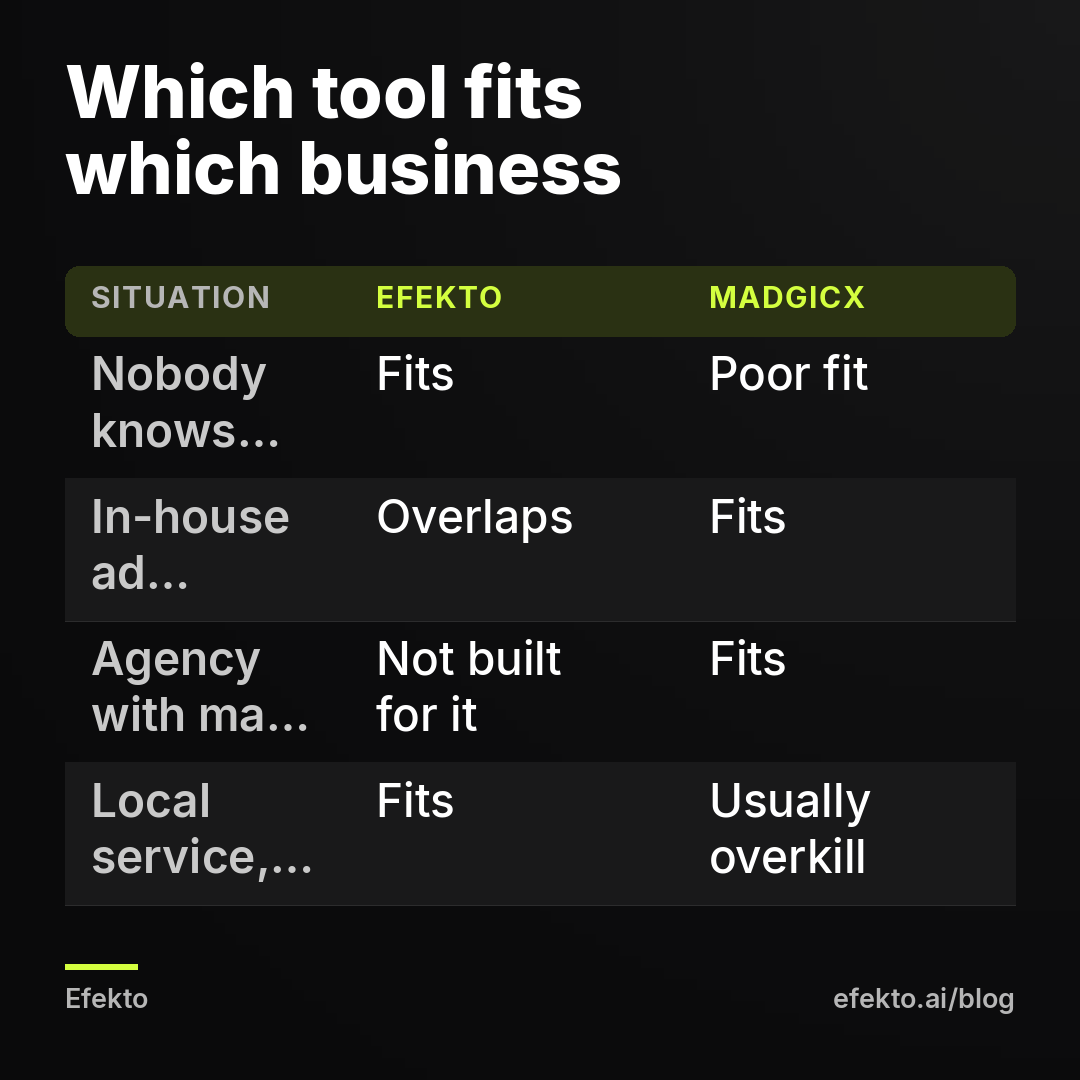
| Efekto | Madgicx | |
|---|---|---|
| What it is | An app that creates and runs Facebook and Instagram ads | A platform of tools for people who manage Meta ads (per its website) |
| Built for | Owners of small local service businesses | Advertisers with someone managing campaigns: e-commerce brands, in-house marketers, agencies (per its positioning) |
| Creates ads | Yes: images and video made from your website | Its website lists AI ad creation features; most of the platform focuses on analysis, automation and reporting |
| Runs campaigns day to day | Yes: optimizes every day, turns off ads that don't bring results and scales the ones that do | Provides automation rules, recommendations and insights; a person configures them and makes the calls |
| Ads Manager knowledge needed | None to start; you approve ads and set a budget | Working knowledge of campaigns, ad sets, audiences, events and attribution |
| Ad account | Your own Facebook ad account, or an Efekto ad account with the budget topped up in advance | Connects to your existing Meta ad account |
| Your weekly time | Approving new ads, answering leads | Reviewing dashboards, acting on recommendations, maintaining rules |
| Price | From $149 per month (Starter plan) | Check the current Madgicx pricing page; we don't quote it here |
The row that decides most purchases is "Runs campaigns day to day". Everything else follows from it. If you want to go deeper on that split across more tools, we wrote a separate piece on AI ad generators vs a tool that runs your ads.
Who is Madgicx actually built for?
Madgicx is built for people who already run Meta ads and want more control and insight than Ads Manager gives them out of the box. According to its website, the platform offers creative analytics (which images, videos and hooks are working), automation rules and tactics, audience tools, AI recommendations, reporting dashboards and AI ad creation. Its messaging leans strongly toward e-commerce advertisers and agencies managing several accounts.
That is a legitimate and useful product. If you spend hours every week in Ads Manager, a layer that shows creative performance side by side, flags spend that isn't converting and lets you set rules instead of checking manually can save real time. We would not tell an e-commerce brand with an in-house ad manager to drop a toolkit like that.
But look at what every one of those features assumes. An automation rule needs a person to decide the thresholds. A recommendation needs a person to judge whether it fits this account this week. Creative analytics needs a person to turn "video 3 has a better hook rate" into a new brief.
For example, say you set a rule: pause any ad whose cost per lead is above $60 after $100 of spend. Sounds sensible. Now say your normal cost per lead is $35 but one ad got unlucky in its first two days, or your account just exited the learning phase, or your form had a broken question. The rule doesn't know any of that. Set the threshold too tight and it kills ads before they had a fair chance. Set it too loose and it never fires. The tool executes your judgment faster. It does not supply the judgment.
That is our main position in this comparison: a toolkit multiplies the skill of whoever uses it. In the hands of someone who knows campaigns, that multiplication is valuable. In the hands of a roofing company owner who opens it on Sunday night, it multiplies close to zero.
Who is Efekto built for?
Efekto is built for the owner of a small local service business who wants customers from Facebook and Instagram and does not want to hire an agency or learn Ads Manager. Think car detailing, roofing, HVAC, med spas, dental practices, home services.
Efekto creates ads from your website, publishes them, and optimizes them every day: it turns off the ones that don't bring results and scales the ones that do. It is what our team does by hand in ad accounts, built into an app. The owner's job is narrow on purpose:
- Approve the first batch of ads. You need at least 5 approved ads before the campaign starts.
- Choose the ad account: your own Facebook ad account, or an Efekto ad account with the budget topped up in advance.
- Set a daily budget. The minimum in Efekto is $15 per day.
- Answer the leads quickly. No tool can do that part for you, and it decides more of your results than any ad setting.
What you give up is control over the dials. You won't be building audiences by hand or writing automation rules. For an owner, that is the point. For a professional ad manager, it is a reason to pick a toolkit instead.
How much Ads Manager knowledge do you need for each tool?
For Efekto you need none to start; for Madgicx you need enough to make decisions the tool can only suggest. Here is a quick self-test. Answer honestly, yes or no:
- Can you explain the difference between a campaign, an ad set and an ad without looking it up?
- Do you know which event your campaigns optimize for (leads, purchases, link clicks) and why?
- Have you ever changed a budget or audience and then waited out the learning phase instead of changing it again?
- Can you tell whether a high cost per lead comes from the ad, the audience or the form?
- Do you look at your ad account at least twice a week already?
- Would you know what to do if a tool recommended "duplicate this ad set with a broader audience"?
If you answered yes to 4 or more, you can get real value from a toolkit like Madgicx. If you answered yes to 2 or fewer, a toolkit will mostly produce charts and alerts that sit unread, and you will keep paying for it. Between 2 and 4 is the gray zone: a toolkit can work if you commit a few hours a week to learning, otherwise you are better off with something that runs the campaigns.
This is not about intelligence. A good HVAC technician is a specialist in HVAC. Expecting that person to also become a specialist in Meta auction mechanics in their spare evenings is the mistake, and a lot of software is sold on exactly that expectation.
Does Madgicx create ads, and how is that different from Efekto creating them?
According to its website, Madgicx includes AI ad creation features, so the answer is yes, it can help make ads. The difference is what happens after an ad exists.
Creating an ad is maybe 20% of the job. The other 80% is deciding which ads get budget today, which get turned off, when to bring in new ones because the old ones are tiring, and how much to scale a winner without breaking it. In a toolkit, creation and running are separate steps: the tool helps you make creatives, you upload or launch them, then you (or your rules) manage them.
In Efekto, creation and running are one loop. Ads are created from your website, published, and then the app optimizes every day. On the Starter plan that loop has 60 images and 6 videos per month to work with, which matters because local audiences are small and the same ad shown to the same 30,000 homeowners stops working. If ad fatigue is new to you, the short version: in a small service area, people see your ad again and again, and response drops. Fresh creative is what keeps cost per lead stable.
So the question to ask any tool is not "does it make ads?" Almost everything does now. Ask: after the ad is made, who decides every day whether it keeps getting money? In Efekto, the app does. In Madgicx, a person does, with better information.
How much does each option really cost? A worked example
Efekto starts at $149 per month on the Starter plan, plus your ad budget. Madgicx publishes its plans on its own pricing page; prices for tools in this category change often, so check it directly rather than trusting any third-party number, including ours.
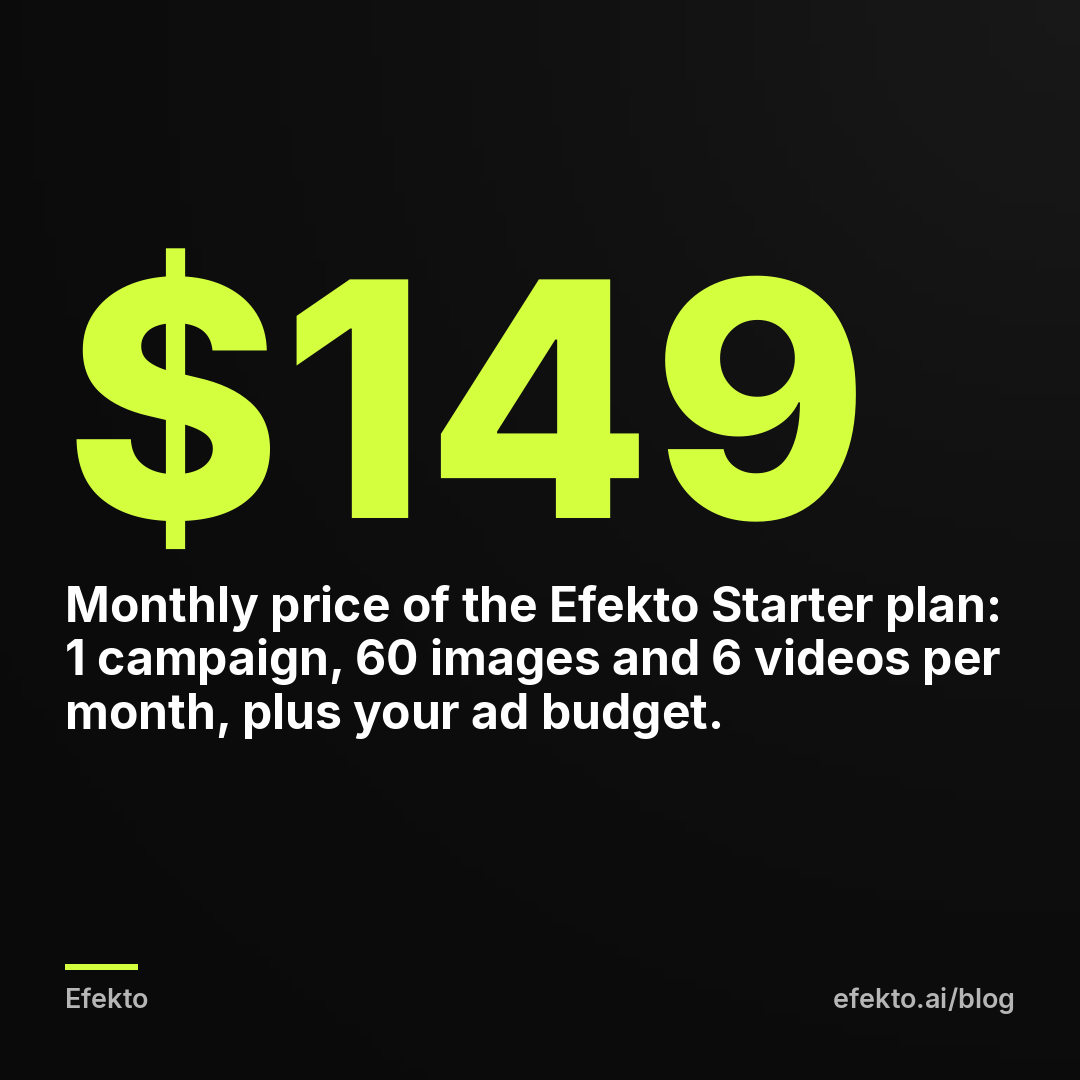
Add-ons: 25 extra videos for $149, an additional campaign for $99 per month. Annual billing is 20% cheaper than monthly. The full breakdown is on our pricing page.
The subscription is rarely the biggest cost, though. Two things matter more: what the ad budget brings back, and what your own time costs. Here is a worked example. These are illustrative numbers, not results of Efekto customers.
| Example: detailing business | Value |
|---|---|
| Daily ad budget | $20 |
| Monthly ad spend (30 days) | $600 |
| Form leads reported by Meta | 20 |
| Cost per lead according to Meta | $30 |
| Leads that are real and reachable after you call them | 14 |
| Cost per verified lead | about $43 |
| Booked jobs (say 35% of verified leads) | 5 |
| Average job value | $400 |
| Revenue from the month | $2,000 |
Notice the two cost-per-lead lines. Meta counts a lead the moment a form is submitted, before anyone checks whether the phone number works or the person lives in your area. After you call everyone, the number that matters is usually higher. In this example it goes from $30 to about $43. Any tool, Efekto or Madgicx, will show you the first number by default. You should track the second one yourself. Our guide on what counts as a good cost per lead for a local business explains how to do it with a simple spreadsheet.
Now the time side. Say you go the toolkit route and spend 3 hours a week reviewing dashboards, adjusting rules and launching creatives. That is about 13 hours a month. If your time is worth $75 an hour to your business (pick your own number), that is roughly $975 of time every month, on top of the tool subscription. For an ad manager whose job is this work, those hours are the job. For an owner, they are hours not spent on estimates, crews or customers.
The honest conclusion: a toolkit is cheaper only if someone is already being paid to do the work it supports.
How do you decide between them in 15 minutes? Step by step
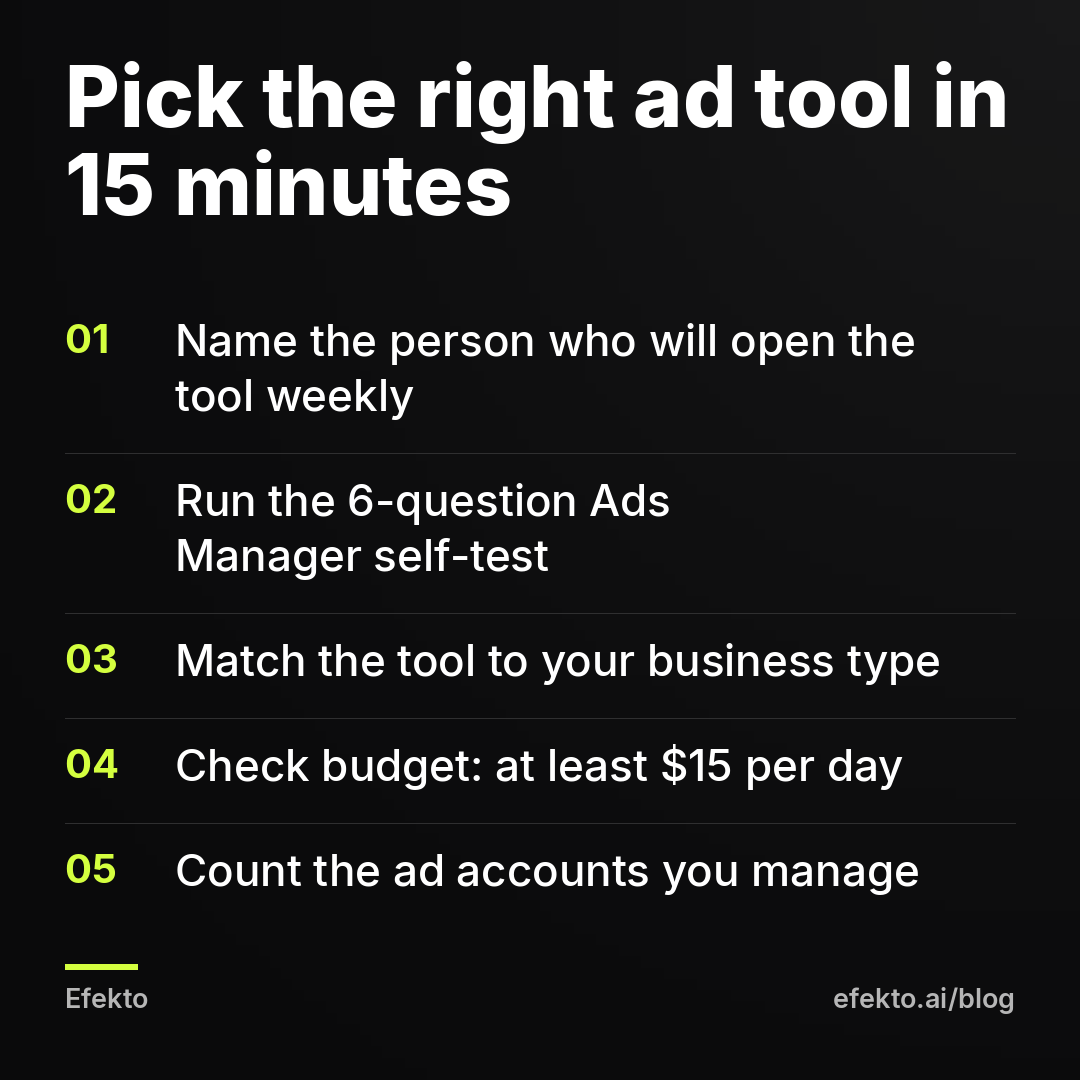
You can make this call in one sitting. Do these steps in order and stop when the answer is clear.
| Step | What to do | What the answer tells you |
|---|---|---|
| 1 | Write down who will open the ad tool every week, by name | No name means you need a tool that runs ads, not a toolkit |
| 2 | Do the 6-question self-test above for that person | 4+ yes: toolkit is viable. 2 or fewer: it isn't |
| 3 | Check your business type | Local services with leads point to Efekto; online stores with catalogs and purchase tracking point to toolkits built for e-commerce |
| 4 | Check your budget | Under $15 per day, neither tool makes sense yet (see below) |
| 5 | Count how many ad accounts you manage | Several client accounts is agency territory, where Madgicx is built to work |
One common error at step 1: writing down "me" when the honest answer is "me, when I have time". If you already postponed checking your ad results last month, assume it will happen again.
When does Efekto not make sense?
Efekto is the wrong choice in these situations, and we would rather you know now:
- You have a skilled in-house ad manager who wants full control. Efekto makes the daily campaign decisions. Someone who wants to hand-build audiences, run custom attribution analysis and write their own rules will feel boxed in. Give that person a toolkit.
- You run an agency managing many client accounts. Efekto is built for a business running its own ads, not for an agency's multi-account reporting and workflows. That is where Madgicx's positioning fits better.
- Your budget is under $15 per day. That is Efekto's minimum. Below it, fix your website, collect reviews and get your Google Business Profile in order first. Those bring customers without ad spend.
- Nobody can answer leads within a few hours. Ads will generate form submissions. If they sit until Friday, most will have called a competitor. Sort out who calls back before paying for any tool.
- You can't approve ads. You need at least 5 approved ads before launch. If you can't spare 15 minutes to look at them, the campaign doesn't start.
When is Madgicx the wrong choice?
Madgicx is a poor fit when nobody will use it the way it is designed to be used. Specifically:
- The owner is the only person who would log in, and the owner doesn't know Ads Manager. You will pay for recommendations you can't evaluate. This is the most common mismatch we see with toolkits generally, not just this one.
- You don't have campaigns running yet. A toolkit analyzes and optimizes existing activity. If you are starting from zero, you still need someone to build the first campaigns, write the offer and set up the form or landing page.
- Your budget is small and your business is local. With $20 to $30 a day in one service area, there isn't enough data volume for heavy analytics to tell you much that a weekly 10-minute review wouldn't.
None of this is a criticism of the product. A professional camera is a great camera. It is a bad choice for someone who just wants good photos without learning exposure settings.
What should you test during a trial of either tool?
Whichever you try, judge it on what reaches your phone, not on how good the dashboard looks. Use this checklist in the first week:
- Count leads by hand. Write down every lead and whether it was real and reachable. Compare that to what the tool reports.
- Track your own minutes. Note how long you spent in the tool. If a toolkit takes 4 hours in week one and you can't sustain that, the trial already answered your question.
- Check what happened without you. With Efekto, look at which ads were turned off and which got more budget. With a toolkit, check whether any rule actually fired and whether you agreed with it.
- Look at the ads themselves. Would you call this business if you saw this ad? Generic stock-looking creatives hurt local businesses more than any setting.
- Read your results with three numbers: spend, verified leads, booked jobs. Ignore everything else for the first week.
For Efekto specifically: the free trial is 7 days, counted from the launch of your first campaign, and no card is required at sign-up; the card is added only when you launch. For Madgicx, check its website for current trial terms. We put a feature-by-feature summary on our Efekto vs Madgicx comparison page if you want the short version to share with a partner or office manager.
Can you start with one and switch to the other later?
Yes, and the switch is less painful than people expect, because your campaign history lives in your Meta ad account, not inside either tool. If you connect your own ad account, that history stays with you.
A typical path we would recommend: a local service business starts with an app that runs the ads, because the owner has no time. The business grows, hires a marketing coordinator who learns the platform, and at some point that person wants more control and analysis. That is a reasonable moment to look at a toolkit. The reverse also happens: an owner buys a toolkit, realizes after two months that nobody opens it, and moves to something that does the work.
What we would not do is run both on the same campaigns at the same time. Two systems making budget decisions on the same ads will fight each other, and you won't know which one caused a change in results.
FAQ
Can a small business owner use Madgicx without marketing experience?
You can sign up, but you will get limited value. Its features assume someone who can judge recommendations and set rule thresholds. Without that knowledge, most of what the tool shows you won't turn into decisions.
Does Efekto work with my existing Facebook ad account?
Yes. You can connect your own Facebook ad account, or use an Efekto ad account with the budget topped up in advance. Either way, you approve the first batch of at least 5 ads before the campaign starts.
Is Madgicx only for e-commerce?
Its public messaging leans heavily toward e-commerce and agencies, but it works with Meta ad accounts generally. The better question is not your industry but whether someone on your side manages campaigns week to week.
What is the minimum ad budget for Efekto?
$15 per day, which is about $450 over a 30-day month, plus the plan price. Below that, there usually isn't enough data for daily optimization to make good decisions.
Which is cheaper, Efekto or Madgicx?
Compare the subscriptions on each pricing page, then add the cost of the time each requires. A toolkit is only the cheaper option when someone is already being paid to run your ads.
Our own choice is clear: we built Efekto because, after years of running campaigns for service businesses, we kept seeing owners pay for tools they never opened, and we would rather do the daily work than sell another dashboard. If that sounds like your situation, you can see how it works for your business at efekto.ai.
- Jakub Zwoliński
Founder, Lemon Agency · Efekto · October 25, 2026