Facebook Ads for House Cleaning Businesses: Turning One-Time Cleans Into Regulars
How to run Facebook ads for a house cleaning business: first-clean offer, lead form questions, crew creatives, and how to calculate what a recurring client is worth.

Facebook ads work for a house cleaning business when the first clean is the way in and the recurring schedule is the product. In practice that means four things. The ad shows the first-clean price and the biweekly price together. The lead form asks for home size and how often the person wants cleaning. The photos show your actual crew and your actual results. And someone asks for the recurring booking before the crew leaves the house. Judge the ads by what one recurring client costs you, not by the cost of a form submission. A cleaning company that books only one-time jobs from Facebook is usually paying to stay busy.
In short:
- Price the first clean to cover the extra work of a first visit, and show the recurring rate in the same ad.
- A cleaning lead form should ask for ZIP code, home size and cleaning frequency, so you can quote before you call and spot one-time shoppers early.
- The number that tells you whether the ads pay is the cost of one recurring client: ad spend divided by the clients still on a schedule a month later.
Do Facebook ads work for house cleaning companies?
Yes, for recurring residential cleaning. They work less well for one-off move-out jobs. People rarely search for "biweekly house cleaning" until something pushes them: a new baby, a new job, a messy month, guests coming. Before that point they aren't on Google typing anything. They are on Facebook and Instagram, and an ad from a local crew with a clear price can be the push.
Cleaning is also a trust purchase. You are asking a stranger to let people into their home, often while they're at work. Faces, names and real kitchens do more here than in most service businesses. Facebook gives you room to show all three. A three-line search ad doesn't.
We should say where we stand. We make money when businesses advertise on Facebook and Instagram, through Lemon Agency and through Efekto, so we have an interest in you running ads. We've run lead generation for more than 300 clients, and one pattern holds in every service business: the first job is rarely where the profit is. In cleaning that's even more true, because a good client books 15, 20 or 25 times. Most first campaigns we see from cleaning companies are still built to win the first job as cheaply as possible. That is the mistake this post is about.
What offer should a house cleaning business run on Facebook?
Run a priced first deep clean with the recurring rate shown in the same ad. For example: "First deep clean $199 for a 3-bed home, then every two weeks from $150." The numbers are an example. Use your own. Showing both prices does two jobs. It tells the reader what they're signing up for, and it filters out people who only want one cheap clean before they ever fill out the form.
Cleaning companies usually run one of these four offers:
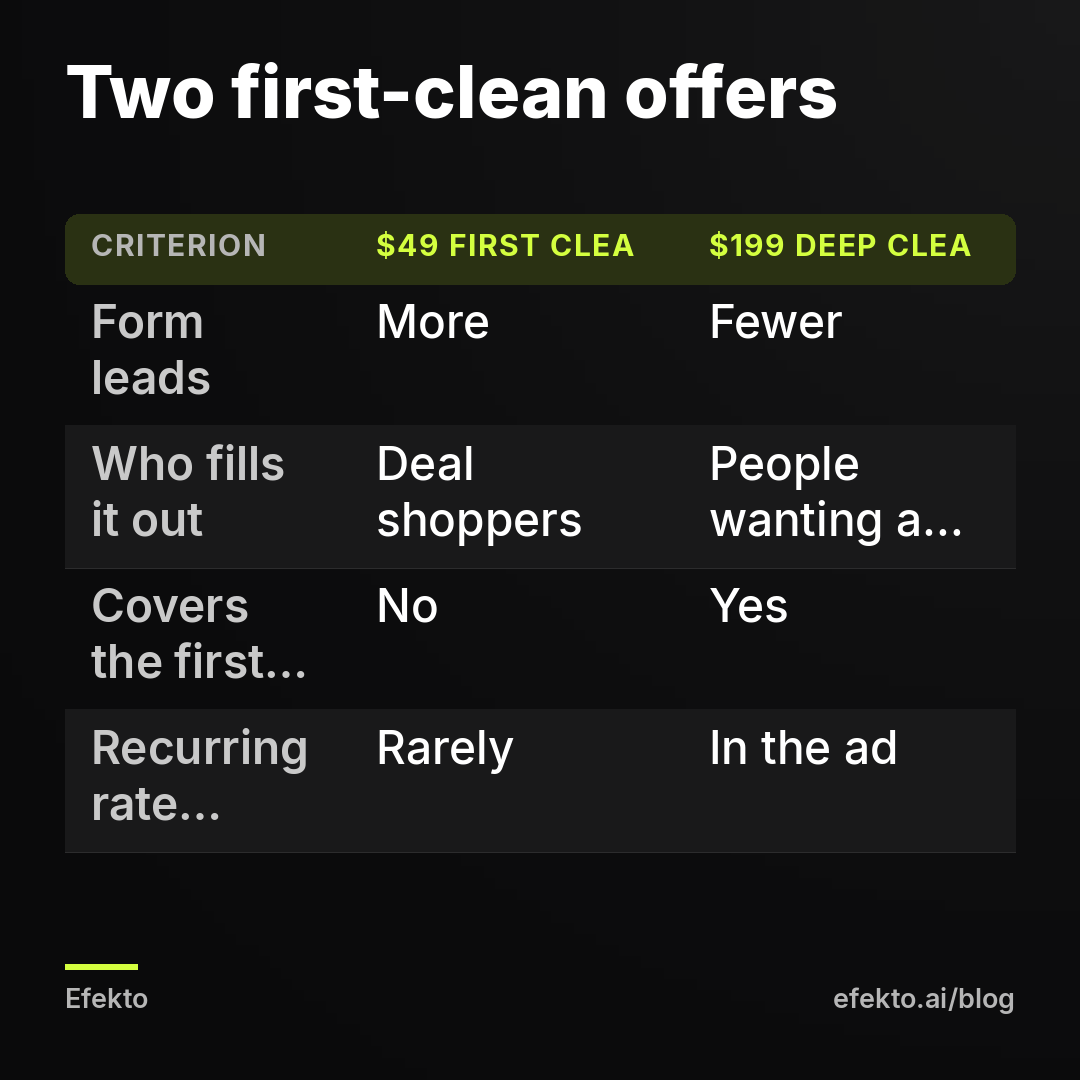
- A heavy discount on the first clean ("$49 first clean", "50% off your first visit"). This brings the most form submissions and the worst clients. You are buying a list of people who wanted a $49 clean.
- A free quote or estimate. Weak for cleaning. Nobody is excited about a quote for something they can roughly price in their head. It works better for windows, carpets or post-construction jobs.
- A priced first deep clean plus the recurring rate. Our default. Fewer leads, much better ones.
- A recurring package offer ("Book biweekly, get your first deep clean at the regular rate" or "Lock in $150 per visit for 6 months"). Good as a second ad for testing once offer 3 is running.
If you're stuck on wording, our guide on how to write a Facebook ad offer for a local service business walks through the structure: what's included, for which home size, for what price, in what area.
How much should a first cleaning cost in a Facebook ad?
Enough to cover the first visit at break-even or better, before ad cost. The first visit takes longer than a maintenance clean because of built-up grime, so pricing it like a maintenance visit, or below one, means losing money on the job itself. Your own job logs tell you how much longer. Check the last 20 first visits against the last 20 maintenance visits.
Here's why we're blunt about the $49 offer. Say a first clean takes a crew of two 3 hours, you pay $22 per hour per cleaner, and supplies and driving add $20. That's $152 in direct cost. At $49 you lose $103 on every job before you spend a cent on ads. If one in four of those clients goes recurring, the three who don't each cost you $103 plus the ad money. The discount doesn't make the ads cheaper. It hides the real cost inside your payroll.
There's a second problem. A client who came for $49 compares every later price to $49. Your recurring rate of $150 feels like a 200% price increase, even though it's your normal price. A client who paid $199 for a deep clean sees $150 as a step down.
If you want an incentive, attach it to the recurring booking, not to the first clean. "Book biweekly and your second visit is $99" rewards exactly the behavior you're paying for.
What questions should a cleaning lead form ask?
Ask for ZIP code, home size, cleaning frequency, type of clean and timing. That's enough to quote and to sort leads before you call. Use the "Higher intent" form type in Meta's instant forms, which adds a review step before submission. It cuts down on accidental taps.
| Question | Answer format | Why it's there |
|---|---|---|
| ZIP code | Short answer | Drops leads outside the area your crews drive to |
| Bedrooms and bathrooms | Multiple choice (1-2 bed, 3 bed, 4+ bed; 1, 2, 3+ bath) | Lets you quote without a walk-through |
| Approximate square footage | Multiple choice (under 1,500, 1,500-2,500, 2,500-3,500, over 3,500) | Catches the "3-bed" home that turns out to be 4,000 sq ft |
| How often do you want cleaning? | Multiple choice (weekly, every 2 weeks, monthly, one time, not sure yet) | The question that sorts recurring prospects from one-off shoppers |
| Type of clean | Multiple choice (regular, deep clean, move-in/move-out) | Move-outs are one-time by nature; price and handle them separately |
| Pets in the home? | Yes/No | Affects time and supplies |
| When would you like the first clean? | Multiple choice (this week, next 2 weeks, this month, just checking prices) | Tells you who to call first |
| Name, phone, email | Prefilled by Meta | Contact |
Keep the "not sure yet" option on frequency. People who pick it are often the best recurring prospects. They just haven't been asked properly yet. The person who picks "one time" isn't a bad lead either. Call them second, quote the first clean, and mention the recurring rate once.
You'll notice the form has more questions than Meta's default. That's on purpose. Every question removes some people who would never have booked, and you pay for each submission either way. Our longer guide on setting up Facebook instant forms to get real customers instead of junk leads covers the form settings in detail.
One thing that confuses almost every owner in the first month: the cost per lead Meta shows you is the cost of a form submission before anyone has checked it. Some submissions come from wrong numbers, people outside your area, or someone who tapped through without meaning it. Your real cost per lead is ad spend divided by the leads that turned out to be real, reachable and inside your service area. That number is always higher than the one in Ads Manager. The example further down shows both.
What photos and videos work for house cleaning ads?
Your own crew, and close-up results from real homes. Stock photos of a smiling woman with a spray bottle look like every franchise ad in the country, and people scroll past them. What gets attention is specific:
- The crew at the door. Two or three people in your shirts, with your car or van behind them, looking at the camera. It answers "who is coming into my house?" before anyone asks.
- The owner talking for 20 to 30 seconds. Filmed on a phone, held vertically, in a clean kitchen. Say who you are, which towns you cover, what the first clean includes and what biweekly costs. No script on screen, no music needed.
- Close-up results. Stovetops, shower glass, grout, baseboards, the inside of a microwave. Before and after, shot from the same angle and in the same light. Wide shots of a living room don't show much; a greasy burner next to a clean one does.
- A sped-up clean. A two-hour job cut to 15 seconds. It shows the work is real and the crew is organized.
- A text-on-photo ad with the offer. A clean kitchen photo, the first-clean price, the recurring price, the service area.
Start with 6 to 10 variations so the ad system has something to compare. Mix formats: 2 or 3 crew photos, 2 or 3 result close-ups, 1 or 2 short videos, 1 offer graphic.
Two rules for filming in clients' homes. Get permission first, in writing, even by text. And check the frame before you shoot: no house numbers, no family photos on the fridge, no mail on the counter, no kids' names on the wall. One careless photo can cost you a client and a review.
If you don't have photos yet, a phone and one weekend of jobs is enough. We wrote up how to make Facebook ad images and videos from your website and phone photos, including how to shoot before-and-afters that look consistent.
How much is a recurring cleaning client worth?
Far more than the first clean. That's why one-time revenue is the wrong yardstick for the ads. Here's a full month worked through with example numbers. None of these are our results or market rates; replace them with your own.
For example, say you spend $30 per day for 30 days.
| Step | Example number | How it's calculated |
|---|---|---|
| Ad spend for the month | $900 | $30 per day x 30 days |
| Form submissions (cost per lead in Ads Manager: $25) | 36 | $900 / $25 |
| Verified leads (real, reachable, in the service area) | 24 | 2 out of 3 submissions |
| Real cost per verified lead | $37.50 | $900 / 24 |
| First cleans booked | 10 | About 4 in 10 verified leads |
| Cost per first clean | $90 | $900 / 10 |
| Revenue from first cleans at $199 | $1,990 | 10 x $199 |
| Clients who move to a biweekly schedule | 4 | 4 in 10 first-clean clients |
| Cost per recurring client | $225 | $900 / 4 |
| Revenue per recurring client over 8 months | $2,550 | About 17 biweekly visits x $150 |
| Total revenue from one month of ads | $12,190 | $1,990 + 4 x $2,550 |
Notice the gap between $25 and $37.50. Ads Manager would tell you leads cost $25. After your office made the calls, a usable lead cost $37.50. Plan around the second number.
Now add margin, because revenue doesn't pay your ad bill. Say your gross margin after labor and supplies is 40%:
- The first cleans alone bring $1,990 x 40% = $796 in gross profit. That's less than the $900 you spent. On one-time cleans alone, the ads lose money.
- The 4 recurring clients bring $10,200 x 40% = $4,080 over 8 months.
- If only 2 clients go recurring instead of 4, you still get $5,100 x 40% = $2,040 from them, plus $796 from first cleans, against $900 of spend.
- If nobody goes recurring, you're $104 short and you've filled 10 slots with jobs that won't repeat.
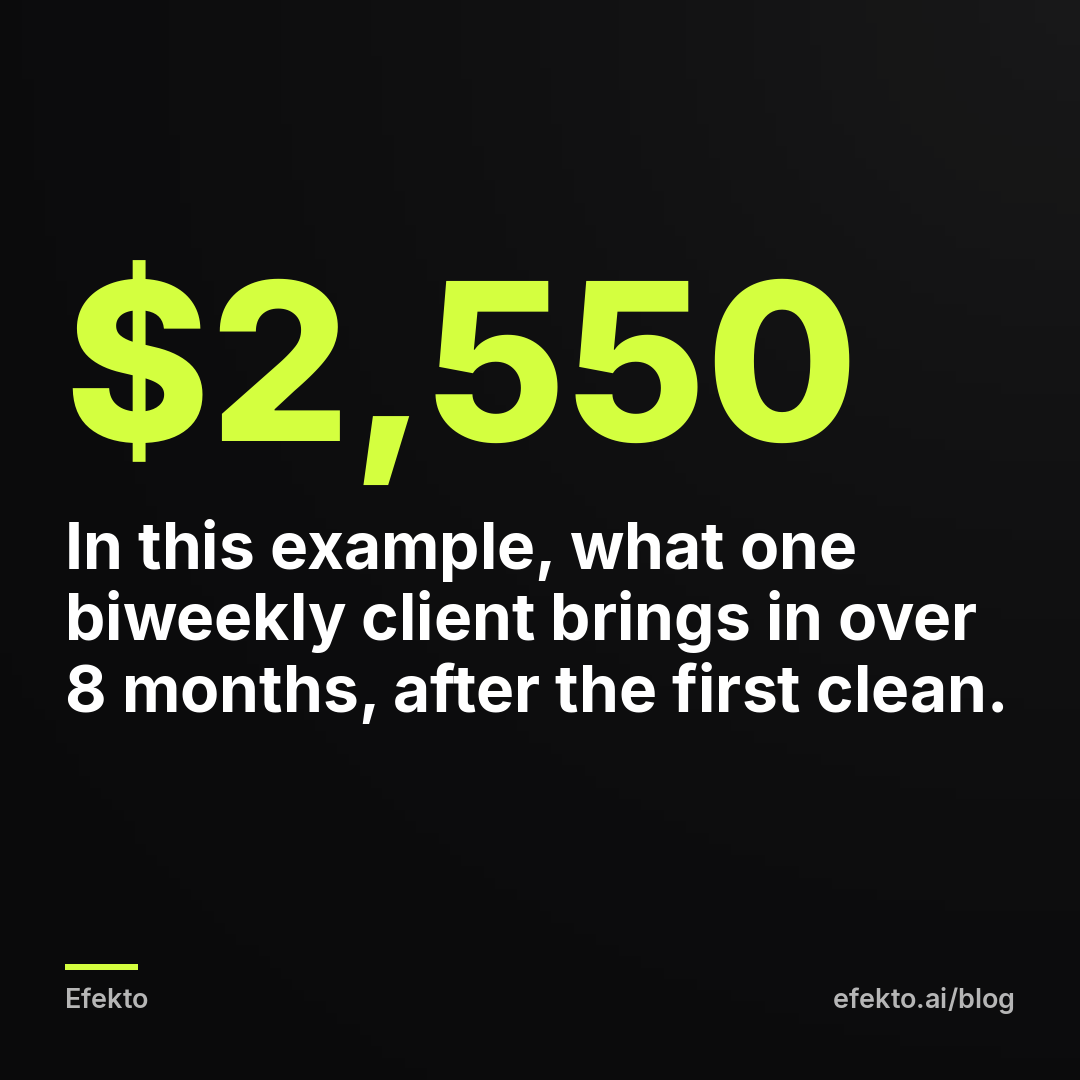
This gives you a ceiling. Decide what share of a recurring client's gross profit you're willing to spend to get one. In the example, one recurring client brings $1,020 in gross profit over 8 months. If you're fine spending a third of that, you can afford about $340 per recurring client. At $225 the campaign is healthy. At $450 something is broken, and it's usually not the ads. It's the step between the first clean and the second booking.
The numbers worth tracking every month are short: ad spend, verified leads, first cleans booked, and clients still on a schedule 30 days after their first clean. If you want a simple weekly routine, our post on reading your Facebook ads results in 10 minutes a week lists what to look at and what to ignore.
How do you turn a first clean into a recurring client?
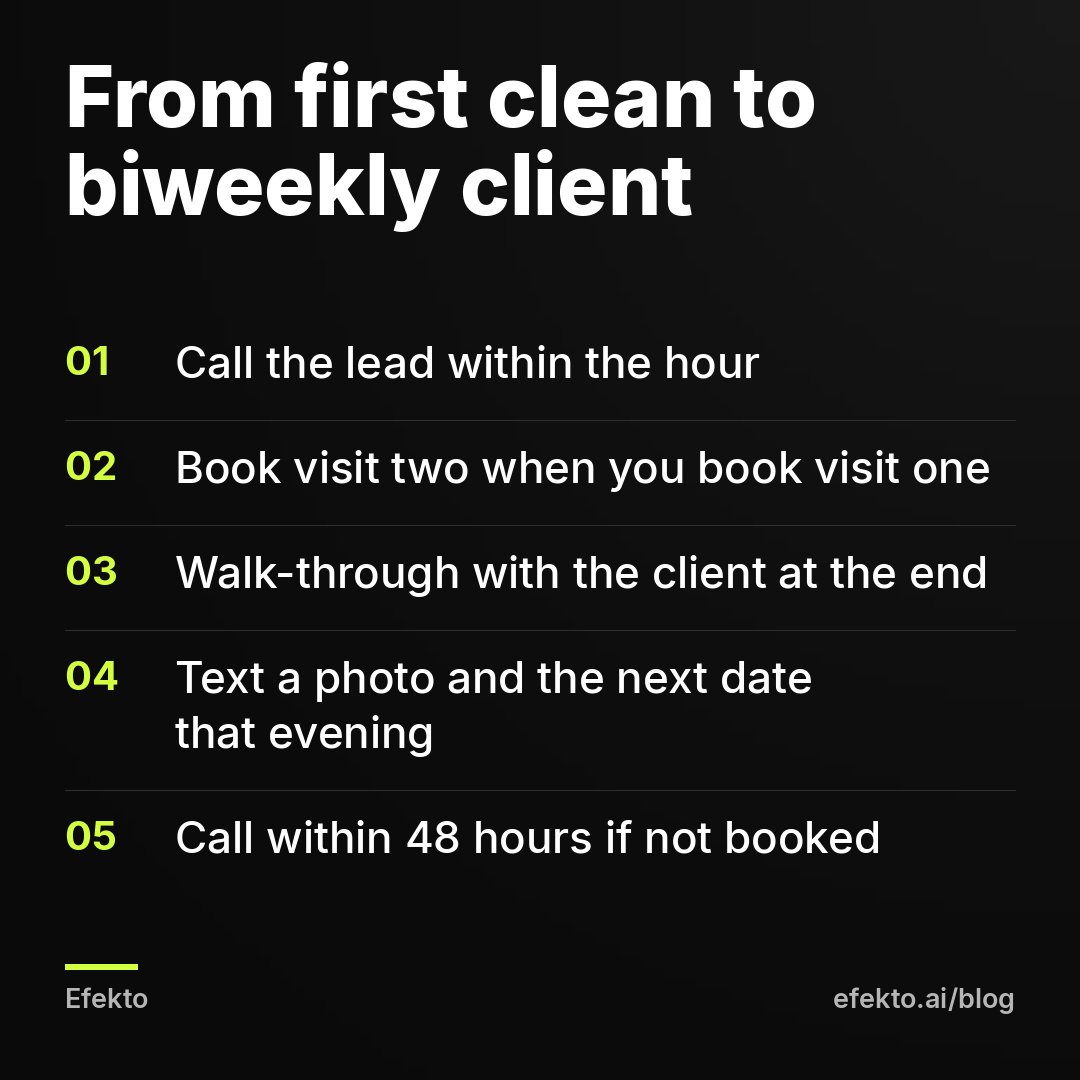
You ask for it on the first call, put it in writing before the visit, and ask again before the crew leaves. The ad can bring a person who's open to a schedule. Only you can close the schedule. These are the steps we'd put in place before raising any budget:
- Call within the hour. A cleaning lead who fills out your form at 8 p.m. has likely filled out two others. The first company to call usually books the job. Our guide on following up on Facebook leads fast enough to book the job covers scripts and what to do when nobody picks up.
- Repeat their frequency answer on the call. "You mentioned every two weeks. Let's do the deep clean Tuesday the 10th and pencil in the 24th at $150." Booking the second visit at the same time as the first is the single biggest lever you have.
- Send the recurring price in writing before the first visit. A text or email with the first-clean price, the recurring price and what each includes. No surprises at the door.
- Do a 3-minute walk-through at the end. The crew lead walks the client through the kitchen and bathrooms, asks if anything was missed, and fixes it on the spot. Then they confirm the next date, or ask for one.
- Text the same evening. A photo of the clean kitchen and one line: "Want us back on the 24th at $150? Reply YES and you're booked."
- Call within 48 hours if they haven't booked. Ask what would make it work. Often it's a different day, a different frequency or one room skipped.
There's also an ad-side step. Upload your list of one-time clients from the last 6 months as a custom audience in Meta and run a small separate ad to them: a photo of their kind of home, "Back on a schedule? Biweekly from $150, first visit this month at the regular rate." Do the same for people who submitted the form but never booked. These audiences are small and cheap to reach, and they already know your name.
When is the best time of year to run house cleaning ads?
All year, at different budgets. Most cleaning companies see the same pattern: demand climbs in spring, move-outs pile up in summer and at the end of each month, and the weeks before Thanksgiving and the December holidays fill up fast. January often brings people who decided to stop doing it themselves.
What that means for the ads:
- Keep a base budget running year-round. A campaign that stops and starts has to relearn who responds every time. That costs you a few slow days and the leads you would have had in them.
- Raise the budget 4 to 6 weeks before your busy season. You want recurring clients locked in before the rush. During the rush, one-time demand comes on its own and you won't have slots for it.
- During peak weeks, sell only recurring. Change the offer to the package version ("Start biweekly before the holidays") and quote one-time cleans at full price. Your schedule is the scarce thing, so spend it on clients who stay.
- In slow months, lean on past clients. The custom audience ad to one-time clients from the previous 6 months often does better in a slow month than a cold campaign.
- Treat move-out cleaning as a separate offer. It's one-time by nature. If you want move-outs, run them as their own ad with their own price, and don't count them in your recurring conversion numbers.
How do you set up a house cleaning campaign step by step?
One campaign, one instant form, a tight radius, 6 to 10 ads, and a week without touching it. Here's the setup we'd use in Ads Manager:
- Objective: Leads. Conversion location: Instant forms. Not Traffic, not Engagement, and not a boosted post.
- Form: Higher intent, with the questions from the table above. Add a short intro that repeats the offer and the area: "Deep cleaning and biweekly service in [your towns]. First deep clean from $199."
- Location: draw the area your crews actually drive to. Use a radius around your base or list ZIP codes. If a 40-minute drive kills the margin on a $150 visit, don't put that town in the ad. Our post on targeting homeowners in your service area covers this setup step.
- Audience: broad. Location and age 25+ is usually enough. Detailed interests rarely help a local cleaning business; the form questions do the filtering.
- Budget: pick a daily number you can hold for a month. In the example above it was $30 per day. Below roughly $15 per day the ad system gets too little data to learn from.
- Ads: 6 to 10 variations in mixed formats, with the same offer across all of them so you're testing creatives, not offers.
- Leave it alone for 7 days. Don't change budgets or pause ads in the first week unless something is clearly broken (a wrong price, a wrong area). After that, pause the ads with no form submissions and keep the ones that bring verified leads.
- Connect the form to your phone. Get a text or email for every new lead, so the one-hour rule is possible. A lead sitting in Meta's Leads Center for two days is a lead someone else booked.
Wait to judge recurring conversion until 30 days after the first cleans, because you need the second visit to happen before you know.
When do Facebook ads not make sense for a cleaning business?
When the problem isn't a shortage of leads. We'd tell a cleaning owner to hold off on ads, or fix something first, in these cases:
- Your schedule is full and you're turning work down. Ads will make that worse. Hire, then advertise.
- Nobody can call leads within a few hours. If the owner cleans all day and calls back at night, most of the ad budget turns into leads that already booked elsewhere. Get someone answering first, even part-time.
- Your crews churn every month. Recurring clients stay for the same faces. If the cleaner changes every visit, your recurring conversion will stay low no matter how good the ad is.
- You only want move-outs and post-construction jobs. These are one-time and urgent. People search for them, so Google search ads and local listings tend to match that intent better than Facebook.
- You can't hold a budget for a month. Spending $15 for three days and then stopping teaches you nothing. Better to start a month later with a budget you can sustain.
- You don't have a recurring price. If every quote is custom and you can't say "biweekly from $X", the ad has nothing concrete to sell. Set your pricing tiers first.
If none of these apply and the hard part is making the ads, Efekto is one option. Efekto creates ads from your website, publishes them, and optimizes them every day: it turns off the ones that don't bring results and scales the ones that do. You approve the first batch, at least 5 ads, before anything goes live. It runs on your own Facebook ad account or on an Efekto ad account with the budget topped up in advance. The minimum ad budget is $15 per day. The Starter plan is $149 per month for one campaign, and the 7-day free trial counts from the launch of your first campaign, with no card needed at sign-up. You can see how Efekto works step by step before deciding.
It won't do the part that makes cleaning profitable, though. It doesn't call your leads, quote homes or ask for the second booking. If nobody on your team can do those things, an app or an agency will only get you more leads you don't convert. Fix that first.
What we'd do differently from most first campaigns we see: no $49 offer, a frequency question on every form, the second visit booked on the first call, and a monthly report that ends with one number, the cost of a client still on a schedule 30 days later. If that number is under the ceiling you set, raise the budget. If it isn't, fix the step after the first clean before you touch the ads.
FAQ
How much should a house cleaning company spend on Facebook ads per month?
There's no correct number, only the one you can sustain for at least a month. In the example above, $30 per day came to $900 a month. Work backward from what you can afford per recurring client and how many new regulars your crews can take on.
Should I offer a discount on the first house cleaning?
Not on the first clean itself. A heavy first-clean discount attracts people who want one cheap clean and makes your regular rate look expensive. If you want an incentive, attach it to booking a recurring schedule, such as a lower price on the second visit.
Are Facebook leads for cleaning services worse than Google leads?
They're different. Google search catches people who are already looking, often for an urgent one-time job. Facebook reaches people before they start looking, so the leads need a faster call and a clearer offer. For recurring cleaning, those leads often turn into longer-lasting clients.
How long does it take for Facebook ads to bring cleaning clients?
With a working form and offer, form submissions usually start within the first few days, and first cleans follow from the calls you make. You won't know your recurring conversion until about a month in, because the second visit has to happen first. Judge the campaign on that 30-day number, not the first week.
Can I run Facebook ads for cleaning without before-and-after photos?
Yes. Crew photos and a short video of the owner talking often do as well. Results photos help, but they need permission from the client and a careful check that nothing personal is in the frame. Start with what you have and add close-ups as you collect them.
If you'd rather have the ads made and adjusted every day while you focus on calls and the second booking, you can try it at efekto.ai.
- Jakub Zwoliński
Founder, Lemon Agency · Efekto · October 25, 2026