Facebook Ads for Dental Practices: Getting New Patients Without Discount-Only Leads
How dental practices can use Facebook ads for new patients, implants, Invisalign and emergencies without attracting only bargain hunters, plus Meta's health ad rules.

To get new dental patients from Facebook without filling your schedule with one-time bargain hunters, advertise a specific reason to book instead of a price. That can be a new patient visit with evening or Saturday slots, an implant or clear aligner consultation that includes a real scan, or same-day emergency appointments. Then put 3 to 4 qualifying questions in the lead form and call every lead within minutes. The classic $59 exam-and-cleaning special brings the cheapest leads and the fewest patients who stay, because the ad tells people that price is the only reason to come.
In short:
- A discount-led dental ad attracts people who compare discounts, so the cheapest leads usually turn into the fewest returning patients.
- Meta rejects dental ads that imply something about the viewer's teeth or health, and ads with before-and-after photos, so write about the service and the visit, not the patient's problem.
- Judge a dental campaign by ad cost per patient who is still with you months later, not by the cost per form that Meta reports.
Why do dental ads on Facebook attract so many discount hunters?
Because most dental ads lead with a price, and the price becomes the whole message. When the headline is "$59 exam, cleaning and x-rays," Meta's delivery system does exactly what it was built to do: it finds the people most likely to fill out a form for $59. Many of them have no dentist, no plan to keep one, and a habit of booking whichever practice is cheapest this quarter. They come for the special, decline the treatment plan, and you never see them again.
Three things make it worse.
- The offer. A price drop is the easiest reason to click and the weakest reason to stay.
- The form. A default instant form with name and phone number, prefilled from the Facebook profile, takes a few seconds to submit. Curiosity gets counted as a lead.
- The follow-up. The front desk calls back the next afternoon. The person who submitted forms to three practices has already booked with whoever called first.
Our position is simple: a steep discount in a dental ad is not a growth strategy. It is a filter, and it filters for the patients you least want. You can still run promotions. But if the price is the only reason in the ad, the price is the only reason the patient comes.
What should a dental practice advertise on Facebook?
Advertise one service per campaign, with an offer built around what the patient actually wants from that service. A cleaning lead, an implant lead and a toothache call are three different people with three different questions, and mixing them in one campaign means Meta optimizes for whichever is cheapest. That is almost always the cleaning.
| Service | Offer that works without a steep discount | Who it tends to attract | What to keep out of the ad |
|---|---|---|---|
| New patients (general) | New patient visit: exam, x-rays, cleaning and a written plan, with evening and Saturday slots and the insurance plans you accept listed | Families who moved, people unhappy with their current dentist, people whose plan changed | Anything about the viewer's teeth, such as "Embarrassed by your smile?" |
| Implants | Consultation with a 3D scan and a written price range, financing options explained | Adults already comparing implant options and prices | Before-and-after photos, "permanent results," "pain-free" |
| Clear aligners (Invisalign) | Consultation with a scan, an estimate of treatment length, monthly payment plans mentioned | Adults and parents of teens planning ahead | Promised outcomes, "perfect smile in 6 months" |
| Emergency | Same-day appointments, a call button, your hours | People in pain today, most of whom search on Google first | Graphic photos of injuries, decay or blood |
Yes, the implant and aligner offers use a free consultation. That is not the same as a discount. The consultation is a step in the decision, and the patient pays the full fee for the treatment. It only works when the consult contains something real: a scan, a price range on paper, a doctor who answers questions. A free consult that turns out to be a 10-minute sales pitch produces no-shows and bad reviews.
Keeping services in separate campaigns also keeps your numbers honest. For example, if a new patient lead costs $25 and an implant lead costs $90, a mixed campaign will drift toward the $25 leads and report a lower average cost while the implant chair stays empty.
How do you write a new patient offer that isn't just a discount?
Replace the price with a reason that is specific to your practice. Every dentist in town can cut a fee. Not every dentist is open until 7 pm on Thursdays.
Reasons that work in new patient ads:
- Time. "New patients seen this week, including Tuesday and Thursday evenings." Working parents care about this more than $40 off.
- Insurance clarity. "In network with Delta Dental, Cigna and MetLife. We tell you what's covered before any treatment." Use the plans you actually accept.
- A plan for the uninsured. An in-house membership plan with a monthly price attracts people who intend to come twice a year, which is the patient you want.
- Comfort, stated as a fact. "Sedation options available" is a fact. "Pain-free dentistry" is a promise Meta may reject and patients may hold against you.
- The visit itself. Say what happens, how long it takes and what they walk out with: "60 minutes: exam, x-rays, cleaning, and a written plan with prices."
A full new patient ad built this way might read: "New patient visits in [City], evenings and Saturdays. Exam, x-rays and cleaning in one appointment, plus a written plan with prices before any treatment. In network with most major PPO plans. Book in 30 seconds." No discount, and nothing about the reader's mouth.
If you want a price in the ad, show your regular new patient fee openly, or tie a modest reduction to something that predicts loyalty, such as a family booking two or more members. Our test before any ad goes live: if you delete the discount and the ad has nothing left to say, the ad is not ready.
What questions should a dental lead form ask?
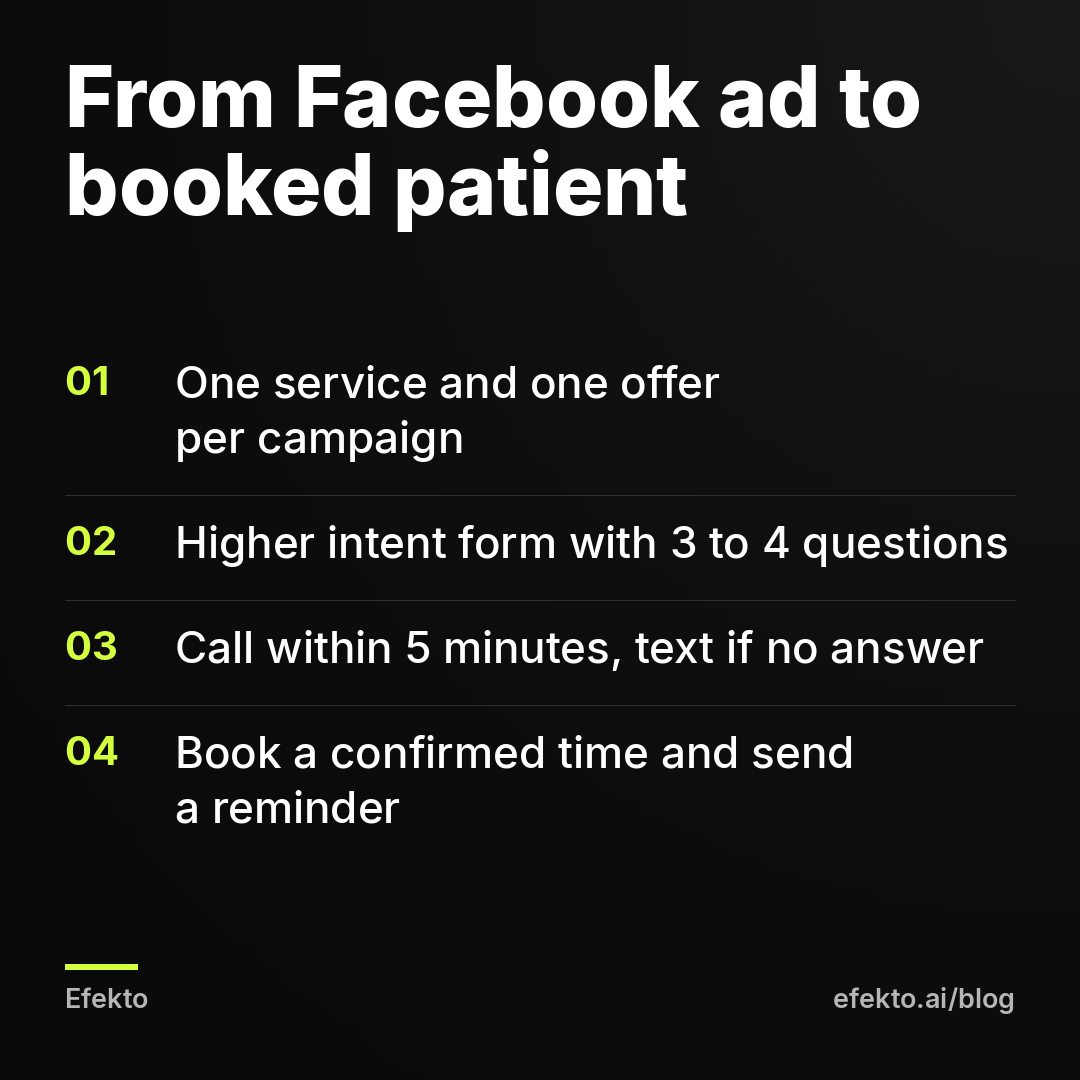
Ask 3 to 4 multiple-choice questions that a bargain hunter skips and a real patient answers without thinking. In Meta's instant form settings, choose the higher intent form type, which adds a review screen before the form is submitted. You will get fewer forms, and more of them will pick up the phone.
Questions that work for dental:
- What are you looking for? New patient visit / Implant consultation / Clear aligner consultation / Something hurts and I need to be seen soon. This routes the lead to the right person on your team.
- Do you have dental insurance? Yes, [your top two or three plans] / Yes, a different plan / No, I'd pay myself / I'd like to hear about your membership plan. Your front desk knows how to open the call before dialing.
- When would you like to come in? This week / Within a month / I'm just comparing for now. The third answer is not a bad lead. It is a lead for a text, not a call.
- For implants and aligners: what would help you decide? Knowing the price range / Financing options / Talking to the doctor first. This tells the consult what to cover.
Do not ask about medical conditions, symptoms or past treatment in the form. Meta's lead ad rules restrict custom questions that collect health information, and you do not want that data sitting in a Facebook export anyway. Ask about intent and logistics, and save the clinical questions for the intake form at the office. We go deeper on form settings in our guide to setting up Facebook lead ads that bring real customers.
The form is only half of lead quality. The other half is how fast someone calls. A dental lead called within 5 minutes during office hours is a different lead from the same person called the next day. If nobody can pick up, send an automatic text with a booking link, then call when you can. Here is how to follow up on Facebook leads fast enough to book the appointment.
What are Meta's advertising rules for dental practices?
Dental ads are allowed on Facebook and Instagram and are not a special ad category, but Meta's personal health and appearance policies apply to them. In practice that means four rules, and most rejected dental ads break the first or the second.
- Don't imply you know something about the viewer. "Missing teeth?" or "Your gums are bleeding for a reason" suggests the ad knows the reader's health. Meta treats that as asserting a personal attribute and rejects it.
- No before-and-after images and no unlikely results. That includes split smiles, "day 1 vs day 90" collages and zoomed comparisons of teeth.
- No negative self-perception. Copy that tries to make people feel bad about their appearance, such as "Tired of hiding your smile?", gets rejected or quietly limited.
- No shocking imagery. Close-ups of decay, broken teeth or blood are out, even in an emergency ad.
| Likely to be rejected | Allowed alternative |
|---|---|
| "Missing teeth? We can fix that." | "Implant consultations with a 3D scan, this month in [City]." |
| "Tired of hiding your smile?" | "Clear aligner consultations, evenings and Saturdays." |
| "Your gums are bleeding for a reason." | "New patient visits: exam, x-rays and cleaning in one appointment." |
| Before-and-after photo of a patient's smile | Photo of your treatment room, your team, or the doctor at the scanner |
| "Pain-free implants, guaranteed." | "Sedation options available. Ask at your consultation." |
For images, the safest material is also the most convincing: your actual office, your actual team, the doctor explaining a scan on a screen, the front desk. If a patient appears in an ad, get written consent, and make sure the photo shows a person in your office, not a result. Keep your real before-and-after cases on your website, with consent, where they help a patient who is already interested.
Targeting has changed too. Meta has removed most detailed targeting options tied to health topics, so "people interested in dental implants" is not a reliable audience anymore. What works is a radius around the practice, an age range that fits the service (for implants we would start at 40 and up), and an ad that is specific enough to find the right person on its own. The same approach applies to other health-adjacent businesses; we cover it in Facebook ads for med spas.
One more limit that dental practices often miss: Meta restricts what website event data health-related advertisers can send and optimize for, and the US Department of Health and Human Services has published guidance on tracking technologies on healthcare websites. Before you put the Meta Pixel on appointment request pages, talk to whoever handles HIPAA compliance for your practice. It is one more reason we start dental campaigns with instant forms rather than a website conversion setup.
How do you advertise implants and Invisalign without promising results?
Sell the consultation and the clarity, not the outcome. People who are considering implants usually stall on two things: price and fear of the procedure. An ad that says the consultation ends with a written price range and an explanation of financing answers the first. A 30 to 45 second video of your doctor explaining, in plain words, what happens at the consult answers a lot of the second. Neither says anything about results.
For clear aligners, the buyer is often a parent planning for a teenager or an adult who has thought about it for years. Give them a reason to stop thinking and book: "You'll leave with a scan, an estimate of your treatment length and your monthly payment options." Do not promise a timeline ("straight teeth in 6 months"), because treatment length depends on the case, and do not quote financing terms in the ad unless you can show every condition attached to them. "Ask about monthly payment plans" is enough.
Expect fewer implant leads, at a higher cost each, than new patient leads. That is fine and it is the point. For example, if an implant case is worth $4,000 to the practice and one consult in five goes ahead, each consult is worth $800 in expected revenue. Paying $90 for a lead that becomes a consult half the time still leaves a wide margin. The mistake we see most often is a practice that shuts off the implant campaign after two weeks because its leads cost three times more than cleaning leads, without counting a single case.
Can Facebook ads bring in dental emergency patients?
Only partly. Someone with a toothache at 10 pm searches Google, and that is where most of your emergency budget belongs: Google search ads and a Google Business Profile with current hours and fresh reviews. Facebook cannot catch the person at the moment of pain, because nobody opens Instagram to find an emergency dentist.
What Facebook can do is make your practice the name people remember when it happens. A small, always-on ad with "Same-day appointments in [City]", your hours and a call button keeps you in that memory for a low daily cost.
Two rules for emergency ads. Use a call button, not a form, because a person in pain will not wait for a callback. And only run call ads during hours when someone actually answers. An emergency ad that sends calls to voicemail is worse than no ad, because it trains people to try the next practice.
How much should a dental practice spend, and what does the math look like?
Start with $30 to $50 per day for one service, run it for at least 30 days, and judge it by patients who show up and stay, not by forms. The number Meta reports as cost per lead is the cost of a form submission before anyone has checked whether the phone number works, whether the person lives nearby, or whether they meant to submit at all. Your real cost per lead, after your front desk has made the calls, is always higher. Both numbers matter, and the gap between them tells you how good your form is.
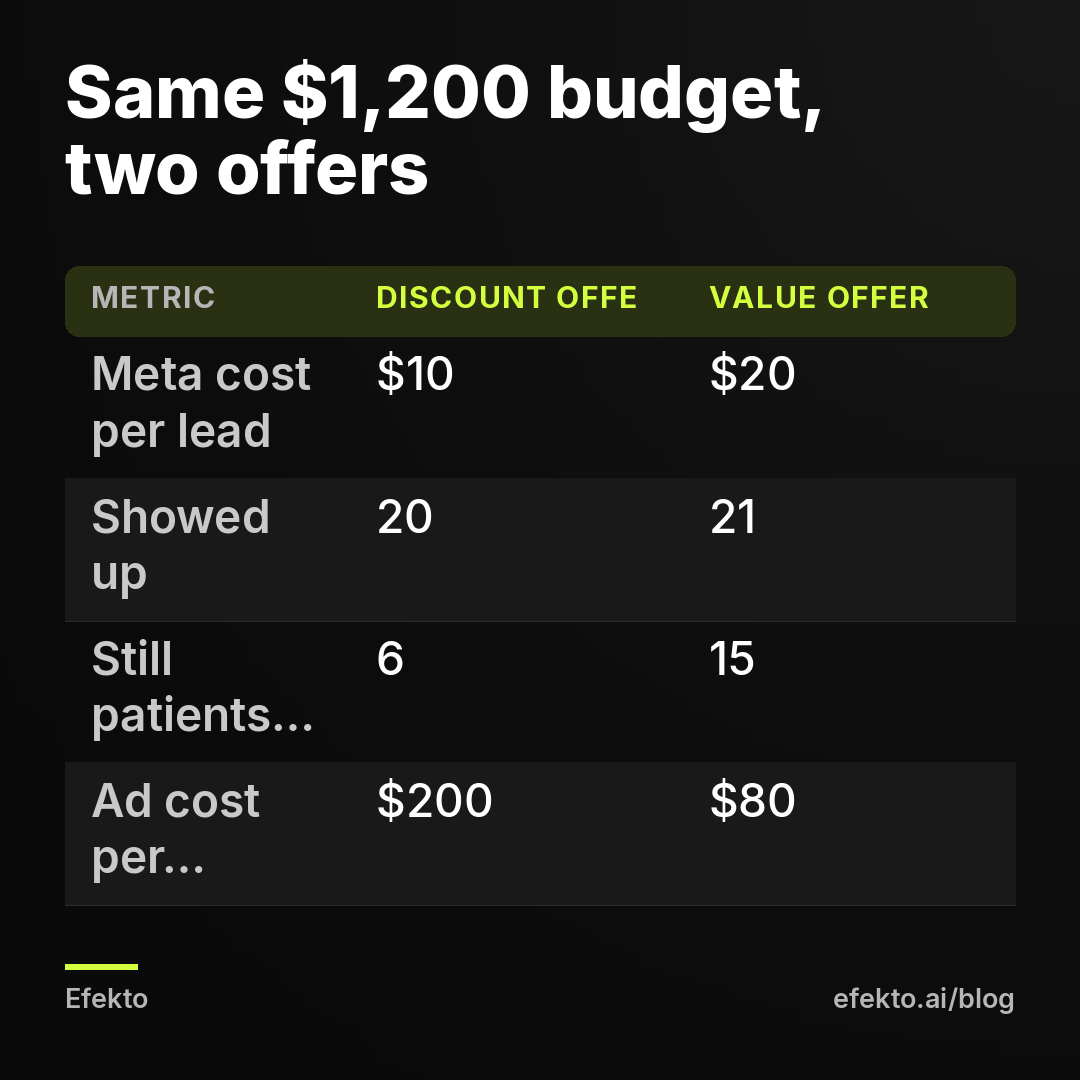
Here is a worked example comparing a discount offer with a value offer at the same budget. These are illustrative numbers, not results from any practice:
| Step | Discount offer ($59 exam, cleaning, x-rays) | Value offer (regular-price visit, evening slots, insurance listed) |
|---|---|---|
| Daily budget | $40 | $40 |
| Spend over 30 days | $1,200 | $1,200 |
| Form submissions (Meta-reported) | 120 | 60 |
| Cost per lead according to Meta | $10 | $20 |
| Real, reachable, in your area | 54 | 42 |
| Cost per verified lead | $22 | $29 |
| Booked appointments | 30 | 26 |
| Showed up | 20 | 21 |
| Still patients after 6 months | 6 | 15 |
| Ad cost per retained patient | $200 | $80 |
On the Meta dashboard, the discount campaign looks twice as good: $10 per lead instead of $20. In the chair, it is the other way around. Say a retained general patient is worth $700 a year to your practice. The discount campaign produced about $4,200 of yearly value from 6 patients. The value campaign produced about $10,500 from 15. Same spend, same month.
To run this math yourself, you need three columns your front desk fills in: reached or not, booked or not, showed or not. Add a fourth column at the 3 and 6 month marks: still a patient or not. Without these, you are optimizing for whatever Meta counts, and Meta counts forms.
When should a dental practice run which campaign?
Dental demand has a calendar, and your ads should follow it.
- January to February: many insurance plans reset on January 1, deductibles start over and people make health resolutions. Push new patient visits.
- February to April: tax refund season. People who have postponed implants or aligners suddenly have cash. Increase the implant and aligner budget.
- June to August: parents plan aligners for teens before the school year, and back-to-school checkups fill August. Run aligner consultations aimed at parents and family new patient visits.
- October to December: patients whose plans reset January 1 have unused benefits. "Use your dental benefits before December 31" is a legitimate, non-discount message, and it is the one moment a deadline is real rather than invented.
- Holidays: other offices close. If you are open, run the same-day appointment ad harder around Thanksgiving and the last two weeks of December.
Implant consultations can run all year; they simply get more budget in refund season. New patient ads should not run when your hygiene schedule is booked 6 weeks out, which brings us to the next section.
When do Facebook ads not make sense for a dental practice?
Facebook ads are the wrong tool in five situations, and running them anyway wastes money that would do more elsewhere.
- Your schedule is full. If new patients wait 6 weeks for a first visit, half of them will book somewhere else before the date comes. Fix capacity first.
- Nobody calls leads within an hour. Then the problem is the follow-up, not the ads. Assign one person, set a 5-minute target during hours and an automatic text after hours.
- You only want emergency patients. Put that money into Google search ads and your Google Business Profile.
- You are a referral-based specialist. An oral surgeon or endodontist who gets most cases from general dentists will usually do better investing in those relationships than in consumer ads.
- Your budget is below $15 a day per campaign. Below that, a campaign gathers results so slowly that you cannot tell a weak ad from a weak week. Spend the money on getting reviews instead.
If you are in one of these situations, say so to whoever offers to run your ads. Anyone who takes your money anyway is selling you activity, not patients.
What would we set up first if we ran ads for a dental practice?
We would set up one new patient campaign before anything else, and we would not touch a discount. In order:
- Write the new patient offer around time, insurance clarity and what happens at the visit.
- Build a higher intent instant form with the 3 to 4 questions above.
- Shoot 10 photos and two short videos in the office: the team, the treatment room, the doctor explaining a scan. No patients' mouths.
- Create 5 or more ad variations and check every line against the four Meta health rules.
- Set a radius around the practice, $40 a day, and a tracking sheet with the reached, booked, showed and still-a-patient columns.
- After 30 days, add an implant or aligner campaign, depending on which chair has more open time.
What we would not do: run a $59 special to "build volume" and fix lead quality later. Lead quality is decided by the offer on day one, and an account trained on bargain hunters keeps finding bargain hunters.
Where does Efekto fit for a dental practice?
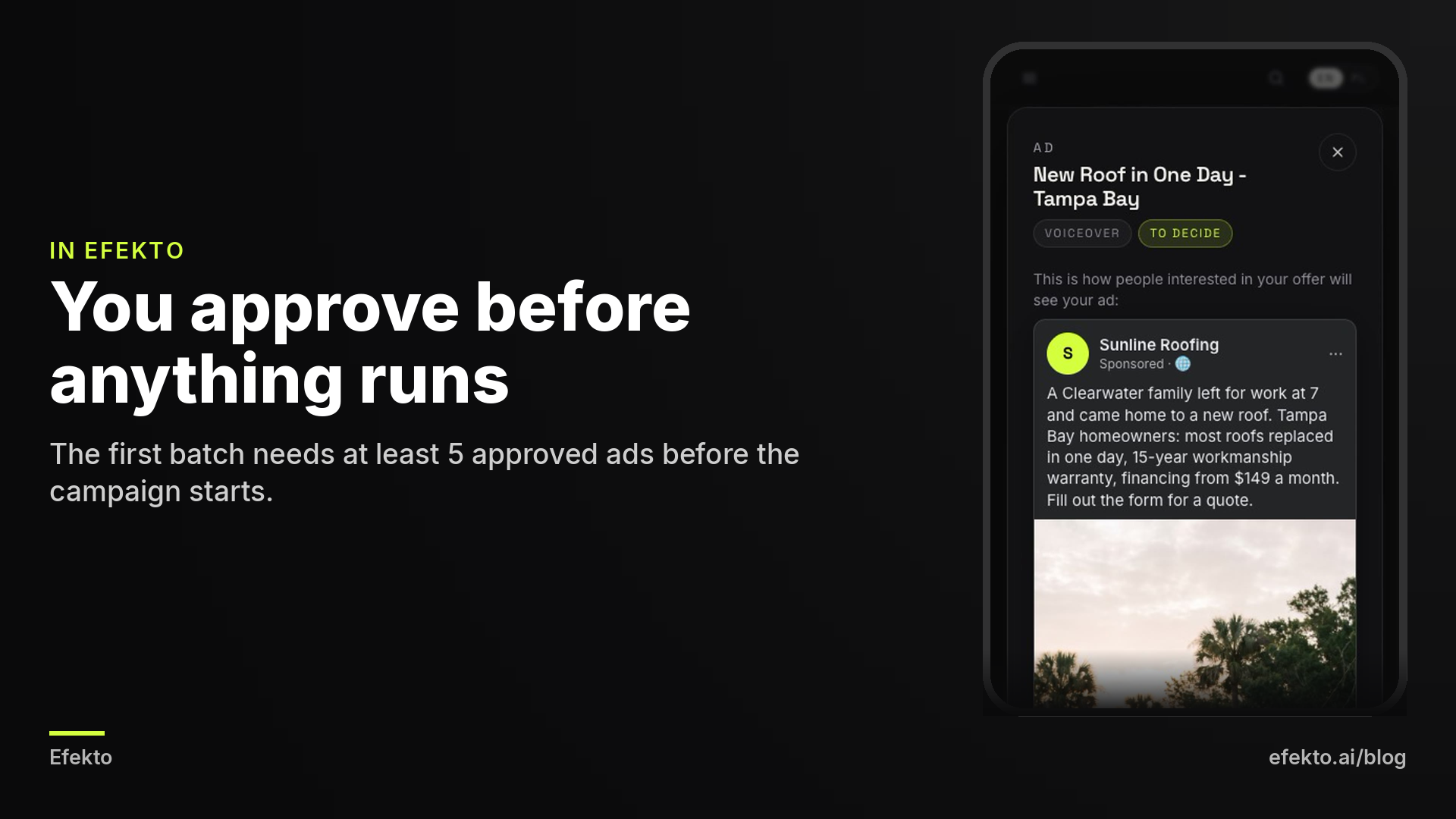
A note on our interest first: we make money when businesses advertise on Meta, so read our views on Facebook ads with that in mind. The team behind Efekto runs Lemon Agency, which has worked with more than 300 clients on lead generation. Efekto creates ads from your website, publishes them on Facebook and Instagram, and optimizes them every day: it turns off the ones that don't bring results and scales the ones that do. For a dental practice, the useful part is the approval step. You approve the first batch, at least 5 ads, before the campaign starts, so every claim gets checked against Meta's health rules and your state dental board's advertising rules by someone who knows the practice. You can use your own Facebook ad account or an Efekto ad account with the budget topped up in advance. See how Efekto works for the details.
The minimum daily ad budget is $15, the Starter plan is $149 per month for one campaign, and the 7-day free trial counts from the launch of your first campaign, with no card needed at sign-up. Efekto does not make sense if nobody at the practice will call leads quickly, or if your schedule is already full; no tool fixes either of those.
FAQ
Can I show before-and-after photos of patients in Facebook ads?
No. Meta's personal health and appearance policy prohibits before-and-after images in ads, and dental smile comparisons are among the most commonly rejected. Keep consented before-and-after cases on your website, and use photos of your team and office in the ads.
Should dental ads send people to a landing page or an instant form?
Start with a higher intent instant form, because it is faster for the patient and avoids sending health-related website data to Meta. Move to a landing page later if your form leads are consistently poor and you have checked your tracking setup with your compliance advisor.
Is it allowed to advertise a free exam or free consultation?
Meta allows it, but some insurance contracts and state rules limit how free or reduced services can be offered to insured patients. Check your payer contracts and your state dental board's guidance before running a free exam, and prefer free consultations for elective treatment like implants and aligners.
Can I target people who have dental insurance?
No, Meta does not offer targeting by insurance status. Target a radius around your practice and ask about insurance in the lead form, which tells your front desk how to open the call.
How long before I know whether a dental Facebook campaign works?
Give one campaign 30 days before judging cost per booked appointment. Judge retention at 3 and 6 months, because that is where discount campaigns and value campaigns separate.
If you want ads for your practice created, published and optimized every day without learning Ads Manager, you can start a 7-day free trial at efekto.ai.
- Jakub Zwoliński
Founder, Lemon Agency · Efekto · October 25, 2026