Facebook Ads for Electricians: Getting Panel Upgrades and EV Charger Jobs, Not Just Repairs
How electricians can use Facebook ads to book panel upgrades, EV charger installs and generators: offers, creatives, form questions, seasons and a worked budget example.

Facebook ads work for electricians when they sell one planned, clearly priced job, such as a panel upgrade, an EV charger install or a standby generator, to homeowners who are not in an emergency yet. They work badly for "call us for any electrical problem," because someone with a dead outlet searches Google instead of scrolling Instagram. Below is how we would set up each of those three jobs: the offer, the creative, the form questions, the season, and a worked budget example.
1. Run one planned job per campaign, never "all electrical services"
The single most common mistake on electrician ad accounts is one campaign that advertises everything: repairs, lighting, panels, chargers, generators, "licensed and insured, call today." It burns budget because nobody scrolling Facebook has a problem called "electrical services." They have a new EV arriving in three weeks, or a 100-amp panel that cannot handle the heat pump they want, or they lost power for two days last winter.
So split it. One campaign for panel upgrades, one for EV chargers, one for generators if you install them. Each gets its own ads, its own form and its own budget, which also means you can see which job actually produces paid work instead of one blended number.
When it makes sense: you can take on at least 2 to 3 extra planned jobs a week and you have a price range you are willing to say out loud.
When it does not: you are already booked six weeks out. Ads will just create a waiting list of people who go to the next electrician. Fix capacity first.
2. Panel upgrades: sell the reason, not the panel
Nobody wakes up wanting a new panel. They want an EV charger, a heat pump, a hot tub, a kitchen remodel or an addition, and their current panel is in the way. Your ad should start from that reason.
Offer examples (adjust to your own pricing):
- "Adding an EV charger or heat pump? We'll tell you in one visit if your panel can handle it."
- "200-amp panel upgrade, permit and inspection handled by us, typical homes from $X."
- "Still on fuses or a 60-amp panel? Flat-price upgrade, one-day install in most homes."
Put a real number or range in the ad. "Starting at" with a believable figure filters out people who expected $300, and it saves you driving to estimates you will never close.
Creatives that tend to fit this job: a photo of an old fuse box next to a clean new panel from one of your jobs, a 15-second phone video of your electrician explaining what "200 amps" means for a house with an EV, your truck in a recognizable local neighborhood. Stock photos of a lightning bolt or a smiling model in a hard hat say nothing about you.
When it makes sense: your area has older housing stock, or a lot of people adding EVs, heat pumps or remodels.
When it does not: your market is mostly new construction where panels are already 200 amps. You would pay for clicks from people who do not need you.
3. EV charger installs: the cleanest offer you have
EV charger installs are the easiest planned job to advertise because the buyer knows exactly what they want, it has a clear deadline (the car is coming), and most installs fall into a predictable price band.
Offer examples:
- "Level 2 charger installed for $X if your panel is within 25 feet of the garage. Longer runs quoted from a photo."
- "Got your EV? Send us two photos and get a fixed price today."
- "We install the charger you already bought, or recommend one that fits your panel."
The "send photos, get a fixed price" angle is powerful because it removes the site visit for simple jobs. You quote from a photo of the panel and the garage wall, and only go out for the complicated ones.
Creatives: a car plugged in inside a garage you actually wired, the clean conduit run on the wall, a short clip of the charger lighting up. Mention the panel check in the copy, because some of these leads will turn into a panel upgrade too. That is often the bigger ticket.
You cannot reliably target "people who own an EV" in Meta anymore, so let the ad do the filtering. A headline that starts with "Got your EV?" is ignored by everyone else, which is exactly what you want.
When it makes sense: suburbs with garages and driveways, and areas where you see EVs on your own service calls.
When it does not: dense apartment areas where residents need building approval and street parking makes home charging rare. Most leads there stall at "I'll ask my landlord."
4. Standby generators: a long sale with a short season
Generators are the biggest ticket of the three and the slowest to close. People think about them in the week after an outage and then forget. Your ads should run before that week, not during it.
Offer examples:
- "Whole-home generator sized to your house. Free sizing visit, installed price range given on the spot."
- "Keep the fridge, well pump and heat running next outage. Installs typically from $X."
Our position on storm ads: do not run "power out? call now" ads in the middle of an outage in your own area. You cannot install a standby unit in 24 hours, the people calling need a portable generator or a utility crew, and you collect angry leads instead of buyers. Run your generator campaign in the 6 to 8 weeks before your local storm or winter season, and pause or soften it during an actual event.
Form or follow-up should ask: natural gas or propane available, rough home size, and what they want to keep running. That tells you whether this is a $5,000 conversation or a much larger one before you drive out.
When it makes sense: areas with regular multi-day outages, rural homes on well pumps, homeowners with medical equipment.
When it does not: your area rarely loses power for more than a few hours. You will pay to educate people who will not buy.
5. Lead form questions that filter out the wrong calls
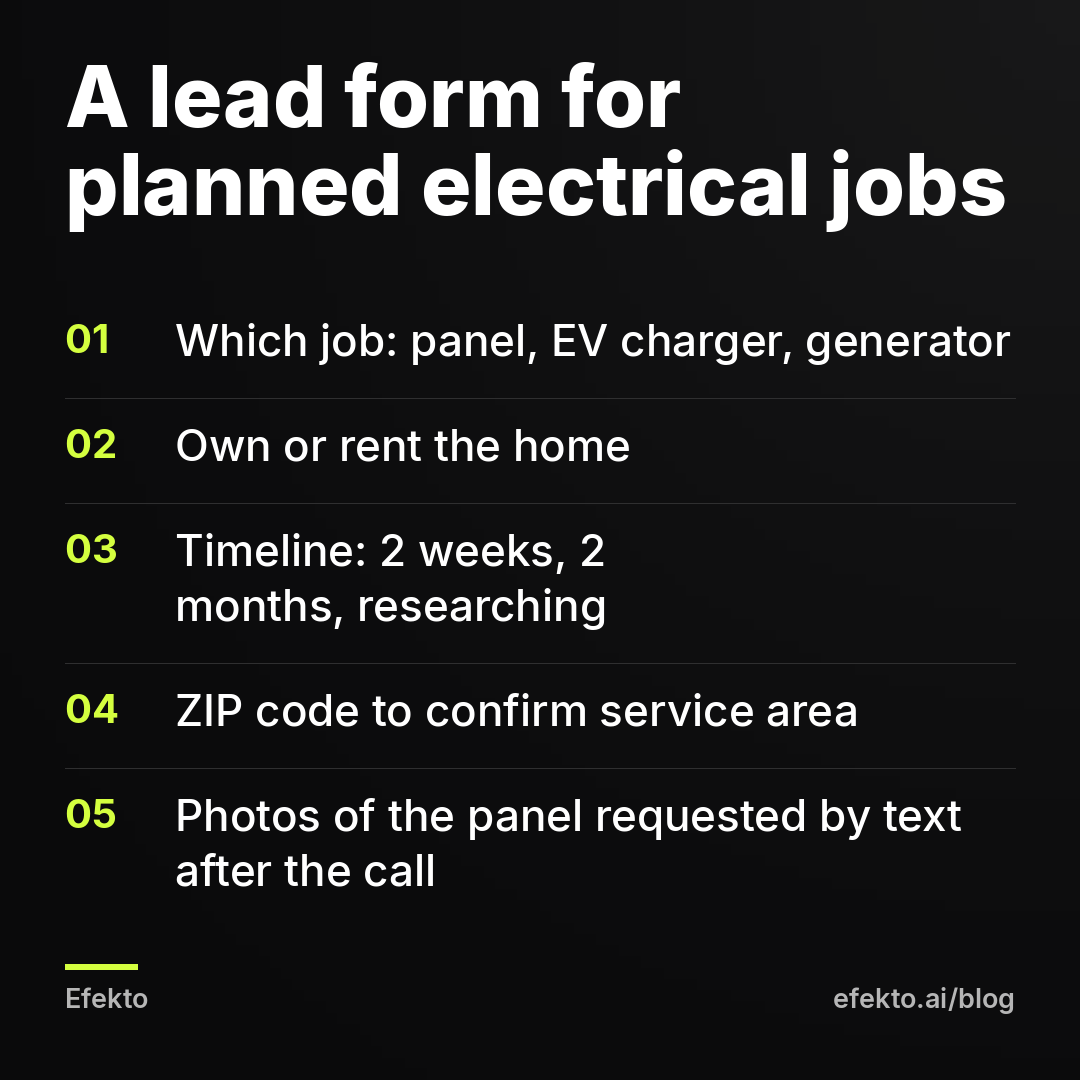
A Facebook lead form with only name and phone gets you lots of names and phones. For planned electrical work we would use Meta's "Higher intent" form type, which adds a review screen before submitting, and three to four short questions:
- Which job? Panel upgrade / EV charger / generator / other. (Multiple choice, so the answer lands in your sheet cleanly.)
- Do you own the home? Yes / No. Renters cannot approve a panel swap.
- When do you want this done? Within 2 weeks / within 2 months / just researching.
- ZIP code. Catches people outside your service area even when your targeting is set correctly.
Optional for EV chargers: "Is your panel in the garage, basement or outside?" That one answer tells you a lot about the run length.
Then ask for photos by text right after the first call, not in the form. Upload fields in forms cut submissions sharply, and a text with two pictures takes the customer 30 seconds once they are already talking to you.
Avoid "free estimate" as your main hook. It attracts people collecting three quotes to pick the cheapest. A price range plus "we tell you in one visit" attracts people who want it done.
From our accounts: in the 90 days to Nov 8, 2026, buying companies flagged 28 of the 561 business electricity and gas leads we delivered (5.0%), and we replaced each of them with a new one. That is a different market than residential electrical work, but the lesson carries over: even with qualifying questions, a slice of leads will be wrong numbers, duplicates or people who did not mean it. Do not judge a campaign by one bad lead. Judge it by how many qualified estimates it books per month.
6. Get every lead to your phone within minutes
The best form in the world does nothing if the lead sits in Meta's lead center for two days. Planned jobs feel less urgent than repairs, but the homeowner filling in your EV charger form is often filling in two others the same evening. Whoever calls first usually gets the visit.
What we would set up:
- Leads go instantly to email and a text alert to whoever answers the phone, not only to the owner's inbox.
- A target of calling back within 15 minutes during business hours, and first thing the next morning for evening leads.
- A simple sheet with columns: date, job type, called (Y/N), estimate booked (Y/N), job sold (Y/N), amount. Without this you will never know which campaign makes money.
Test the connection with Meta's lead testing tool before you spend a dollar, and again after anyone changes access settings on your Facebook Page.
From our accounts: Meta lead form leads can fail to reach your CRM with no error at all. In one case we diagnosed in August 2026, the Page had lead access manually limited to one integration, and the other one received nothing. The ads ran, Meta counted leads, and the business saw an empty inbox. If your Ads Manager shows leads but your phone is quiet, check the Page's lead access settings first; we walk through the full fix in our guide on Facebook leads not showing up in your email or CRM.
When this matters most: always. When it matters less: never. This is the one step with no exceptions.
7. Example: from daily budget to booked jobs
Here is a worked example so you can see the mechanism. Every number below is an assumption for illustration, not a result from our accounts or a forecast for yours.
Say you run an EV charger and panel upgrade campaign at $30 a day for 30 days.
| Step | Example number | How it's calculated |
|---|---|---|
| Monthly ad spend | $900 | $30 x 30 days |
| Form leads (say $45 each) | 20 | $900 / $45 |
| Reached and qualified | 12 | about 60% answer and fit |
| Estimates or photo quotes | 8 | some decide on price alone |
| Jobs sold | 3 | 2 EV chargers, 1 panel upgrade |
| Revenue (say $1,400 per charger, $2,800 per panel) | $5,600 | 2 x $1,400 + $2,800 |
| Ad cost per booked job | $300 | $900 / 3 |
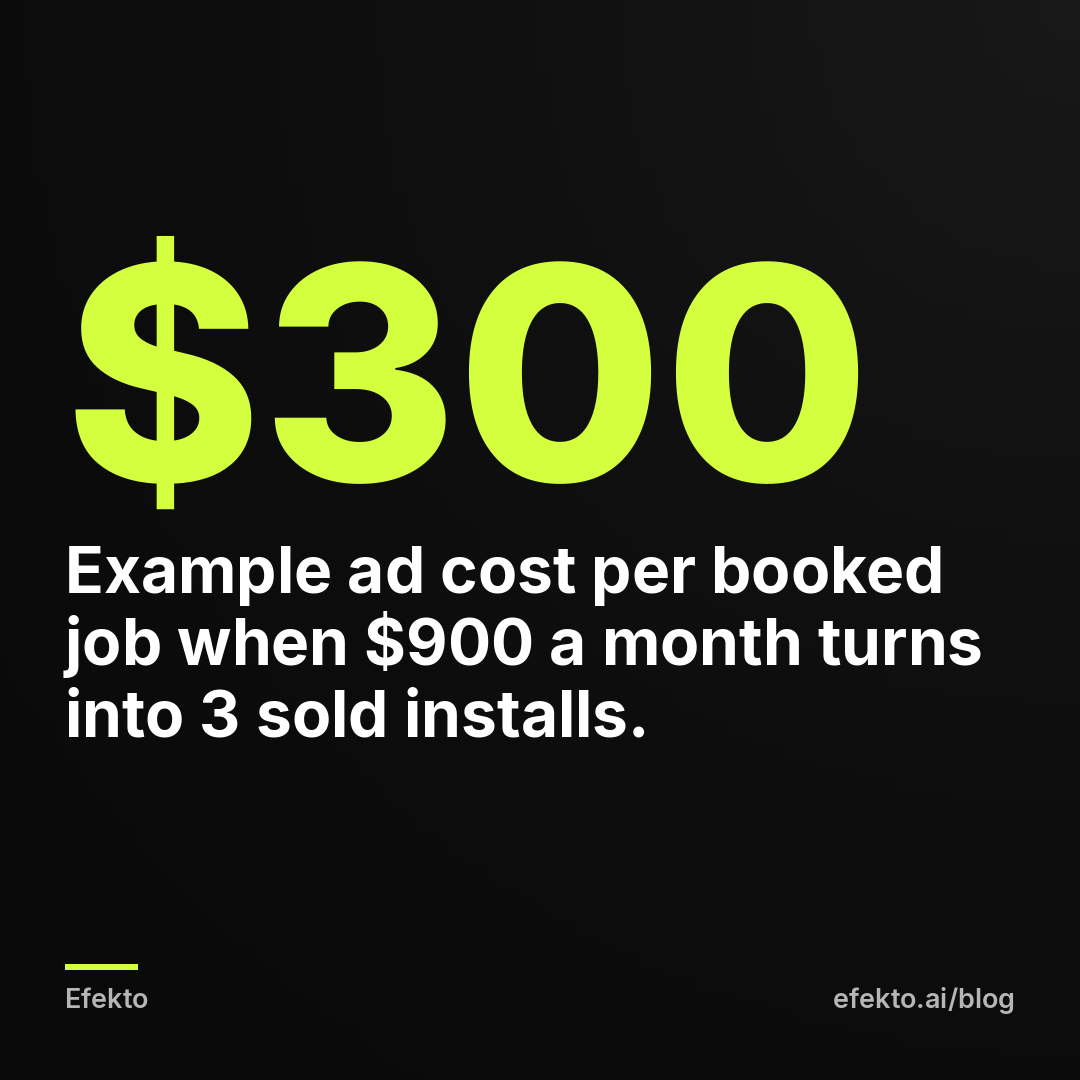
Now change one assumption. If your leads cost $90 instead of $45, you get 10 leads, maybe 1 or 2 jobs, and the same $900. Whether that still works depends on your margin per job, not on what Ads Manager calls a "good" cost per lead. That is why we track cost per booked job, not cost per lead. If you want to work backward from the number of jobs you need, our guide on setting your daily budget based on the jobs you need shows the full calculation.
Give any new campaign at least 2 to 3 weeks before judging it. Planned jobs have a lag: someone who fills in a generator form in week one may not sign until week five.
8. Seasonality: when to push each job
Electrical work is less seasonal than roofing or HVAC, but each planned job has its own rhythm. This is how we would plan the calendar:
- EV chargers: steady all year, with extra pushes around tax refund season in spring and year-end car buying in November and December. Keep this campaign on as your baseline.
- Panel upgrades: follow remodel and heat pump season. Spring and early fall are when homeowners start projects that need more capacity.
- Generators: the 6 to 8 weeks before your local outage season. In hurricane areas that means late spring; in cold climates, early fall. Wind down once the season starts and you are booked.
- Repairs and service calls: leave these to Google search and your phone number on the truck. Facebook is the wrong place for "my breaker keeps tripping right now."
When you shift budget between jobs, change the budget, not the ads themselves. Editing live ads often resets their learning, and you lose a week of data.
9. When Facebook ads are the wrong tool for an electrician
We make money when businesses advertise on Facebook and Instagram, so weigh our opinion with that in mind. It comes from running lead generation campaigns for 300+ clients through Lemon Agency. Even so, there are cases where we would tell an electrician not to start here:
- Your business is mostly emergency repairs. People with a burning smell or no power search Google and call the first number. Google Local Services Ads or search ads fit that intent better; we compare the two in Facebook ads vs Google Local Services Ads.
- Nobody can answer the phone within a few hours. Facebook leads cool fast. If calls go to voicemail until Friday, you are paying for your competitors' customers.
- You will not name any price. Without a range, planned-job ads collect browsers. If pricing "depends on everything," at least publish a typical range.
- You cannot put in $15 a day for a few weeks. Below that, Meta does not get enough data to find buyers, and you end up judging the channel on a handful of clicks.
If you want the campaigns from this guide without learning Ads Manager, Efekto is one option. Efekto creates ads from your website, publishes them on Facebook and Instagram, and optimizes them every day: it turns off the ones that don't bring results and scales the ones that do. You approve the first batch (at least 5 ads) before anything goes live, and it runs on your own ad account or an Efekto ad account with the budget topped up in advance.
The minimum daily ad budget in Efekto is $15, the free trial is 7 days counted from the launch of your first campaign, and no card is needed at sign-up. It does not replace the parts only you can do: answering leads fast, quoting honestly and showing up on time.
Summary: the three planned jobs side by side
| Job | Offer example | Creative that fits | Key form question | When to push | Skip it when |
|---|---|---|---|---|---|
| Panel upgrade | Flat price for 200-amp, permit handled | Old fuse box vs new panel from your job | Own or rent? | Spring and early fall | Mostly new construction in your area |
| EV charger | Fixed price within 25 feet of panel | Car plugged in a garage you wired | Where is your panel? | All year, extra in spring and Nov-Dec | Dense rentals with street parking |
| Standby generator | Free sizing visit with a price range | Your install next to a real house | Gas or propane available? | 6 to 8 weeks before outage season | Outages in your area are rare and short |
| Emergency repairs | Not on Facebook | n/a | n/a | n/a | Use Google search instead |
FAQ
How much should an electrician spend on Facebook ads per month?
Work backward from jobs, not from a round number. Decide how many planned jobs you want, estimate how many leads that takes with your close rate, and multiply by a realistic cost per lead. For a single campaign we would not go below $15 a day, and the worked example above uses $30 a day for two job types.
Should I show prices in electrician Facebook ads?
Yes, as a range or a "from" price for a defined scope. A clear number filters out people expecting a bargain and makes the ones who submit more likely to book. You can still adjust after seeing photos or the site.
Can I target people who own an EV or an older home on Facebook?
Not reliably. Meta has removed most detailed targeting options of that kind. Target your service area broadly and let the headline do the filtering: "Got your EV?" or "Still on fuses?" gets ignored by everyone it does not apply to.
How fast should I call back a Facebook lead for a panel or charger job?
Within 15 minutes during business hours if you can, and the next morning at the latest for evening leads. Homeowners often fill in several forms the same night, and the first electrician who calls with a clear answer usually books the visit.
If you want to see how these campaigns would look for your own electrical business, you can start at efekto.ai.
- Jakub Zwoliński
Founder, Lemon Agency · Efekto · November 14, 2026