Facebook Ads for Pest Control: Getting Recurring Plans, Not Just One-Off Sprays
Use the seasonal pest to get the click and the quarterly plan to get the sale. Offers, lead form questions, ad images Meta approves, and a worked example.

Facebook ads work for pest control when this month's pest gets the click and the quarterly plan gets the sale. A $49 one-time spray fills your calendar with people who never book again. An offer built on a first visit plus three follow-up visits fills it with customers who pay you all year.
1. Lead with the pest people are seeing this month
Your hook should name the pest homeowners in your area are already noticing. Nobody scrolls their feed looking for "pest control" in general. Someone who found ants on the counter this morning stops on an ad about ants. Across most of the US the calendar looks roughly like this. It runs a few weeks earlier in the South and later in the North:
| Season | What homeowners notice | Ad hook example | How it leads to a plan |
|---|---|---|---|
| March-May | Ants, termite swarmers, spiders | "Ants back in the kitchen this spring?" | Ants return every year, so a quarterly barrier makes sense |
| June-August | Mosquitoes, wasps, fleas | "Get your backyard back this summer" | Monthly mosquito visits in season, then quarterly |
| September-November | Mice, stink bugs, spiders moving indoors | "Keep mice out before it gets cold" | Fall exclusion plus winter rodent checks |
| December-February | Mice, rats, cockroaches indoors | "Hearing scratching in the walls?" | Rodent monitoring on the same quarterly route |
When it makes sense: Rotate the hook with the season, every season. Launch each new hook 2-3 weeks before the local peak. Meta needs a few days to find the right people, and you want the ads running well before the phones start ringing.
When it does not: Termite inspections and bed bug treatments are separate sales. Each has its own price and its own decision process. Give them their own campaign instead of folding them into the seasonal ad. Otherwise your form fills up with people who expect a completely different price from the one your ad showed.
2. Make the quarterly plan the offer, not the spray
The offer that builds a pest control business is a first visit plus a recurring visit price, both written in the ad. The seasonal pest gets attention. The plan is what you actually sell.
A cheap one-time spray does bring leads, and plenty of them. But it attracts people comparing three companies on price, and most of them never book a second visit. In our view, the cheap-spray ad is the most common way pest control companies burn a Facebook budget. The leads look cheap in Ads Manager, and the revenue never shows up.
This is how we'd write the offer. The prices are examples, so use your own:
- Initial service: one price, shown in the ad ("First visit $149, inside and out").
- Recurring visit: one price per quarter ("Then $119 every 3 months").
- Free re-service between visits if pests come back. This line sells the plan. It answers the real fear, which is paying and still having ants.
- How to stop: say plainly how cancellation works. People who suspect a contract trap don't fill in the form.
For other offer types you can test against this one, see our list of offers for home service businesses.
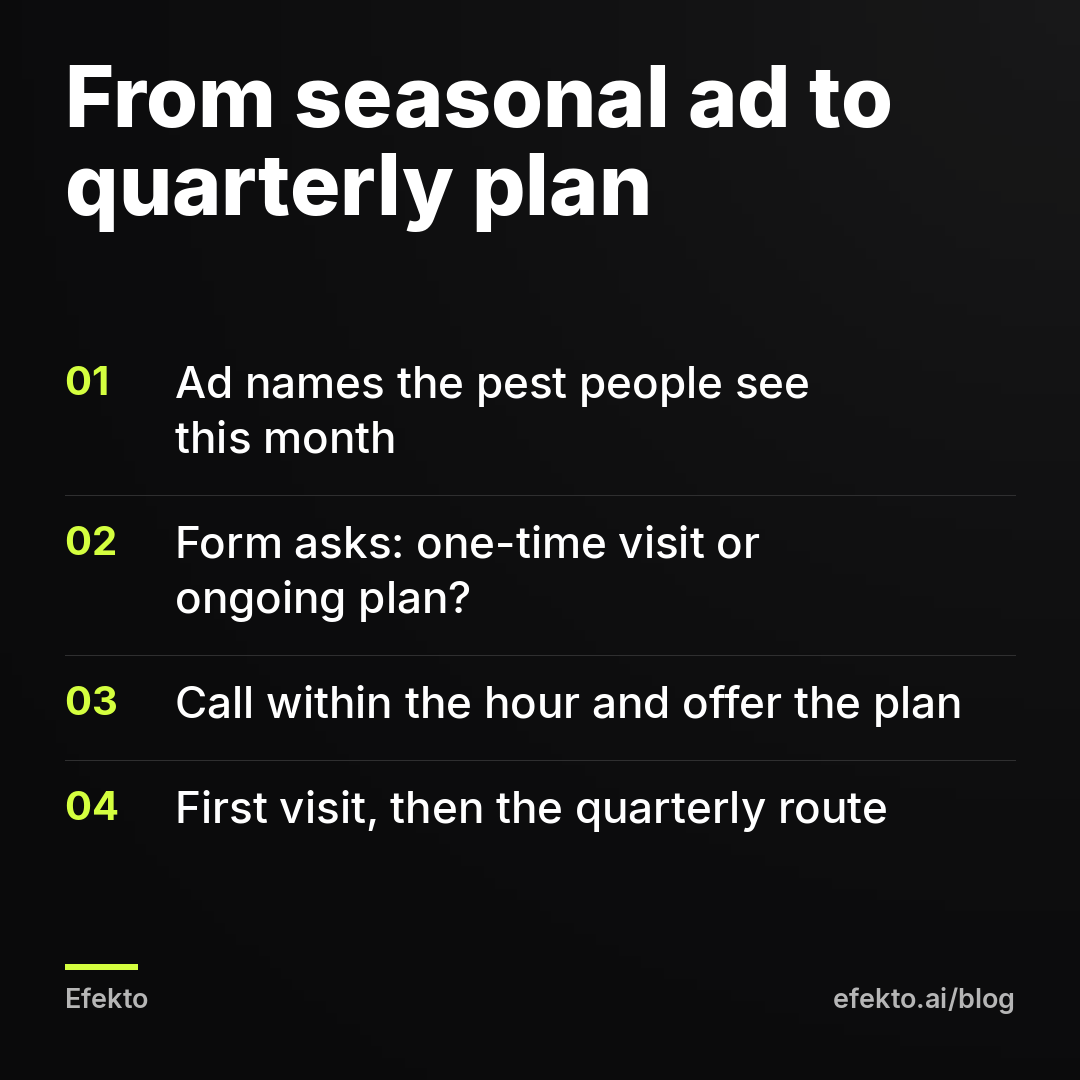
When it makes sense: general household pests that come back every season, such as ants, spiders, rodents and roaches.
When it does not: truly one-time problems, like a single wasp nest. Sell those as one-time jobs at a fair price. Then offer the plan on site, after your technician has earned some trust.
3. Use ad images without the gross-out photos
Your ad images should show the result and the people, not the pest. Close-ups of roaches, rats, droppings or bites hurt you twice:
- Rejection risk. Meta's advertising standards restrict shocking and sensational images, so graphic infestation photos can be rejected or get limited delivery.
- Lost reach. Even when they pass, people hide the ad or scroll past faster, and those negative signals cost you reach on the ads that come after.
These are the images we'd make first:
- A technician in uniform at a front door, or treating the perimeter of a house.
- Your branded truck on a residential street that looks like your area.
- A clean kitchen or a family on a back porch, with the text "Ant-free since spring."
- A gloved hand sealing a gap under siding. It shows the method without showing the mouse.
- A plain text card: "Quarterly pest plan. First visit $149. Free re-service between visits."
- A 15-second phone video of your technician explaining what they check on a first visit.
If you need to show the pest, use a small illustrated icon or one distant, non-graphic photo. Never show a swarm.
Keep the copy calm too. "Seeing ants in the kitchen this spring?" works. "Your home is crawling with roaches" makes the reader feel accused.
Be careful with words like "safe" or "non-toxic" about the products you use. Advertising claims about pesticides are regulated, so check what your state allows before putting those words in an ad.
When it makes sense: every campaign.
When it does not: we can't think of a case where a gross-out photo beats a clean one for a plan offer. Shock gets a stare, not a booking.
4. Ask lead form questions that separate plan buyers from spray shoppers
Use a Meta lead form with five questions. Make one of them ask directly whether the person wants a one-time visit or an ongoing plan. That single answer tells you whom to call first.
The questions we'd use:
- ZIP code (short answer). This filters out people you can't fit on a route.
- What are you seeing? (Ants / Spiders / Mice or rats / Mosquitoes / Roaches / Something else)
- Where? (Inside / Outside / Both)
- What are you looking for? (A one-time treatment / A regular plan so it doesn't come back / Not sure yet)
- Do you own or rent the home? (Own / Rent)
Name, phone and email come prefilled from the profile. Choose the "higher intent" form type, which adds a review screen before submitting. Fewer people finish it, but more of the ones who do will pick up when you call.
The own/rent question is there because a landlord often decides on pest service. Renters are worth calling. Just expect a different conversation.
When it makes sense: when someone can call back within the hour.
When it does not: if nobody can call back quickly, a call ad works better than a form. The customer reaches you while the problem is still in front of them. Whatever you run, send yourself a test lead before launch and confirm it arrives in your email or CRM.
5. Target only the homes you can route to
Target the ZIP codes along routes you already drive, not your whole metro. Recurring plans are profitable when stops sit close together. A plan customer 40 minutes off-route eats the margin on every quarterly visit for as long as they stay.
The settings we'd use:
- Location: set to people living in your service ZIP codes, not people "interested in" the area.
- Age and interests: leave them broad. Meta finds homeowners with pest problems better through who responds to the ad than through stacked interests.
- Exclusions: exclude ZIP codes inside your radius that you don't serve, such as across a river or past a toll bridge.
- Backup filter: the ZIP question in the form catches whoever slips through.
When it makes sense: always, for plans.
When it does not: if you are deliberately opening a new area, target it. Give it a separate campaign and budget, though, so its results don't hide inside your main area's numbers.
6. Set your target cost from real lead costs, then do the math on the plan
Set your target cost per lead from what leads actually cost in your market, then judge ads against that number. A target picked from hope kills ads that were working.
From our accounts: We once ran with a target cost per lead of about $16 in an industry where the real cost was $29-38. Every ad set looked like a loser and got switched off. That was a financial services campaign in October 2026, not pest control, but the mistake carries over directly. Today we set the target from the industry's real cost, not from hopes. For a pest control company, that means running 2-3 weeks before deciding what "expensive" means, then comparing ads against your own real number.
Once you have that number, do the math on the plan, not on the lead. Here is a worked example. Every number in it is illustrative:
| Step | Example number |
|---|---|
| Daily budget | $30 |
| Monthly ad spend | $900 |
| Cost per lead reported by Meta | $35 |
| Form leads | about 26 |
| Real leads after your calls (reachable, in your area, real pest problem), say 70% | 18 |
| Cost per real lead | $50 |
| Sold as a quarterly plan, say 40% | 7 |
| Year-one revenue per plan ($149 + 3 × $119) | $506 |
| Year-one revenue from one month of ads | $3,542 |
| Ad cost per plan sold | about $129 |
Look at the gap between $35 and $50. Meta reports the cost of a submitted form before anyone has checked it. The cost of a lead you can actually serve is always higher, and that's the number to watch.
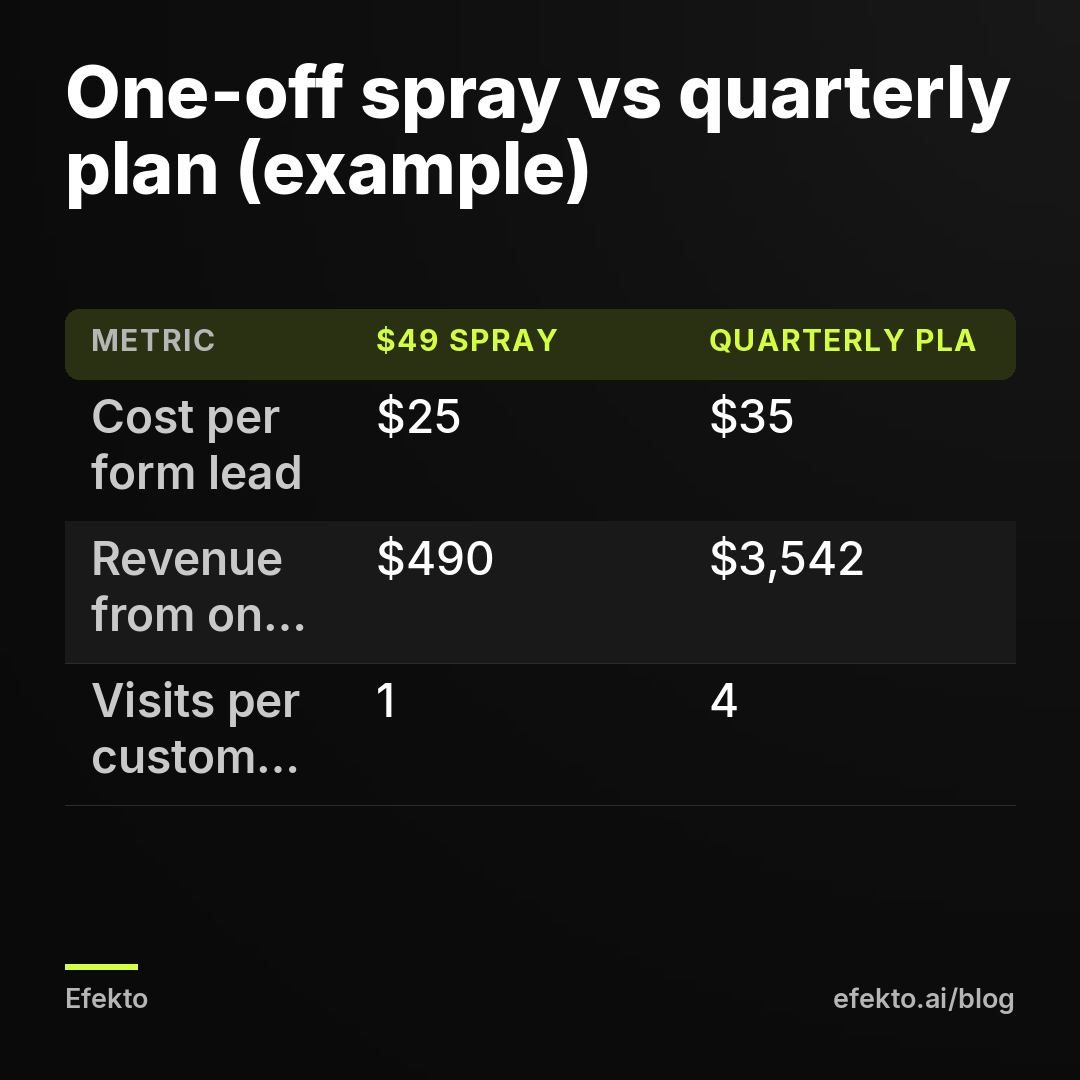
Now run the same month on a $49 spray offer. Say the cheaper offer drops the cost per form lead to $25. That gives you 36 forms, maybe 20 real leads, and 10 booked sprays: $490 in revenue against $900 in ads. Most of those customers won't book again. The leads are cheaper and the business is worse.
When it makes sense: if your plan customers usually stay past year one, each plan is worth more than $506, and you can afford a higher cost per lead than this example.
When it does not: if you don't yet know how many leads you close, don't touch the budget. Track your first 30 leads to a yes or no first.
7. Answer weekend leads, because that's when many forms come in
Plan for weekend leads. Pest problems don't wait for office hours, and neither do the forms.
From our accounts: We looked at 3,490 Meta lead form leads collected in the 90 days to Nov 1, 2026, across the accounts we run. The most came in on Sunday (19.2%) and the fewest on Monday (12.5%). Saturday and Sunday together brought 33% of all leads.
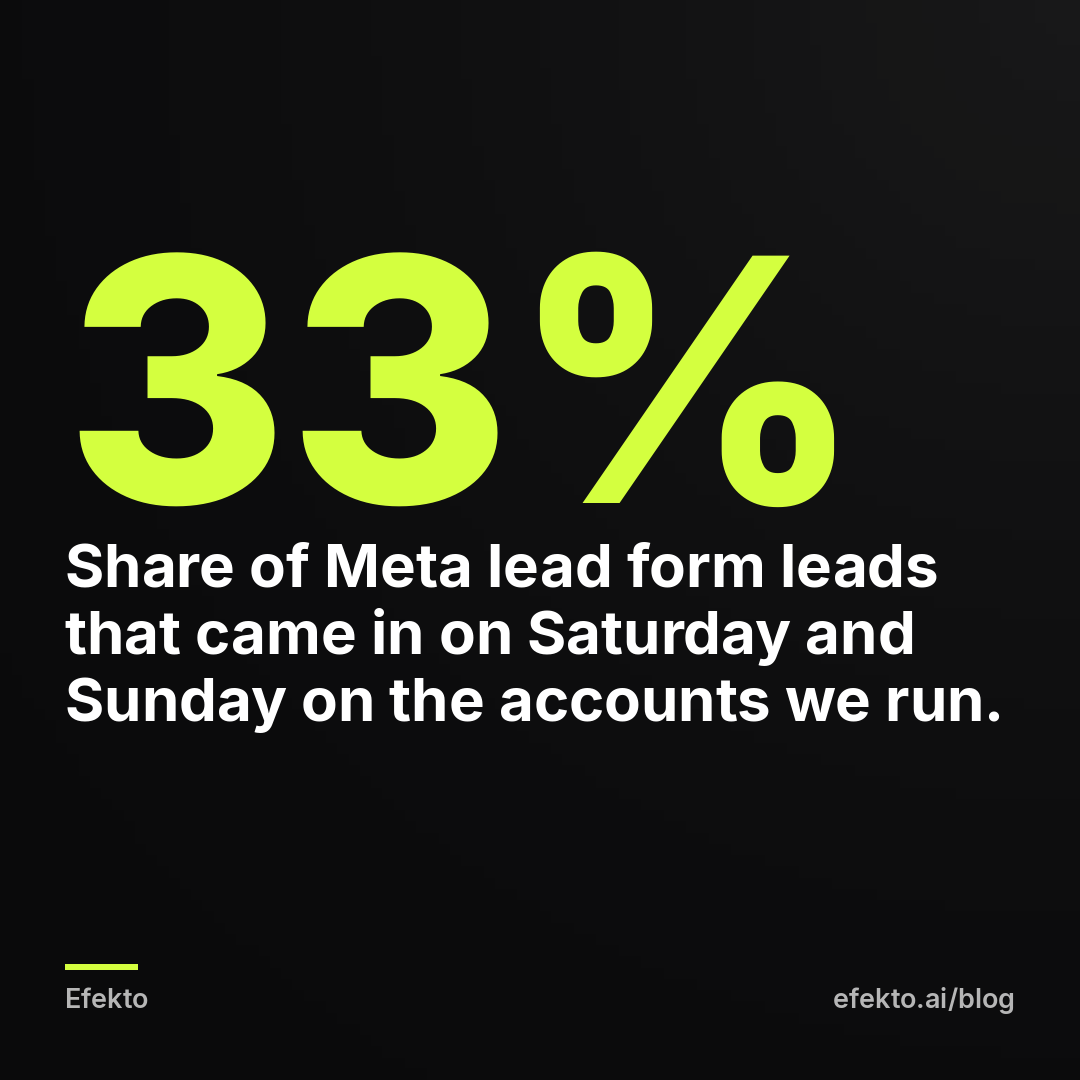
That data isn't pest-control-only, but the pattern fits the trade. Someone who sees a mouse on Saturday evening fills in a form that night and books the first company that answers. If your office opens Monday at 8 a.m., a competitor with an on-call phone has already booked that inspection.
This is what we'd set up:
- Instant text reply. An automatic text within 5 minutes of every lead, signed with a real name.
- Weekend callbacks. One person on call Saturday and Sunday for callbacks, even if visits wait until Monday.
- Ads stay on. Keep ads running on weekends. Switching them off cuts the days that bring the most leads.
More on response speed is in our post on following up on Facebook leads fast enough to book the job.
When it makes sense: for any company getting more than a handful of leads a week.
When it does not: if nobody can work weekends at all, at least send an automatic text promising a call Monday by 9 a.m., and keep that promise. A clear time beats silence.
8. Turn last year's one-off customers into plan customers
The cheapest plan you'll ever sell goes to someone who already paid you for a one-time treatment. Upload a list of customers who bought a one-off service in the last 12 months as a custom audience. Use only contacts you collected with their permission. Then show that list a plan-only ad.
Keep the message personal and seasonal. For example: "Treated ants with us last spring? Lock in quarterly visits before they come back." A small budget is enough here, say $5-10 a day, because the audience is small and already knows your name.
When it makes sense: once you have a few hundred past one-off customers with phone numbers or emails.
When it does not: with fewer than about 200 past customers, skip the ad. A personal text from the owner costs less and converts better.
9. Know when Facebook ads are the wrong tool for pest control
We make money when businesses advertise on Meta, so read this as the honest exception list. Facebook ads are the wrong first move when:
- You mostly serve commercial accounts. Restaurants, warehouses and property managers are usually won through direct sales and referrals, not a homeowner's feed.
- Your work is mostly emergencies. In wildlife removal, for example, people search Google at the moment of the problem. Search ads fit that moment better.
- Your peak-season schedule is already full. More leads in July just means more people you disappoint. Save the budget for the shoulder months, when the schedule has gaps.
- Nobody can call leads back within a day. Fix that first. Ads only make the gap more expensive.
Summary: what to set up and what to avoid
| Step | What to set | Mistake to avoid |
|---|---|---|
| Seasonal hook | This month's pest, launched 2-3 weeks before peak | The same generic "pest control" ad all year |
| Offer | First visit + quarterly price + free re-service | A $49 one-off spray as the main offer |
| Ad images | Technician, truck, clean home, text card | Close-ups of roaches, rats or bites |
| Lead form | 5 questions, including one-time vs plan | Name and phone only |
| Area | ZIP codes on your existing routes | The whole metro |
| Target cost | Set from real lead costs, judged after 2-3 weeks | A target picked from hope |
| Weekends | On-call person or instant text | Office closed until Monday |
| Past customers | Custom audience with a plan-only offer | Ignoring last year's one-off buyers |
If you'd rather not build and monitor all of this yourself, Efekto is one option. Efekto creates ads from your website, publishes them on Facebook and Instagram, and optimizes them every day: it turns off the ones that don't bring results and scales the ones that do. You approve the first batch before anything runs, with at least 5 approved ads, so no bug close-up goes live without your yes. Here is how Efekto works, step by step.
The Starter plan is $149 per month, and the minimum ad budget is $15 per day. The free trial runs 7 days from the launch of your first campaign, and no card is needed at sign-up. Efekto doesn't make sense if your website says nothing about your services and plans, or if nobody will answer leads quickly. No ad tool fixes a phone nobody picks up.
FAQ
How much should a pest control company spend on Facebook ads per month?
Start from the number of plans you want each month and work backward, not from a round budget. In our worked example, $900 a month at $30 a day produced 7 plans. Run 2-3 weeks to learn your real cost per lead, then adjust.
Should I put prices in pest control ads?
Yes, at least the first-visit price and the quarterly price. A visible price filters out people expecting a $49 spray before they fill in the form, which saves you calls that go nowhere. It also makes the plan feel concrete instead of vague.
Why did Meta reject my pest control ad?
The most common reason is the image. Graphic photos of infestations, droppings or bites can fall under Meta's restrictions on shocking content. Swap in a technician, your truck or a clean-home photo, keep the copy calm, and resubmit.
Do Facebook ads work for pest control in winter?
They can, if the hook matches the season. Mice, rats and indoor roaches peak when it's cold, and rodent monitoring fits the same quarterly route as your other plans. Winter is also a good time to run plan-only ads to last year's one-off customers.
If you want ads like these running without learning Ads Manager, you can start with Efekto.
- Jakub Zwoliński
Founder, Lemon Agency · Efekto · November 4, 2026