Best Facebook Ad Offers for Home Service Businesses: 7 Types to Test
7 Facebook ad offer types for home service businesses, with example ad copy for HVAC, roofing, plumbing and cleaning, pros and cons, and a way to test them.

The Facebook ad offers that work best for home service businesses make the first step cheaper without cutting the price of the job. A paid inspection or tune-up, a scheduling guarantee and a seasonal package usually bring leads you can book. A plain free estimate and a percentage discount for new customers bring the most form fills and the most dead ends. Below are 7 offer types we test in home service ad accounts. Each comes with example ad copy for different trades, what it does well and badly, and a cheap way to test offers against each other.
In short:
- A free estimate is the minimum every competitor offers, so it only works when you add something specific to it, like a deadline or a written report.
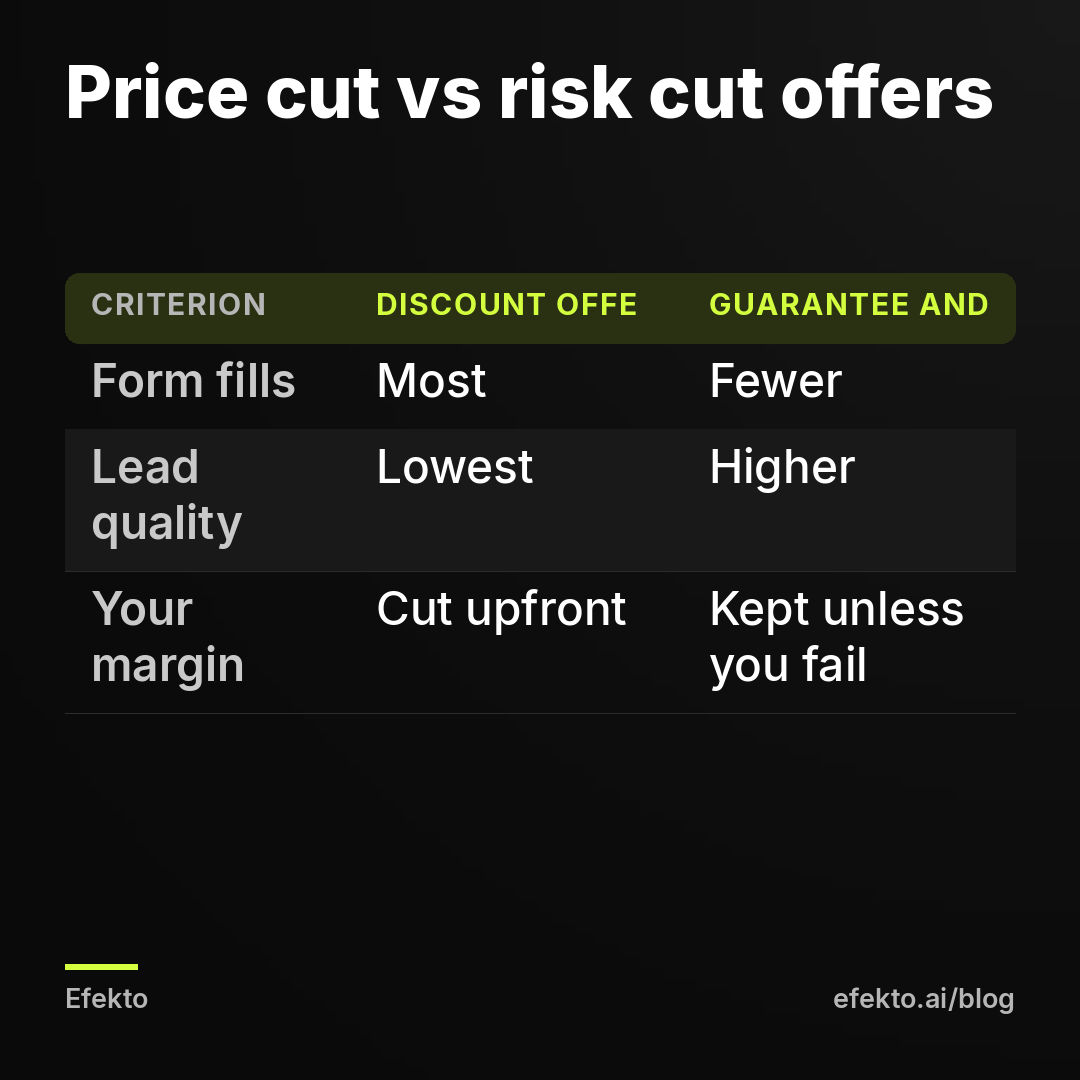
- Offers that cut your price (new customer discounts) produce the cheapest form fills and the weakest customers, while offers that cut the customer's risk (guarantees, inspections) produce fewer but better leads.
- Judge an offer by cost per verified lead and booked jobs, never by the cost per lead Facebook shows you.
How do you choose a Facebook ad offer for a home service business?
Pick the offer that makes the first step small and specific, filters out people who can't buy, and pays for itself or leads straight to the main job. People on Facebook aren't searching for a plumber. They're scrolling. Your ad has to give them a reason to stop and act this week instead of someday. Being a good company isn't a reason. A small, clear next step with a number attached is.
We judge every offer by four questions:
- Is the first step small? Booking a $79 check is easy. Committing to a $12,000 roof from a phone screen is not.
- Is it specific? A number, a time frame, or a list of what's included. Quality service isn't an offer.
- Does it filter? A good offer turns away renters asking about a roof replacement and people outside your service area.
- Can you deliver it without losing money? Either the first visit breaks even, or it leads to the main job often enough to cover the cost.
This post is a list of ready-made offer types. If you want the process of building an offer from scratch, wording included, see our guide on how to write a Facebook ad offer for a local service business.
Here is how the 7 types compare. Volume and quality ratings reflect what we typically see in service accounts, not measured averages. Your market will move them.
| Offer type | Works best for | Lead volume | Lead quality | What it costs you | Main risk |
|---|---|---|---|---|---|
| 1. Free estimate | Roofing, remodeling, painting, fencing | High | Low to medium | Drive time per estimate | Quote collectors who never book |
| 2. Inspection or tune-up | HVAC, plumbing, pest control, roofing, chimney | Medium to high | Medium to high | Tech time, thin margin on the visit | Feels like an upsell trap if handled badly |
| 3. Seasonal package | HVAC, lawn care, gutters, pressure washing, pest control | Medium | Medium to high | Planning, bundled margin | Only works inside a short window |
| 4. Scheduling guarantee | Plumbing, HVAC repair, garage doors, electricians, cleaning | Medium | High | Penalty when you miss | Breaks trust if you can't keep it |
| 5. New customer offer | Cleaning, lawn care, pest control, detailing | Very high | Low | Margin on the first job | One-time bargain hunters |
| 6. Referral program | Any trade with past customers | Low | Very high | Reward per referral | Needs a customer list, grows slowly |
| 7. Financing | Roofing, HVAC replacement, windows, remodeling | Low to medium | Medium | Lender fees | Ad restrictions and legal disclosures |
Does a free estimate offer still work on Facebook?
A free estimate still works, but only when you add something to it. On its own it isn't an offer. It's the minimum. Every roofer, painter and fence company in your area says free estimates, so the phrase gives nobody a reason to pick you or to act now.
What fixes it is a concrete extra: speed, a format, or proof.
Roofing example: Free roof estimate in writing within 48 hours, with photos of every problem we find. No pressure, no door knocking. Serving [your county] homeowners.
Painting example: Send us 4 photos of the rooms, get a fixed-price estimate by text the same day. If you like the number, we come out to confirm it.
What it does well: Everyone understands it, no explanation needed. Volume is high. For jobs that need a site visit before anyone can quote, there's no real alternative.
What it does badly: It attracts people collecting three quotes to find the cheapest. There's no urgency. Every estimate costs you an hour or more of driving and measuring, and that cost is invisible in your ad results.
Who should use it: High-ticket trades where an in-person look is unavoidable. Always pair it with one qualifying question on the form, such as when do you want the work done, with options like this month, in 1-3 months, just researching. People who pick just researching are still leads. They just don't get a same-day truck roll.
Is a free or paid inspection a good Facebook ad offer?
An inspection or tune-up is one of the strongest offers in home services, and we prefer the paid version. It gets you into the home and in front of the system or structure that will need work. The customer gets something of real value. A small charge, even $49 to $99, filters out people who would never pay for anything.
HVAC example: $79 AC tune-up before the heat hits. 21-point check, coil cleaning, refrigerant level, written report. Book this week and pick your time slot.
Pest control example: Free termite inspection for homes in [city]. Licensed tech, 45 minutes, photo report you keep even if you never hire us.
Roofing example: Roof check after last week's storm, $99, credited back if we do any repair. You get photos of every shingle we flagged.
What it does well: It produces real homeowners who own the system you service. The visit often finds the bigger job, like a failing capacitor, a cracked heat exchanger or lifted shingles. The value of the offer is easy to understand.
What it does badly: The margin on the visit itself is thin or negative. A free inspection, especially a free roof inspection after a storm, has a bad reputation because door-to-door storm chasers have used it for years. If your techs push every customer toward a replacement, the reviews will say so and the offer stops working.
Who should use it: HVAC, plumbing, pest control, chimney and roofing companies with techs who can recommend honestly. Our view: charge something and credit it toward the repair. Paid-and-credited sounds more confident than free, and the people who book it are more serious.
Do seasonal packages work better than one-off discounts?
Yes, in trades with a clear season, a package beats a discount because the reason to act now is built in. Spring cleanup has a deadline that a 15% off coupon doesn't. A bundle also hides the discount inside the package, so you don't train customers to wait for sales.
Lawn care example: Spring cleanup plus first mow, one price for lots up to 1/4 acre. Leaves, beds, edges, haul-away. Only 40 spots before May 1.
Gutter example: Fall gutter package: full clean, downspout flush, and a photo of every gutter when we're done. Booking October dates now.
HVAC example: Pre-summer package: AC tune-up, new filter, and a thermostat check. Done before June or the filter is on us.
What it does well: The urgency is real. Customers can compare it to doing nothing rather than to a competitor's price. It fills the weeks right before your busy season instead of fighting for jobs during it.
What it does badly: It only works in a window of a few weeks. Start too late and the slots are gone or the weather has turned. You have to plan capacity, because a package that sells 80 spots you can't deliver is worse than no ad at all.
Who should use it: Lawn, gutter, pressure washing, pest control and HVAC companies. Launch the ads 2-3 weeks before the season starts. Facebook needs a few days to find buyers, and people book ahead. If you put a cap in the ad, like 40 spots, make it a real number and stop the ad when you hit it.
Does a scheduling guarantee bring better leads than a discount?
A scheduling guarantee usually brings fewer but better leads than a discount, because it answers what homeowners fear most about service companies: waiting all day for someone who doesn't show. A discount cuts your price for everyone. A guarantee costs you only when you fail.
Plumbing example: Same-day service in [city] or the service call is free. Call before 2 pm, a licensed plumber is at your door today.
Garage door example: Door stuck? Tech at your house within 4 hours or $50 off the repair. Upfront price before any work starts.
Cleaning example: You pick a 1-hour arrival window. If we're late, $25 comes off your bill. Same cleaner every visit.
What it does well: It attracts people with an urgent problem who are ready to pay. It sets you apart from competitors who all say fast and reliable without a number behind it. Your price stays the same.
What it does badly: It only works if you have the capacity. If a cold snap fills your board, the guarantee becomes a stream of refunds or angry customers. The fine print, like call before 2 pm or within our service area, has to be in the ad, not buried.
Who should use it: Emergency and repair trades and recurring services like cleaning. Before you run it, check your last 30 days. If you hit the promise less than 9 times out of 10, fix scheduling first. A guarantee you break in public is worse than no guarantee.
Are new customer discounts worth running on Facebook?
New customer discounts are worth running only when the discount is tied to a recurring commitment. A plain 20% off your first service is the weakest offer on this list. It brings the cheapest form fills you will ever see. A large share of those people want the cheap job once and never come back.
What makes it work is attaching the discount to something that keeps the customer.
House cleaning example: First clean $99 for up to 2 bedrooms when you book every-other-week service. Same cleaner, cancel anytime after the third visit.
Pest control example: First treatment $49 when you start a quarterly plan. Inside and outside, re-treat free between visits.
Lawn care example: First mow free with a season-long weekly plan.
What it does well: Volume. If your business makes money on repeat visits, a loss on the first one can pay back within two months. It's also simple to understand.
What it does badly: It attracts deal hunters. Your ad results look great while your schedule fills with one-time jobs at a loss. Past customers who see the ad may feel punished for paying full price.
Who should use it: Recurring services only: cleaning, lawn, pest, pool, detailing memberships. If your work is a one-time job like a water heater or a roof, skip discounts and test a guarantee or an inspection instead.
How do you run a referral program with Facebook ads?
You run a referral offer by showing it only to people who already hired you. Upload your customer list to Meta as a custom audience and target the ad at that list instead of the general public. These are the best leads you can get. The person referring has already vouched for you, and the audience is small, so the budget needed is small too.
Plumbing example: Know a neighbor with a leaky water heater? Send them our way. When they book, you both get $50 off your next service.
HVAC example: Thanks for trusting us with your AC. Refer a friend who books a tune-up and we'll do your next filter change free.
What it does well: Lead quality is the highest on the list. It's cheap to run because you're paying to reach a few hundred people, not a whole county. It also keeps your name in front of past customers between jobs.
What it does badly: You need a list. Most small companies have customer names and phone numbers in their invoicing software but have never exported them. Volume is low and slow. Only upload contacts of people who actually did business with you, and only use the list for your own ads.
Who should use it: Any trade with at least a few hundred past customers. It isn't a replacement for ads to new people. It's a cheap layer on top of them.
Can you advertise financing on Facebook for home services?
You can, but financing ads come with rules most owners don't expect, so plan for them before writing the ad. Under Meta's special ad category rules, ads that promote credit or financing go into a restricted category that limits targeting by age, gender and zip code. Separately, federal lending rules (the Truth in Lending Act) require extra disclosures when an ad quotes specific credit terms like a monthly payment or an interest rate.
Roofing example: Your roof can't wait, your budget might. Replace it now and pay over time with financing through [partner name], subject to credit approval. Free inspection first.
HVAC example: AC died in July? New system installed this week, with payment options available. Ask about financing when you book.
We left monthly payment amounts out of these examples on purpose. A number like from $89 a month is exactly the kind of term that triggers the disclosure requirements. Get approved wording from your lending partner before you use one.
What it does well: It removes the biggest objection on jobs above a few thousand dollars. A homeowner who has been patching a roof for two years because of the price is a real buyer. Financing gives them a reason to call now.
What it does badly: Targeting restrictions mean less control over who sees the ad. Approval is never guaranteed, so some leads fall through after the credit check. The legal side means you can't freely play with the wording.
Who should use it: Roofing, HVAC replacement, windows, siding and remodeling companies that already work with a lending partner. Use financing as a second line in the ad, under an inspection or estimate offer, not as the headline.
How do you test Facebook ad offers without wasting budget?
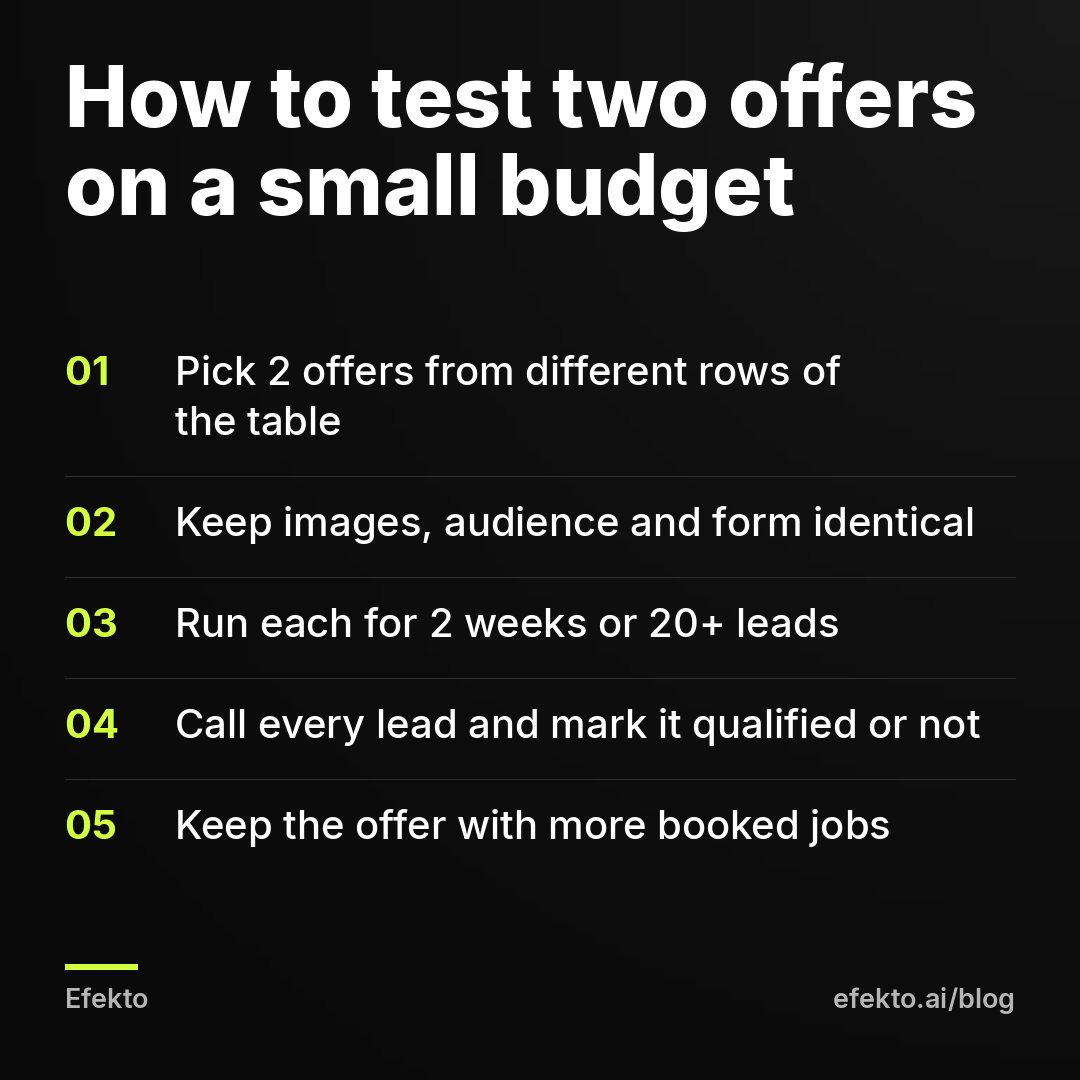
Test two offers at a time, change nothing but the offer, and compare them on verified leads and booked jobs after you have enough data. If the images, audience and form change too, you won't know which change moved the result.
Here is a worked example. For example, say an HVAC company spends $30 per day, $900 over 30 days, on each of three offers. All numbers below are illustrative, not results from any account.
| Example: $900 per offer | Free estimate on new system | $79 tune-up | 25% off first service |
|---|---|---|---|
| Leads (form fills) | 30 | 50 | 75 |
| Cost per lead shown by Facebook | $30 | $18 | $12 |
| Qualified after a phone call | 9 (30%) | 35 (70%) | 19 (25%) |
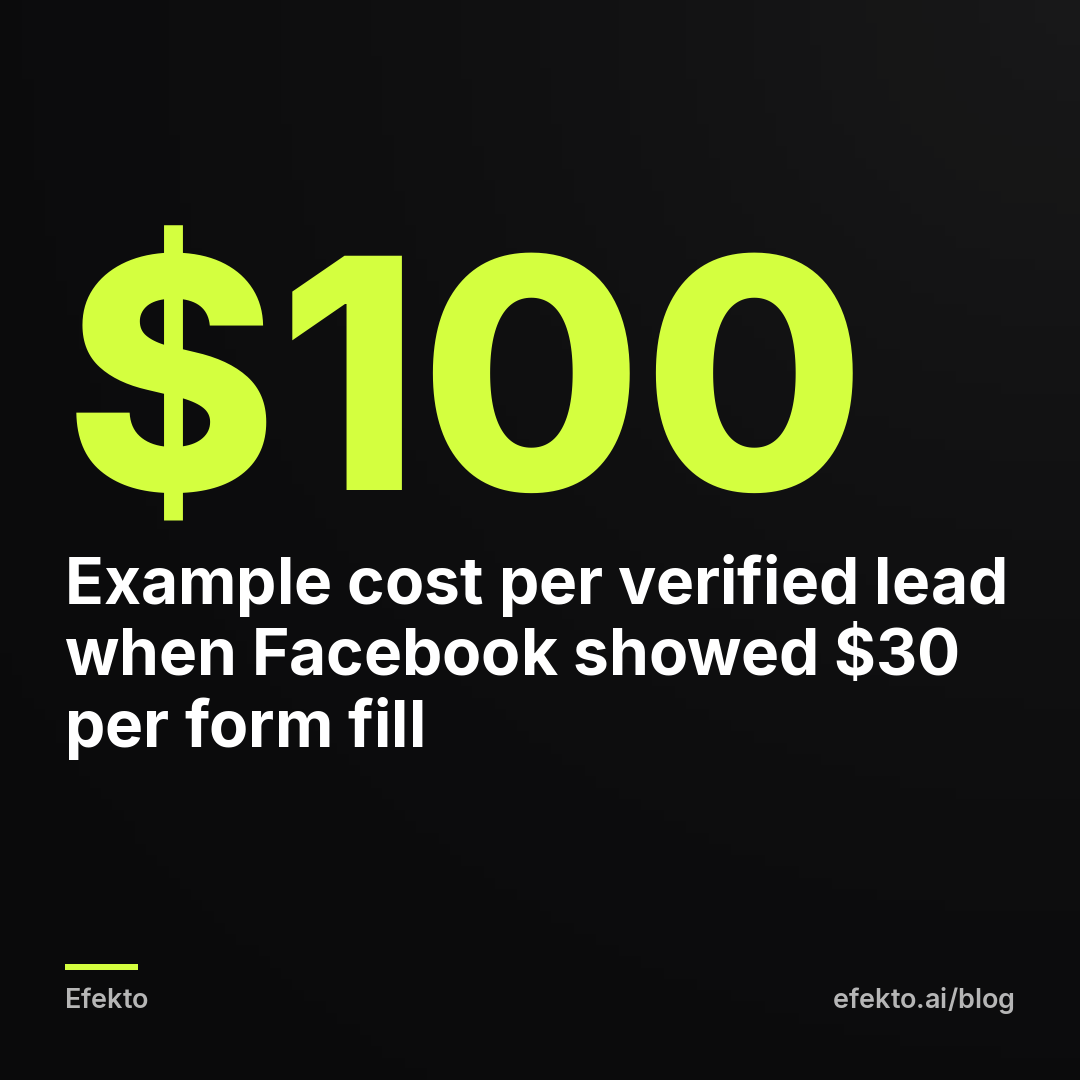
| Cost per verified lead | $100 | $26 | $47 |
| Booked jobs | 2 replacements | 25 tune-ups | 10 small repairs |
In this example, the discount looks like the winner in Ads Manager at $12 per lead. After calling everyone, it costs $47 per real prospect. The free estimate went from $30 to $100. The cost per lead Facebook shows you counts form submissions before anyone has checked if the person exists, owns a home or lives in your area. Your real cost is always higher. How much higher depends on the offer. We cover this gap in more detail in our post on what counts as a good cost per lead on Facebook.
The tune-up wins on volume of real customers. Two replacements from the free estimate offer could still bring more revenue. That's why the last row matters more than any cost figure. Track booked jobs and revenue per offer in a spreadsheet, even a simple one.
Three mistakes we see most in offer tests:
- Calling it after 3 days. Facebook spends the first days learning who to show the ad to. Give each offer about 2 weeks or at least 20 leads.
- Slow follow-up. A lead called back the next morning books far less often than one called within minutes. A slow phone makes every offer look bad. Our guide on following up on Facebook leads fast enough to book the job covers the setup.
- Changing the offer and the images at once. Then you are testing two things and learning neither.
If you don't want to run this test by hand in Ads Manager, this is the work our app does. Efekto creates ads from your website, publishes them, and optimizes them every day: it turns off the ones that don't bring results and scales the ones that do. You approve the first batch, at least 5 ads, before anything goes live. The minimum budget is $15 per day. The choice of offer is still yours. Put it on your website and in the brief, and the app tests the ads built around it. The details are on how Efekto works.
A disclosure: we earn money when businesses run ads on Facebook, through Efekto and through Lemon Agency, which has run campaigns for more than 300 clients. Keep that in mind when we tell you to keep testing.
Which offer should you start with, and when will no offer help?
Start with the offer that cuts the customer's risk, not your price. If we were starting a home service account tomorrow, this is what we would run first:
- HVAC: paid tune-up, with a scheduling guarantee as the second test.
- Roofing: inspection with a photo report, financing as the second line for replacements.
- Plumbing, garage doors, electricians: scheduling guarantee.
- Lawn, gutters, pressure washing: seasonal package, launched 2-3 weeks before the season.
- Cleaning and pest control: first-visit price tied to a recurring plan.
- Remodeling, painting, fencing: free estimate with a concrete extra, like written within 48 hours or quoted from photos.
- Everyone with past customers: a referral ad shown only to the customer list, running alongside.
No offer will help in some situations, and we would rather say that now than after you spend a month's budget:
- You can't take more work. If the schedule is full for 3 weeks, ads create leads that go cold. Hire or raise prices first.
- Nobody answers the phone. If calls go to voicemail during jobs, fix that before spending a dollar on ads.
- Your reviews are thin or bad. People check Google before booking. An offer gets them to click, and 11 reviews at 3.6 stars stops them there.
- Your service area is a few small towns. A tiny audience sees the same ad over and over, and results drop within weeks. Referrals and local search may do more for you.
- You can't spend at least $15 to $20 per day. Below that, a test takes months to tell you anything.
The free estimate and the percentage discount are the two most common offers in home service ads, and in most accounts they are the two weakest. We stopped leading with either. A business that charges $79 for a real inspection, promises a time and keeps it, or sells the season before it starts gives people a better reason to book than another competitor saying free estimates. Pick two offers from the table, run them for two weeks each, call every lead, and count booked jobs.
FAQ
Should I put prices in my Facebook ads for home services?
Put a price on the first step, like a $79 tune-up or a $99 inspection, but not on the main job. A visible price on a small service filters out people who won't pay anything and builds trust. A price on a full replacement invites comparison before you've seen the job.
How long should I run one offer before changing it?
Run each offer for about 2 weeks or until it has at least 20 leads, whichever comes later. After that, change the images before you change the offer. Results often drop because people have seen the same ad too many times, not because the offer stopped working.
Can I run the same offer all year?
Scheduling guarantees, referral offers and inspections can run all year. Seasonal packages can't, by definition. Rotate them by season and keep one always-on offer underneath, so the account never goes dark between seasons.
Do discount ads hurt a home service brand?
Constant discounts teach customers to wait for the next deal and make past customers feel they overpaid. One discount tied to a recurring plan does little damage. A permanent 20% off banner does real damage. If you want a deal, add value, like a free filter or a photo report, instead of cutting the price.
If you want to test these offers without building every ad yourself, you can start with Efekto.
- Jakub Zwoliński
Founder, Lemon Agency · Efekto · October 25, 2026