Facebook Ads for Solar Installers: Getting Qualified Homeowners, Not 'Free Solar' Clickers
How solar installers can get qualified homeowners from Facebook ads: qualifying form questions, honest offers that pass Meta review, real cost per lead from our accounts, and a worked budget example.

Solar installers get qualified homeowners from Facebook by filtering people out before they leave a phone number. Ask about home ownership, the monthly electric bill and the roof in the lead form, say plainly how the system is paid for, and drop every "free panels" or "government program" angle. Those angles fill the form with renters and curious clickers, and your sales team pays for each one in wasted calls.
1. Decide who you can't help, because Meta won't filter homeowners for you
Before you spend a dollar, write down who your ads should turn away. Meta's targeting has no dependable "owns a house with a good roof" switch, so your copy and your form have to do that filtering.
- Location: list the zip codes you actually install in, not a 50-mile circle around your shop. If a utility in part of your area makes interconnection slow or net metering unattractive, leave those zips out.
- First line of the ad: name who it's for. "For homeowners in Maricopa County with an electric bill over $150 a month" removes renters and low-bill households before anyone clicks.
- Exclusions in writing: keep a one-line list for your team covering renters, mobile homes if you don't do them, roofs you won't touch, and areas outside your permits. Every ad and form question should reflect it.
Every residential installer needs this step, and it takes about 20 minutes. The exception is a company that only sells commercial or ground-mount systems to farms and businesses. A homeowner campaign is the wrong tool for that buyer, and direct outreach plus referrals from electricians usually work better.
2. Advertise a real offer, not "free solar"
The promise in your ad has to match what happens at the kitchen table.
"Free solar" is not a product. Under a lease or a PPA, the homeowner pays monthly for the system or the power. Under a loan, they pay the loan. With cash, they pay up front. Ads that say "free panels," "the government pays for your system" or "new no-cost program for homeowners" are bait. People who click expecting free equipment are angry on the first call, and your closer spends 15 minutes undoing the ad. Meta's advertising standards prohibit deceptive and misleading claims, these ads get rejected, and a string of rejections can hurt your ad account. Some lead sellers run exactly this style because it produces cheap form fills. Cheap form fills are not customers.
What to advertise instead:
- A bill review with a savings estimate: "Send us your last bill, we'll show what a system would cover and what it would cost."
- A satellite roof check: "We'll check your roof's direction and shade before anyone visits."
- A real price range: "Most systems we install in [area] run $X to $Y before incentives." A number scares off clickers and attracts people who are already budgeting.
- "$0 down" only if it is true, and only with the word "loan" or "lease" next to it.
Incentives: don't put a tax credit percentage or a rebate amount in an ad unless you can name the program and the date you checked it, and link the official source on your landing page. Incentive rules change, and an ad that was accurate last year can be false today.
Financing ads: if your ad promotes a loan or financing offer, Meta may require a special ad category for financial products, which limits targeting by age and location. We explain how that works in our post on which local businesses need a special ad category on Facebook.
There is no version of this step to skip. If your sales model only works with the "no cost" pitch, Meta will keep rejecting the ads, and your close rate will expose the pitch anyway.
3. Put the qualifying questions in the lead form
A Meta instant form should ask the three things that decide a solar sale (ownership, bill, roof) plus timing, so your team sees them before the first call.
Use multiple-choice answers wherever you can, because typed answers get skipped or filled with junk. Choose the "Higher intent" form type, which adds a review screen before submission. You will get fewer leads, and more of them will be real.
| Question | Answer options | What a "no" tells you |
|---|---|---|
| Do you own the home you live in? | Yes / No, I rent / Buying a home soon | Renters can't sign. Thank them, don't call. |
| Average monthly electric bill? | Under $100 / $100-200 / $200-300 / Over $300 | Under $100 rarely pays back quickly. Lower priority. |
| What is your roof made of? | Asphalt shingle / Tile / Metal / Flat / Not sure | Flags roof types you don't install on |
| How old is the roof? | Under 10 years / 10-20 years / Over 20 years / Not sure | Over 20 years often means a reroof conversation first |
| How much shade hits the roof? | Mostly sunny / Some trees / Heavy shade | Heavy shade usually means a polite no |
| When are you looking to decide? | Within 3 months / 3-12 months / Just researching | Sets call order, not a reason to reject |
Add the zip code as a typed field. It costs a few seconds and catches people outside your area.
On the thank-you screen, state the rules plainly: "We install only on owned homes in [area]. If that's you, expect a call within the hour." Renters who read that rarely complain when nobody calls.
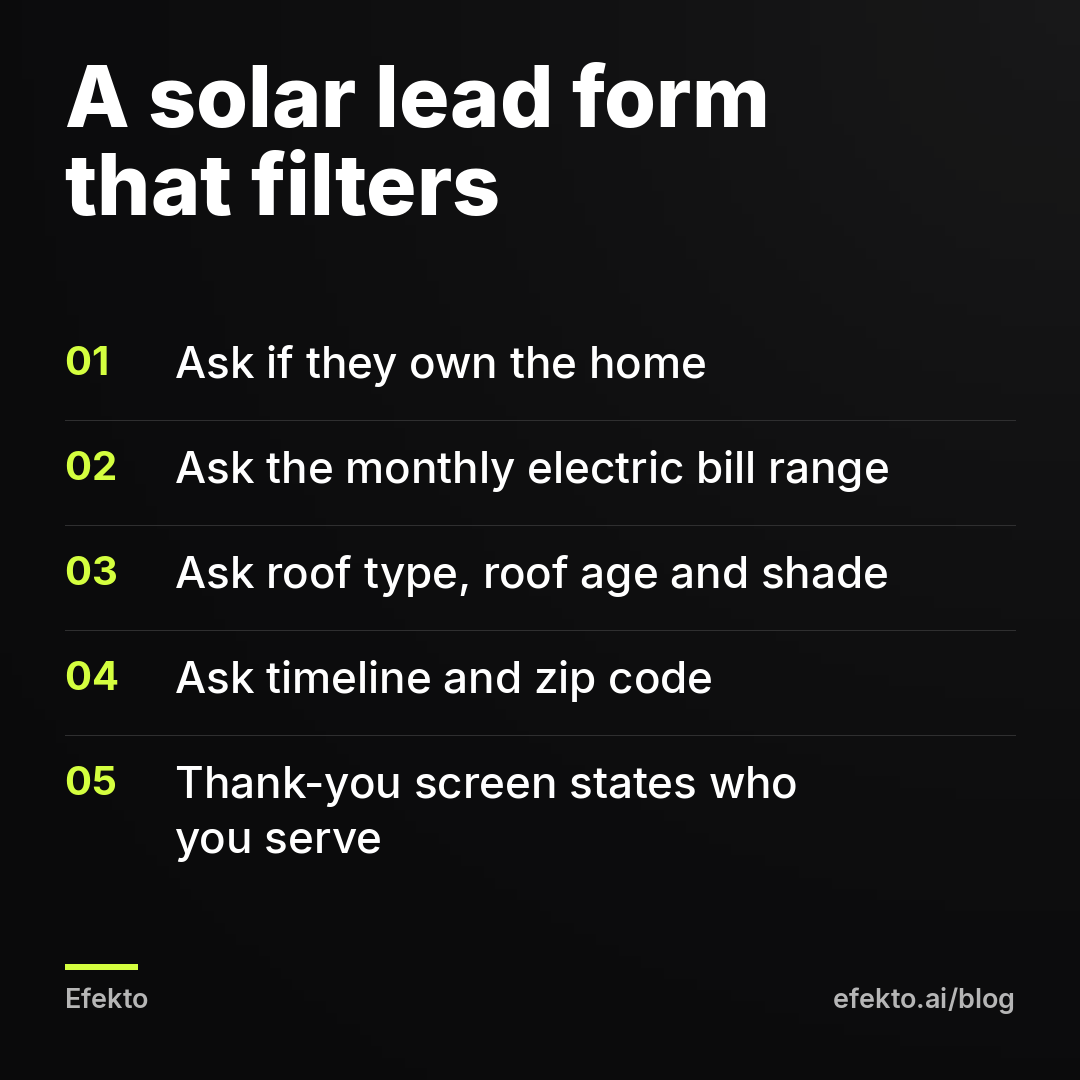
The full six-question form pays off in any area that produces more than about one lead a day. In a small rural market where leads already trickle in, it can cut volume too far. There, keep ownership, bill and zip in the form and ask about the roof on the phone.
4. Judge the cost per lead your sales team accepts, not the one Meta shows
The cost per lead in Ads Manager is the cost of a filled-in form before anyone has checked it. What you pay per lead that turns out real is higher, and that is the number worth managing.
We make money from ads on Meta, and Lemon Agency has managed over $1M in ad spend for clients, so we are not neutral about the platform. That is also why we don't trust the dashboard number alone.
From our accounts: Over the 30 days to Nov 8, 2026, Meta lead form campaigns for solar panels in the US on the accounts we run spent about $804 and collected 42 leads, an average of about $19.15 per lead. Over the same 30 days, the same type of campaign for solar panels in Poland spent about $1,167 and collected 84 leads, an average of about $13.89 per lead. Both are the Meta number, counted before anyone picked up the phone.
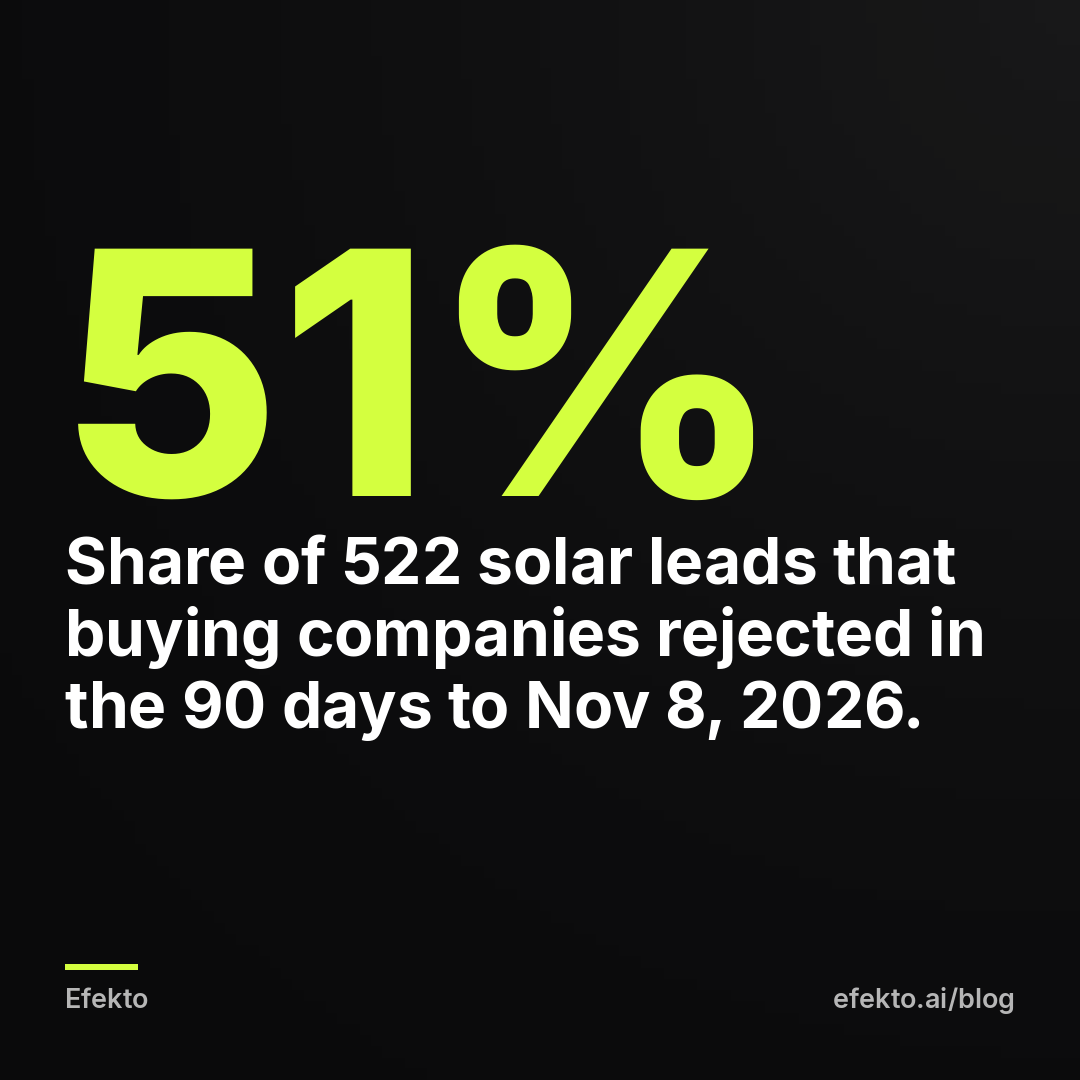
From our accounts: Of 522 solar panels leads that buying companies marked with a status in the 90 days to Nov 8, 2026, 32% were marked "in contact", 9% meeting booked or sale, 9% "no answer" and 51% rejected.
That 51% is the honest picture of solar lead generation: roughly half of what a form produces gets rejected by the people selling the systems. To show the effect, here is an example only, combining the two datasets as if they described the same leads. If you paid $19.15 per form lead and 51% were rejected, each lead that survives costs about $39. If 9% reach a meeting or a sale, the ad cost per meeting or sale is about $213. These are illustrations, not our results, but the mechanism holds: your real cost can sit several times above the dashboard figure, and how far above depends on how well the ad and form filter.
If Ads Manager looks fine and revenue doesn't move, this gap is usually the reason. We go deeper in why Ads Manager shows leads but your revenue doesn't grow.
One limit: below 20 leads a month, rejection percentages swing too much from week to week to mean anything. Track rejection reasons (section 5) until the volume builds.
5. Call within minutes and log every status with a reason
A simple follow-up routine plus a status for every lead tells you which ads produce homeowners and which produce noise. In our status data, 9% of leads were "no answer". Some of that is fake numbers. A good part is slow follow-up.
The routine we would use:
- Call within 5 minutes during business hours. A person who filled in a form at 7:40 pm gets a text right away and a call the next morning before 9.
- No answer: send a text immediately with your name, company and "you asked about solar for [address/zip]."
- Make three call attempts in 48 hours, then one final text. After that, mark "no answer" and stop.
- Give every lead one status: new, in contact, appointment, sold, rejected.
- Give every rejection a reason: renter, bill too low, roof, shade, outside area, fake number, "thought it was free".
The last reason matters most. If "thought it was free" shows up more than once or twice a week, one of your ads is promising something you don't sell. Find it and turn it off.
If nobody can call new leads the same day, cut the budget until someone can. A lead that waits three days costs exactly as much as one called in 5 minutes and closes far worse.
6. Use creative that shows the work and the math
Images and video should look like your company, on roofs in your area, with numbers people can check.
What tends to attract homeowners:
- Photos of your crew on real roofs in your service area, with a recognizable local detail.
- A finished install shot from the street, the way neighbors see it.
- A blurred-out real electric bill next to a production screen from a monitoring app (with the customer's permission).
- A 20-30 second phone video of a site assessment: "Here's what we check before we quote."
- Headlines with a number: "Electric bill over $200? See what a system would cover."
What attracts clickers: stock photos of smiling families with "$0" in huge type, fake news-style layouts, politicians' names, "limited spots in your area" countdowns. They get clicks because they look like a giveaway.
No install photos yet? Don't borrow renders of someone else's house. Show your team, your trucks and your office, and give your install count only if the number is real.
7. Plan the budget around electric bills and the install calendar
Solar interest follows pain: people look for answers in the month their bill jumps. Time spend to that, and to when your crews can actually install. We would plan it like this:
- Hot climates: raise the budget 2-3 weeks before the first big cooling bill lands, usually late spring.
- Homes with electric heat: the winter bills do the same job.
- Utility rate increases: when your utility announces a rate change, run ads that mention it with the source and the date.
- Install capacity: leads you get in March become installs in May or June. If your crews are booked four months out, more leads now mostly mean longer waits and cancellations.
In slow months, keep a smaller budget running rather than switching campaigns off. A restart means days of the campaign relearning while no leads come in.
The one time to stop pushing for leads is when your backlog is already longer than homeowners will wait. Put that money into keeping current customers happy and asking them for referrals.
8. Worked example: from daily budget to signed contracts
This is an example with made-up round numbers, not a result from our accounts. It compares a filtered campaign with a "free solar" one on the same budget.
| Step | Filtered ad + qualifying form | "Free solar" ad + short form |
|---|---|---|
| Daily budget | $40 | $40 |
| Spend over 30 days | $1,200 | $1,200 |
| Cost per form lead (Meta) | $20 | $8 |
| Leads | 60 | 150 |
| Pass qualification | 50% = 30 | 15% = 22 |
| Become consultations | 30% = 9 | 20% = 4 |
| Signed (1 in 4) | about 2 | 1 |
| Ad cost per signed contract | $600 | $1,200 |
| Calls your team makes | 60 | 150 |
The "free solar" campaign looks two and a half times cheaper in Ads Manager and ends up twice as expensive per contract, with 90 extra calls. Say your average residential contract is $25,000. In the filtered version, the ad cost is about 2.4% of the sale, a number most installers can live with.
This math only works with your own close rate. If you don't know it, run 30 days with the statuses from section 5 and replace our numbers with yours.
9. When Facebook ads, or Efekto, are not the right fit
Skip Facebook, or wait, if any of these is true: you only sell commercial systems; nobody can call leads within the hour; your service area is so small that the same few thousand people would see the ads every week; your offer only works when described as "free"; or you can't spend at least $15 a day for a month. Referrals from past customers, partnerships with roofers and electricians, and a well-kept Google Business Profile will do more for you in those cases.
If you would rather not build and watch campaigns yourself, Efekto creates ads from your website, publishes them, and optimizes them every day: it turns off the ones that don't bring results and scales the ones that do. You approve the first batch (at least 5 ads) before anything goes live, the minimum budget is $15 a day, no card is needed at sign-up, the 7-day free trial starts when your first campaign launches, and the Starter plan is $149 a month. One warning: because the ads come from your website, a site that says "free solar" will produce ads with the same problem, so fix the site first. You can see the whole flow on how Efekto works.
Our stance is simple. We would rather send an installer 40 homeowners who own their roof and know there is a price than 150 people who think the government is handing out panels, and that's how we set up solar campaigns.
Summary
| Step | What to do | Skip or scale back when |
|---|---|---|
| 1. Define who you can't help | Real zip codes, "for homeowners with a bill over $X" in the first line | You only sell commercial systems |
| 2. Honest offer | Bill review, roof check, price range, financing named as a loan or lease | Your pitch depends on "no cost" |
| 3. Qualifying form | Ownership, bill, roof type and age, shade, timeline, zip; Higher intent form | Rural area with very low volume: keep 3 questions |
| 4. Real cost per lead | Track accepted leads, not form fills | Under 20 leads a month: track reasons instead |
| 5. Fast follow-up | Call in 5 minutes, 3 attempts in 48 hours, status and reason for every lead | Nobody can call the same day |
| 6. Creative | Your crew, your roofs, numbers people can check | No install photos yet: show team and trucks |
| 7. Seasonality | Raise budget 2-3 weeks before high-bill months | Backlog longer than homeowners will wait |
| 8. Budget math | Daily budget to leads to contracts, with your close rate | Close rate unknown: run 30 days first |
FAQ
How much does a solar lead cost on Facebook?
On the US solar accounts we run, Meta lead form campaigns averaged about $19.15 per lead over the 30 days to Nov 8, 2026. That is the cost of a filled-in form before anyone checks it. Once you remove renters, bad roofs and fake numbers, the cost per usable lead is usually two or more times higher.
Can I say "$0 down" in a solar ad?
Only if you actually offer it, and only when the ad says what it is: a loan, a lease or a PPA. If the ad promotes financing, check whether Meta requires a special ad category for it. "$0 down" next to a picture of free panels is the kind of claim that gets rejected and brings in the wrong people.
Should I buy shared solar leads instead of running my own ads?
Shared leads are often sold to more than one installer, so you compete on speed and price from the first call. Before buying, ask the vendor how many companies receive each lead and what their ads say. Your own ads take more effort, but every lead has seen your name and your offer.
Is an instant form better than a landing page for solar?
For most local installers, a Higher intent instant form with qualifying questions is the faster start, because people never leave Facebook. A landing page with a bill upload filters harder but gets fewer leads. Start with the form and test a landing page once you have 30 days of statuses to compare against.
If you want ads for your solar company created, published and optimized every day without learning Ads Manager, you can start a free trial at efekto.ai.
- Jakub Zwoliński
Founder, Lemon Agency · Efekto · November 16, 2026