What Is a Special Ad Category on Facebook, and Which Local Businesses Need One?
A Special Ad Category is a label Meta requires for housing, employment, financial and political ads. It limits targeting. Here is when realtors, solar companies and remodelers need one.

A Special Ad Category is a label you must declare on a Facebook or Instagram campaign when the ad is about housing, employment, financial products and services (Meta's broader name for what used to be the credit category), or social issues, elections or politics. For the first three, Meta then limits who you can target: you can't choose age, gender or ZIP codes, and you can't use lookalike audiences. The category depends on what the ad promotes, not on your industry. A remodeler normally doesn't need one. The same remodeler advertising monthly payment plans does.
In short:
- The ad's content decides the category, so one business can run some campaigns with a category and some without.
- Housing, employment and financial categories lock age and gender, block ZIP code targeting and lookalikes, and in the US require a location radius of at least 15 miles.
- If an ad mentions financing, a job opening or a home for sale or rent, declare the category before Meta rejects the ad for you.
What are the Special Ad Categories on Facebook right now?
There are four, and you pick them in the campaign settings in Ads Manager:
- Housing: home listings, rentals, homeowners insurance, mortgages, home appraisals and similar housing opportunities.
- Employment: job openings, recruiting, internships, job fairs and hiring ads of any kind.
- Financial products and services: credit cards, loans, financing, payment plans, and in Meta's expanded definition also products like insurance and investments.
- Social issues, elections or politics: ads about candidates, ballot measures or hot-button social topics. This one works differently. It requires identity authorization and a "Paid for by" disclaimer, and it doesn't impose the targeting limits of the other three.
Meta introduced the first three after a 2019 settlement with civil rights groups, including the National Fair Housing Alliance and the ACLU, that challenged discriminatory targeting. In 2022 the US Department of Justice announced a further settlement under the Fair Housing Act. According to that announcement, Meta agreed to retire its Special Ad Audience tool and build a system that balances who actually sees housing ads. Meta updates these rules regularly. Before you launch, read the current "About Special Ad Categories" article in Meta's Business Help Center. What follows is how the rules work in practice. It isn't legal advice.
A note on where we stand: we make money running ads on Meta, with over 300 clients served at Lemon Agency. We have no reason to make these limits sound worse than they are. We also think they're fair.
What does a Special Ad Category restrict in targeting?
It takes away almost every way of narrowing an audience by who people are. You keep targeting by place, with a coarser resolution. These are the US rules for housing, employment and financial campaigns as Meta describes them today:
| Setting | Regular campaign | Housing, employment, financial (US) |
|---|---|---|
| Age | Any range | Fixed at 18 to 65+ |
| Gender | Men, women or all | All only |
| Location | ZIP codes, small radius | Cities, counties, states; radius of at least 15 miles; no ZIP codes |
| Detailed targeting | Full list | Reduced list, no exclusions |
| Lookalike audiences | Available | Not available |
| Custom audiences (your customer list, site visitors) | Available | Allowed with limits; check Ads Manager |
For a local service business, the 15-mile radius is the change that hurts most. Here is the math as an example. Say a remodeler only takes jobs within 10 miles of the shop. A 15-mile circle covers 2.25 times the area of a 10-mile circle (15 x 15 vs 10 x 10). If people were spread evenly, roughly 55% of the area you pay to reach would sit outside your service zone. Real populations cluster in towns, so your actual share will differ. The direction won't. You'll get leads you can't serve, and you have to filter them somewhere other than targeting. We explain the theory behind the lost tool in what a lookalike audience is and whether it still works locally.
Do real estate agents have to use the housing category?
Yes, for practically every ad they run. Listings, open houses, "homes in your area" and rentals are housing. Seller-side ads such as "find out what your home is worth" are about real estate transactions too, and we'd put them in housing without debating it. The same goes for property managers, mortgage brokers and homeowners insurance agents. Mortgage and insurance ads can also count as financial products, so select every category that fits.
The practical result: an agent can't target "women 30 to 45 who recently got engaged in ZIP 78704". You can target a city or a 15-mile radius and let the ad's wording do the selecting. Name the neighborhood and the price range in the ad itself. Buyers who aren't interested will scroll past.
Does a solar company need a Special Ad Category for financing ads?
Only for the ads that promote financing. "$0 down," "pay less per month than your electric bill," "low monthly payments," a loan partner or a lease are all financial products and services. An ad about panels, savings on bills or a free roof assessment, with no financing message, normally needs no category.
That's why we'd split solar into two campaigns rather than putting the whole account in a restricted category:
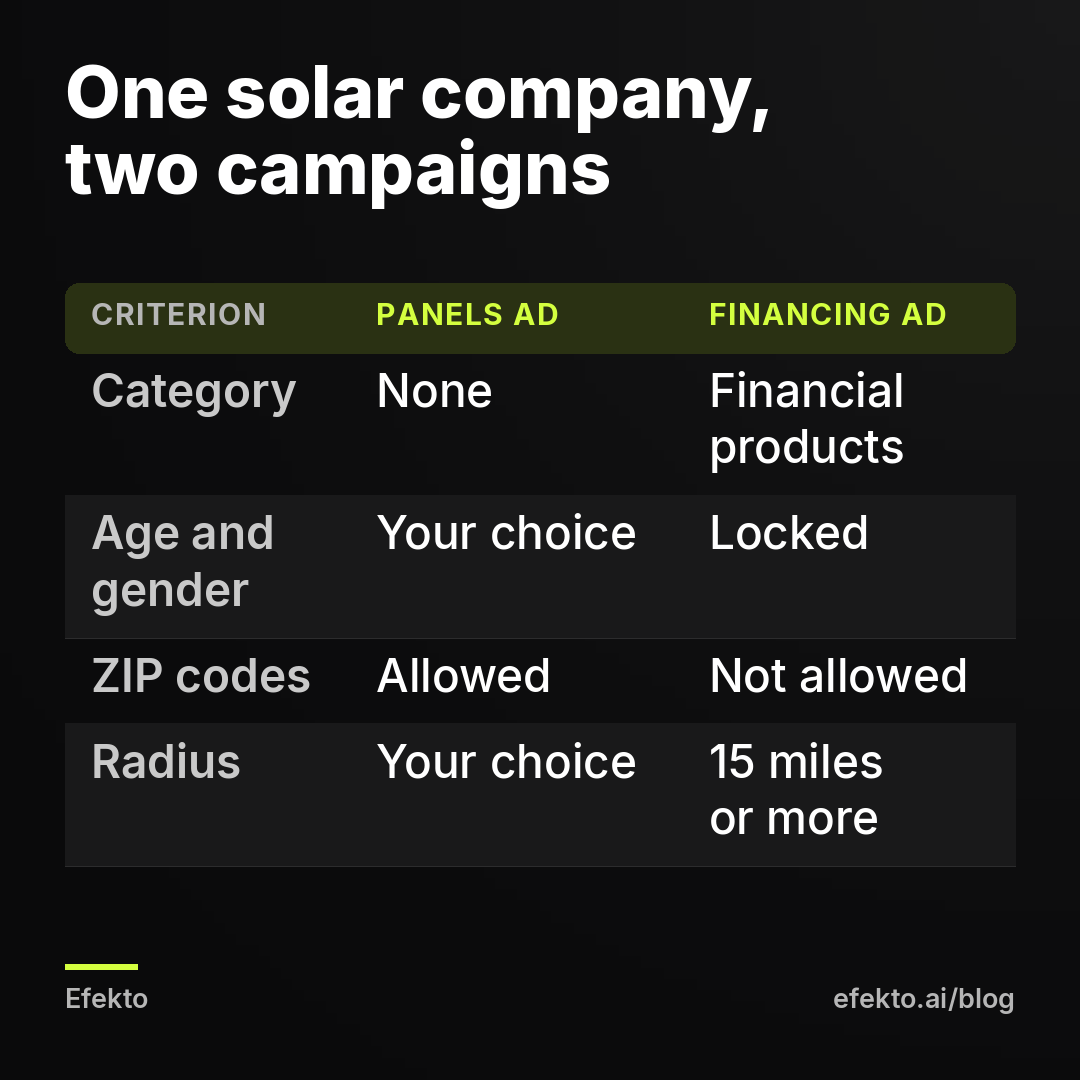
For example: a company spends $40 a day, $20 on each campaign. The panels campaign targets the ZIP codes where it installs. The financing campaign runs on a 15-mile radius with a lead form question that filters out addresses outside the service area. After a month, compare the cost per qualified lead of the two campaigns, not the cost per form. Then move budget to whichever produces more booked site visits.
One thing we'd never do is strip the word "financing" from an ad that is clearly about financing, just to keep ZIP targeting. Meta reviews the ad and the page it sends people to. If the reviewer sees a loan offer, the ad gets rejected. Repeated rejections can lead to account restrictions, which cost far more than a wider radius does.
Do remodelers and contractors offering payment plans need one?
They need one when the payment plan is in the ad. "Kitchen remodels from $199 a month," "0% APR for 18 months," or "financing available, apply in 60 seconds" all promote a financial product. "Kitchen remodel, free design consultation" doesn't.
The same rule reaches beyond construction:
| Business | Ad that needs a category | Ad that normally doesn't |
|---|---|---|
| Remodeler, roofer, HVAC | "New AC for $89 a month, approved in minutes" | "AC tune-up this week, book online" |
| Solar installer | "$0 down solar with our financing partner" | "See how much your roof could save" |
| Dental practice, med spa | "Implants with monthly payment plans" | "New patient exam and cleaning" |
| Real estate agent | Nearly every ad (housing) | Rare; brand content with no property or transaction |
| Any business hiring | "We're hiring HVAC techs, $28 an hour" (employment) | Ads selling your service |
The amounts in the table are sample ad copy, not market rates.
What about ads hiring people for your crew?
Every hiring ad goes in the employment category, even when the business behind it is a car detailer or a roofing company that has nothing else to do with jobs. If you need two technicians before summer, the recruiting ad runs as a separate employment campaign and the customer ads stay where they are. You can't target "men 22 to 35 who like trucks". Write the requirements into the ad instead: license, shift, pay, location. People who don't fit will select themselves out.
What changes in your follow-up when you can't narrow the audience?
The filtering moves from targeting to the form and the phone. When Meta decides who sees the ad, more of the people who fill in the form will be outside your area, renters asking about a roof, or curious rather than ready. We'd add one or two qualifying questions to the lead form, such as ZIP code, own or rent, and project timeline. Then we'd call fast, because a lead that turns out to be a fit goes cold just like any other.
From our accounts: of 3,184 Meta lead form leads collected in the 90 days to Oct 25, 2026 on the accounts we run, the most came in on Sunday (19.1%) and the fewest on Monday (12.8%). Saturday and Sunday together brought 32% of all leads. Those numbers come from all our campaigns, not only restricted ones. The lesson carries over directly, though. If nobody checks forms on weekends, close to a third of your leads wait until Monday. With a 15-mile radius sending you some leads you can't serve, you also need a quick way to sort them. Our guide on following up on Facebook leads fast enough to book the job covers the setup.
How do you set up a Special Ad Category campaign step by step?
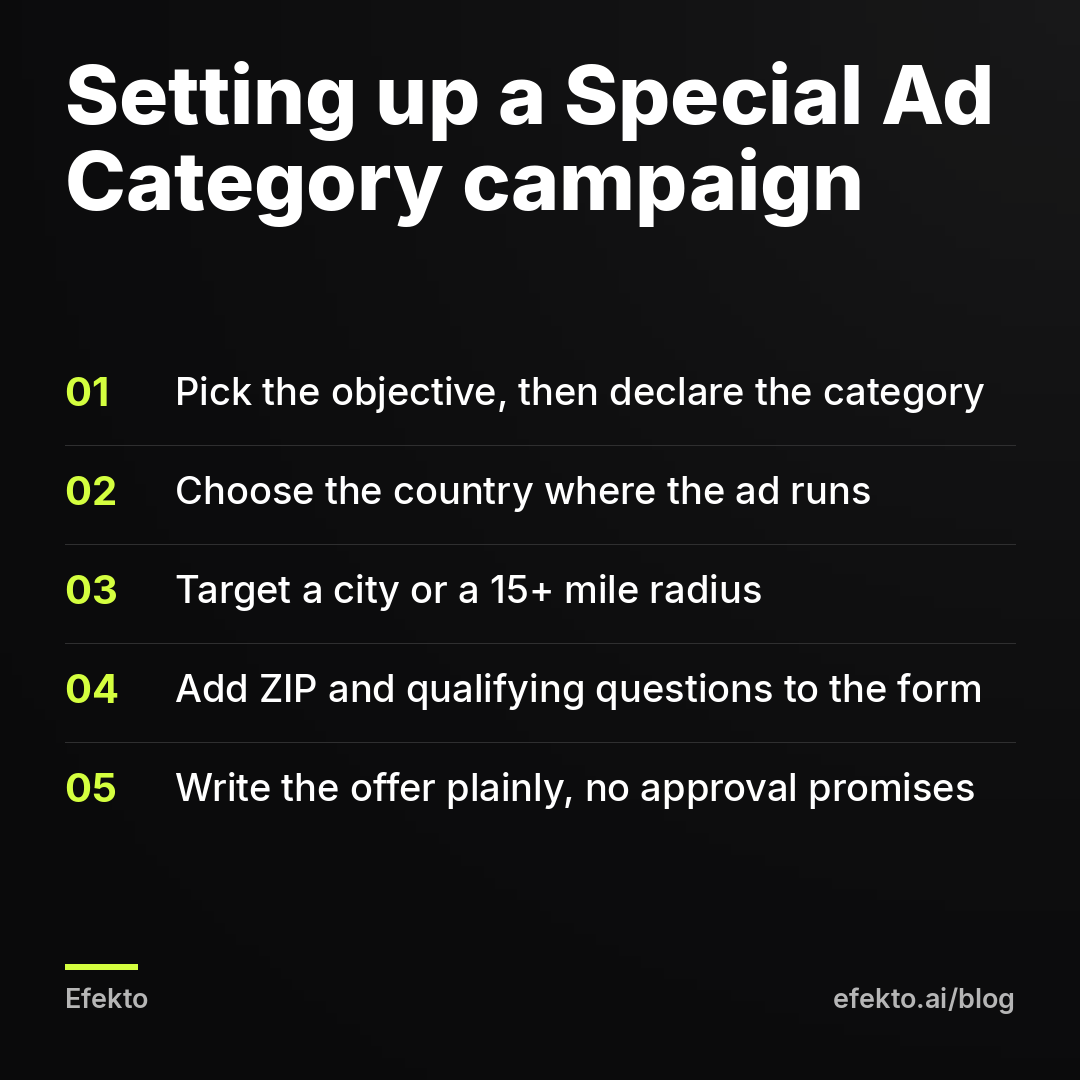
Declare the category when you create the campaign, before you build the ad set:
- In Ads Manager, click Create and choose your objective (Leads for most service businesses).
- In the campaign settings, find Special Ad Categories, select every category that applies, and select the country where the ad will run.
- In the ad set, target a city, county or a radius of 15 miles or more. Age and gender will already be locked.
- In the lead form, add a ZIP code question and one qualifying question about project type, ownership or timeline.
- In the ad, state the offer plainly. If financing is the offer, say so and avoid promising approval.
If an existing campaign needs a category it doesn't have, we'd create a new campaign with the category set from the start. Editing a live campaign that Meta has already flagged tends to create more problems than it solves.
What happens if you skip the category when you need it?
Usually the ad gets rejected during review, and the rejection says it belongs in a Special Ad Category. Sometimes it runs for a while and gets caught later. Either way, the cost is days without leads and a campaign that has to learn again from zero. Repeated violations can restrict the whole ad account. Then even your ordinary service ads stop.
Meta's checkbox also isn't a legal shield. The Fair Housing Act, the Equal Credit Opportunity Act, employment law and state rules apply to your ad copy whatever you click in Ads Manager. If your financing or housing ads make specific claims about rates or eligibility, have someone who knows those laws read them. We don't give legal advice, and this post isn't legal advice.
When does a Special Ad Category not apply?
It doesn't apply to most of what local service businesses advertise. Detailing packages, roof inspections, AC tune-ups, cleanings, med spa treatments without a financing pitch and new patient offers all run as regular campaigns with full location and audience settings. Don't select a category "to be safe". You'd give up targeting for nothing.
If you'd rather not manage these settings yourself, Efekto creates ads from your website, publishes them, and optimizes them every day: it turns off the ones that don't bring results and scales the ones that do. It doesn't change Meta's rules. A financing or hiring ad belongs in its category no matter which tool runs it. How Efekto works shows the process: you approve at least 5 ads before the campaign starts, the minimum budget is $15 a day, and the Starter plan is $149 a month after 7 free days counted from your first campaign launch.
It doesn't fit everyone. Political or social issue ads need Meta's identity authorization, which you handle yourself. And if your entire marketing is housing ads on less than $15 a day, a simple self-run campaign in Ads Manager will do.
FAQ
Does a roofing company need a Special Ad Category?
Not for ordinary roofing ads such as inspections, storm damage checks or replacement quotes. It needs the financial products and services category for ads that promote financing or monthly payments, and the employment category for hiring ads.
Do Special Ad Category campaigns cost more?
Meta charges no extra fee. Your cost per form can go up or down, because the audience is broader. The number to watch is cost per lead that actually fits your service area, since a wider radius brings more leads you can't serve.
What if financing only appears on my landing page, not in the ad?
Meta reviews the destination as well as the ad. If financing is a main message on the page the ad sends people to, we'd select the category. Otherwise you can send the ad to a page without the financing pitch.
Is selecting the housing category enough to comply with fair housing law?
No. The category limits Meta's targeting tools, but your ad's wording and your business practices still have to comply with federal and state law on their own. For questions about specific claims, ask a lawyer.
If you want ads for your regular services running and optimized every day while you handle the leads, start at efekto.ai.
- Jakub Zwoliński
Founder, Lemon Agency · Efekto · October 28, 2026