How to Know When to Turn Off a Facebook Ad and When to Give It More Time
Turn-off rules for small budgets: how much each ad should spend and how many days to wait before you judge it, plus the early signals that matter.

Turn off a Facebook ad when it has spent about twice your target cost per lead and brought no lead, or three times your target and its leads cost more than 1.5x that target. Do the same if most of its leads turn out to be junk. Give it more time if it hasn't spent that much yet, hasn't run 7 full days, and its click-through rate and lead quality look healthy. On a small budget you hit the money threshold long after the calendar one, so the real decision is how many ads you can afford to test at once.
1. Set your target cost per lead before the ad goes live
Every turn-off decision compares an ad against one number: the most you can pay for a lead and still make money on the job. If you don't have that number, you will judge ads by mood, and mood switches off good ads on bad days.
This is how we'd work it out. For example, say your average job is $800 and you keep $300 of it after materials and labor. You're willing to spend up to $120 to win a customer. You close 1 in 3 real leads, so you can pay $40 per real lead. If about 70% of form submissions turn out to be real people who want a quote, the target you compare against the Ads Manager number is $28 ($40 x 0.7). The full method is in our guide on working out the most you can pay for a customer from Facebook ads.
From our accounts: we set a target cost per lead of about $16 for a financial services campaign in an industry where the real cost was $29-38. Every ad set looked like a loser and got switched off. Today we set the target from the industry's real cost, not from hopes. For you, this means a target below what your market actually costs will kill every ad you test, and you'll decide Facebook doesn't work when the real problem was the number you picked.
When it makes sense: always, before you spend the first dollar.
When it doesn't: in businesses where leads take months to close, like remodeling or solar, a target per lead alone will mislead you in the first weeks. Judge by booked estimates or site visits instead, and give it a longer window.
2. Decide how much each ad must spend before you judge it
An ad should spend at least twice your target cost per lead before you judge it on leads. With a $28 target that's $56 per ad. With a $40 target it's $80. Below that amount, one lead more or less swings the result so much that you're reading noise.
The problem on a small budget is that the money gets split between ads. Here is a worked example with an $80 threshold per ad:
| Daily budget (example) | Ads in the ad set | Spend per ad per day (if split evenly) | Days until each ad reaches $80 |
|---|---|---|---|
| $15 | 2 | $7.50 | 11 |
| $15 | 3 | $5.00 | 16 |
| $30 | 3 | $10.00 | 8 |
| $50 | 4 | $12.50 | 7 |
In practice Meta usually doesn't split evenly. It pushes most of the budget to one or two ads it likes early. That's fine, it just means the ads it starves never reach a fair test.
What we'd do at $15-30 a day: run 2-3 ads per ad set, not 8. Eight ads at $15 a day means each ad gets less than $2 a day, and you'll be judging ads that have spent $10 after a week.
When it makes sense: for any ad you're deciding to keep or kill based on leads.
When it doesn't: if Meta has spent $3 on an ad in a week, you can't judge it and you don't need to. Meta has already decided it prefers the other ads. Turn it off only if you want room for a new one.
3. Wait at least 7 full days, including a weekend
Never judge an ad before it has run a full week with a Saturday and Sunday in it. Lead volume changes a lot by day and by hour, and a Monday-to-Thursday reading leaves out a big share of the leads.
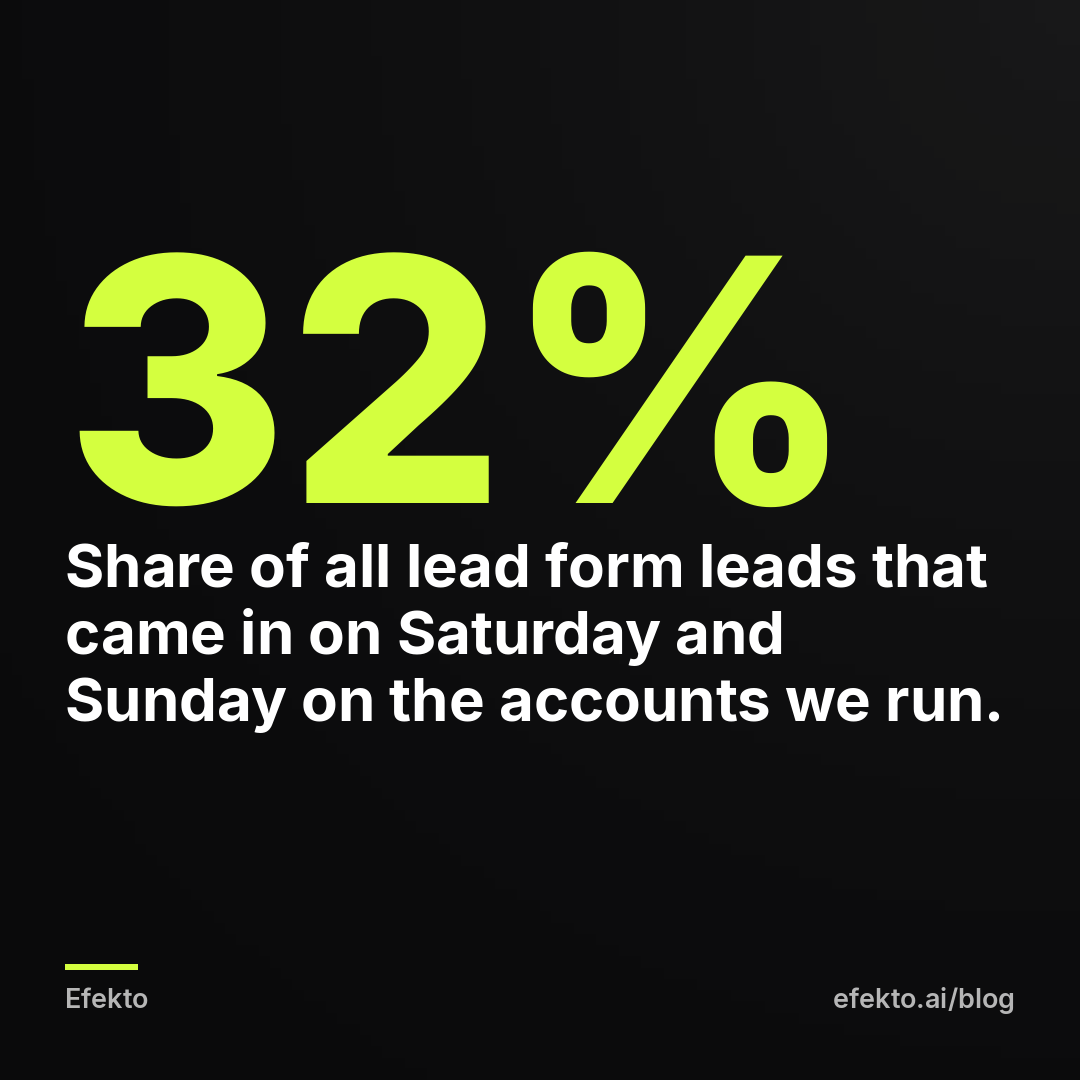
From our accounts: of 4,060 Meta lead form leads collected in the 90 days to Nov 15, 2026 on the accounts we run, the most came in on Sunday (18.8%), the fewest on Saturday (13.0%), and Saturday plus Sunday brought 32% of all leads. On Efekto users' accounts in Poland (21 brands, 550 leads in the 180 days to Nov 15, 2026), 37% of leads came in after 6 pm and only 28% on weekdays between 8 am and 4 pm. An ad you check on Friday afternoon and turn off has never had its best two days, and an ad you check at lunch hasn't had its best hours.
When it makes sense: for every ad you judge on lead count or cost per lead.
When it doesn't: the calendar never protects an ad that has already burned through the money threshold. If an ad has spent three times your target by day 4 with zero leads, you don't need the weekend to know.
4. Read the early signals in the first 72 hours: CTR and cost per click
Before an ad has enough spend to judge on leads, two numbers tell you whether people even stop for it. One is link click-through rate (the share of people who saw the ad and clicked through). The other is cost per link click. You can read both after about 1,000 impressions, which on a local budget often comes in a day or two.
The thresholds we'd use:
- Compare ads to each other, not to internet benchmarks. Your best ad in the same ad set is the yardstick, because it's shown to the same audience at the same price.
- Link CTR below half of your best ad's after 1,000 impressions: the hook isn't working. If it stays there after the ad has spent your target cost per lead once, turn it off.
- Cost per link click more than twice the cheapest ad in the ad set: same verdict, same timing.
- Link CTR under about 0.5% across every ad: the problem probably isn't one ad. Look at the offer and the targeting before you start killing ads one by one.
These signals only work in one direction. A bad CTR can justify turning an ad off early. A good CTR can't save an ad that doesn't bring leads. More on what the number does and doesn't tell you in our post on what CTR means for a local business.
When it makes sense: in the first 3 days, to catch ads nobody clicks before they eat the budget.
When it doesn't: if an ad has a high CTR and no leads, it's working and something after the click isn't. Check the form or the landing page before you blame the ad. Turning it off throws away your strongest hook.
5. Judge lead quality, not just the price Meta shows
The cost per lead in Ads Manager is the price of a form submission before anyone checked it. Your real cost per lead is higher, and the gap between the two numbers differs from ad to ad. An ad that looks cheapest in Ads Manager can be the most expensive one in reality.
For example: Ads Manager shows ad A at $25 per lead and ad B at $35. Ad A brought 10 leads and 4 were real people wanting a quote, so $250 / 4 = $62.50 per real lead. Ad B brought 8 leads and 6 were real, so $280 / 6 = $46.67 per real lead. Ad B is the one to keep, and the dashboard says the opposite.
How to do it without a CRM: call every lead within an hour and mark it in a simple sheet as real, wrong person or service, or unreachable after 3 attempts. Add a column for the ad name, which is in the lead form export.
Our threshold: after 10 leads from one ad, if fewer than 4 are real, turn it off, even if it's the cheapest ad in the account. Ads that attract the wrong crowd usually do it with the image or the promise. A huge discount or a free offer pulls in people who will never pay full price.
When it makes sense: once an ad has brought at least 10 leads.
When it doesn't: with 3 or 4 leads, one bad call decides everything. And if you call leads two days later, the low quality is partly yours. People who filled out a form on Sunday evening have hired someone else by Tuesday.
6. Apply the turn-off rules
We make money when businesses run ads on Meta, and the team behind Lemon Agency has managed $1M+ in ad spend for more than 300 clients. Even so, our advice is to turn off more ads than feels comfortable. One ad that eats half the budget for two weeks costs you more leads than any ad you cut too early.
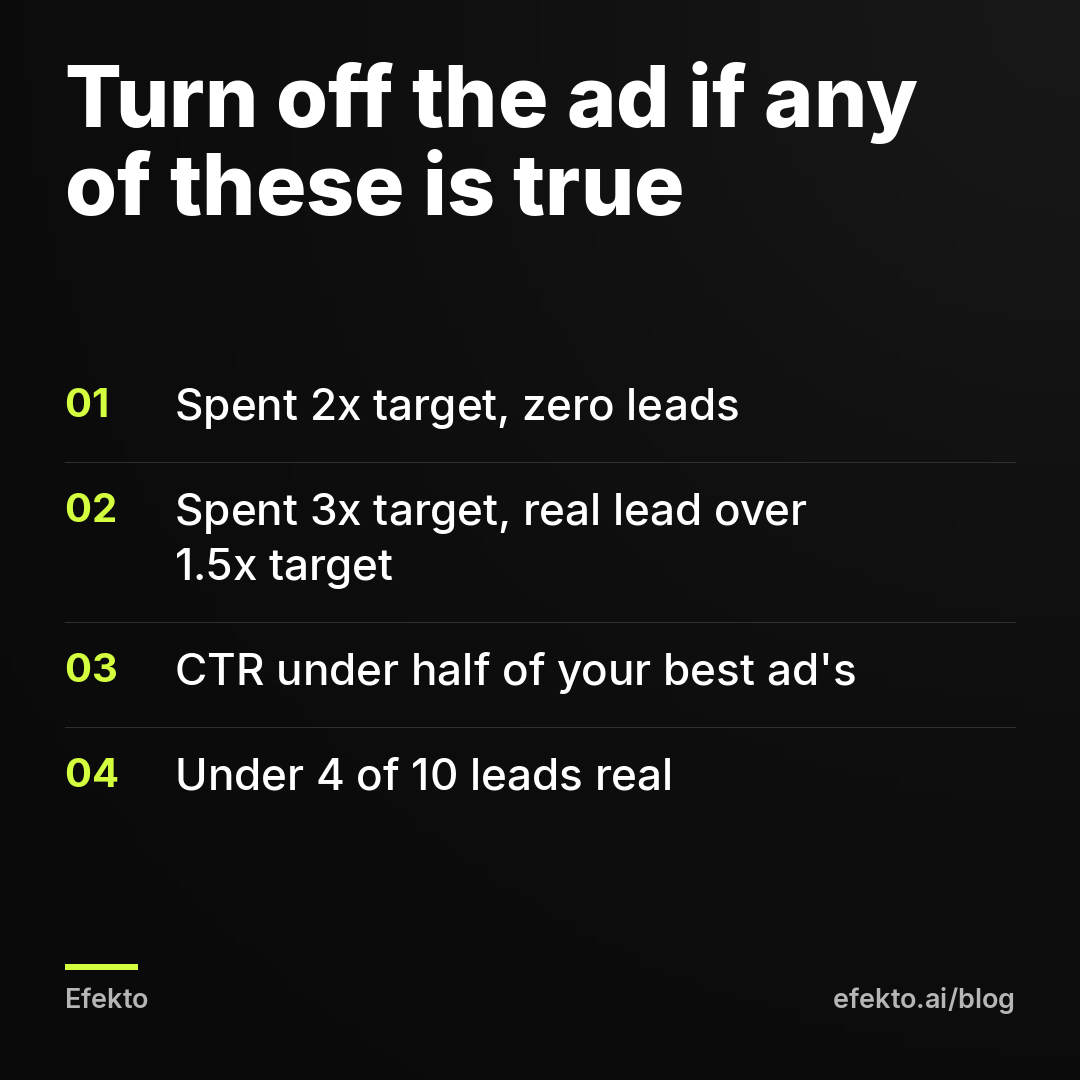
Turn the ad off if any one of these is true:
- It has spent 2x your target cost per lead and brought zero leads.
- It has spent 3x your target and its cost per real lead is above 1.5x the target.
- After 1,000+ impressions and spend equal to 1x your target, its link CTR is below half of your best ad's.
- After 10+ leads, fewer than 4 out of 10 are real.
When it makes sense: check these rules every day, but act on them only when an ad crosses a line, not because yesterday was quiet.
When it doesn't: don't turn off the only ad that brings leads, even if it's over target. Add a new ad next to it first. When the new one proves itself, then cut the old one. Turning off everything at once leaves you with no leads while the new ads find their feet.
7. Give it more time when these are true
Keep an ad running if it has spent under 2x your target, hasn't had 7 full days, and isn't failing on CTR. Do the same if it has brought a few leads that turned out real. Few leads with good quality is a reason to wait, not to cut.
Also give it time when the whole account drops at once. If every ad got worse on the same day, the cause is outside the ads: a holiday week, a competitor's promo, a payment problem that paused delivery. Killing ads then removes your winners for no reason.
What we'd do: write the decision date next to each new ad when you launch it. For example, a new ad on $15 a day with a $28 target gets judged once it has spent $56 or at day 14, whichever comes first.
When it makes sense: for ads that are still under the thresholds above.
When it doesn't: more time can't mean forever. If an ad sits just under the threshold for three weeks because Meta barely spends on it, it isn't being tested, it's taking up space. Turn it off.
8. Turn it off the right way
Turn off the ad, not the ad set, and don't edit a running ad to fix it. Editing a running ad often resets how Meta delivers it, and good ads can drop after a small change, which we cover in why Facebook ads stop working after you edit them. If you want to try a new headline, duplicate the ad, change the copy, and turn off the old one.
Pause instead of delete. You'll want the numbers later to see which hooks failed, so you don't test the same idea twice.
This post is about new ads that never worked. An ad that worked for a month and is now slipping is a different problem. That's ad fatigue, and the fix is fresh creative, not these thresholds. A learning phase warning on the ad set is also a separate issue and doesn't tell you which single ad to cut.
When it makes sense: whenever one ad in an ad set fails the rules and others don't.
When it doesn't: if every ad in the ad set fails, the ads are not the problem. Look at the offer, the audience, or the service area, then turn off the ad set and rebuild it.
Summary: what to check and when
| Signal | When you can read it | Turn off if | Give more time if |
|---|---|---|---|
| Spend vs target | Once the ad has spent 2x target | Zero leads at 2x target | Under 2x target spent |
| Days running | After 7 full days with a weekend | Never a reason on its own | Under 7 days and not failing other rules |
| Link CTR | After about 1,000 impressions | Under half of your best ad's after 1x target spent | In line with other ads |
| Cost per link click | After about 1,000 impressions | More than 2x the cheapest ad in the set | Close to other ads |
| Cost per real lead | After 3x target spent | Above 1.5x target | Near or under target |
| Lead quality | After 10 leads | Fewer than 4 of 10 real | Most leads real, even if few |
If you'd rather not run this check yourself every day, this is what Efekto does. Efekto creates ads from your website, publishes them, and optimizes them every day: it turns off the ones that don't bring results and scales the ones that do. You approve the first batch of at least 5 ads before anything goes live, and the minimum daily budget is $15. How Efekto works shows the full cycle.
It makes less sense if your budget is under $15 a day, or if you want to make every turn-off call by hand. Then the table above and a spreadsheet will do the job.
The mistakes that kill good ads
- Judging on Friday. You miss the weekend, which on our accounts was 32% of leads.
- Testing 8 ads on $15 a day. No ad reaches a fair spend, so you're choosing at random.
- A target taken from hope. Set it from your job profit and your industry's real cost, or every ad will look like a loser.
- Trusting the Ads Manager cost per lead. Call the leads. The cheapest ad on the dashboard is often the most expensive per real customer.
- Turning off the only working ad. Add a replacement first, then cut.
- Editing instead of duplicating. You lose the data and risk resetting delivery.
FAQ
How long should a Facebook ad run before I turn it off?
At least 7 full days including a weekend, and until it has spent about twice your target cost per lead. On a small budget the money usually takes longer than the week. The exception is an ad that has already spent three times your target with no leads, which you can turn off sooner.
How much should I spend on a Facebook ad test?
Plan for about twice your target cost per lead per ad. For example, with a $40 target and 3 ads, that's $240 before you can judge all three. On $15 a day, cut the test to 2 ads so each one reaches its threshold in under two weeks.
Should I turn off a Facebook ad with a high CTR but no leads?
Usually not. A high CTR means the ad gets people to click, so check what happens after the click: a long form, a slow page, or an offer that doesn't match the ad. Fix that first, because the ad itself is your strongest asset.
Is it bad to turn Facebook ads on and off a lot?
Turning a single losing ad off is fine and doesn't hurt the others. What hurts is pausing and restarting the whole ad set every few days, or editing ads that are running. Make the decision once, when the ad crosses a threshold, and leave it.
We'll keep using these thresholds on our own accounts, and if you'd rather have an app apply them every day, start at efekto.ai.
- Jakub Zwoliński
Founder, Lemon Agency · Efekto · November 20, 2026