How to Write Facebook Ad Copy for a Local Business When You're Not a Writer
A five-line formula for Facebook ad primary text: who it's for, the problem, what they get, where you work, what to do next. With HVAC, roofing and detailing examples.

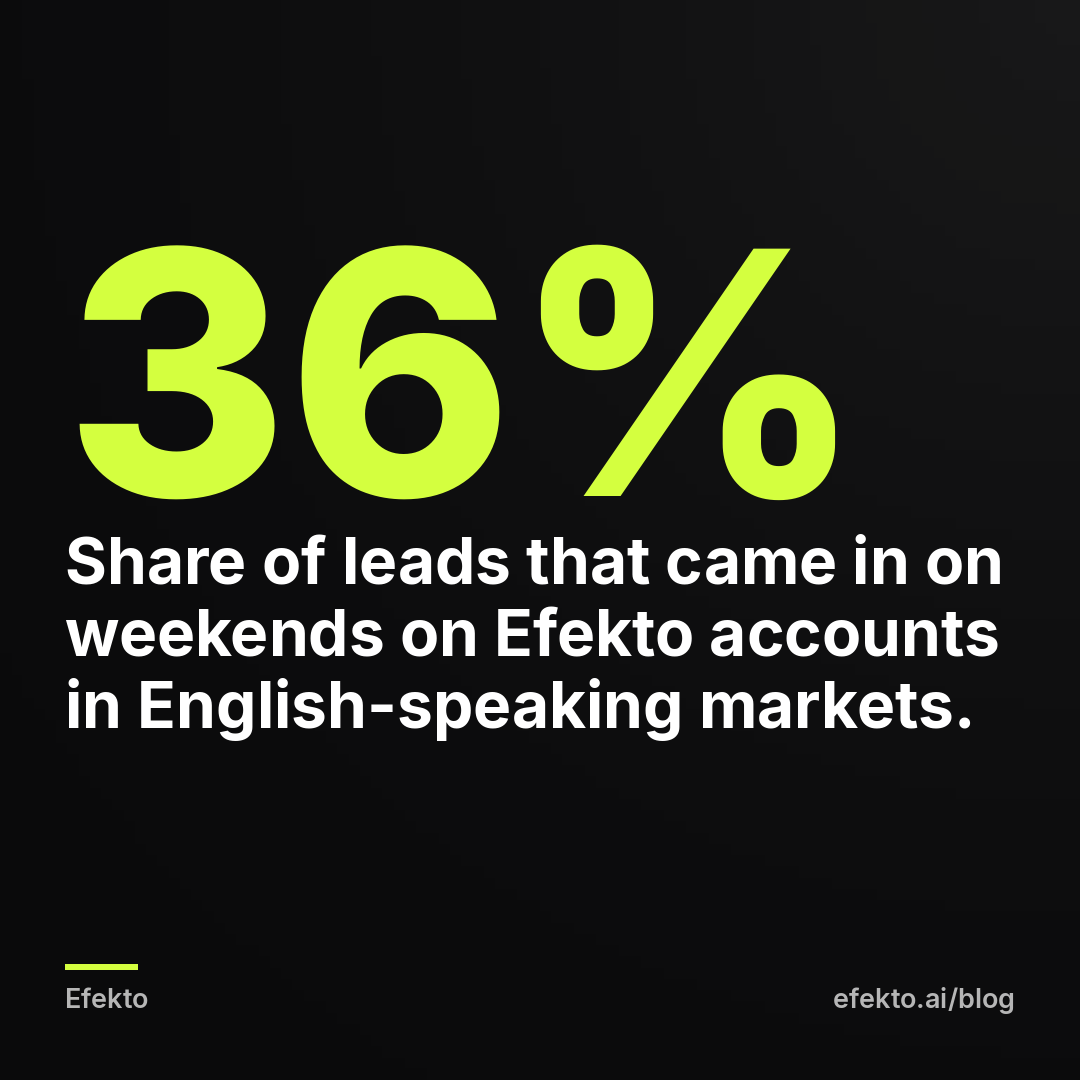
From our accounts: On Efekto users' accounts in English-speaking markets (mostly the US) (12 brands, 189 leads in the 180 days to Nov 15, 2026), 20% of leads came in after 6 pm, only 28% on weekdays between 8 am and 4 pm, and 36% on weekends.
We pulled those numbers to find out when people actually act on a local service ad. Most of them are on a couch or in a parking lot, at hours when the owner is not at the desk. That changes what ad copy has to do. Nobody is there to answer a follow-up question, so the text has to explain everything by itself: who you serve, what you fix, where you work and what happens after someone taps the button.
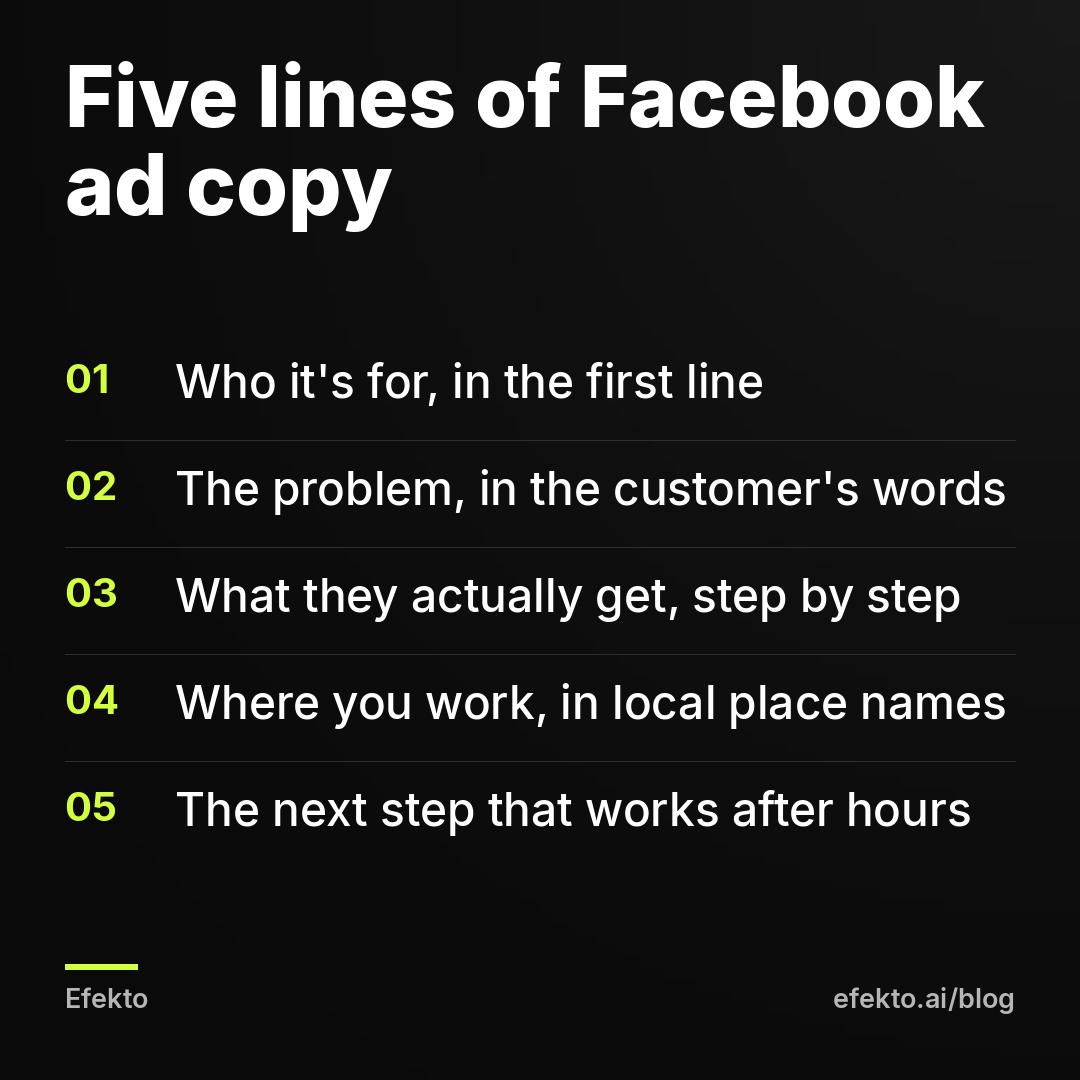
You don't need to be a writer to write Facebook ad copy for a local business. You need five plain sentences in a fixed order: who the ad is for, the problem they have right now, what they get from you, where you work, and what to do next. Write them in the words customers use when they call you, not the words painted on your truck. Then write two more versions that change one line, and let the ads compete. Clever copy is a bad bet for a plumber or a roofer. Clear copy written by the person who answers the phone usually beats anything a hired "wordsmith" produces, because the owner already knows how customers describe their problem.
The steps below cover the primary text only, the block of text above the image or video. Headlines are a separate job, and we wrote up 15 headline templates for local service businesses for that.
Step 1: Name who the ad is for in the first line
The first sentence picks the reader. Facebook shows only the first line or two before it cuts the text with "See more", so this line decides whether someone stops scrolling or keeps going.
Use this pattern: For [who] in [where] who [situation].
- "For homeowners in [Town] whose breaker trips every time the dryer and the microwave run together."
- "For [Town] families who've seen mouse droppings in the garage since it got cold."
- "For homeowners whose water heater takes 20 minutes to give a warm shower."
Do not open with your company name, your years in business or "family owned". Nobody scrolls Facebook looking for your name. They look for their own situation, and they stop when they see it.
Be narrower than feels comfortable. "Homeowners" describes everyone and stops no one. "Homeowners whose house still has the original electrical panel" stops a small group, and that group is the one you want. A narrow first line also pushes away people you can't help, and you pay for every form those people fill out.
Step 2: Describe the problem in the words customers use on the phone
The second line names the problem the way the customer would say it out loud. Owners tend to write in trade language. Customers don't search for "refrigerant charge deficiency". They say "my AC is blowing warm air".
Here is how to get the words without writing anything yourself:
- Open your last 10 text messages, voicemails or call notes from new customers.
- Read your last 10 Google reviews.
- Copy the exact phrases people used to describe the problem. Don't clean them up.
- Pick the phrase that showed up most often. That is your second line.
Then add one short clause about what happens if they wait, as long as it's true. "Mice chew wiring, and two in the garage in November are usually twenty by February" is a fair warning for a pest control ad. "Your house could burn down" for a flickering light is a scare tactic, and people can tell.
| What owners tend to write | What customers actually say |
|---|---|
| HVAC system performance issues | My AC is running but it's not cooling |
| Storm damage restoration | There's a stain on my ceiling since the storm |
| Interior detailing services | The back seat is covered in dog hair |
| Pest management solutions | I keep seeing ants in the kitchen |
| Electrical panel upgrades | My breaker keeps tripping when the dryer runs |
The right column is what goes in your ad.
Step 3: Say what the customer actually gets
The third line describes what physically happens when someone hires you. Not adjectives. Events, in order.
Use this test: could a competitor paste your sentence into their own ad and have it still be true? If yes, it says nothing.
- Fails: "Quality plumbing you can trust at affordable prices."
- Passes: "We drain and flush the tank, test the heating element, and tell you whether it's worth repairing or replacing before we quote either."
- Fails: "We make your house look brand new."
- Passes: "We pressure wash the siding, driveway and walkway, cover the plants first, and send you before-and-after photos the same day."
The passing versions work because the reader can picture the visit. They also answer the worry most people have about hiring a stranger: what will this person actually do at my house, and will the bill surprise me?
Keep this line about the service itself. Discounts, guarantees and bundles are offer design, a separate decision. If you have a real offer, it goes here as one extra clause. If you don't, the line still works without it.
Step 4: Put your service area in plain words
The fourth line says where you work, in names people recognize. Location targeting in Ads Manager decides who sees the ad, but people near the edge of your radius, or just passing through, still see it. Plenty of them will fill out a form for a job you can't take.
Write the area the way a local would describe it:
- Town names: "We cover [Town], [Town] and [Town]."
- Distance from a landmark people know: "Anywhere within about 25 miles of [the mall / the airport / downtown]."
- The county, for rural areas: "Serving all of [County]."
- Whether you come to them: "Mobile, we come to your driveway" or "Drop-off at our shop on [Street]."
This one line costs nothing and cuts the calls from 60 miles away that you then have to turn down politely.
Step 5: Tell them the next step, and make it work at 9 pm on a Saturday
The last line tells the reader exactly what to do and what happens after. On the accounts in the case above, one in five leads arrived after 6 pm and more than a third on weekends. A good share of your readers will act when nobody picks up the phone.
That's why "Call us now!" is a weak last line for most small businesses. If the phone goes to voicemail at 8:30 pm on a Saturday, the person who was ready to act hits a dead end and scrolls to the next ad. Pick a next step that works without you, and say what happens after it:
- "Tap Get quote, tell us how old the water heater is, and we'll reply with a price range by noon the next business day."
- "Tap Book now and choose a morning or afternoon slot on our calendar."
- "Send us a message with a photo of the panel and we'll tell you if it needs an upgrade."
Only promise what you will actually do. If you write "we reply by noon" and the reply comes at 4 pm, you've taught that customer that your ads lie. For more on how lead timing should shape your schedule, see the best times and days to run Facebook ads for a local service business.
The five lines fit on one fill-in template
Print this, fill in the blanks, and you have a complete primary text. No writing talent involved.
| Line | What it answers | Fill in the blank | Check before you publish |
|---|---|---|---|
| 1. Who | Is this ad for me? | For [who] in [where] who [situation]. | Does it exclude anyone? It should. |
| 2. Problem | Do they get my problem? | [Exact customer phrase]. [What gets worse if they wait]. | Is it a phrase from a real call or review? |
| 3. What they get | What will actually happen? | We [step 1], [step 2], and [step 3]. | Could a competitor paste it unchanged? If yes, rewrite. |
| 4. Where | Do they come to me? | We cover [towns] / within [X] miles of [landmark]. | Would a local recognize the place names? |
| 5. Next step | What do I do now? | Tap [button], [do one thing], and we'll [respond] by [when]. | Does it work if nobody answers the phone? |
Aim for 60 to 90 words in total. If your draft runs past 150, you are probably listing services or telling your company history, and both belong somewhere else.
Three examples from different trades
These are example ads we put together for this post, not copies of client ads. Swap the bracketed parts for your real details.
HVAC: AC running but not cooling
For homeowners in [Town] whose AC runs all day but the house won't drop below 78. That's usually a low charge, a dirty coil or a failing capacitor, and a struggling unit tends to quit completely on the hottest day of the week. A licensed tech comes out, finds the cause, shows you the broken part and gives you the price in writing before touching anything. We cover [Town], [Town] and [Town], within about 25 miles of [landmark]. Tap Get quote, answer 3 questions, and we'll text you a time slot by 10 am the next business day.
Why it works: the first line describes a situation the reader is living in right now, and the third line answers the fear of being upsold by a stranger. If you run an HVAC company, our page on Facebook ads for HVAC companies shows how this kind of campaign gets set up.
Roofing: damage after a storm
Homeowners in [County]: if last week's storm left shingles in your yard or a new stain on the ceiling, this is for you. A small leak today turns into wet insulation and a soft roof deck a few months from now. We inspect the roof, photograph every damaged spot and show you the photos before we talk price. If it only needs a repair, we tell you that. Serving [Town] and the rest of [County]. Fill out the form with your address and when you noticed the damage. We'll call back with an inspection time.
Why it works: "if it only needs a repair, we tell you that" speaks to the biggest worry about roofers, being pushed into a full replacement. The form asks for the two things the roofer needs to plan the visit.
Car detailing: interior before a sale
For [Town] car owners whose back seat is covered in dog hair, coffee stains or crumbs ground into the fabric. The gas station vacuum doesn't pull it out, and buyers notice it in the first 10 seconds. We shampoo the seats and carpets, steam the vents and cupholders, and hand the car back smelling like nothing. Mobile: we come to your driveway anywhere in [Town] and [Town]. Tap Book now, pick a day, and send a photo of the worst seat so we can quote it upfront.
Why it works: the photo request filters out people who just want a $40 vacuum, and it lets the detailer quote accurately before driving out.
Write three versions, not one perfect one
Owners who aren't writers tend to spend an evening polishing one ad. Spend that evening writing three rough ones instead. You won't know which wording works until people respond to it.
Change only one line between versions, so you can tell what made the difference. The first line is the best one to vary, because it decides who stops. Here is how a pest control company might do it:
- Version A opens with what they saw: "For [Town] families who keep finding ants on the kitchen counter."
- Version B opens with the season: "For [Town] homeowners who get ants every spring and are tired of spraying it themselves."
- Version C opens with the house: "For homeowners in [Town] with a slab foundation and a kitchen that backs onto the yard."
Lines 2 to 5 stay identical.
For example: say your budget is $20 a day across the three versions. After 7 days you've spent $140. Version A brought 6 form leads, Version B 2, Version C 1. On form count, A wins. Now check who booked. If 1 of A's 6 leads booked and both of B's leads booked, B is the better ad, and the next round should build on B's first line. Count booked jobs, not forms.
From our accounts: Of the 55 brands that launched a campaign in Efekto in the 180 days to Nov 15, 2026, 33 have already received a lead; the median time from launch to the first lead was 11.4 hours, and 25 of them got one within 24 hours. The lesson for copy is that feedback comes quickly. Read every lead that comes in during the first week, including what people typed into the form. If they keep asking about a service you didn't mention, or they're from towns you didn't list, your copy is telling you what to fix.
One caution: don't rewrite live ads every other day. Significant edits send an ad back into a learning period, and you lose the data you were waiting for. Write the new version as a new ad and let the old one keep running until you have a reason to turn it off.
Common mistakes that make plain copy fail
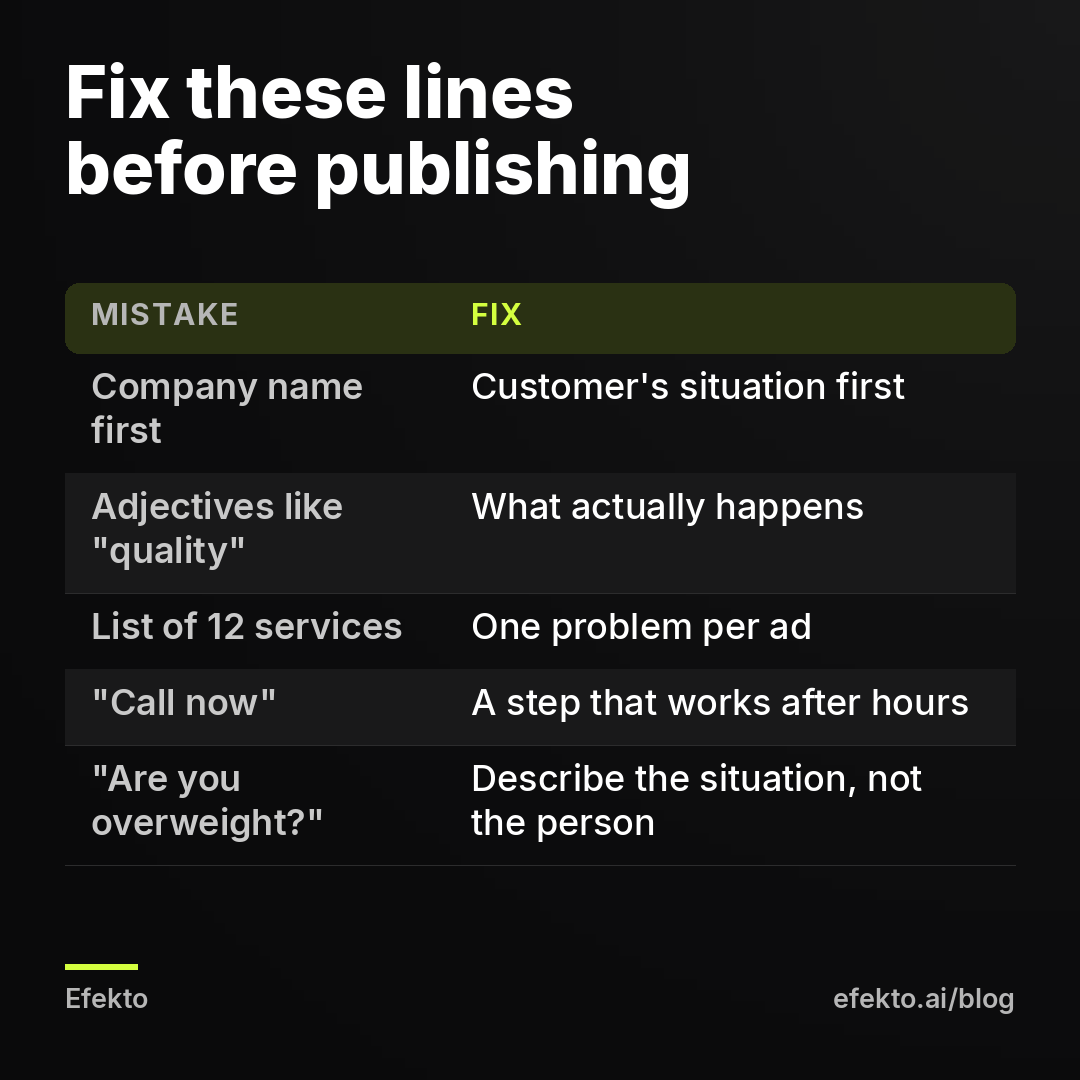
- Opening with yourself. "Family owned since 1998" in line one wastes the only line everyone sees. Move it to the end or cut it.
- Adjectives instead of facts. "Best", "affordable", "professional", "trusted". Every competitor uses the same four words. Replace each one with something that happens on the job.
- Listing every service. "AC repair, furnace repair, duct cleaning, water heaters, air purifiers..." One ad, one problem. If you offer five services, write five ads.
- Talking about the reader's body or personal traits. Meta rejects ads that imply they know something personal about the reader, like "Are you overweight?" or "Struggling with hair loss?". This hits med spas and dental offices most often. Describe the situation or the result instead: "For people in [Town] who want to whiten their teeth before a wedding."
- Jargon without translation. "SEER2 rated", "9H ceramic", "Class 4 shingles". If you use a term, add what it means for the customer in plain words, or drop it.
- Promising a response time you can't keep. The ad ends up working against you on every lead you're late to. Write the time you actually hit on your busiest week, not your quietest.
When writing it yourself is the wrong use of your time
For most owners with one main service in one area, writing the copy yourself is the right call. It takes an evening with the template above, and nobody knows your customers' words better than you do. We'll take that position even though we sell an app that does it for you.
It stops making sense when you run several services or several areas and need a new batch of versions every couple of weeks, or when you can't look at the account every day to see which ad is wasting money. That's the case Efekto was built for. Efekto creates ads from your website, publishes them, and optimizes them every day: it turns off the ones that don't bring results and scales the ones that do. You approve the first batch, at least 5 ads, before the campaign starts, so you still read every line before it goes out. We make money when businesses run ads on Facebook and Instagram, so weigh our opinion with that in mind. Efekto is not the right fit if your website is a single page with a phone number, because it has nothing to build from, or if you want to spend less than $15 per day, which is the minimum. In both cases, write the five lines yourself and run them directly in Ads Manager.
What to take from this
- Write five lines in a fixed order: who, problem, what they get, where, next step. Don't add a sixth line until those five are right.
- Take the problem line from your last 10 calls or reviews, word for word. Don't invent it.
- Make the last line work at 9 pm on a Saturday, because on the US-heavy accounts we looked at, only 28% of leads arrived on weekdays between 8 am and 4 pm.
- Run three versions that change only the first line, and pick the winner by booked jobs, not form count.
- Read every lead from the first week and fix the copy based on what people actually type into the form.
If you'd rather approve ads than write them, you can see how Efekto handles it at efekto.ai.
- Jakub Zwoliński
Founder, Lemon Agency · Efekto · November 19, 2026