What Is CTR on Facebook Ads, and What Does It Tell a Local Business?
CTR on Facebook ads is the share of people who clicked after seeing your ad. Learn link CTR vs CTR (all), how CTR drives cost per lead, and when a high CTR misleads.

CTR (click-through rate) on Facebook ads is the percentage of people who saw your ad and clicked it: clicks divided by impressions, times 100. For a local business, the number that matters is link CTR. It counts only the clicks that take someone to your destination, such as your website, your instant form or a call. Those are the only clicks that can turn into a booked job. CTR tells you whether your ad earns attention. It does not tell you whether that attention becomes customers.
In short:
- Link CTR counts only clicks toward your website, form or phone, while CTR (all) also counts likes, comments and photo taps, so it always looks higher.
- CTR is one of three numbers that make up your cost per lead, next to the price of impressions and the share of clicks that become leads.
- A high CTR with few leads points to a problem after the click, usually the form or the page, not the ad.
What is the difference between link CTR and CTR (all)?
Link CTR counts clicks that lead to your destination. CTR (all) counts every click on the ad. That includes likes, comments, shares, taps to expand the text, taps on your page name and taps to view the image full screen.
The gap between the two is the most common reason owners think an ad is working when it isn't. Say an ad gets 1,000 impressions, 12 people react or comment, and 8 people tap "Get Quote". CTR (all) shows 2%. Link CTR shows 0.8%. Only the 8 people had a chance to become leads.
Meta also reports outbound CTR, which counts only clicks that leave Facebook for your website. If you run instant forms, outbound CTR stays near zero because the form opens inside Facebook. In that case link CTR is the right column.
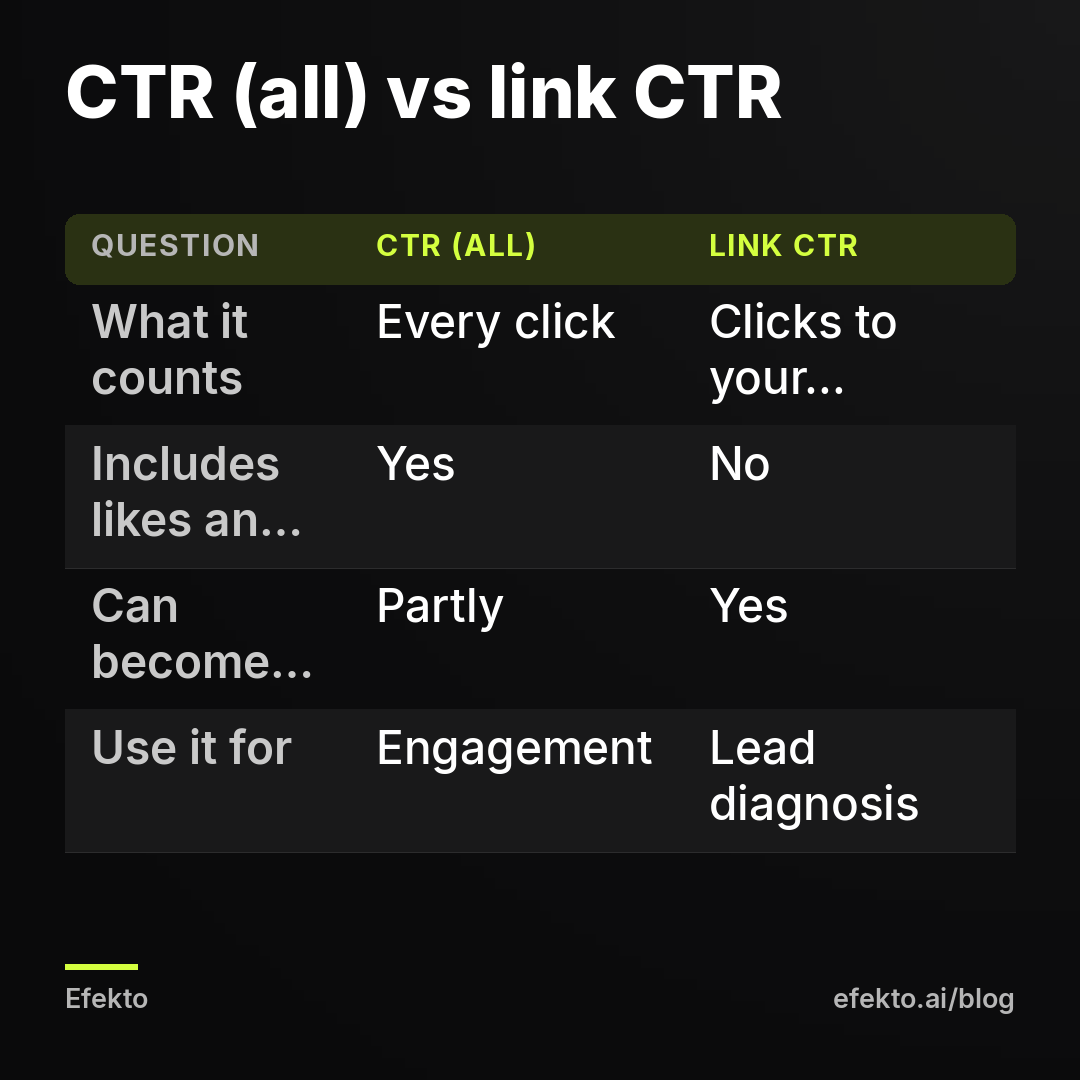
Our position is simple: a lead generation account should not judge ads by CTR (all). It mixes curiosity with intent. A funny image that gets 40 comments and no quote requests will win on CTR (all) and lose on everything that pays the bills.
How do you find link CTR in Ads Manager?
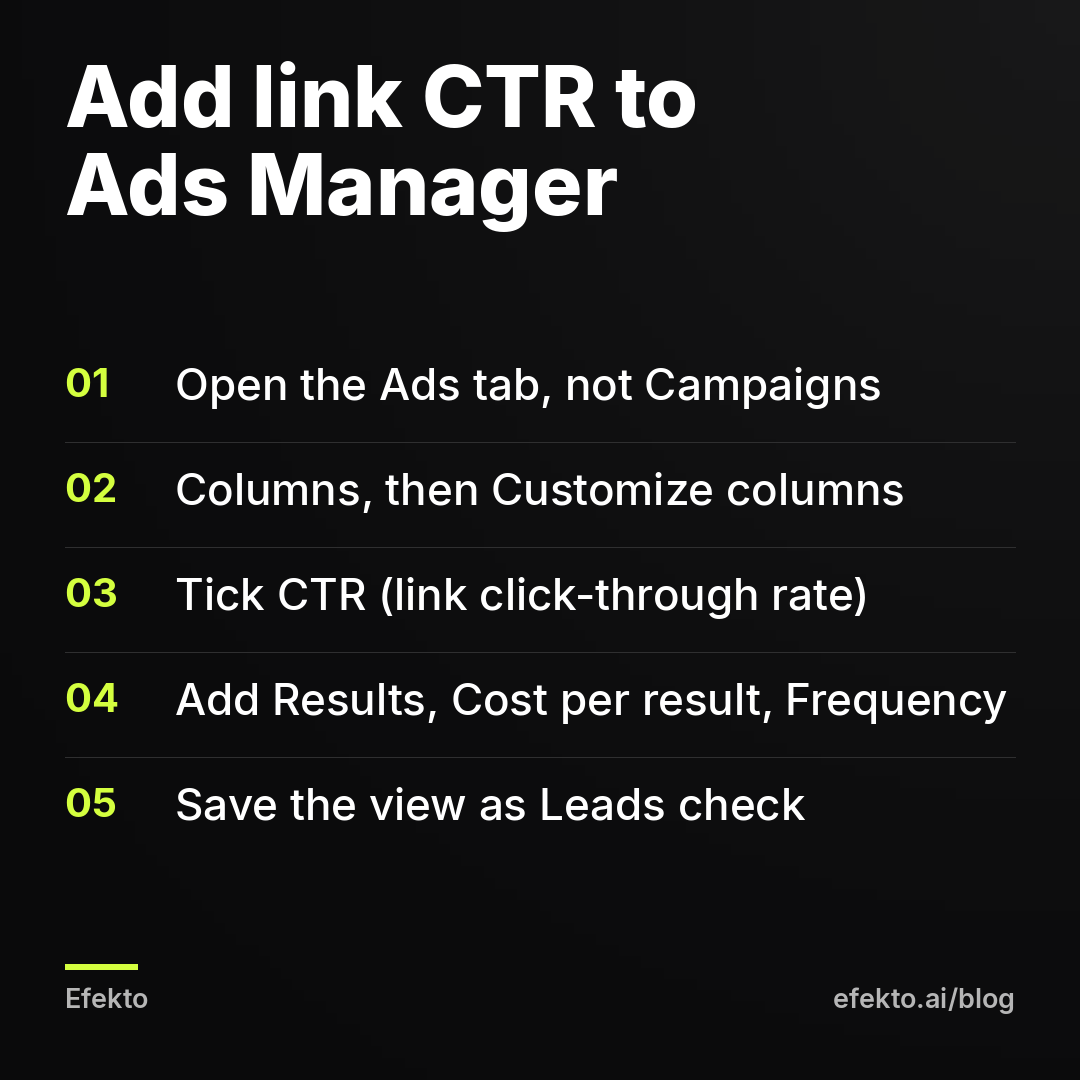
Link CTR is not always in the default columns, so add it once and save the view. Here is how we'd set it up:
- Open Ads Manager and go to the Ads tab, not Campaigns. CTR at campaign level averages good and bad ads together and hides the difference.
- Click Columns and choose Customize columns.
- Search for "CTR (link click-through rate)" and tick it. Add "CTR (all)" next to it so you can see the gap.
- Add "Results", "Cost per result", "Impressions" and "Frequency".
- Save the column set under a name like "Leads check" so it loads next time.
With that view, a weekly check takes a few minutes. We go through the full routine in how to read your Facebook ads results in 10 minutes a week.
How does CTR affect your cost per lead?
CTR is one of three parts of cost per lead. The formula is:
Cost per lead = cost per 1,000 impressions ÷ (1,000 × link CTR × click-to-lead rate)
The cost per 1,000 impressions is what Meta charges to show your ad. Link CTR is how many of those people click. The click-to-lead rate is how many clickers finish the form or call. Change any one of them and cost per lead moves.
For example, assume you pay $20 per 1,000 impressions in every scenario below. These are illustrative numbers, not our results:
| Scenario | Link CTR | Clicks per 1,000 impressions | Click-to-lead rate | Leads per 1,000 impressions | Cost per lead |
|---|---|---|---|---|---|
| A: starting point | 1% | 10 | 10% | 1 | $20.00 |
| B: better ad, same form | 2% | 20 | 10% | 2 | $10.00 |
| C: better ad, worse form | 2% | 20 | 5% | 1 | $20.00 |
| D: clickbait ad | 3% | 30 | 2% | 0.6 | $33.33 |
Scenario B is why CTR matters. Doubling it halved the cost per lead. Scenario D is why CTR alone misleads. The ad with the highest CTR produced the most expensive leads, because it attracted people who were curious, not people who needed the service.
One more caveat. The cost per lead Meta shows is the cost of a form submission before anyone has checked it. After you remove wrong numbers, people outside your area and duplicates, the real cost per lead is higher. We explain the difference in what cost per lead on Facebook means for a local business.
What happens when CTR is high but leads don't come in?
When CTR is high and leads are scarce, the ad is doing its job and something after the click is failing. In our experience, the usual suspect is the form.
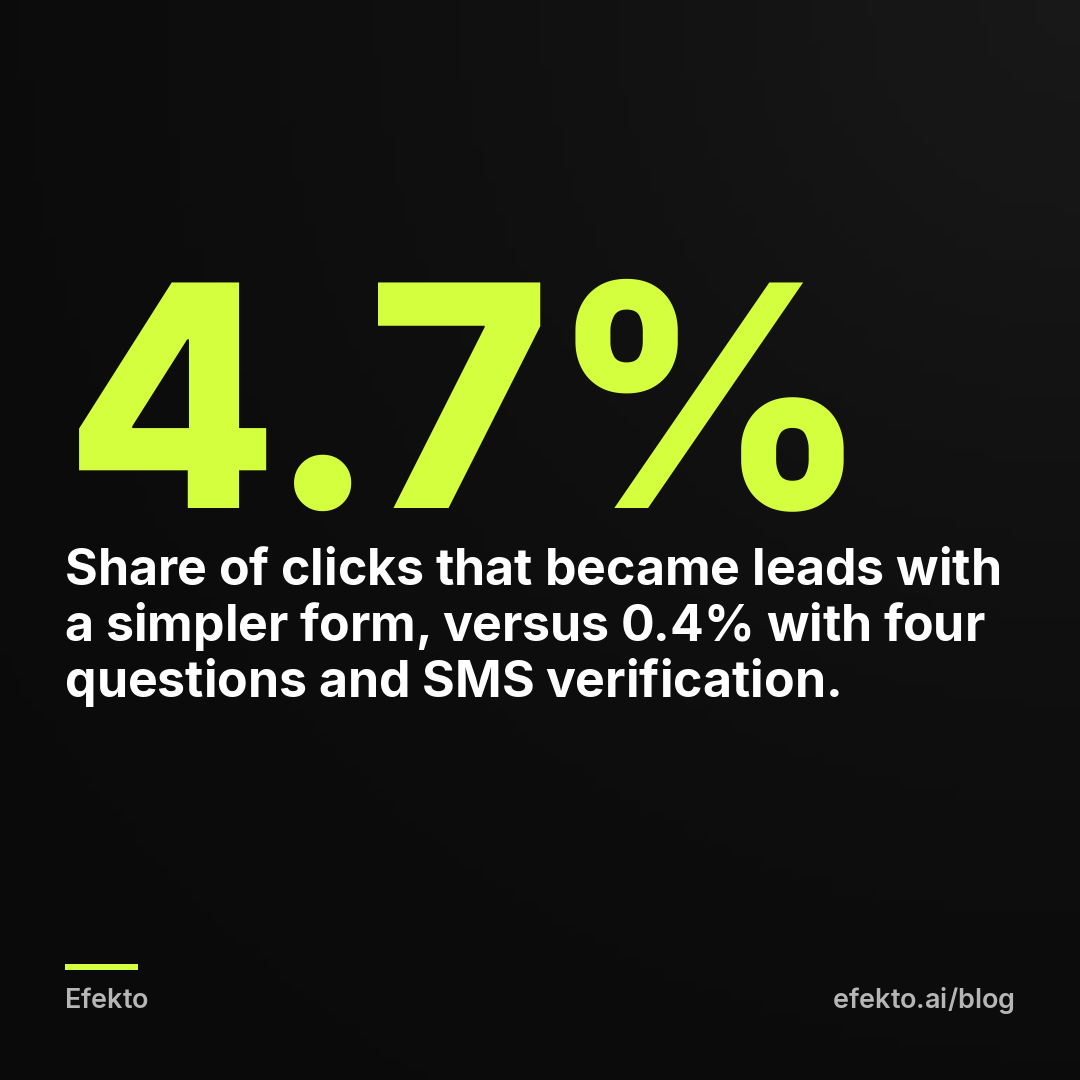
From our accounts: in a lead campaign for business software in October 2026, an ad with a 4-question form plus SMS verification had a 2.19% CTR, but only 0.4% of clicks became leads. A simpler form in a similar campaign converted 4.7%.
This was not a local service campaign, but the mechanism is the same for a roofer or a med spa. To see what it means in money, take the 2.19% CTR and the same assumed $20 per 1,000 impressions from the table above. At 0.4% of clicks converting, that works out to about $228 per lead. At 4.7%, it is about $19 per lead. The CTR stays the same, the ad stays the same, and the cost per lead drops roughly twelvefold.
What we take from it: when CTR looks healthy, stop changing the ad. Cut the form to the fields you actually need to call someone back: name, phone, ZIP code and perhaps one qualifying question. If you are deciding whether to use a form at all, read our comparison of Facebook lead forms vs landing pages.
What does a low CTR mean, and how do you fix it?
A low link CTR means people see the ad and scroll past. The fix depends on which of four causes it is:
| What you see | Likely cause | What to change |
|---|---|---|
| Low CTR from the first day | The image or first line doesn't show the job | Use a real photo of your work: the roof, the clean car, the new unit |
| Low CTR, vague headline | No reason to click now | Name the service, the area and a concrete offer, for example "Free roof inspection in Plano this week" |
| CTR was fine, now falling, frequency above 3 | The same people have seen it too many times | Add new ads with new images, keep the offer |
| High CTR (all), low link CTR | People engage but don't act | Make the button and next step obvious, cut the joke or giveaway angle |
The frequency threshold of 3 is our rule of thumb, not a Meta rule. Watch the direction of the trend rather than one day's number.
What is a good CTR for Facebook ads?
There is no good CTR that applies to every local business, and the benchmark tables that circulate online are mostly useless to you. They mix industries, countries, objectives and both CTR types, often without saying which one they measure. A roofing ad shown to homeowners in one county and an ecommerce ad shown nationally are not the same game.
Through Lemon Agency we have run campaigns for more than 300 clients, and our conclusion is that the only comparison that holds up is against yourself. Compare link CTR between ads in the same ad set, shown to the same audience in the same week. If one ad gets twice the link CTR of another and leads cost the same or less, it wins. That is a real signal. "Above industry average" is not.
If you want a clean comparison on a small budget, follow our method for testing two Facebook ads against each other on $20 a day.
How should a local business use CTR week to week?
Use CTR to explain results, not to choose winners. Leads and booked jobs choose winners. Here is the order we'd check things in every week:
- Cost per lead per ad. Is it within what you can afford for a booked job?
- Link CTR per ad. If cost per lead is high, is the ad failing to get clicks?
- Click-to-lead rate. If CTR is fine, divide leads by link clicks. A low number points to the form or page.
- Frequency. If CTR is falling week over week, check whether the same people keep seeing the ad.
- Lead quality. Call back a sample. A high CTR that fills your inbox with people outside your service area is not a win.
We'd wait until an ad has a few thousand impressions before comparing its CTR to another ad. Below that, a handful of clicks swings the percentage too much to mean anything.
If you don't want to do this check by hand, it is the kind of work Efekto does. Efekto creates ads from your website, publishes them, and optimizes them every day: it turns off the ones that don't bring results and scales the ones that do. You can see the steps on how Efekto works. If you already check your ads weekly and your cost per lead is where you want it, you don't need an app for this. The column view above is enough.
When should you ignore CTR?
Ignore CTR when you already have enough leads to judge ads by cost per lead and booked jobs. At that point CTR is a background number. You only need it when results drop and you want to know why.
Also ignore it for very small retargeting audiences. People who already visited your site often click less but convert more, so a low CTR there means little. And ignore CTR for boosted posts that aim at engagement. Those ads are optimized for reactions, so their CTR (all) says nothing about leads.
What we will keep doing is reading CTR as a diagnosis, never as a target. An ad that chases clicks gets curious people. An ad that shows the job, the area and the offer gets fewer clicks from people who actually call.
FAQ
Why is my CTR (all) so much higher than my link CTR?
CTR (all) counts every interaction, including likes, comments, taps on your page name and taps to expand the text. Link CTR counts only clicks toward your website, form or call. A large gap usually means the ad draws attention but doesn't make the next step clear.
Does a higher CTR lower my cost per lead?
It does if the share of clicks that become leads stays the same. If a more clickable ad attracts less serious people, the click-to-lead rate drops and cost per lead can go up. Always check both numbers together.
Does CTR affect how much Meta charges me?
Meta's delivery system favors ads that people respond to, so ads that get ignored tend to cost more to show. Still, you can't control that price directly. Making the ad clearly relevant to people in your area is the practical lever.
Should I turn off ads with a low CTR?
Not on CTR alone. An ad with a lower CTR and cheaper, better leads is the better ad. Turn ads off based on cost per lead and lead quality, and use CTR to understand why an ad is losing.
Is CTR the same as conversion rate?
No. CTR measures how many people who saw the ad clicked it. Conversion rate measures how many of those clickers became leads. A local business needs both, because cost per lead depends on their combination.
If you want ads judged by leads rather than clicks without checking Ads Manager yourself, you can try it at efekto.ai.
- Jakub Zwoliński
Founder, Lemon Agency · Efekto · November 3, 2026