Best Times and Days to Run Facebook Ads for a Local Service Business
There is no universal best hour for Facebook ads. When an ad schedule helps a local service business, when it hurts a small budget, and how to match ads to your reply hours.

For most local service businesses on a small budget, the best time to run Facebook ads is all day, every day. You don't get better results by narrowing the hours. You get them by answering leads fast at the hours they actually arrive. There is no universal best hour or day that applies to every roofer, med spa or detailer. On the accounts we run, the busiest day for lead forms is Sunday, and many leads come in after 6 pm. A business that switches its ads off on evenings and weekends cuts out the times its customers are filling in forms.
In short:
- On a small budget, let Meta deliver your ads 24/7 and put your effort into how fast you reply.
- An ad schedule makes sense mostly for call ads and messaging ads, where someone has to be there to pick up.
- Judge days and hours from your own leads over weeks, not from a "best time to post" chart.
Is there a best time of day to run Facebook ads?
No single hour works for every business, and any article that gives you one as a fact is guessing. Meta doesn't sell you a time slot the way a radio station does. You give it a budget and a goal, and it shows your ad at the moments it predicts someone is likely to fill in your form. Those moments are different for a homeowner with a leaking roof and for someone booking Botox.
When people ask about the "best time," they are usually asking two separate things:
- When do my customers see ads and act on them? Meta's delivery system works this out better than a schedule you set by hand, as long as it has enough budget and enough hours to work with.
- When can my business actually respond? Only you know this, and it matters more than the first one.
We think most owners mix these up. They switch ads off at 5 pm because the office closes at 5 pm. That treats the second question as if it answered the first. The customer doesn't care that your office is closed. They are on the couch at 9 pm looking at their phone, and that is when they tap your form.
How does Facebook ad scheduling work in Ads Manager?
You set ad scheduling (often called dayparting) at the ad set level, and Ads Manager only offers it when the ad set uses a lifetime budget. It doesn't work with a daily budget. You choose the days and hours when ads may run, and you pick whether those hours follow the viewer's time zone or your ad account's time zone. For a local business with one service area, both settings give you the same result.
This has a practical cost that owners rarely notice. A lifetime budget means you commit to a total amount for a fixed date range, and Meta paces the spend across the hours you allowed. If you allow 45 hours a week instead of 168, the same money is pushed into a much narrower window.
You can also "schedule" by hand: turn the ad set off on Friday evening and back on Monday morning. We recommend against it. Every pause and restart breaks up delivery. If you also edit budgets while you are at it, the ad set goes through another round of learning. We cover how that plays out in why ad sets get stuck in Learning Limited on a small budget.
When does an ad schedule hurt a small budget?
A schedule hurts when your budget is small, because it takes away the hours Meta would use to find cheap leads. It also cuts the number of results the system learns from. A large account can afford to throw away 70% of the week. A $20 to $40 a day account can't.
Here is the mechanism with made-up numbers. For example: say you spend $30 a day, or $210 a week.
| Setup | Hours ads can run per week | Spend per allowed hour | Example cost per lead | Example leads per week |
|---|---|---|---|---|
| All day, every day | 168 | $1.25 | $40 | about 5 |
| Mon-Fri, 8 am to 5 pm | 45 | $4.67 | $55 | about 4 |
| Mon-Fri, 8 am to 5 pm, budget cut to match | 45 | $1.25 | $55 | about 1 |
The cost per lead figures are an example, not a measured result. They show which way things move. In the narrow window you compete for the same weekday office-hours attention as every other advertiser. You lose the evening and weekend people who fill in forms when they have time. And Meta has fewer results per week to learn from.
The last row is the mistake we see most often in how owners reason about this. They cut the hours and also cut the budget "because the ads only run a third of the time." At that point the ad set is spending so little that it barely gets out of learning.
Our position: if you spend under roughly $50 a day, don't put lead form ads on a schedule. This is a rule of thumb from how we set up accounts, not a hard Meta threshold. If you spend more and have weeks of data showing that certain hours bring junk, you can test excluding them. Test it as an experiment, not as a default.
When do leads actually come in on the accounts we run?
In our data, a large share of leads arrive at night and on weekends, the exact hours most schedules cut off. Here are the figures.
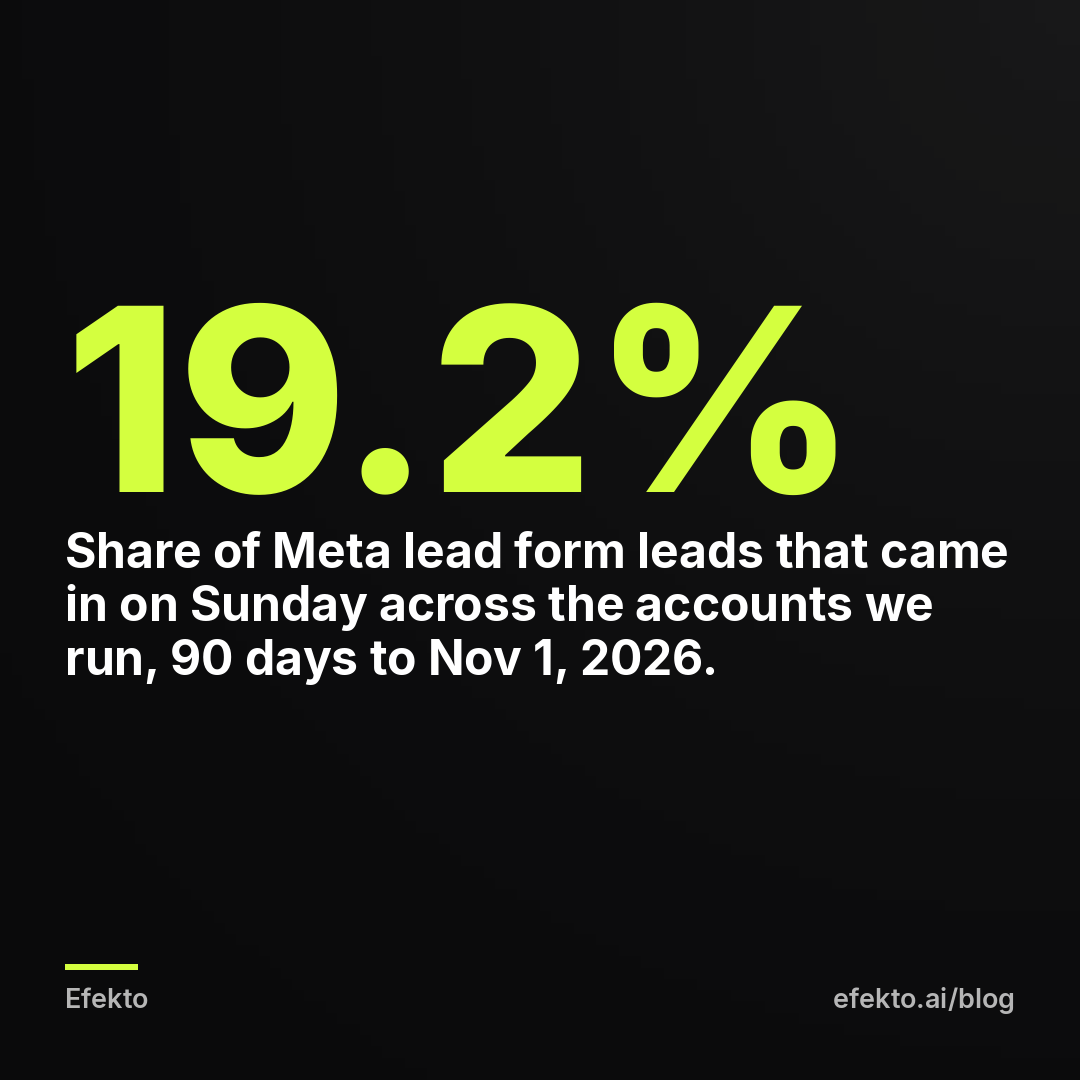
From our accounts: Of 3,490 Meta lead form leads collected in the 90 days to Nov 1, 2026 on the accounts we run, the most came in on Sunday (19.2%), the fewest on Monday (12.5%), and Saturday plus Sunday brought 33% of all leads.
So one in three form leads arrived on a weekend. If you ran ads Monday to Friday only, you would have shut off the most productive day of the week to protect the least productive one.
The hour-of-day picture points the same way. From our accounts: On Efekto users' accounts in Poland (12 brands, 248 leads in the 180 days to Nov 1, 2026), 40% of leads came in after 6 pm, only 29% on weekdays between 8 am and 4 pm, and 25% on weekends.
Poland isn't the US, and 248 leads is a smaller sample, so read it as direction, not as a forecast for your city. But the direction is hard to argue with. Less than a third of leads arrived during classic office hours. An ad set limited to 8 am to 4 pm on weekdays would have been chasing 29% of the demand and leaving the other 71% to whoever kept their ads on.
What this means for you:
- Your customers fill in forms when their own day is over. For a homeowner that is evenings and weekends.
- The hours when your ads should run and the hours when your office is open are different questions.
- Your problem isn't how to stop leads from arriving on Sunday. It's who replies to the Sunday leads, and when.
What are the best ad scheduling options for a local service business?
There are five setups worth knowing, and for most small accounts the first one wins. The criteria we use to choose: the type of ad (form, call or message), daily budget, whether someone can respond in real time, and whether you have enough of your own data to justify narrowing delivery.
| Option | How you set it | Fits these ad types | Budget fit | Who it's for | Skip it if |
|---|---|---|---|---|---|
| 1. All day, every day | Daily budget, no schedule | Lead forms, landing pages | Any budget, best for small ones | Almost every local service business starting out | You run call ads with no one to answer |
| 2. All day, but skip overnight | Lifetime budget, exclude roughly midnight to 6 am | Lead forms, messaging | Mid to larger budgets | Accounts with weeks of data showing overnight leads don't answer the phone | Your data doesn't show it yet |
| 3. Staffed hours only | Lifetime budget, your phone hours | Call ads, click-to-message | Any budget, if calls are the goal | Businesses that want live calls and have someone at the phone | Your main goal is form leads |
| 4. Weekend weighting | Separate ad set or raising the daily budget before the weekend | Lead forms | Larger budgets | Businesses with solid data showing cheaper weekend leads | You'd be editing budgets every week |
| 5. Pause when fully booked | Lower the daily budget, don't schedule | Any | Any | Seasonal trades booked out for weeks | You still have open slots |
1. All day, every day. This is the default, and for us it is the right answer for most accounts under about $50 a day. Meta gets 168 hours to find people and the most results to learn from. Your job moves to the reply side, covered in the next section.
2. Skip overnight hours. This is a refinement, not a starting point. If you have run for a couple of months and your call-backs show that leads submitted between midnight and 6 am almost never pick up, cutting those hours can help. Make that call from your own call log, not from a hunch.
3. Staffed hours only. This is the one case where a schedule clearly earns its place. A call ad that rings an empty office at 7 pm burns money and annoys the person calling. If you run Facebook call ads so customers phone you directly, match the schedule to the hours someone will actually pick up, and keep a lead form ad set running around the clock next to it.
4. Weekend weighting. Our data suggests weekends deserve their full share of budget. That doesn't mean you should start editing budgets every Friday. Each large budget change can push an ad set back into learning. Only do this if your own data shows a clear weekend edge and your budget is big enough to absorb the disruption.
5. Pause when fully booked. If a roofing or HVAC company is booked out for three weeks, the right move is to lower the daily budget, not to schedule ads off. Leads you can't serve for a month go cold anyway. The budget is the tool for capacity. The schedule is not.
How do you match ad delivery to the hours you can answer leads?
Keep the ads running and build the schedule on your side: who replies, when, and with what. A lead that waits until Monday at 10 am after submitting on Saturday at 8 pm is worth a lot less than one you text back within the hour. A 9 am to 5 pm ad schedule doesn't fix that. A reply plan does.
This is how we'd set it up for a small service business with one or two people handling leads:
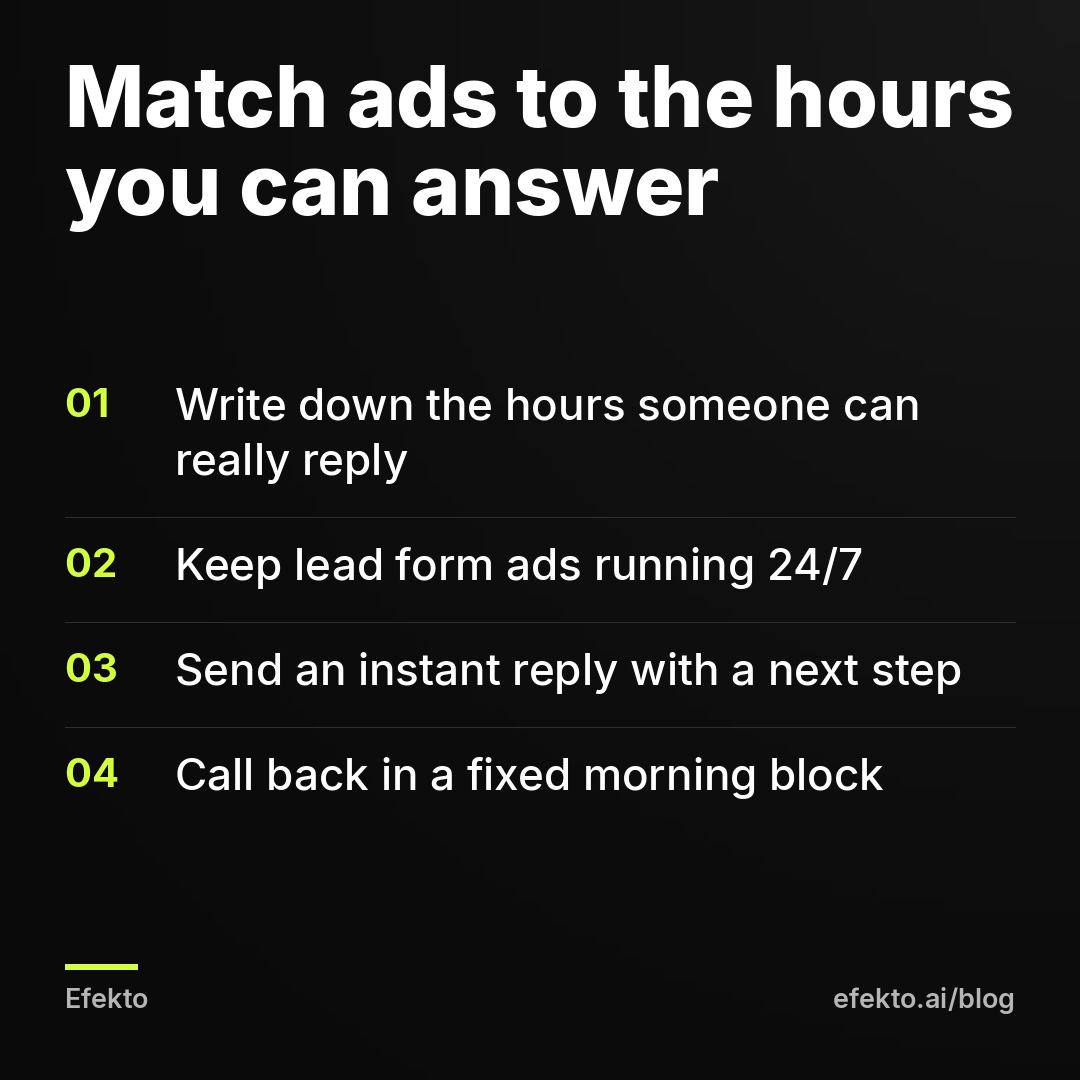
- Write down your real response hours. Not office hours. The hours when someone can actually send a text or make a call, including "I can reply from my phone on Saturday morning."
- Keep lead form ads running all week on a daily budget. No schedule.
- Set an instant reply for every lead. A text or email that goes out within minutes, says who you are, and gives a concrete next step: "We'll call you tomorrow between 8 and 10 am. Reply with a good time if that doesn't work." Most CRMs and Meta's own lead tools can do this. If leads aren't reaching your inbox at all, fix that first with our guide to Facebook leads not showing up in your email or CRM.
- Plan a call-back block. For example, 8 to 9 am every day goes to evening and overnight leads, and Saturday noon goes to Saturday morning leads. Treat the block as a fixed appointment.
- Schedule only the ads that need a live person. Call ads and click-to-message ads follow your staffed hours. Form ads don't.
For example: a detailer gets 6 form leads a week. Two arrive on Sunday evening. With ads switched off on weekends, those two leads simply don't exist. With ads on and an instant text that says "We'll call Monday at 8 am," they exist, they know when to expect you, and the Monday 8 am block turns them into booked jobs. One setup gets 6 conversations a week. The other gets 4.
How long should you run ads before judging days and hours?
You need weeks of leads before day-of-week or hour-of-day patterns mean anything. You can see the first lead fast, but you can't judge timing that fast.
From our accounts: Of the 33 brands that launched a campaign in Efekto in the 180 days to Nov 1, 2026, 20 have already received a lead; the median time from launch to the first lead was 11.2 hours, and 14 of them got one within 24 hours.
That tells you whether the campaign is alive. It doesn't tell you anything about Tuesdays. If your first lead came in at 11 pm, the lesson isn't "leads come at 11 pm." It's "leads come in." The 13 brands that had no lead yet are a reminder that some campaigns need more time, a better offer or a bigger budget before there is anything to analyze.
The numbers problem is simple. Say you get 40 leads in 90 days. Split across 7 days of the week, that is fewer than 6 leads per day. One busy weekend can shift a day's share by several points. Split across 24 hours, most hours get one or two leads. Making scheduling decisions from that is reading tea leaves.
Our rule: don't restrict hours or days on the basis of fewer than about 100 leads with outcomes attached. That is our working threshold, not a Meta rule. "Outcome" means you know whether the lead answered, got a quote and booked. Lead volume by hour is not enough.
How do you check which days and hours work in your own account?
Look at when leads became booked jobs, not only at when Ads Manager shows results. Ads Manager has a time-of-day breakdown in reporting, and you can also export your leads with submission timestamps. Use the export. It lets you add the column that matters.
A simple sheet that does the job:
| Column | What goes in it | Why |
|---|---|---|
| Submitted | Date and time from the lead export | Day and hour of the lead |
| First reply | When you texted or called | Shows your own response delay |
| Reached | Yes / No | Separates junk from real people |
| Quoted | Yes / No | Separates tire-kickers from buyers |
| Booked | Job value in $ or blank | The only thing that pays the bills |
After a few months, sort by day and by hour block (morning, afternoon, evening, overnight) and compare booked jobs, not leads. You will often find that the "bad" hours aren't bad leads at all. They are leads you answered 14 hours late. If Sunday leads book less often than Tuesday leads, check your reply times before you blame Sunday.
If your bad leads cluster in particular hours even after you reply fast, that is a real signal. Then a test of Option 2 from the table above makes sense.
When does running ads 24/7 not make sense?
A 24/7 lead form setup isn't the right default in three situations:
- Your goal is live calls. Schedule call ads to your staffed hours. A missed call from an ad is worse than no call.
- You can't follow up for days. If no one will look at leads from Friday to Monday and you won't set an instant reply, weekend leads go stale. In that case fix the follow-up. If you truly can't, reduce the weekend share of your budget. That's the honest trade-off, not a growth strategy.
- You are fully booked. Lower the budget until you have open slots.
This is also where we should say plainly where we have an interest. We make money from ads on Facebook and Instagram, both through Lemon Agency, which has managed $1M+ in ad spend for clients, and through Efekto. We are not neutral about running ads. On this question, though, our advice actually means less fiddling with ads, not more spend: the same budget, spread across the whole week, with your effort moved to replies.
If you'd rather not manage delivery at all, Efekto creates ads from your website, publishes them, and optimizes them every day: it turns off the ones that don't bring results and scales the ones that do. You approve the first batch (at least 5 ads) before anything goes live, and the minimum daily budget is $15. You can see the whole flow on how Efekto works.
Efekto doesn't answer your leads, and it can't fix a Monday-only follow-up habit. If your bottleneck is replying, not running the ads, start with the reply plan above. That costs nothing.
FAQ
Should I turn off Facebook ads at night?
For lead form ads on a small budget, no. In our data a large share of leads arrives in the evening, and night delivery gives Meta more room to find people. Turn ads off at night only for call ads when no one can answer, or after your own data shows that overnight leads don't book.
Do Facebook ads perform better on weekends?
On the accounts we run, Saturday plus Sunday brought 33% of Meta lead form leads over 90 days, with Sunday the busiest single day. That doesn't guarantee your weekends will be cheaper. It does mean that switching off weekends cuts out a large part of the demand.
Can I schedule Facebook ads with a daily budget?
Not through the built-in ad schedule. In Ads Manager it requires a lifetime budget on the ad set. Turning ads on and off by hand works technically, but the constant pausing breaks up delivery and can send the ad set back into learning.
What time should I reply to Facebook leads that come in after hours?
Send an automatic reply within minutes at any hour. Then call in a fixed block early the next morning or the next working session. The instant message tells the person when to expect you, which keeps more of them warm until you call.
Is Instagram timing different from Facebook timing?
Meta delivers both from the same campaign, so you don't set separate hours for each. The same rule applies to both: keep form ads running all week and plan your replies around when leads arrive.
We'll keep running lead form ads around the clock and spend our energy on the first reply, and if you want the ads side handled the same way, you can start at efekto.ai.
- Jakub Zwoliński
Founder, Lemon Agency · Efekto · November 7, 2026