Best Facebook Ad Formats for Local Service Businesses: Image, Video or Carousel
Image, video or carousel? Which Facebook ad format fits a local service business, when each one fails, and the aspect ratios and lengths we would use.

For most local service businesses, the best first Facebook ad is a single image of real work. Ideally that is a before-and-after in a 4:5 frame, run next to one short vertical phone video of 15-30 seconds. Carousels earn their place only when you sell several distinct services or a job that needs steps to explain. If we had to bet a test budget, we would put it in that order: image first, video second, carousel third.
Producing the images and videos from your site and phone is a separate topic, covered in our guide on making Facebook ad images and videos from your website and phone photos. This post is about choosing the format and getting its specs right.
1. Is a before-and-after image the best Facebook ad for a service business?
If your work changes how something looks, yes. A before-and-after image proves the result in one second without a word of copy, which makes it the strongest single ad most local service businesses can run.
What it is: one image showing the same car, roof, driveway, lawn or room before and after your work.
Where it works: car detailing, roofing, pressure washing, landscaping, painting, junk removal, flooring, cleaning. Any job where a stranger scrolling past sees the difference without explanation.
Setup we would use:
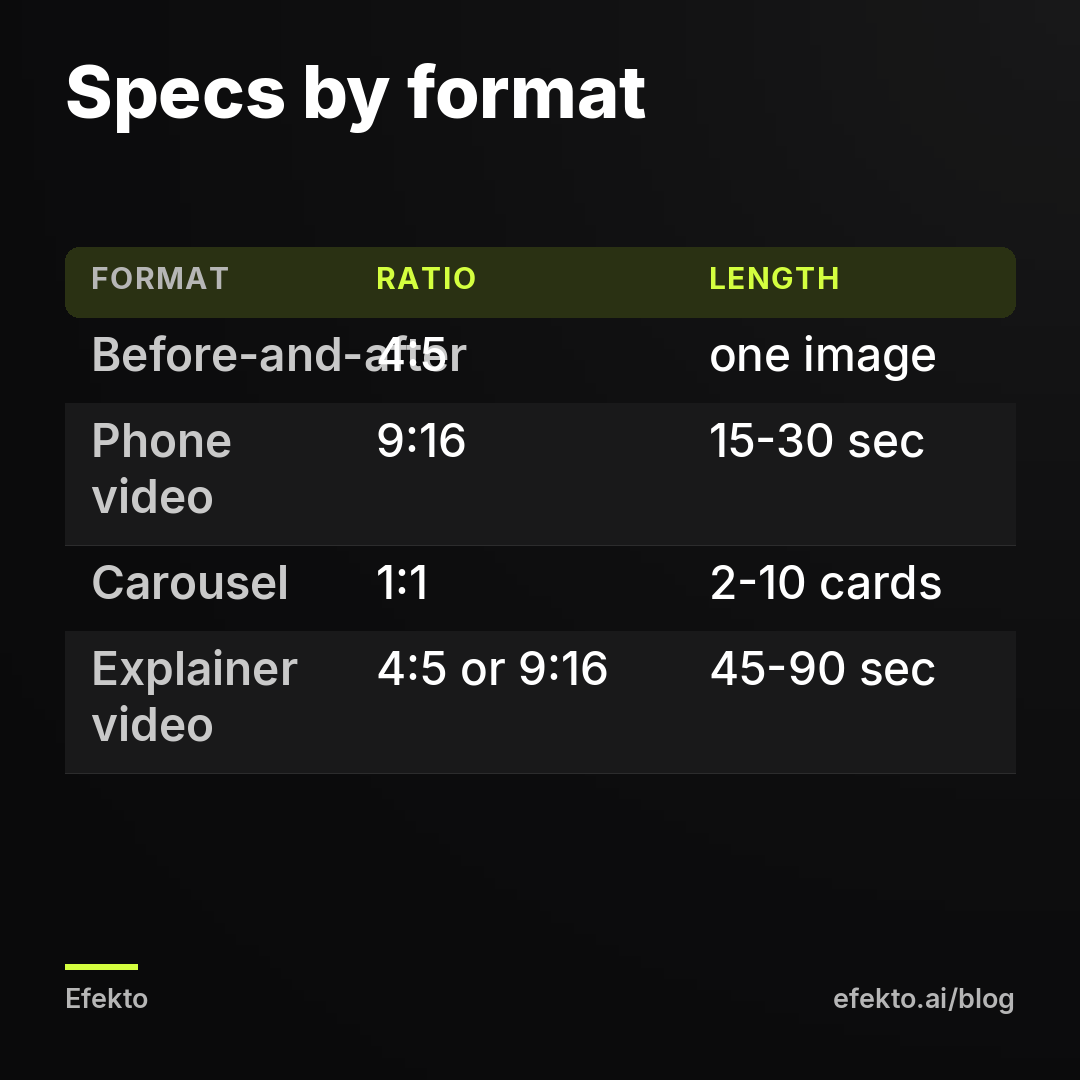
- 4:5 (1080 x 1350 px) for the Facebook and Instagram feed. It takes more screen space on a phone than a square.
- Split top and bottom, not side by side. In a square image on a phone, a side-by-side split makes each half about the size of a postage stamp.
- Same angle, same distance, same light in both shots. If the "after" is shot at noon and the "before" at dusk, people assume you staged it.
- Small "Before" and "After" labels in a corner. That is all the text the image needs.
- A 9:16 (1080 x 1920 px) version for Stories and Reels, with both halves stacked.
Where it backfires: jobs with an invisible result. A tuned furnace, a cleared drain or a rewired panel looks the same before and after. Forcing it means a dirty filter next to a clean one, which reads as a stock trick.
Health and body-related services need extra care. Meta's advertising standards restrict before-and-after images tied to weight loss and some health or cosmetic claims, so a med spa or dental practice should read the current policy before running one. A rejected ad costs you days of learning, not just one ad.
2. What should the ad show if your work is not photogenic?
Show the people and the truck. For HVAC, plumbing, electrical and pest control, one real photo of your technician at a customer's door does more than any graphic: the team in uniform, the branded van in a driveway, the owner next to a new unit.
This fits trades where the buyer's real question is "who is coming into my house?" Trust is the product, so the face is the creative. Use 4:5 for feed, 1:1 (1080 x 1080 px) if you only want one file, and 9:16 for Stories and Reels.
The way this format fails is the stock photo. A smiling model in a spotless polo holding a wrench makes you look like every lead reseller in your area, because people have seen that exact photo a thousand times. We would rather run a slightly blurry phone shot of your real crew than a perfect stock image.
On text: Meta dropped its old limit on text in images years ago, but an image covered in words still reads badly at phone size. One short line, like the offer or the city name, and the rest goes in the primary text.
3. Do short phone videos work better than images for local ads?
Often, if the job has motion worth watching. A 15-30 second vertical clip filmed on your phone during the job is the second format we would test, and for some trades it beats the image: foam going on a car, old shingles coming off, a patio turning clean under a pressure washer, the owner saying three sentences to camera.
Good fit:
- The process is satisfying to watch: detailing, pressure washing, carpet cleaning, roof tear-offs.
- The owner is comfortable on camera and the business sells on personality.
- You need to explain one thing fast, like "we give you a fixed price before we start."
Settings:
- Vertical, 9:16, 1080 x 1920 px. That fills the screen in Reels and Stories.
- 15-30 seconds. Meta accepts much longer videos, but a stranger who has never heard of you rarely watches past half a minute.
- The result or the problem in the first 3 seconds. Not your logo, not "Hi, I'm Mike from...".
- Burned-in captions. Many people scroll with the sound off.
- Text and faces away from the edges.
- A 4:5 crop of the same clip for the feed.
Bad fit: no real footage. A slideshow of stock clips with music loses to a single honest photo. So does an owner reading a script off a screen, which viewers spot in two seconds. If you are not comfortable on camera, film your hands and the work and let captions carry the message.
4. When is a carousel of services worth running?
Only when you sell several services that different people buy. A carousel is the most overused format in local advertising: it looks thorough, but most people only see the first card or two.
The format: 2-10 swipeable cards in one ad, each with its own image, headline and link. Square 1:1 (1080 x 1080 px) is the safe choice; 4:5 is also supported.
Worth it for:
- A home services company doing gutter cleaning, window cleaning and pressure washing, where each service attracts a different customer.
- A detailer with three clear packages: interior, exterior, full detail with ceramic coating.
- Setups where each card links to its own page or form question, so you learn which service people actually want.
Setup: 3-5 cards, not 10. The strongest service goes first, because that card does most of the work. One service per card, a price or "from $X" if you are comfortable showing it, and a final card with the offer and the button.
Skip it if you do one thing. A roofer with five cards of five roofs is running a single image ad with extra steps. It also fails when every card links to the same homepage, which throws away the carousel's one advantage: finding out which service pulls.
The second trap is browsing. People swipe, tap a card out of curiosity, look and leave. A format can win on clicks and lose on customers, so judge it by submitted forms, never by click-through rate.
From our accounts: over 14 days of our lead form campaigns in October 2026, the share of clicks that ended in a submitted lead form was 4.9% for business loans, 6.1% for solar, 6.5% for business electricity and 8.1% for mortgages. These are not service trades, but they show the size of the drop: even in well-run campaigns, more than 9 out of 10 clicks never turn into a form. A format that adds curious clicks without adding forms makes that drop steeper.
For example, say you spend $420 over 14 days on each of two ads. The carousel brings 300 clicks and the single image brings 200. If the carousel's clicks submit at 4.9%, you get about 15 forms. If the image's clicks submit at 8.1%, you get about 16. The ad that "lost" on clicks won on leads. The two rates are borrowed from the case above purely as reference points; your own account will show its own numbers.
5. Can a carousel tell the story of one job?
Yes, and for bigger jobs this is the better use of a carousel. Instead of five services, you show one job in four steps. For a roofer: card 1, storm-damaged shingles; card 2, tear-off; card 3, finished roof; card 4, "Free roof inspection in [your area]" with the button.
It pays off on jobs worth thousands of dollars where the process builds trust: roof replacement, bathroom remodels, fence installs, HVAC system replacements. The homeowner wants proof that you do the boring parts properly, not just that the result looks nice.
Specs: 1:1 or 4:5, 3-5 cards, one short headline per card that reads like a caption ("Day 1: old roof off"). Here all cards can link to the same form, because the point is the story, not the split.
Nobody needs a four-step story about a $150 gutter cleaning, so leave this format to high-ticket work. And if your middle steps are piles of debris, cut them: a before-and-after image tells the same story in one frame.
6. When should you run a longer explainer video?
When the purchase is big, slow and scary. A 45-90 second clip, usually the owner or lead tech talking to camera or walking through a job, fits high-ticket services, but not as the first ad a stranger sees. Use 4:5 for feed and 9:16 for Reels.
Use it for:
- Roof replacement, HVAC system replacement, dental implants, solar, foundation repair.
- A second ad to people who already watched your short video or visited your site. Someone who has seen you once will give you a minute; a stranger will not.
- The fear of being upsold. "Here's exactly what happens in a free inspection, and here's what we won't do" handles that objection better than any image.
Don't use it for cheap, quick decisions, or as your only ad. One 90-second video shown to cold audiences means most of your budget pays for people who watched four seconds.
7. Should you let Meta change your ad automatically?
Not without checking what it changes. Meta's Advantage+ creative options can crop, brighten, add music, rewrite text and expand or generate parts of an image, and several are switched on by default when you create an ad.
We make money running ads on Meta's platforms, so we are not neutral about Meta, but this is a practice we push back on. Automatic cropping to fit placements is usually harmless. A generated background or an "enhanced" before-and-after photo is not: it is no longer a photo of your work. If a customer later sees a roof that looks different from the ad, you have a trust problem and possibly a complaint.
What we would do:
- Keep placement cropping, but open the preview for feed, Stories and Reels and fix any crop that cuts off the "after" half or the technician's face.
- Turn off anything that generates or alters image content on before-and-after and job photos.
- Test text variations only if you would be happy to see every version published under your name.
The rest of these settings are in our post on whether a small business should turn on Advantage+.
8. How do you pick the winning format on a small budget?
Run two formats against each other with everything else locked, and decide by forms and booked jobs. Not by likes, not by click-through rate.
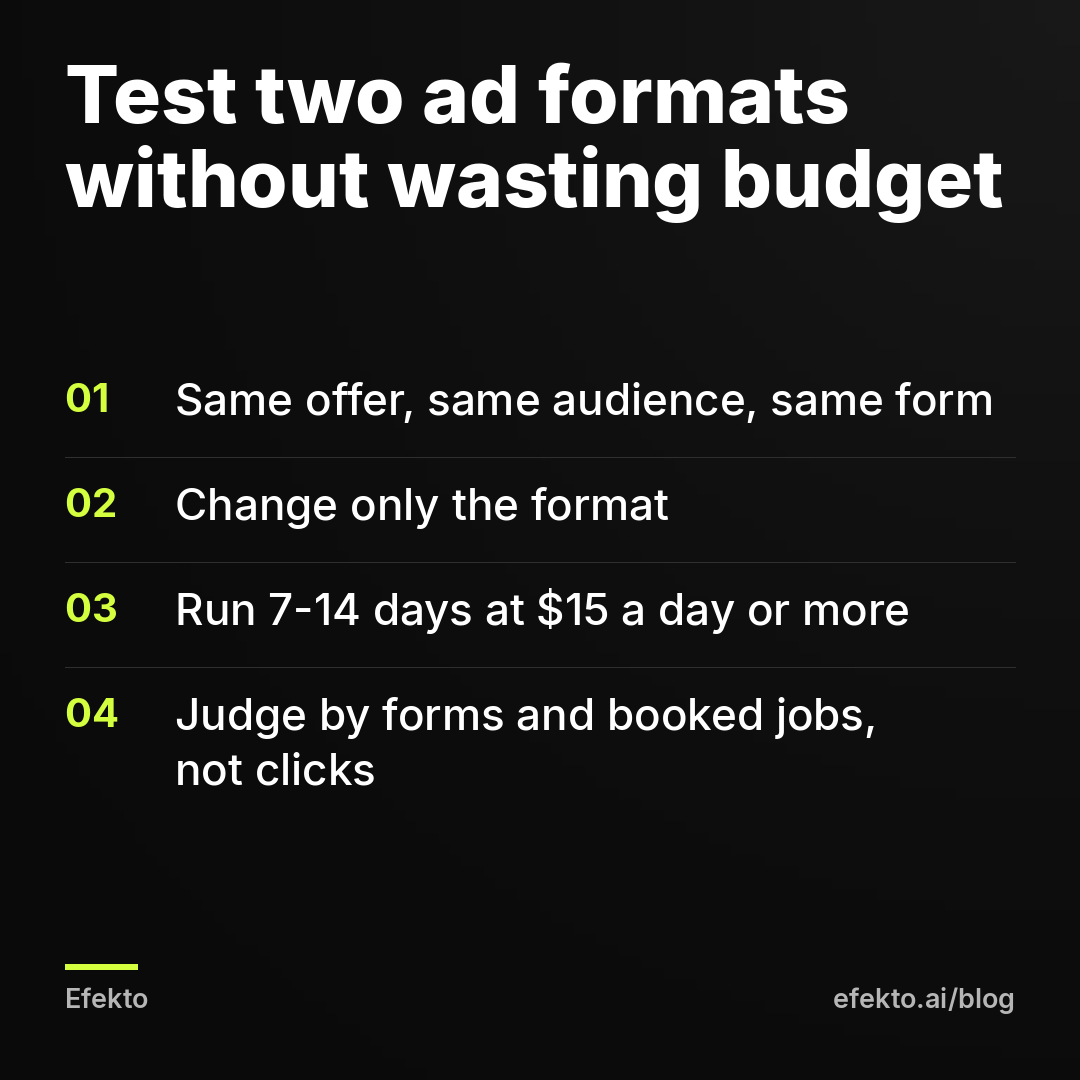
Step by step:
- Pick one offer. "Free roof inspection" or "Interior detail, $X this month." Word for word the same primary text in both ads.
- Pick two formats, not four. For most businesses: before-and-after image vs 15-30 second phone video. At $15 to $30 a day, four formats split the budget so thin that none gets enough data.
- Same audience, same form, same ad set. Both ads in one ad set so Meta can deliver both. If one gets almost no spend after 3 days, that is already a signal, not a bug.
- Wait 7-14 days. Fewer than 7 days is noise. Past 14 on a small budget, you are paying to confirm what you already know.
- Count forms, then booked jobs. Write down how many forms each ad brought and how many turned into a booked job. The second number decides.
- Keep the winner, replace the loser with a new version of the winner. If the before-and-after won, the next test is a different before-and-after, not a carousel.
Whatever wins will tire. The same image shown to the same few thousand people in your area wears out, usually within weeks on a small local audience; the signs are in our post on why Facebook ads stop working after two weeks. Have a fresh version of your best format ready before you need it.
If you would rather not run this cycle by hand, this is the work Efekto does. Efekto creates ads from your website, publishes them, and optimizes them every day: it turns off the ones that don't bring results and scales the ones that do. It makes both images and videos (the Starter plan at $149 per month includes 60 images and 6 videos per month), you approve at least 5 ads before the campaign starts, and the minimum ad budget is $15 per day. The details are on how Efekto works.
An app is the wrong buy if someone in-house already films jobs every week and manages Ads Manager well. And if you cannot commit $15 a day for at least two weeks, no tool will produce a fair test; fix the budget or start with your Google Business Profile and referrals.
Summary: which Facebook ad format fits which business?
| Format | Best for | Size we would use | Length / cards | Skip it when |
|---|---|---|---|---|
| Before-and-after image | Detailing, roofing, pressure washing, landscaping, cleaning | 4:5, 1080 x 1350 px (plus 9:16) | One image, top/bottom split | The result is invisible, or health and body claims are involved |
| Image of team, truck or job | HVAC, plumbing, electrical, pest control | 4:5 or 1:1, 1080 x 1080 px | One image, one line of text | You only have stock photos |
| Short phone video | Process jobs, owner-led businesses | 9:16, 1080 x 1920 px (plus 4:5 crop) | 15-30 seconds, hook in first 3 | No real footage, scripted talking head |
| Carousel of services | Several services with different buyers | 1:1 or 4:5 | 3-5 cards (2-10 allowed) | You sell one service, or all cards link to one page |
| Carousel of one job | Big jobs: roofs, remodels, HVAC replacement | 1:1 or 4:5 | 3-5 cards as steps | Low-ticket jobs, boring middle steps |
| Longer explainer video | High-ticket, slow decisions; retargeting | 4:5 or 9:16 | 45-90 seconds | Cheap quick jobs, or as your only cold ad |
Our position, plainly: most local businesses that start with a carousel or a polished brand video are solving the wrong problem. Start with one honest before-and-after or job photo and one phone video, test them for two weeks, and add other formats only once you know which of the two books jobs.
FAQ
What is the best image size for Facebook ads in 2026?
For the feed, 1080 x 1350 px (4:5) takes the most space on a phone and is our default. Make a 1080 x 1920 px (9:16) version for Stories and Reels. A single 1080 x 1080 px (1:1) file works in most placements but wastes vertical screen space.
Do Facebook video ads cost more than image ads?
Meta does not charge more for a format; you pay for delivery in the same auction either way. What changes is how many people stop, click and fill out the form, so one format can end up cheaper per lead than another. Compare formats by cost per submitted form and per booked job, not by cost per view.
How many ads should a small local business run at once?
On $15 to $30 a day, two to four ads in one ad set is plenty. More spreads the budget so thin that no ad collects enough results to judge. Add new ads when an existing one stops bringing forms, not to fill the ad set.
Can I reuse my Instagram Reels as Facebook ads?
Yes, if they are vertical, under about 30 seconds for cold audiences and start with the result in the first 3 seconds. Keep captions and faces away from the top and bottom of the frame, where Meta places buttons and text. Remove trending music you do not have rights to use in ads.
If you want images and videos made from your site and tested for you every day, you can start with Efekto.
- Jakub Zwoliński
Founder, Lemon Agency · Efekto · October 30, 2026