Facebook Ad Set Stuck in 'Learning Limited'? What It Means on a Small Budget
Learning Limited means Meta expects your ad set won't get about 50 results a week. On a small local budget that's normal. Here is how to check it and the three fixes that work.

Learning Limited means Meta has predicted that your ad set won't get the roughly 50 results in 7 days it needs to finish its learning phase. The usual causes are a budget that is too small for your cost per result, or a budget split across too many ad sets. On a small local budget this is the normal state. It does not mean your ads are failing. An ad set at $15 a day that brings leads at a price you can live with is doing its job, with or without the label. Fix it only when leads are too expensive or too few. When you do, the fixes are almost always the same three: fewer ad sets, one combined audience, and a conversion goal that happens more often.
In short:
- Learning Limited is a forecast about volume, not a verdict on quality: Meta expects fewer results than it needs to stabilize delivery.
- On a small local budget the math rarely reaches about 50 results a week, so judge the ad set by cost per booked job, not by the label.
- When results are bad, consolidate first: one campaign, one ad set, one broad audience covering your service area, optimized for leads rather than a rare event.
One disclosure before we start. We make money when businesses advertise on Meta, through Lemon Agency and through Efekto, and we have managed over $1M in ad spend for clients. We have also watched plenty of owners kill campaigns that were working because a yellow label scared them. This post is about telling those two situations apart.
What does "Learning Limited" mean on Facebook ads?
It means your ad set is still in the learning phase and Meta doesn't expect it to get enough results to leave that phase any time soon. You see it in the Delivery column of Ads Manager, next to the ad set name.
The learning phase comes from how Meta delivers ads. When you launch an ad set or make a significant change to it, the system doesn't yet know which people, placements and times produce the result you asked for. So it experiments. It shows the ads to different slices of your audience and watches who converts. Meta describes this in its Business Help Center article About the learning phase. The article says performance is less stable during this period and cost per result is usually higher.
An ad set leaves learning once it has collected enough optimization events, which are the results you chose to optimize for. When Meta predicts that won't happen, the status changes from Learning to Learning Limited.
Three things the label does not mean:
- The ad set isn't paused. It keeps delivering and keeps spending your budget.
- Your ads haven't been rejected. Rejection shows up as a separate status with a policy reason.
- Your leads aren't fake or worse. The label is about how many results come in, not who those people are.
How many results does an ad set need to exit the learning phase?
According to Meta's documentation, an ad set generally exits the learning phase after about 50 optimization events within 7 days of its last significant edit. That works out to roughly 7 results a day, every day, for a week.
For a local service business this is a high bar. The number Meta counts is the result you optimize for. If you optimize for leads, it means 50 leads. If you optimize for a purchase or a booked appointment tracked by the pixel, it means 50 of those, and they are much rarer.
Here is the math. Weekly results equal daily budget times 7, divided by your cost per result. The table uses example costs per lead, not market rates. Your own numbers will differ.
| Daily budget (example) | Weekly spend | Results/week at $20 per lead | at $30 per lead | at $50 per lead |
|---|---|---|---|---|
| $15 | $105 | about 5 | about 3.5 | about 2 |
| $40 | $280 | 14 | about 9 | about 5.5 |
| $100 | $700 | 35 | about 23 | 14 |
| $214 | about $1,500 | about 75 | about 50 | 30 |
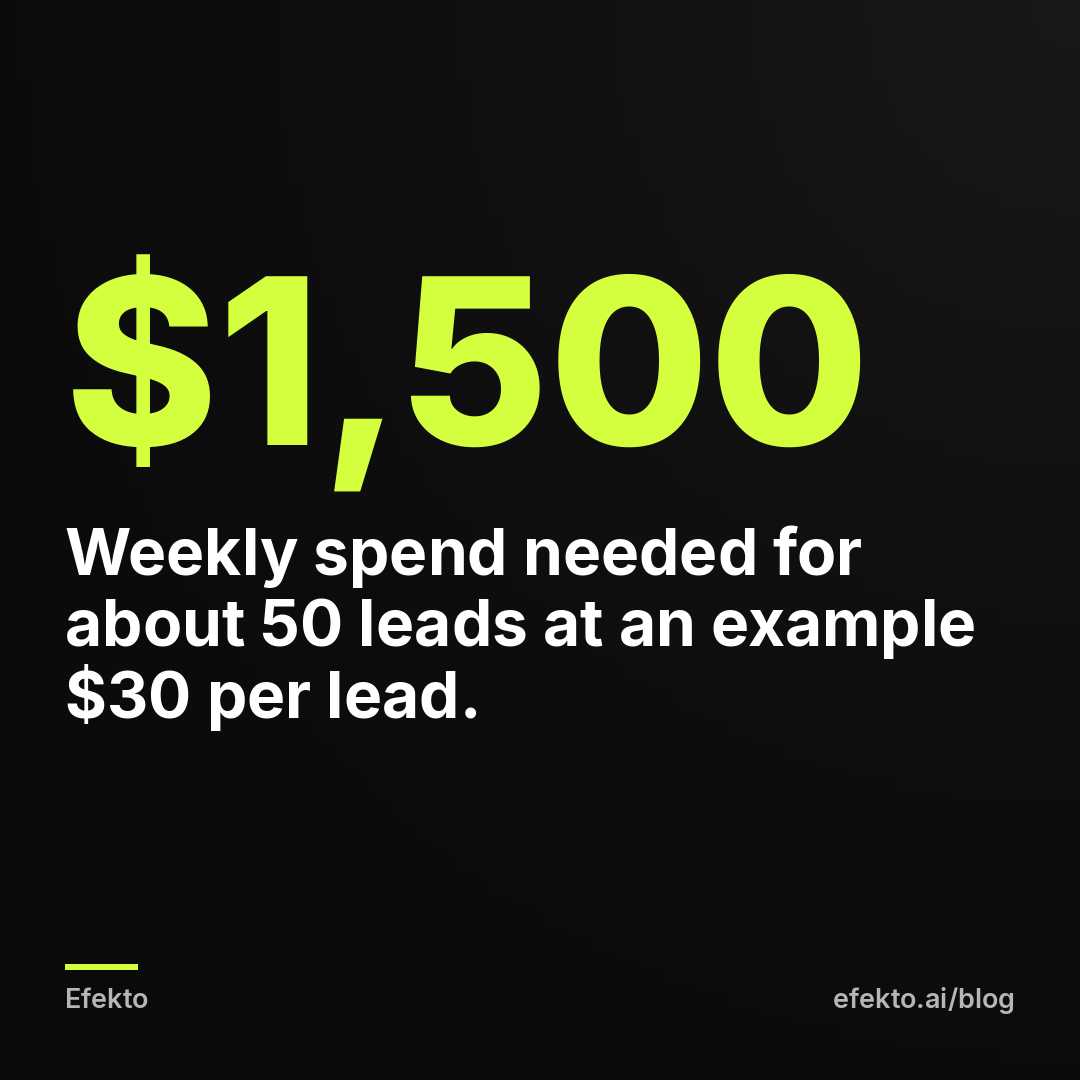
Read the last row in the middle column. At $30 per lead, getting 50 leads a week takes about $1,500 a week. Most small detailing shops, med spas and roofing crews don't spend that on ads, and they shouldn't feel they have to. If your cost per lead is in that range and your budget is smaller, Learning Limited is not a setup error. It is arithmetic.
Should you worry about Learning Limited on a small budget?
Usually not. Worry about your cost per lead and whether those leads turn into jobs. The label tells you delivery will be less stable and that costs may run higher than in a fully learned ad set. It doesn't tell you whether you are making money.
Our position is simple. For a business spending under about $100 a day, Learning Limited is the default, and chasing the green "Active" status is a bad reason to change anything. The test we use takes ten minutes a week:
- Cost per lead over the last 14 days. Use 14 days, not 3. On a small budget, three days is too few results to mean anything.
- Cost per qualified lead. Meta reports cost per lead before anyone has checked the lead. If you get 10 leads for $300, Meta shows $30 per lead. If only 6 of them were real people in your area who wanted the service, your real cost is $50. That gap is invisible in Ads Manager and it is the number that matters.
- Cost per booked job. If those 6 qualified leads produced 2 jobs, each job cost $150 in ads. Compare that with your average job value and margin.
If step 3 works for your business, leave the ad set alone, label included. If it doesn't, the label is one possible cause, and the causes below are where to look. For a deeper walk through these numbers, see our guide on what counts as a good cost per lead for a local business.
Why is my ad set stuck in Learning Limited?
The causes below are in the order we see them, most common first. Meta's own help pages list the same family of reasons: budget, audience size, bid limits, too many ad sets and frequent edits. Each cause comes with a way to check it and a way to fix it.
1. The budget can't buy enough results
How to check: Multiply your daily budget by 7 and divide by your cost per result over the last 14 days. If the answer is far below 50, this is your main cause, and probably the only one.
How to fix: You have two honest options. Raise the budget until the math gets close to 50, if your cost per booked job justifies it. Or accept the label and judge the ad set by cost per booked job. What doesn't work is splitting the budget in an attempt to "test more". That makes every piece smaller.
2. The budget is spread across too many ad sets
How to check: Count the active ad sets that serve the same goal in the same area. Three ad sets at $15 each look like a $45 campaign. To Meta, they are three separate $15 experiments that each learn on their own. Each one collects a third of the data.
How to fix: Merge them into one ad set (steps in the next section). A single ad set at $45 a day collects all the results in one place. It may still show Learning Limited, but it learns three times faster than any of the three pieces did.
3. The audience is split or squeezed too narrow
How to check: Look at your targeting. Common patterns are separate ad sets per zip code, per age bracket, per interest ("homeowners", "new movers", "luxury cars"), or a tight 3-mile radius around a dense neighborhood. Also look at the Audience overlap tool if you have several ad sets in the same area. Ad sets with overlapping audiences bid against each other.
How to fix: Use one ad set with one location setting that covers your real service area. Set age broadly unless the law or your service requires a limit. Use detailed targeting only as a suggestion, or leave it off. For local services, the location does most of the targeting work. Our guide on targeting homeowners in your service area covers radius and zip code choices in detail.
4. The ad set optimizes for an event that rarely happens
How to check: In the ad set, look at the performance goal and the conversion event. If it is a purchase, a "booked appointment" custom conversion, or a thank-you page that only paying customers reach, ask yourself how many of those happen per week from ads. If the honest answer is 3, Meta has 3 signals a week to learn from.
How to fix: Move one step up the funnel to an event that happens more often, usually a lead. Don't move too far up. More on that in the conversion goal section below.
5. Frequent edits keep restarting learning
How to check: Open the ad set's activity history (the clock icon in Ads Manager, or History in the side panel). If you see targeting tweaks, new ads, or budget jumps every two or three days, the ad set has never had 7 quiet days to collect results.
How to fix: Batch your changes and make them once a week. The section on edits below lists which changes count as significant.
6. A bid cap or cost cap is set too low
How to check: In the ad set, look at the bid strategy. If it says Bid cap or Cost per result goal and the number is below what you actually pay, Meta will skip most auctions. Delivery stalls and Learning Limited follows. This often shows up together with an ad set that won't spend its budget. That problem has its own guide: why a Facebook ad isn't spending its budget.
How to fix: On a small budget, switch to Highest volume, which is the default. Caps make sense when you have enough volume to give up some of it. At $15 to $50 a day you don't.
How do you combine ad sets and audiences without losing control?
Build one ad set that holds everything the old ones did, then let the ads compete inside it. That way you still find out which offer or photo works. You read it at the ad level instead of the ad set level.
Step by step in Ads Manager:
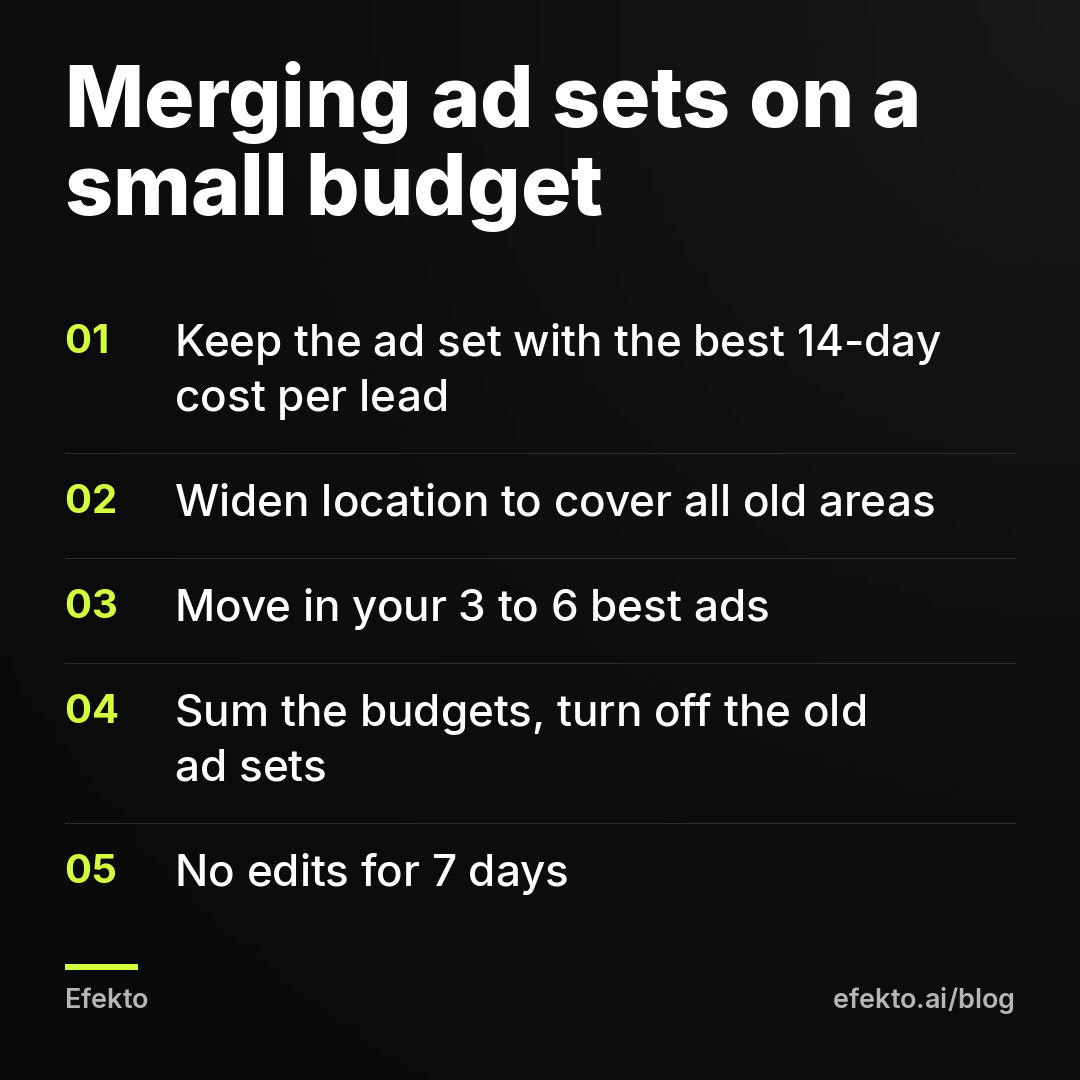
- Pick the ad set with the best cost per lead over the last 14 days. Don't use the one with the lowest cost per click. You keep it as the base, so its history isn't thrown away.
- Duplicate it and use the copy as the combined ad set, or edit the original if it has been running less than a week.
- Widen the location to cover all the areas the old ad sets covered. If you had separate zip code ad sets, list all the zip codes in one ad set, or use one radius that covers them.
- Remove the splitting conditions. Drop the narrow age brackets and stacked interests. If you ran separate ad sets for Facebook and Instagram, turn on Advantage+ placements instead.
- Move the ads in. Bring in your 3 to 6 best ads from the old ad sets. More than about 6 ads on $15 to $40 a day means most ads never get enough impressions to show whether they work.
- Set the budget to the sum of the old ad sets' budgets.
- Turn off the old ad sets at the same moment you turn on the new one. If both run, they compete for the same people.
- Leave it alone for 7 days. Check spend daily if you want, but don't edit.
The usual objection is: "but then I can't tell which neighborhood works." You can. Ads Manager's Breakdown menu shows results by region, age and placement inside one ad set. You lose nothing except the budget fragmentation.
When should you not combine? When two ad sets truly serve different businesses. A roofing company running storm-repair ads in one state and gutter installation in another, with different offers, forms and crews, is two campaigns. Combine ad sets that only differ by targeting slices, not ones that differ by what you sell.
Which conversion goal should a local service business optimize for?
For most local service businesses: leads, through a Meta instant form or a website form tracked by the pixel. A lead happens often enough to give Meta signal on a small budget and is close enough to a sale to stay useful.
The trade-off works like a ladder. Events lower down happen more often, which helps learning. Events higher up are closer to money, which helps quality. Pick the highest step your budget can feed.
| Optimization event | How often it happens | How close to a paying customer | When it makes sense |
|---|---|---|---|
| Purchase or booked appointment (pixel or CRM event) | Rarest | Closest | Your budget can fund around 50 of them a week |
| Lead, instant form set to Higher intent | Frequent | Close, the extra review step filters casual taps | Most local service businesses on a small budget |
| Lead, instant form set to More volume | Most frequent of the lead options | Further, more junk | Only if Higher intent brings too few leads |
| Landing page views | Very frequent | Far | Building a retargeting audience, not for leads |
| Link clicks | Most frequent | Furthest | Almost never for a service business |
The mistake we see most often goes in the wrong direction. Someone reads that Learning Limited means "not enough events" and switches the ad set to link clicks. The label goes away, because clicks are cheap and plentiful. Then Meta does exactly what it was told and finds people who click, not people who call. The dashboard turns green and the phone stays quiet. Learning Limited on leads beats "Active" on clicks every time.
If you switch from a website conversion to an instant form, set the form up so it filters. Ask one question that a real customer can answer and a casual scroller won't bother with, like the vehicle type or the age of the roof. Our guide to setting up instant forms that bring real customers walks through each field.
Which edits reset the learning phase, and how often can you change things?
According to Meta's documentation, learning restarts after a significant edit. Significant edits include changes to targeting, creative or the optimization event, adding a new ad, changing the bid strategy, pausing the ad set for 7 days or longer, and changing the budget by a large amount. Meta doesn't publish an exact budget threshold. In our accounts we keep budget changes to roughly a fifth of the current budget at a time, and we space them out.
| Change | Restarts learning? | How we handle it on a small budget |
|---|---|---|
| New targeting or location | Yes | Plan it once, at the weekly review |
| Adding a new ad | Yes | Add 1 or 2 ads per week, at the review |
| Switching the optimization event | Yes | Only when cost per booked job says the current one fails |
| Large budget jump | Yes | Raise in small steps a few days apart |
| Small budget change | Usually no | Fine when needed |
| Pausing for a few days | Usually no | Fine for holidays or a full schedule |
| Pausing a week or longer | Yes | Expect a slower restart |
The practical rule: one review a week, one batch of changes, then 7 days of quiet. On $20 a day, an ad set edited every other day never gets the data it needs. An ad set left alone for a week at least gets a clean read. If you want a template for that weekly review, our post on reading your Facebook ads results in 10 minutes a week gives you the exact columns to check.
Ad fatigue is the exception that tempts people into daily edits. If one ad's cost per lead has doubled and its frequency is climbing, replace it. Do it at the weekly review, not the morning you notice.
What does fixing Learning Limited look like in practice?
Here is a worked example with made-up numbers for an HVAC company. It shows the mechanism, not a result from any real account.
Before. Say an HVAC company spends $40 a day split across three ad sets: one for AC tune-ups in the city, one for AC tune-ups in the suburbs, one for furnace replacement across both. Each gets about $13 a day, or about $93 a week. At $35 per lead, each ad set brings in under 3 leads a week. All three show Learning Limited, and none of them learns much from 2 or 3 signals. The owner sees costs swinging from $20 one week to $60 the next. That swing is just small numbers, not anything the ads are doing.
What we would change.
- Keep furnace replacement separate only if it has its own offer and form. If the tune-up and replacement ads both ask for a home visit, they belong in one ad set.
- Merge the city and suburb ad sets into one location setting covering both.
- Keep the 5 best ads across all three ad sets. Turn the rest off.
- Optimize for leads with a Higher intent instant form that asks for the system's age.
- Run $40 a day in one ad set and don't touch it for 7 days.
After, in the same example. $280 a week at $35 per lead is 8 leads a week, all teaching one ad set. The status will very likely still say Learning Limited, because 8 is not 50. What changes is that each ad gets enough impressions to compare, and the weekly cost settles down. Follow the chain through. Say 5 of the 8 leads answer the phone and qualify, and 2 of those book. At an example average ticket of $450, that's $900 in jobs from $280 in ads. Your margin decides whether that works. The label doesn't.
The chain also shows where the money leaks if leads aren't called back fast. Two booked jobs from 8 leads depends on someone picking up the phone within minutes. Fixing the ad set does nothing if leads sit until evening.
When is it not worth fixing Learning Limited?
In several situations the right answer is to leave it or to stop.
- Your cost per booked job already works. Leave it. Edits restart learning and can make a working ad set worse for a week.
- You already run one ad set, one broad audience, and a lead goal. There is nothing left to consolidate. Your remaining lever is budget, and that's a business decision about job value, not an ads setting.
- Your service area is tiny or rural. If your whole area has a few thousand adults and you need a narrow kind of customer, Meta may never find enough people. A wider radius can help. If you can't serve a wider area, a local channel such as Google search ads, where people type what they need, may simply fit better.
- The offer is the problem. If people see the ads, the click-through rate is low, and nobody fills the form, no amount of restructuring helps. Rewrite the offer first.
- The budget is below what one job is worth testing. If a single booked job is worth $300 and your cost per lead is $40, a $10-a-day test produces about 2 leads a week. That's too few to judge anything in a month. Either fund a real test or wait until you can.
Can an app keep your ad set out of Learning Limited?
No app can change the math above, including ours. Efekto creates ads from your website, publishes them, and optimizes them every day: it turns off the ones that don't bring results and scales the ones that do. The minimum budget is $15 per day. At that level your ad set will show Learning Limited most weeks, just as it would if you built it by hand. What it does remove is the part where owners make things worse: splitting budgets into many small ad sets, and editing every couple of days because a number looked bad. You can see the structure it uses on the how Efekto works page.
When it isn't worth it: if you already run one consolidated ad set, check it once a week, and your cost per booked job is fine, an app adds a monthly fee to something that already works. Keep doing what you're doing. For everyone else, the Starter plan is $149 per month. The 7-day free trial counts from the launch of your first campaign, and you don't need a card to sign up.
What we do in our own accounts is consistent. On small local budgets we accept Learning Limited, we run one ad set per offer, we optimize for leads that pass a qualifying question, and we judge every ad set by cost per booked job after two weeks, never by the color of a label after two days.
FAQ
Does Learning Limited mean my ads are being shown less?
No, the ad set keeps delivering and spends its budget as usual. The label means Meta expects too few results to finish learning, so delivery and cost per result can swing more from week to week than in a fully learned ad set.
Should I duplicate an ad set that's stuck in Learning Limited?
Usually no. A duplicate starts learning from zero and, if both run, splits your budget and competes for the same people. Duplicate only when you're merging several ad sets into one and turning the old ones off at the same time.
How long can an ad set stay in Learning Limited?
As long as the volume stays below what Meta needs, which on a small budget can be indefinitely. That's fine if the cost per booked job works. Time alone doesn't clear the label; more results per week do.
Will raising my budget get me out of Learning Limited?
Only if the new budget can buy close to 50 results a week at your cost per result. Raise it in steps a few days apart, because a large jump counts as a significant edit and restarts learning. Raising from $15 to $25 a day is a reasonable test of more volume, but on its own it rarely removes the label.
Is Learning Limited the reason my cost per lead went up?
It can add some volatility, but on small budgets the bigger causes are usually ad fatigue, a weaker offer, or a recent edit. Compare the last 14 days with the 14 before, check ad frequency and the activity history, and change one thing at a time.
If you'd rather have the consolidated setup and the daily optimization done for you, you can start a trial at efekto.ai.
- Jakub Zwoliński
Founder, Lemon Agency · Efekto · October 26, 2026