Why Is My Facebook Ad Reach So Low in a Small Town or Rural Area?
Low Facebook reach in a small town usually comes from a tight radius, stacked interests and too many ad sets. How to check each cause and fix it in 10 minutes.

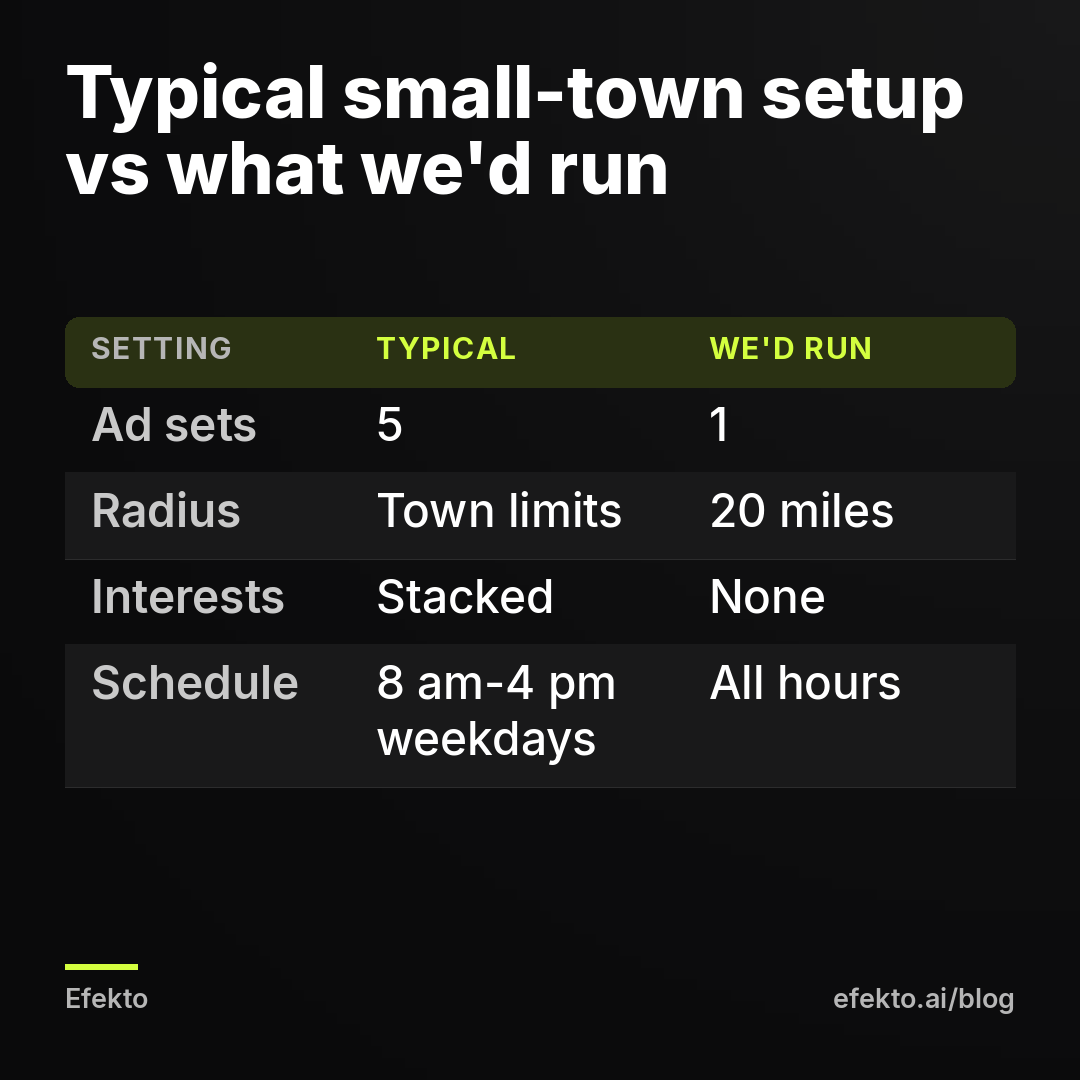
In a small town, low Facebook reach comes from two things. The first is simple math: only so many adults live within driving distance. The second is how most local ad accounts are set up. A tight radius, stacked interests, several ad sets and a weekday-only schedule each shrink that small number again.
Start checking in one place. Open your ad set and look at the estimated audience size under Audience. Then compare it with the Reach column for the last 7 days.
- If reach is already a large share of the audience, you don't have a reach problem. You have a small market, and you need fresh ads and realistic frequency.
- If reach is a small share of the audience, something in your setup is choking delivery. The sections below go through the usual suspects, most common first.
Our position, from running lead campaigns for more than 300 clients: in a small market, the fix is almost always to loosen settings, not tighten them. Owners in rural areas instinctively narrow everything down to "people like my customers." That works against them when the whole pool is a few thousand people. We make money when businesses advertise on Meta. That's exactly why the last section covers where Facebook isn't worth it for a rural business.
Is your radius smaller than the area your customers actually drive from?
Owners draw the circle around the town name, while their customers come from the whole county.
Symptom: The estimated audience shows a few thousand people. Reach stops growing after the first week, and frequency climbs past 4 within 7 days. Cost per result rises even though you changed nothing.
How to check:
- Go to Ads Manager > your ad set > Audience > Locations.
- See whether you targeted the town by name or with a pin and radius. A town name usually means the town's boundary only, not the farms and subdivisions around it.
- Write down the estimated audience size shown in the audience panel.
- Ask yourself: how far would I actually drive for a $500 job? If the answer is 30 miles and your radius is 5, that gap is your problem.
How to fix: Set the radius to the distance you'd really drive for a job. For a rural roofer, HVAC company or detailer with a mobile van, we'd usually start at 15-25 miles. You can also add the surrounding towns or ZIP codes one by one. If you get leads from places you won't serve, switch the location option from "people living in or recently in this location" to "people living in this location." Don't shrink the circle back down.
Here's what a wider radius does to how often the same person sees your ad. These are illustrative numbers, not data from our accounts.
For example: say your budget is $20 a day and you pay $12 per 1,000 impressions. That buys about 1,667 impressions a day, roughly 11,700 a week and 50,000 a month.
| Targeting (example) | Adults in audience | Impressions per person per week, if spread evenly | Per month |
|---|---|---|---|
| Town limits only | 6,000 | 1.9 | 8.3 |
| 15-mile radius | 30,000 | 0.39 | 1.7 |
| 25-mile radius | 70,000 | 0.17 | 0.71 |
Meta never spreads impressions evenly. It shows ads more often to the people most likely to respond, so real frequency in the "town only" row will be higher than 8 a month. At that point you're paying to show the same ad to the same 2,000 people again and again.
Did you stack interests, age and gender on top of a small town?
This is the second most common cause, and in a small town it's the most self-defeating. Interests like "Home improvement" or "Luxury cars" might cut a big-city audience from 2 million to 400,000, and that still works. In a 6,000-person town, the same cut leaves you with 1,200 people. Meta's interest data on rural users is also thinner, so some of your real customers get filtered out.
Symptom: The estimated audience is under 10,000 even with a reasonable radius. Your ads get few comments, and the leads you do get look nothing like your usual customer.
How to check: Open the ad set, go to Audience and look at the detailed targeting box. Count the interests, behaviors and demographics in it. Check the age range and gender too.
How to fix:
- Remove all interests.
- Set the age range to 25-65+, unless your service legally requires otherwise.
- Include all genders.
- Turn on Advantage+ audience if it's offered.
Your ad's image and headline do the targeting now. An ad that says "Roof leaking? Free inspection within 20 miles of [town]" filters people better than any interest checkbox. Give it 7 days before you judge it.
Are several ad sets fighting over the same few thousand people?
Often, yes. The setup usually comes from a template or an agency that builds the same structure for every client. One ad set for "homeowners," one for "retargeting," one for "lookalike," one per service, all aimed at the same town. In a city, that structure can work. In a rural market, all five ad sets show to largely the same people and bid against each other in the same auctions.
We'll say it plainly: selling a 5-ad-set structure to a business in a town of 6,000 is padding the setup. It looks thorough on a call. In the account it splits a small budget into pieces too small for any of them to learn.
Symptom: Each ad set gets 0-2 results a week. Several of them say "Learning limited." Reach per ad set is small, but frequency is high.
How to check: On the Ad Sets tab, filter by active. Count the ad sets that target the same location. Then check each one's daily budget. If you have 5 ad sets at $5 a day, you're running five starved campaigns instead of one fed one.
How to fix: Run one campaign with one ad set and put 3-6 ads inside it. Retargeting a small-town audience is rarely worth a separate ad set, because your main ad set already reaches most of the same people. To see what that "Learning limited" label means on a small budget and when to ignore it, we cover that in Learning Limited on a small budget.
Is your ad schedule cutting out the hours people actually respond?
If you turned on ad scheduling to run only during business hours, you probably cut your reach and your leads at the same time. Owners do this so they can answer the phone. The cost is that ads stop showing exactly when rural customers scroll: in the evening, after the kids are in bed, and on weekends.
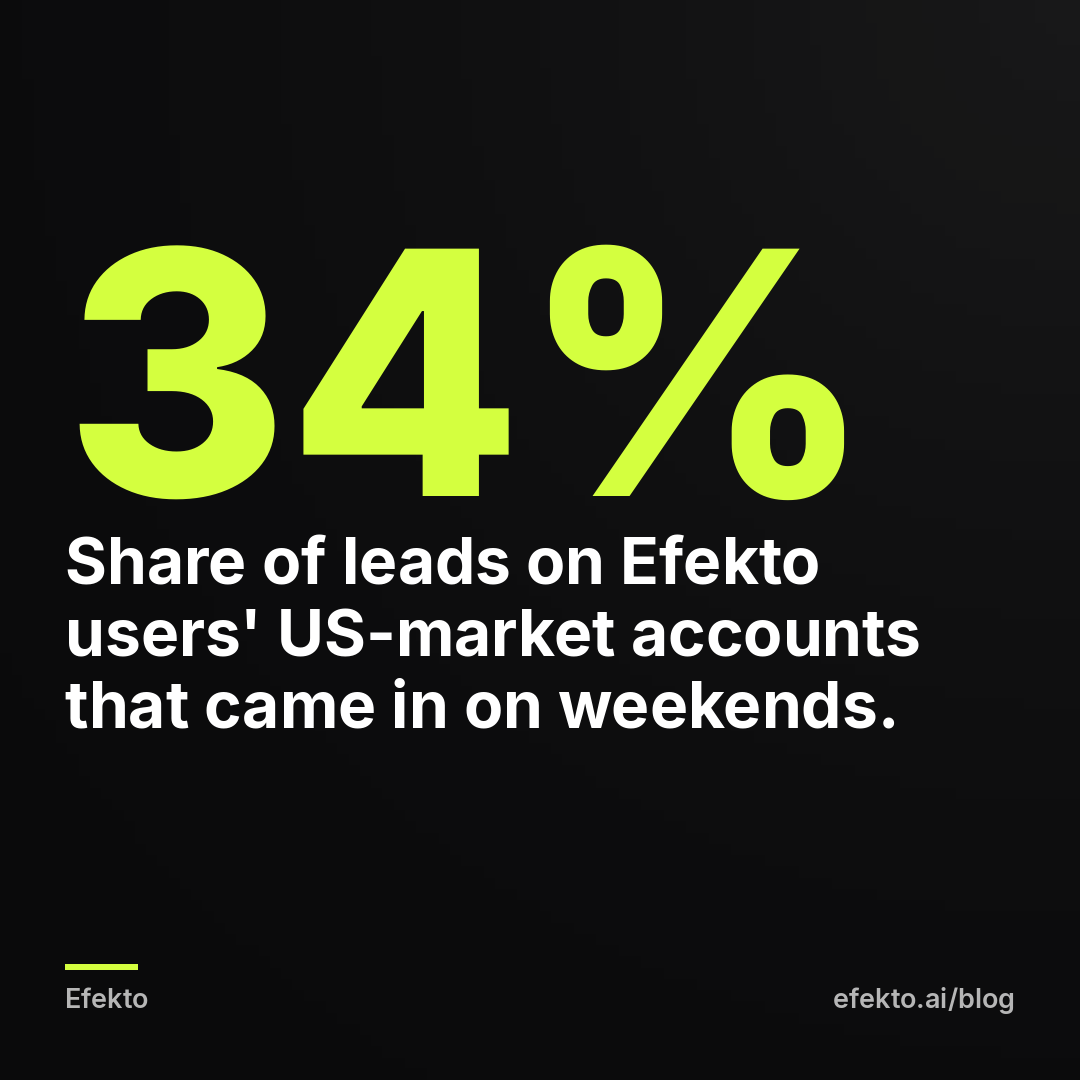
From our accounts: On Efekto users' accounts in English-speaking markets (mostly the US), we looked at 10 brands and 138 leads in the 180 days to Nov 8, 2026. 18% of leads came in after 6 pm, only 27% on weekdays between 8 am and 4 pm, and 34% on weekends. If you run ads only during weekday office hours, you're showing up for the slice of the week that brought about a quarter of the leads.
In a small audience, scheduling hurts twice. It shrinks the number of hours your ad can be shown. It also pushes all your budget into those hours, so frequency goes up while reach stays the same.
Symptom: Spend clusters in a few hours of the day. Weekend results are zero because the ads weren't running.
How to check: In the campaign, open the budget and schedule settings and see whether ads run all the time or on a schedule. Then use Breakdown > By Time > Day in Ads Manager to see which days deliver.
How to fix: Run ads at all hours. Handle the response problem on your side: put an auto-reply on lead forms, check leads twice in the evening, and call weekend leads first thing Monday. For more on timing, read our post on the best times and days to run Facebook ads for a local service business.
Is your reach low, or is your ad just not spending?
These look similar but have different causes. Low reach with steady spend means you're showing the same people your ad repeatedly. Low reach with low spend means Meta isn't delivering at all. That usually comes down to a rejected ad, a payment issue, a bid cap or an account restriction, not your town size.
How to check: Compare Amount spent with your daily budget over the last 7 days. If you spent less than 70% of the budget, start with our guide on why a Facebook ad isn't spending its budget. Fix delivery first, then come back to reach.
Are you only running in the Facebook feed?
If you manually chose placements and kept only the Facebook feed, you cut out the Instagram feed, Stories, Reels and Marketplace. Those are the same people in your town, on different screens. In a big market, losing a few placements barely matters. In a small one, it can cut the number of chances to reach someone this week by a meaningful share.
Symptom: The placement breakdown shows only one or two placements, and frequency rises quickly.
How to check: Open the ad set > Placements. If it says "Manual placements," see what's unchecked. Then go to Breakdown > By Delivery > Placement in the reporting view.
How to fix: Switch to Advantage+ placements. The only exception is Audience Network. If you see a spike of junk leads coming from it, turn it off and keep everything else.
Are people in your town seeing the same two ads for a month?
This is the cause owners notice last, and the one that costs the most over time. In a small town, your audience runs out of new faces quickly. Once that happens, the only thing left to change is what they see. Two ads running for 6 weeks to the same 8,000 people will wear out. You'll see it in the numbers, and sometimes in the comments ("I see this every time I open Facebook").
Symptom: Click-through rate falls week after week, and cost per result climbs. Comments turn sarcastic, and reach barely grows even with budget left.
How to check:
- Go to Columns > Customize columns and add Frequency and CTR (link click-through rate).
- Set the date range to the last 7 days and compare with the 7 days before that, at the ad level.
- If an ad's frequency rose and its CTR dropped by a third or more, that ad is tired.
How to fix: Build a rotation instead of waiting for ads to die. Here's how we'd set it up for a small market:
- Keep 3-6 ads live in the one ad set.
- Every 2-3 weeks, turn off the weakest 1-2 and add 1-2 new ones.
- Make new ads actually different. Change the photo, the angle (price, speed, reviews, a seasonal problem) or the format (image vs short video). Changing a single word in the headline doesn't count.
- Don't edit a running ad that works. Add a new one next to it.
This is the part we built Efekto to handle. Efekto creates ads from your website, publishes them, and optimizes them every day: it turns off the ones that don't bring results and scales the ones that do. On the Starter plan that's 60 images and 6 videos a month, enough to keep a small-town rotation fresh without you shooting new photos every two weeks. You can see the details on how Efekto works. If you'd rather do it by hand, the rotation rules above work the same way in Ads Manager.
What ad frequency is normal in a small town?
Higher than most online advice suggests, and that's fine as long as results hold. Advice written for national brands treats frequency above 2 as a warning sign. In a town where your realistic audience is 20,000 adults, a weekly frequency of 2-3 is the cost of being visible, not a mistake. What matters is whether CTR and cost per result hold up as frequency rises.
Here's how we'd read it. This is our rule of thumb, not a Meta benchmark:
| 7-day frequency | What it usually means in a small market | What we'd do |
|---|---|---|
| Under 1.5 | Plenty of room left in the audience | Leave targeting alone, check that budget is spending |
| 1.5-3 | Normal for a small town | Keep rotating 1-2 new ads every 2-3 weeks |
| 3-5 | Audience is getting saturated | Add 2-3 new ads now, widen the radius by 5-10 miles |
| Above 5, CTR down a third or more | Fatigue | Replace most ads, consider lowering the daily budget |
The last row is the one people get wrong. If you've widened the radius as far as you'll drive and frequency is still above 5, more budget won't buy more customers. It buys more repetitions. Lower the budget until frequency settles, and put the difference into something else.
To set expectations on speed, here's what we see on launches.
From our accounts: Of the 49 brands that launched a campaign in Efekto in the 180 days to Nov 8, 2026, 28 have already received a lead. The median time from launch to the first lead was 9.7 hours, and 22 of them got one within 24 hours.
That's across all markets, not only small towns. Read it both ways. A first lead within a day is common. But 21 of the 49 brands hadn't received one yet, so a slow start doesn't automatically mean your setup is broken. In a rural market, judge a campaign after 7-14 days of full spend, not after one afternoon.
When is Facebook the wrong channel for a rural business?
When the honest audience is too small to carry even a minimum budget. Here's the test we'd use.
For example: your service area is a town of 3,000 adults, and you can't serve anyone more than 10 miles out. That's about 12 per adult per month. You'll get some leads in month one. By month three, you'll mostly be paying to remind the same people.
In that situation, we'd tell you not to run continuous Facebook ads, including with us. Better options:
- Run Facebook in bursts. Run 2-3 weeks around a seasonal trigger (first freeze for HVAC, spring storms for roofing), then pause.
- Use Google for the people already searching for your service. Search volume in small towns is low, but intent is high.
- Go after referrals and local presence. Ask for reviews, sponsor the high school team and put your name on the truck. In a town where everyone knows everyone, these often beat any ad.
If your real service area holds 30,000 people or more, Facebook can run year-round. The setup just has to be loose enough to use all of them.
10-minute checklist
- Estimated audience size noted and compared with 7-day reach
- Radius matches how far you'd actually drive for a job (we'd start at 15-25 miles in rural areas)
- Interests removed, age 25-65+, all genders
- One campaign, one ad set per service area, no overlapping ad sets
- Ad schedule off, ads running evenings and weekends
- Amount spent is at least 70% of the daily budget (if not, fix delivery first)
- Advantage+ placements on
- Frequency and CTR columns added, 1-2 new ads planned for the next 2-3 weeks
If you'd rather have the ad rotation and the daily on/off decisions handled for you, you can start with a 7-day free trial at efekto.ai.
- Jakub Zwoliński
Founder, Lemon Agency · Efekto · November 10, 2026