Facebook Ads for Auto Repair Shops: Building Trust Before the Car Breaks Down
How an auto repair shop can use Facebook ads to earn trust before the breakdown: seasonal checks, tire offers, entry services, real mechanics in ads, a worked cost example.

An auto repair shop should use Facebook ads to become the shop people already know before something goes wrong. The approach that works is to advertise small, low-risk first visits like seasonal inspections, tire changeovers and diagnostics, and to show your actual bay and the mechanics who will touch the car. Then follow up fast and keep the customer with reminders. Discount coupons alone bring people who leave for the next coupon. A real face and a reason to come in before the breakdown bring people who come back.
In short:
- Advertise a first visit that costs the customer little and shows them how you work, not your lowest price.
- Put your shop, your mechanics and your inspection process in the ads, because a stranger's biggest fear with a repair shop is being ripped off.
- Most Facebook leads arrive when your front desk is closed, so plan the follow-up before you plan the ad.
What should an auto repair shop advertise on Facebook?
Advertise the visit that comes before the expensive repair. Nobody scrolling Facebook on a Tuesday evening needs a transmission, but plenty of them know their tires are worn, their A/C smells odd or the check engine light has been on for three weeks. Those are the people you can reach before they pick a shop in a panic.
We'd build the account around three types of offers:
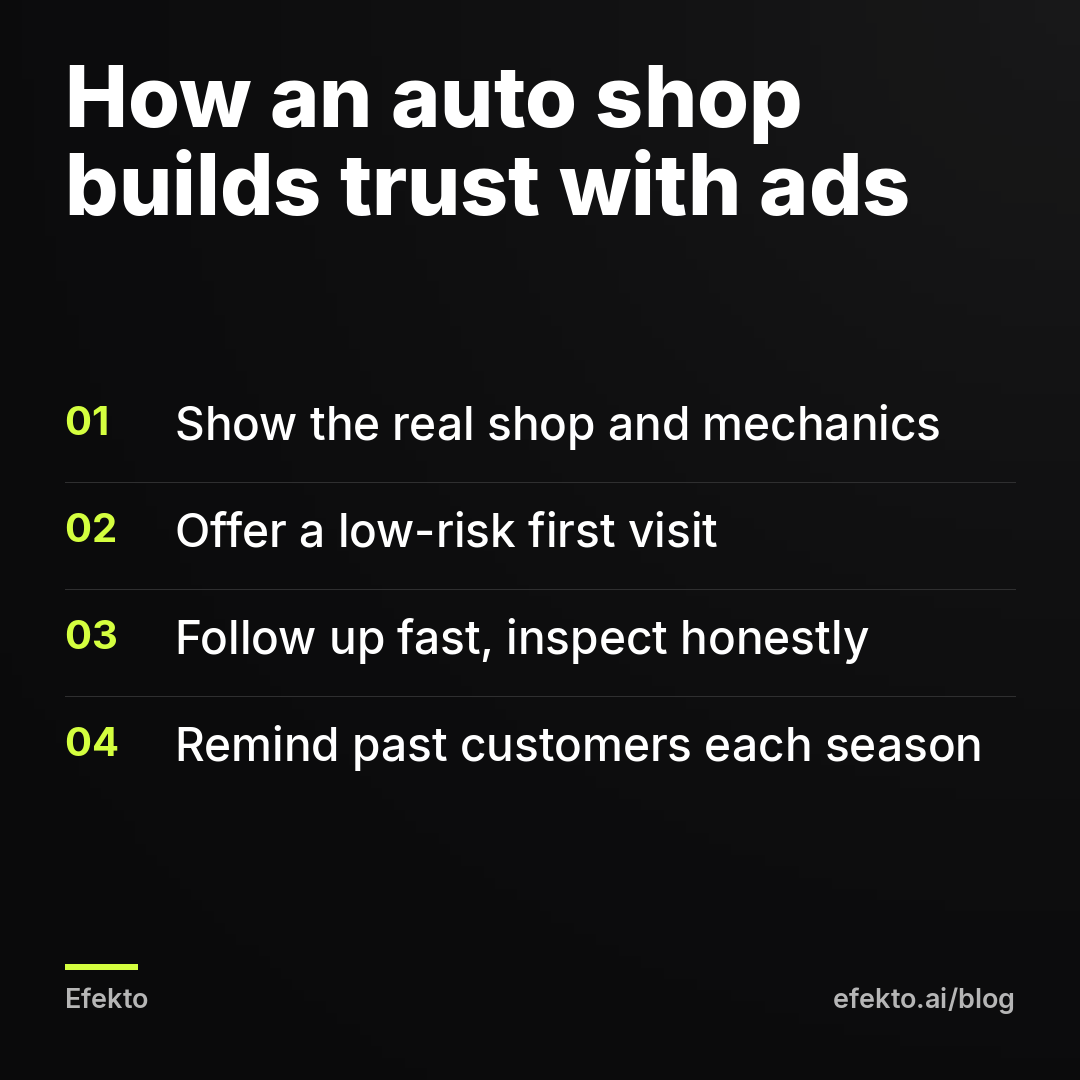
- Seasonal checks. A pre-winter check (battery, coolant, wipers, tires, brakes) or a pre-summer A/C and cooling check. The customer gets a clear reason to come in now, and you get the car on a lift.
- Tires. Tire sales, mounting and seasonal changeovers in states with real winters. Tires are a purchase people plan, compare and time, which fits how Facebook works.
- Entry services. An oil change, a check engine light diagnostic or a brake inspection. Small tickets that start a relationship.
What we would not advertise as the main message: "major repairs," "full service auto shop," or a list of 20 services. A list tells the reader nothing about why you and not the shop two blocks away.
Are oil change coupons a good Facebook ad offer?
An entry offer is a good idea. A coupon as your entire strategy is not. The auto repair industry has trained customers to expect the cheap oil change that turns into a $900 upsell, and that habit is exactly why people distrust shops. If your ad looks like every other coupon, you get judged like every other shop.
The difference is in what the offer promises. "$29.99 oil change" sells a price. "Oil change plus a photo report of your brakes and tires, sent to your phone, no pressure to fix anything today" sells a way of working. The second one may cost a bit more per lead, but it filters for people who want a shop they can trust, not the cheapest one this week. We wrote more about this pattern in why Facebook ads attract price shoppers.
| Entry offer | What the customer gets | What you get | Risk |
|---|---|---|---|
| Discounted oil change | A cheap service | Car on the lift, chance to inspect | Coupon hunters who never return |
| Free brake or tire inspection with photos | Proof of the condition of their car | A documented, honest recommendation | Some people take the photos to another shop |
| Check engine light diagnostic at a flat price | An answer to a nagging worry | A real repair lead | Low if the price is stated up front |
| Seasonal check (winter or A/C) | Peace of mind before the season | Planned work in your slow weeks | Weak response if launched too late in the season |
| Tire changeover or mount and balance | A task they already planned | Repeat visit twice a year in snow states | Price comparison with big chains |
Our position: pick one entry offer, state the price or the "free" part plainly, and never hide conditions in small print. If the inspection is free only with an oil change, say it in the ad. A trust-based campaign that starts with a surprise at the counter is dead on arrival.
How do you show your shop and mechanics in ads without a video crew?
Use a phone, your real bay and your real people. A stock photo of a smiling mechanic in a spotless shop tells the viewer you have something to hide. A slightly messy bay with your name on the wall tells them you exist.
Creatives we'd shoot first, all on a phone:
- A 20 to 30 second walk-around. A technician walks around a car on the lift and points at two things: "Brake pads here are at 3 millimeters, these tires have one more season." No script beyond that.
- The owner or service advisor at the counter saying what happens when you drop off a car: "We call you before we touch anything over the quote."
- The inspection report itself. A screenshot of the photos and notes you send customers, with the name blurred.
- The front of the building with the sign, so locals recognize it when they drive past.
- A tire wall or a set of new tires being mounted for tire offers.
What to avoid: dramatic "before and after" engine shots that imply a miracle, fake urgency like "your brakes could fail tomorrow," and any creative that shames the viewer. Fear sells one repair. It does not build the relationship you need for the next ten.
When do Facebook leads for auto repair actually come in?
Most leads come in when your shop is closed. This is the part most shops get wrong, and it has nothing to do with the ad.
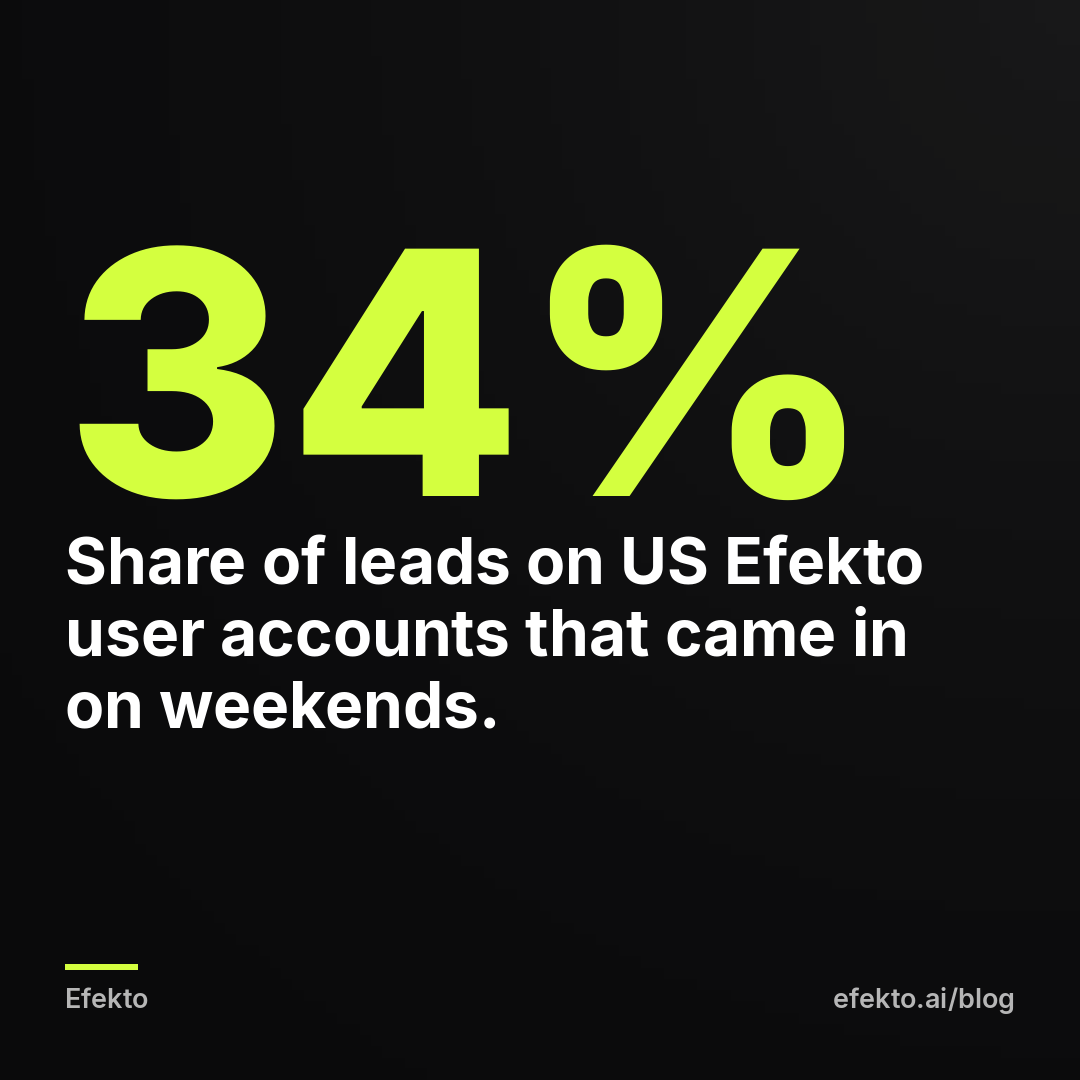
From our accounts: On Efekto users' accounts in English-speaking markets (mostly the US) (10 brands, 138 leads in the 180 days to Nov 8, 2026), 18% of leads came in after 6 pm, only 27% on weekdays between 8 am and 4 pm, and 34% on weekends. On the larger set of accounts Lemon Agency runs, of 3,733 Meta lead form leads collected in the 90 days to Nov 8, 2026, the most came in on Sunday (19.2%), the fewest on Monday (12.6%), and Saturday plus Sunday brought 32% of all leads.
Neither data set is auto repair specific, and we won't pretend it is. But the pattern is consistent enough to plan around. Only about a quarter of leads arrive while a typical service desk is staffed. The rest arrive Saturday afternoon, Sunday evening, or at 9 pm when someone finally sits down and looks at that warning light.
What this means for a shop:
- Monday morning is your most important hour. Whoever opens the shop calls or texts every weekend lead before the first car is on the lift. A lead from Saturday that hears from you Tuesday has already booked somewhere else.
- Send an automatic text or email the moment the form comes in: "Thanks, we got your request about your 2016 Civic. We'll call you at 8 am Monday." That one message holds the lead over the weekend.
- Offer a booking link for the entry service, so a Sunday evening lead can pick a slot without waiting for a call.
- Do not turn ads off on weekends to "save budget." You would cut the days that bring roughly a third of leads.
If you want to dig into scheduling, we covered it in best times and days to run Facebook ads for a local service business.
What questions should an auto repair lead form ask?
Ask enough to quote and prioritize the job, and nothing that feels like paperwork. We'd use Meta's instant form with the "Higher intent" setting, which adds a review screen before submitting and cuts accidental taps.
The questions we'd use:
- Year, make and model (short answer). You need it for parts and pricing, and it filters out people who weren't paying attention.
- What's going on? (multiple choice): check engine light, brakes or noise, A/C or heating, tires, scheduled maintenance, something else.
- When do you need it? (multiple choice): this week, in the next 2 weeks, just checking prices.
- ZIP code (short answer). Catches leads from outside your area.
- Name and phone, prefilled by Facebook.
The "just checking prices" answer is not a reason to ignore the lead. It is a reason to call it second, and to text a price range instead of a sales pitch. Those people book later, often after a second reminder.
One mistake we see on lead forms across industries: adding a sixth and seventh question "to qualify better." Every extra field lowers the number of leads, and a mechanic on the phone qualifies a customer in 40 seconds anyway.
How much does a customer from Facebook ads cost an auto shop?
It depends on your area, offer and creative, and anyone who gives you one number without seeing your account is guessing. What we can show is how to do the math, so you know what to watch. The numbers below are an example, not our results.
Say your budget is $25 per day, so $750 for a 30-day month. Say Ads Manager reports a cost per lead of $30. That gives you 25 form submissions.
That $30 is the cost of a form submission before anyone checked it. Some numbers are wrong, some people don't answer, some live 40 miles away. Say you reach and confirm 15 of the 25. Your real cost per verified lead is now $750 / 15 = $50, not $30. Track the second number. The first one only tells you the ad is getting attention.
| Step (example numbers) | Value |
|---|---|
| Monthly budget ($25 x 30 days) | $750 |
| Form leads at $30 each (Ads Manager) | 25 |
| Reached and confirmed | 15 |
| Cost per verified lead | $50 |
| Booked first visits (60% of confirmed) | 9 |
| Cost per booked first visit | $83 |
| First visit revenue (9 x $120 average ticket) | $1,080 |
| Customers returning for a repair within a year (4 of 9, at $450 each) | $1,800 |
In this example the first month barely covers the ad spend plus labor. The money comes from the 4 customers who come back. This is why discount-only campaigns look fine in Ads Manager and bad in your bank account: they produce the first visit and skip the return.
To know your own numbers, you need to mark which leads booked and which came back. A spreadsheet is enough. Here is how to track which Facebook leads turned into paid jobs without a CRM.
When should an auto shop run which ads during the year?
Run each seasonal offer 3 to 6 weeks before the season hits, not when it hits. When the first freeze comes, people with dead batteries call whoever answers. The goal is to be the shop they already booked a check with in October.
| Period | What to advertise | Notes |
|---|---|---|
| Late Feb to April | Spring tire changeover, post-winter check (suspension, alignment after potholes) | In snow states, the busiest tire window |
| May to June | A/C check before summer, road trip inspection | Launch before the first heat wave |
| July to August | A/C repair, tires, brakes for back to school driving | Steady; push entry offers to fill slow days |
| September to November | Winter prep check, winter tire changeover, battery test | Start early, the changeover rush fills fast |
| December to January | Diagnostics, brakes, maintenance reminders to past customers | Use your customer list, new customer ads are harder |
In states without real winters, drop the tire changeover and lean harder on A/C and cooling in spring and summer. The principle stays the same: advertise the reason to come in before the problem.
How do you set up the campaign, step by step?
This is how we'd set up a first campaign for a single-location shop:
- Objective: Leads, with an instant form (the form from the section above).
- Location: a radius around the shop that matches how far people drive for repairs, usually 8 to 15 miles in a suburb, wider in rural areas. Choose "People living in this location."
- Audience: age 25 and up, no interest targeting. Let the creative do the filtering.
- Budget: at least $20 to $30 per day for one offer. Below that, the campaign collects too few leads to learn which ad works.
- Creatives: 3 to 5 ads for the same offer: the walk-around video, the counter video, the inspection report screenshot, the building photo. Same offer, different proof.
- Run for 7 days without editing. Every edit restarts learning. After a week, turn off the ads with no leads and leave the rest.
- Follow-up: automatic text on submission, calls within one business hour, Monday morning call block for weekend leads.
- Past customers: upload your customer list and run a separate small campaign with seasonal reminders. People who already trust you are the cheapest booking you will get.
When do Facebook ads not make sense for an auto repair shop?
Facebook ads are the wrong tool in a few cases, and we'd rather say so.
- You are booked 3 weeks out. More leads will wait longer, get annoyed and leave. Raise prices or hire before you advertise.
- Nobody can answer leads within a day. If your lead follow-up is "when someone has a minute," fix that first. Ads will only make the problem expensive.
- You do mostly emergency towing and breakdown work. People with a car stuck on the shoulder search on Google and call. They don't scroll Facebook. Google ads and your Google Business Profile matter more there.
- Your budget is under $15 per day. At that level you get a handful of leads a month, too few to tell what works. Spend the time on reviews and your Google profile first, and come back to ads later.
- Your main business is fleet contracts. A handful of fleet managers are better reached by phone and email than by local ads.
Can an app run these ads for an auto shop instead of an agency?
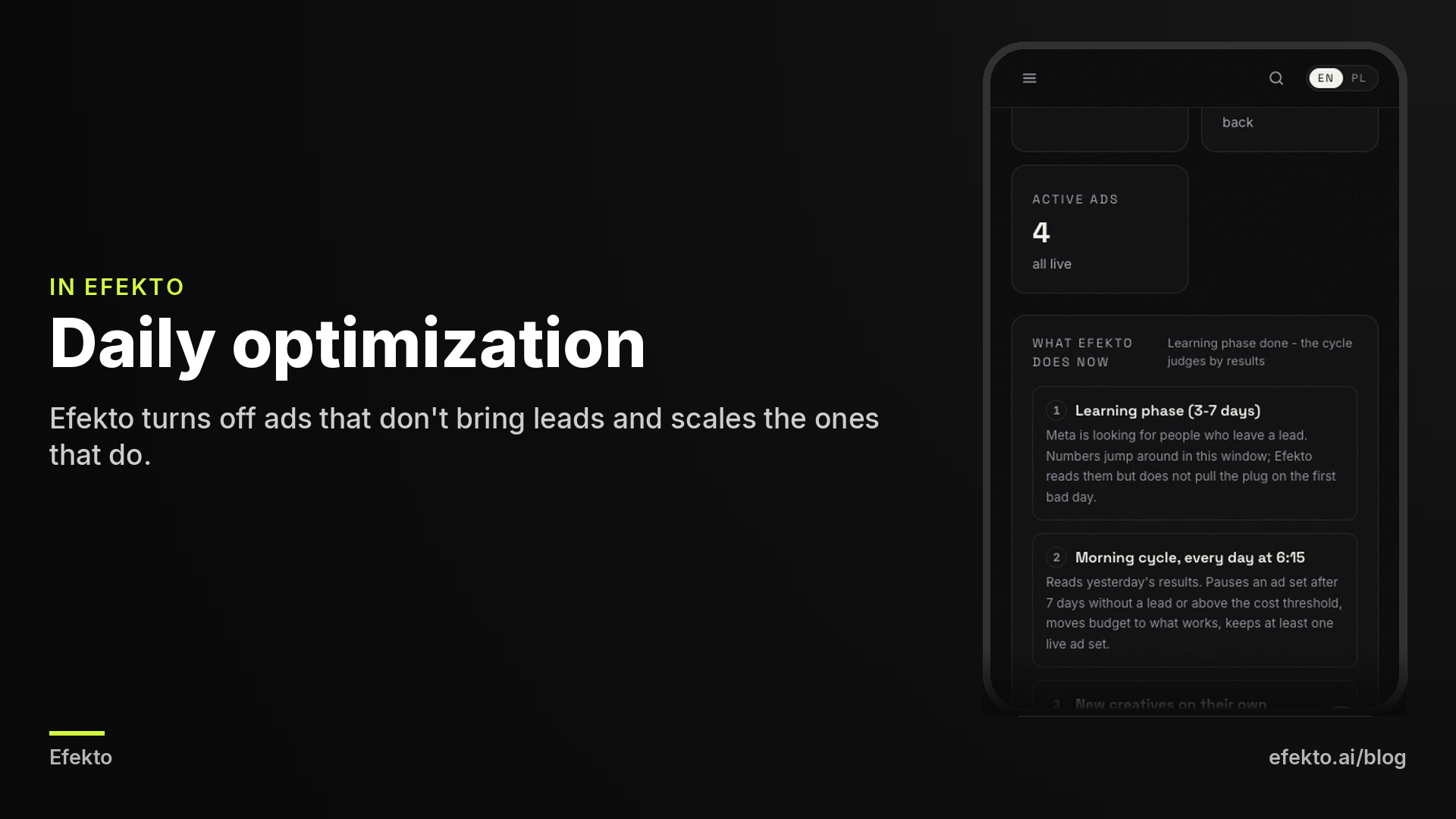
Yes, if the shop handles the follow-up itself. We have an interest here: we make money from ads on Meta, and the team behind Lemon Agency has run lead generation campaigns for over 300 clients. Efekto is the app we built from that work. Efekto creates ads (images and video) from your website, publishes them on Facebook and Instagram, and optimizes them every day: it turns off the ones that don't bring results and scales the ones that do. You approve the first batch, at least 5 ads, before anything goes live, and it runs on your own Facebook ad account or an Efekto ad account. The minimum daily budget is $15, and the 7-day free trial counts from the launch of the first campaign. Details are on how Efekto works.
What no app does for you: shoot the walk-around video in your bay, call the Saturday lead at 8 am Monday, or send an honest inspection report. If your website shows stock photos and no prices, the ads built from it will look the same, so add real shop photos to the site first. What we do differently from coupon-driven shop marketing is simple: we start every auto repair campaign from the first visit and the people doing the work, and we judge it by return visits, not by the cost of a form.
FAQ
How much should an auto repair shop spend on Facebook ads per month?
For one location and one offer, we'd start at $20 to $30 per day, so roughly $600 to $900 a month. That is enough for the campaign to collect leads every week and show which ad works. Raise it only when you can handle the extra calls.
Should auto shops use Facebook or Google ads?
Use both for different jobs. Google catches people who already have a problem and are searching right now. Facebook reaches people before the problem, which is where seasonal checks and tire offers fit. If you can only afford one and most of your work is urgent repairs, start with Google.
Can I show prices in Facebook ads for car repair?
Yes, and for entry offers we recommend it. A stated price for an oil change, diagnostic or tire changeover removes the fear of a surprise bill. For larger repairs, show a starting price or the inspection step instead, because the real cost depends on the car.
Do Facebook ads work for a small independent repair shop competing with dealers and chains?
They work better for an independent shop than for a chain, because you can show a real owner and real mechanics, which a chain can't. Dealers and chains compete on brand and coupons. You compete on the fact that the customer knows who is working on their car.
If you want the ads created and optimized while you focus on the cars, you can start at efekto.ai.
- Jakub Zwoliński
Founder, Lemon Agency · Efekto · November 15, 2026