Facebook Ads for Gyms and Personal Trainers: Getting Sign-Ups After January
How gyms and personal trainers can get sign-ups from Facebook ads after the New Year rush: offers that work in spring and fall, Meta-safe creatives and trial-to-membership math.

From our accounts: we looked at 3,184 Meta lead form leads collected in the 90 days to Oct 25, 2026 on the accounts we run. The most came in on Sunday (19.1%) and the fewest on Monday (12.8%). Saturday plus Sunday together brought 32% of all leads. These leads come from many industries, not just fitness, and they all point the same way. People fill in forms when they finally have a quiet moment, and for most people that moment is not during business hours.
The smaller sample from Efekto users' accounts in Poland says the same thing more sharply. Across 4 brands and 128 leads in the 180 days to Oct 25, 2026, 43% of leads came in after 6 pm, only 27% on weekdays between 8 am and 4 pm, and 28% on weekends. For a gym this matters more than for most businesses. Someone who decides on Sunday evening to start training is at peak motivation right then. If the front desk calls back on Tuesday afternoon, that person is often already back to "maybe next month."
Here is the direct answer. To get sign-ups after January, stop advertising memberships and advertise a short program with a fixed start date: a 21-day challenge, a 2-week trial pass or a 6-week small group. Ask about schedule in the lead form, not about weight or appearance. Answer leads within hours, Sunday evenings included. Then turn the trial into a membership with a conversation booked before the trial ends. Show people training, not bodies transformed. Meta rejects the second, and it does not convert better anyway.
January is the worst month to judge your ads by
In January almost any gym ad works, because the motivation comes from the calendar, not from the ad. That makes January a trap. Owners see cheap sign-ups, assume the ad is good, and then watch the same ad fall flat in March.
The problem is the offer. "Join now, no enrollment fee" works when people are already looking for a gym. In February, March, June or October, most people scrolling Instagram are not looking for anything. You have to give them a reason to start this week. That reason is a defined, short, low-risk starting point with a date on it.
We would treat January as a bonus month and build the ad account for the other eleven. If your ads only work in January, you don't have working ads. You have a calendar.
Sell a start date, not a membership
A membership asks for a commitment of months. A challenge or trial asks for 2 to 6 weeks and gives a clear end point. That end point is what makes people sign up in a cold month. Here are the offers we would test, in the order we would test them.
| Offer | What the ad says | Best for | Price we'd start with (example) | Main risk |
|---|---|---|---|---|
| 21-day challenge with a start date | "Next group starts Monday, March 9. 12 sessions, coach-led." | Gyms with group classes | $49 to $99, credited toward membership | Empty challenge if you launch ads less than 10 days before the start |
| 2-week trial pass | "Two weeks, unlimited classes, one intro session with a coach." | Boutique studios, CrossFit-style boxes | $29 to $49 | Free trials attract people who never planned to pay |
| 6-week small group (4 to 6 people) | "Strength training for beginners, 6 people max, Tue/Thu 6:30 pm." | Personal trainers, small studios | $199 to $349 | Needs a real coach schedule before you advertise |
| Intro session with a trainer | "One 45-minute session: we plan your first month." | Solo personal trainers | Free or $25 | Turns into free coaching if you don't pitch at the end |
| Bring-a-friend week | "Train free for a week with a friend who is a member." | Gyms with an active member base | Free | Works only if members actually share it |
Three rules we would apply to any of these.
Charge something. A $29 trial filters out people who sign up for everything free. You lose some volume and gain show-up rate. A free offer can still work for a solo trainer whose time is the bottleneck, but then the qualifying questions in the form have to do the filtering.
Put a date or a seat count in the ad. "Next group starts March 9" or "6 spots per group" is a real deadline, because it is true. Don't invent fake scarcity. People check, and a "last 3 spots" ad running for six weeks tells them you lie in ads.
Credit the trial price toward membership. "Your $49 counts toward your first month" removes the feeling of paying twice and gives the coach an easy line at the end of the trial.
The lead form should sort people by schedule, not by body
For a gym we would use Meta's instant form, not a landing page. Most of the traffic is on phones at night, and a pre-filled form converts better there. We cover the setup details in our guide to Facebook lead ads that bring real customers, not junk leads. For gyms, the questions matter more than the format.
We would set up the form like this:
- Name, phone, email pre-filled from the profile.
- "When could you train?" Options: early morning (before 8 am), lunchtime, evening (after 5 pm), weekends. This is the most useful question you can ask. It tells the coach which class to offer during the first call.
- "What do you want from training?" Options: get stronger, more energy, get back to training after a break, prepare for an event, train with a coach for the first time. Every answer is positive. None of them asks the person to describe their body.
- "Have you trained in a gym before?" Yes, regularly / Yes, a while ago / No. This changes how the first session is pitched.
- Optional higher-intent question: "Can you start in the next 2 weeks?" Yes / Not yet. The "not yet" leads go to a nurture list, not to the first call list.
Do not ask "How much weight do you want to lose?" or "What do you dislike about your body?" Apart from being a terrible way to start a relationship with a client, questions that frame the person's body negatively are exactly the type of content Meta's personal health rules target.
Before-and-after creatives get rejected, so show the work instead
Meta's advertising standards on personal health and appearance restrict before-and-after images and ads that make people feel bad about their bodies in order to sell fitness or weight loss. Ads that imply you know something about the viewer, such as "Struggling with your weight?", also break the rules on personal attributes.
The good news is that the safe version is also the stronger ad for a local gym. A stranger's transformation photo looks like every other fitness ad on the internet. A real member laughing between sets in your actual room does not.
What we would use instead:
- A class in progress, shot on a phone, with the coach in the frame. People join a gym for the room and the coach.
- The first session explained: "Here is what happens when you walk in for the first time", with three short clips: warm-up, coach showing a movement, cooldown.
- One member, one sentence about the experience, never about results: "I've shown up 3 times a week since October because the 6:30 class actually waits for me." Consistency and community, not kilograms. Our post on using customer reviews in Facebook ads within Meta's rules covers how to get permission and what to avoid.
- The schedule itself: a clean image with "Beginner strength: Tue/Thu 6:30 pm, 6 people max." Boring to designers, very effective for someone checking whether it fits their week.
- The coach on camera, 20 seconds, explaining who the program is for.
And the copy rules: no promised outcome ("lose 10 pounds in 21 days"), no timelines tied to body change, no "get beach ready." Promise what you control: the number of sessions, the group size, the coach's attention, the start date.
A worked example: what $20 a day can buy a small gym
This is an example to show the mechanism. The numbers are assumptions, not results from our accounts.
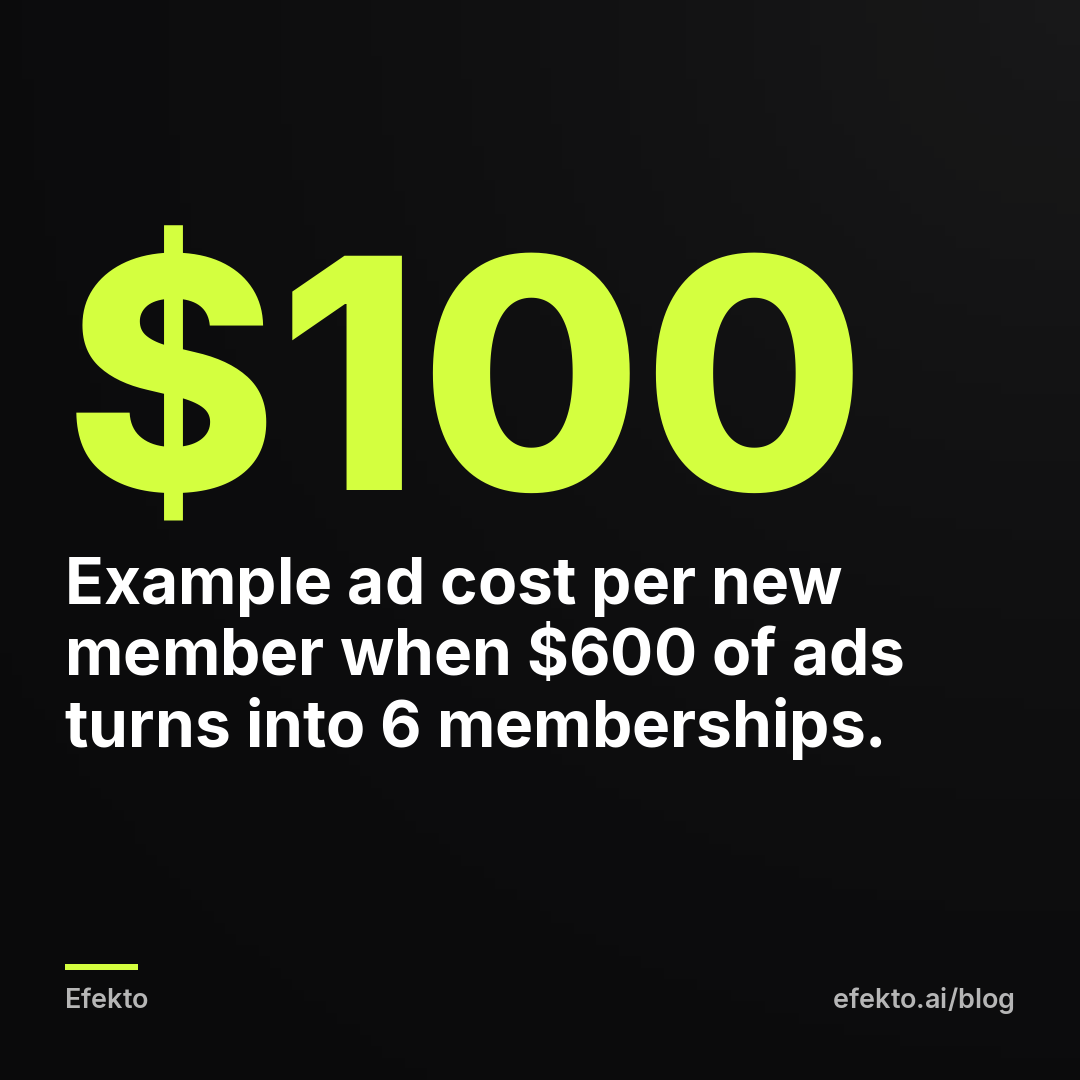
Say a studio spends $20 a day for 30 days on a 21-day challenge priced at $49, credited toward membership. Membership is $129 a month.
| Step | Example number | How we got it |
|---|---|---|
| Ad spend | $600 | $20 a day x 30 days |
| Form submissions (Meta's count) | 50 | Assumed $12 per submission |
| Cost per submission according to Meta | $12.00 | $600 / 50 |
| Reachable, real leads after calling | 35 | 70% answer and are genuine |
| Cost per verified lead | $17.14 | $600 / 35 |
| Paid for the challenge | 14 | 40% of verified leads |
| Finished most of the challenge | 11 | Roughly 8 in 10 |
| Became members | 6 | About half of finishers |
| Ad cost per new member | $100 | $600 / 6 |
| Revenue from 6 members over an assumed 7-month stay | $5,418 | 6 x $129 x 7, plus 14 x $49 challenge fees not counted |
Two things to notice. First, the "cost per lead" in Ads Manager is the cost of a form being filled in, before anyone checked whether the number works or the person meant it. In this example it says $12. The real cost of a lead you can talk to is $17.14, about 43% higher. If you compare your ads with anyone else's numbers, make sure you are comparing the same thing.
Second, the number that decides whether the ads pay is cost per new member, not cost per lead. A $25 lead from a form with schedule questions that converts at 20% beats a $9 lead from a "free week, no questions" form that converts at 3%. We explain this way of measuring in why service businesses should track cost per booked job.
The trial is where the membership is won or lost
Most gyms lose the sale after the lead comes in, not before. Ads only fill the top. These are the steps we would put in place before spending a dollar.
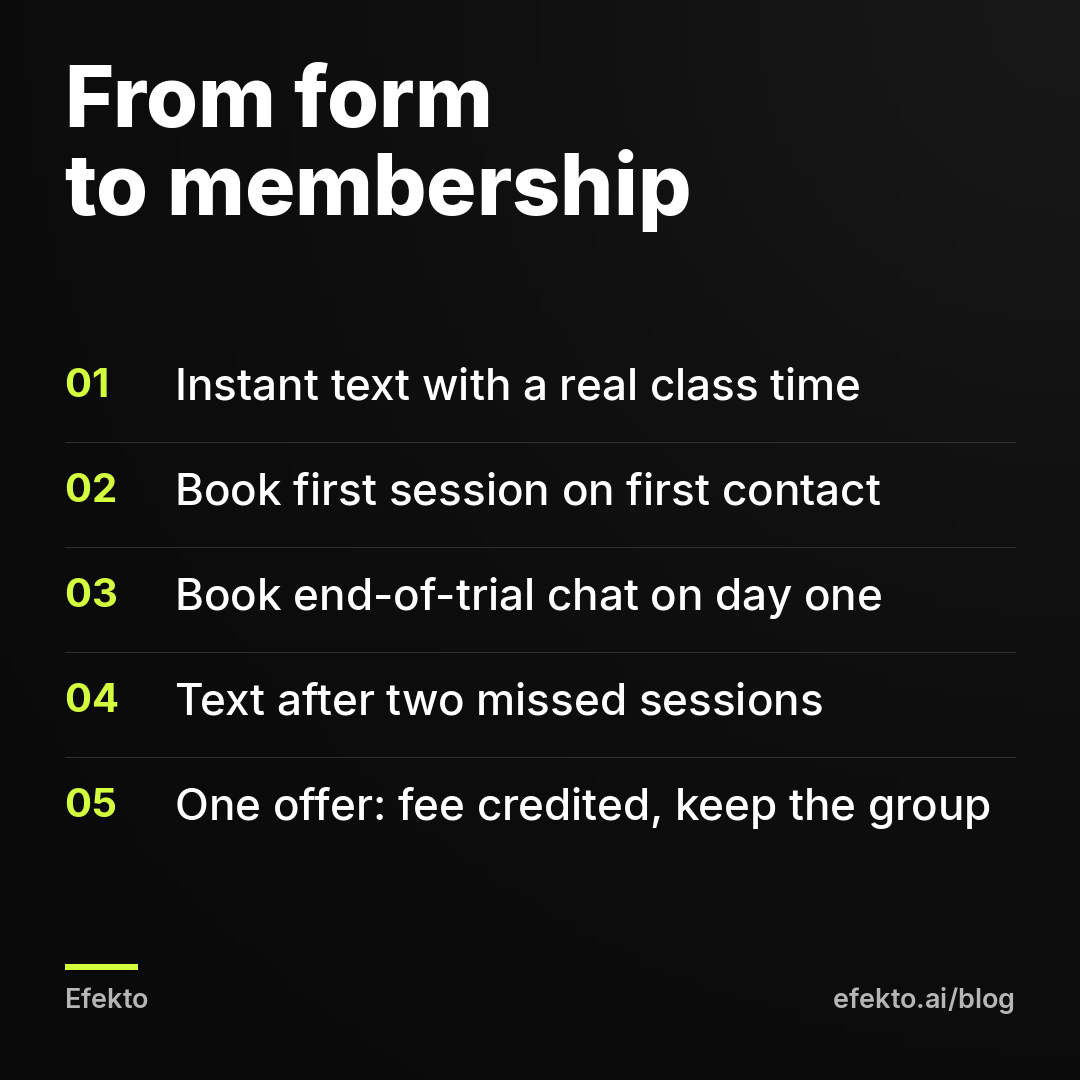
1. Reply fast, including Sunday night. Given that 19.1% of leads on our accounts came in on Sunday, a gym that only calls back during weekday desk hours is answering one in five leads a day or more late. Set up an instant text the moment a lead arrives: "Hi Sam, this is Coach Dana from [gym]. Saw you picked evenings. Does Tuesday 6:30 pm work for your first session?" A real name and a real time slot, not "we'll be in touch." Our guide on following up on Facebook leads fast enough to book has the scripts and tools.
2. Clear the Monday backlog first thing. Monday brings the fewest new leads (12.8% on our accounts), so it is the day to call everyone from the weekend who did not answer the text. Two attempts, then one last text.
3. Book the first session during the first contact. Not "come by anytime." A specific class, a specific coach.
4. Book the end-of-trial conversation on day one. During the first visit, the coach puts a 10-minute chat in the calendar for the final week: "On the 19th we'll sit down and look at how it went." This is the single habit that separates gyms that convert trials from gyms that hope.
5. Check in at the midpoint. If someone missed two sessions in a row, the coach texts. People quit trials quietly, and a message from someone who noticed brings many of them back.
6. Make one clear offer at the end. The challenge fee credited, a membership start date, and one reason to decide now that is true, for example keeping their spot in the same small group.
Plan the year around four start dates
The calendar gives gyms more natural starting points than January alone. We would run one dated program for each of these and start ads 2 to 3 weeks before each one:
- Early March: people who quit their January plan and want a second try. Message: "Didn't stick in January? Start again with a group."
- Late April to May: longer days, outdoor plans. Message about energy and training outside or with friends, not about bodies for summer.
- Early September: back-to-routine after summer, kids back at school. Often the second strongest month after January for adult routines. Morning and lunchtime classes for parents.
- Late October to November: "start before the holidays" programs, so people arrive in January already in the habit.
Between these, keep a small always-on campaign for trial sessions with the schedule creative. It does not need to be big. It keeps the account from starting cold every time.
When Facebook ads are the wrong move for your gym
We make money when businesses run ads on Meta, so take this with that in mind. Even so, there are clear cases where we would not run them.
- Nobody can answer leads within a few hours, evenings and weekends included. You will pay for leads that go cold. Fix the follow-up first, or advertise only a program with online booking and payment.
- Your classes are already full. Ads that bring people into a full 6:30 pm class create bad first impressions. Advertise only times with real space.
- You are a franchise location with strict corporate creative rules. Check what you are allowed to run before building anything.
- Your budget is under about $15 a day. At that level Meta gathers so few results that it barely learns. A referral program for existing members will likely bring more trials for less money.
- You want to sell a 12-month contract straight from the ad. Cold traffic doesn't buy long contracts from a stranger. Sell the trial.
Where Efekto fits
If you'd rather not build campaigns in Ads Manager yourself, Efekto creates ads from your website, publishes them on Facebook and Instagram, and optimizes them every day: it turns off the ones that don't bring results and scales the ones that do. You approve the first batch before anything runs, with at least 5 approved ads before the campaign starts, so nothing with a before-and-after photo or a body-focused line goes live without you seeing it. You can see the full process on how Efekto works.
On price: the minimum daily ad budget is $15, the Starter plan is $149 a month, and the 7-day free trial counts from the launch of your first campaign. No card is required at sign-up. The follow-up steps above are still yours. No app replaces the coach who texts a trial member on Sunday night.
What to take from this
- Build your ads around dated programs (21-day challenge, 2-week trial, 6-week small group), with four start dates through the year, not around January.
- Ask about training schedule and goals in the lead form. Never ask people to describe their body, and drop before-and-after images entirely.
- Answer every lead within hours, Sunday evening included, and clear the weekend backlog on Monday morning.
- Book the end-of-trial conversation on the trial's first day and credit the trial fee toward membership.
- Judge the ads by cost per new member, and remember that Meta's cost per lead is the cost before you verified anyone.
If you want your gym's ads created and adjusted every day while you focus on the trial members walking in, you can start on Efekto.
- Jakub Zwoliński
Founder, Lemon Agency · Efekto · October 29, 2026