Facebook Ads for Lawn Care and Landscaping: Booking Season Contracts Before Spring
When to launch Facebook ads for a lawn care business, how to sell a full-season contract in February, which photos to use, and what one seasonal customer is worth.

Lawn care and landscaping companies should run Facebook ads from late January to early April. Sell a full-season contract (mowing, fertilization, spring and fall cleanup), not one-off jobs, and show photos of properties you actually maintain. By the first warm weekend, most homeowners who wanted a crew have already signed with someone, so the work is done before spring, not during it.
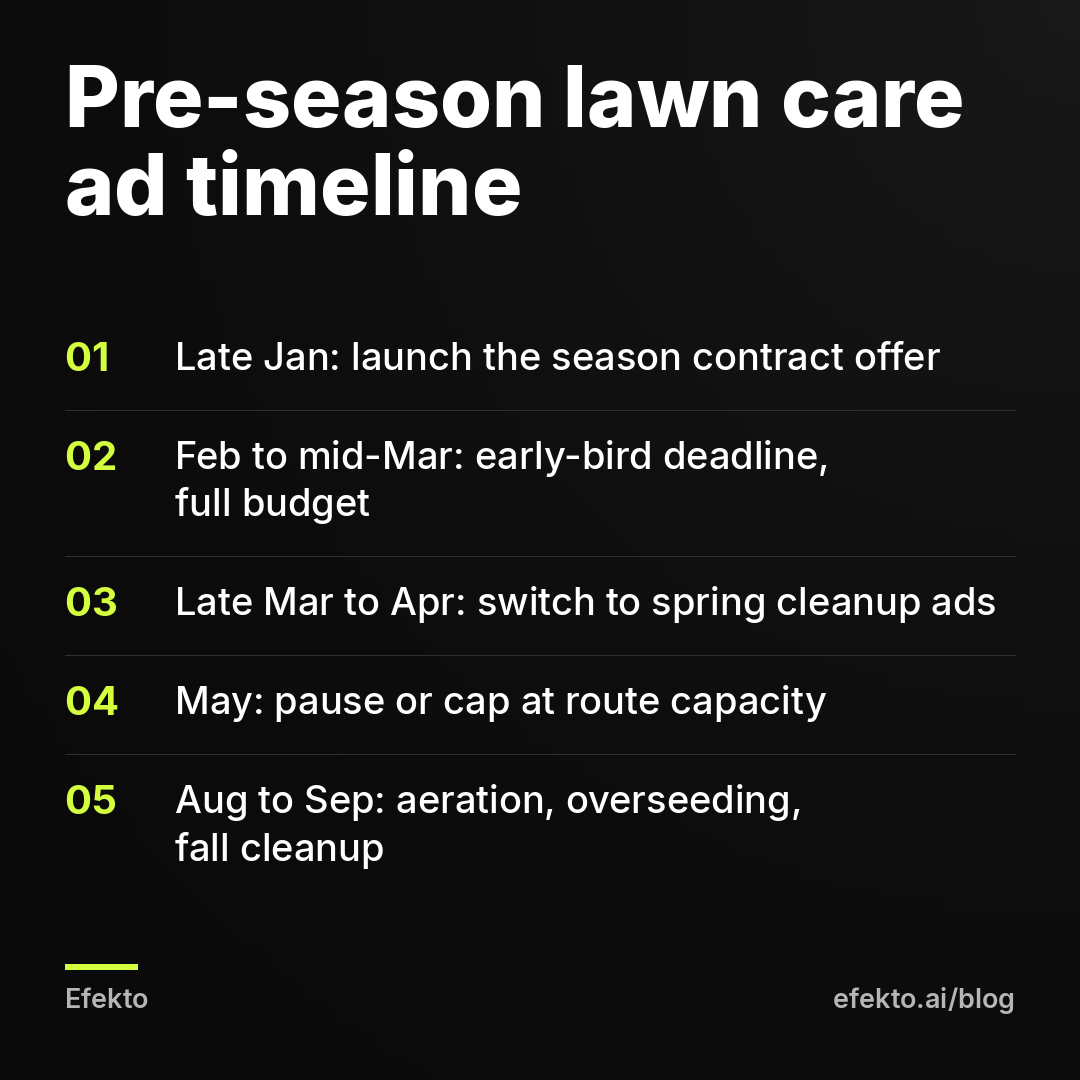
1. Launch in late January, not when the grass starts growing
A pre-season campaign goes live in the last week of January or the first week of February. Your crews are idle, and many of your competitors are plowing snow or taking their only vacation of the year. A homeowner picks a lawn service in the weeks before the first mow, not on the morning the grass hits their ankles. If your ad shows up in April, it lands next to every other lawn company's ad. In February it often lands alone.
This makes sense when you sell recurring maintenance and next season's route isn't full yet. It also makes sense when you're adding a crew and need 30 or 40 new stops to pay for the truck.
It does NOT make sense in year-round mowing climates, where there is no off-season to win. There we'd run steady all year and push a little harder before the growth surge. It also doesn't make sense if renewals already fill your route. Then the campaign only builds a waitlist you'll disappoint.
2. Sell the season, not the mow
The offer that works in February is one agreement for the whole season. Weekly mowing April through October, a fertilization and weed control program, spring cleanup and fall leaf cleanup, all in one price. Bill it monthly so the number looks like a utility bill, not a lump sum. For example: "Full-season lawn care for $195 a month, April through October. Sign by March 15 and spring cleanup is half price."
The early-bird deadline does real work here. Without a date, a homeowner reads the ad in February, thinks "good idea, I'll call in April," and forgets. A deadline in mid-March gives them a reason to fill out the form now. It also gives you a full route on paper before you buy fertilizer and schedule crews.
What we'd avoid is "first mow free." It pulls in people who want one free mow and have no intention of paying for 27 more. A discount on spring cleanup, or a price locked at this year's rate for two seasons, attracts people who are already thinking in seasons. If you want more offer formats to test, we compared seven offer types for home service businesses separately.
This section does NOT apply to design-build landscaping. If you sell patios, retaining walls and plantings, a season contract isn't your product. Your February ad sells a design consultation that books a spring install slot. Same timing, different offer.
3. Use photos of lawns you actually cut
The photos that work are from your own route. Think fresh stripes on a front lawn, crisp bed edges, a before-and-after of a spring cleanup, and your truck and trailer in a real driveway. A homeowner looking at a stock photo of a golf course sees a national franchise. A homeowner looking at a lawn two streets over sees a crew that works in their neighborhood.
The problem in February is that everything outside is brown or white. So the job right now is to dig through last season's phone photos. Pick 10 to 15 shots where the lawn is green and the house looks like a normal house in your area. Crop out house numbers and license plates, and ask the homeowner before you use a photo that shows their home clearly.
If you have no photos from last year, the campaign can still run on your website images. But make it a rule this season: the last stop of every Tuesday gets three photos before the crew leaves. By next January you'll have 80 shots to choose from.
What does NOT work: photos of properties you didn't service, or a dormant winter lawn shown as a "before" next to a summer "after." Customers notice. And a brown February lawn next to a green July lawn proves the season changed, not that you're good at your job.
4. Ask form questions that tell you if the property fits your route
A lead form for lawn care should sort leads by route fit and job size before you pick up the phone. These are the questions we'd set:
- Street address or ZIP code. This is the most important question. A stop on a street you already mow adds minutes. A stop across town adds drive time you never get paid for.
- Approximate lot size: under 1/4 acre, 1/4 to 1/2 acre, 1/2 to 1 acre, over 1 acre. This tells you if your mower and pricing fit.
- Services wanted (checkboxes): weekly mowing, fertilization and weed control, spring cleanup, fall cleanup, aeration and overseeding.
- When do you want service to start? Answers like "this week" in February are usually confused. "April" is your buyer.
- Do you have a lawn service now? Someone switching providers already knows what the service costs. That means fewer price surprises on the call.
Use Meta's higher intent form type, which adds a review screen before submitting. You'll get fewer forms, but more of them are real. We wrote up the full setup in our guide to instant forms that bring real customers.
The form does NOT make sense for commercial work. Property managers for HOAs and office parks don't fill out Facebook forms. They send bid requests.
5. Target your routes, not the whole metro
The right targeting for a lawn company is the ZIP codes where you already have stops, plus the ones directly next to them. Not a 30-mile radius around your shop. Route density is where lawn care profit comes from. Ten houses on one street can be mowed in the time it takes to drive between three scattered ones.
Add the ZIP codes as locations in the ad set and leave the age and interest settings broad. The address question in the form and the photos of single-family yards do more filtering than any interest setting. Apartment renters scroll past a striped front lawn. Homeowners stop.
When does this NOT apply? When you're deliberately breaking into a new suburb. Then you target that suburb on purpose and accept thin density for one season. Plan it that way, and price it that way, instead of letting a wide radius scatter your route by accident.
6. Budget by phase, and change the message in April
The budget should follow the season, not stay flat. Say you plan roughly $2,000 for the year. Here's how we'd split it:
- February 1 to mid-March: most of the money, for example $30 a day, on the season contract offer with the early-bird deadline.
- Mid-March to late April: drop to around $20 a day and switch the ad to spring cleanup and mulch. Some of those one-time customers turn into season agreements once they see the crew work.
- May to July: pause, or keep a small budget only if you have open slots on specific days.
- August to September: a short push for aeration, overseeding and fall leaf cleanup. Write down every fall cleanup customer. They're your first calls next January.
The mistake we'd warn against is raising the budget in April because the phone is ringing. If your route is full by mid-March, turn the contract ads off. Leads you can't serve cost you ad money and your reputation, and nobody forgets the crew that said yes in April and never showed up.
If you'd rather not build and adjust this in Ads Manager yourself, Efekto creates ads from your website, publishes them, and optimizes them every day: it turns off the ones that don't bring results and scales the ones that do. You approve the first batch (at least 5 ads) before the campaign starts, and it runs on your own Facebook ad account or an Efekto account. Here's how Efekto works. It won't take photos of your lawns for you, so upload last season's shots if your website has none.
7. Answer leads on Saturday and Sunday
Homeowners think about their yard when they're standing in it, and that happens on weekends. If your office only returns calls Monday through Friday, your weekend leads wait until Monday. By then they've called two other companies.
From our accounts: Of 3,184 Meta lead form leads collected in the 90 days to Oct 25, 2026 on the accounts we run, the most came in on Sunday (19.1%), the fewest on Monday (12.8%), and Saturday plus Sunday brought 32% of all leads. For a lawn company, that means roughly a third of your February forms will arrive when the office is closed. Monday, the day most owners sit down to return calls, is the day with the fewest new leads.
What we'd set up: an automatic text that goes out the minute the form comes in ("Got your request, we'll call you today"). Then someone checks leads Saturday and Sunday morning and calls back within a few hours. In February your crew isn't working weekends anyway. We go deeper on scripts and timing in our post on following up on Facebook leads fast enough to book the job.
What does NOT make sense is scheduling your ads to run only during office hours. You'd be switching them off during the hours that bring the most forms.
8. What one seasonal customer is worth: a worked example
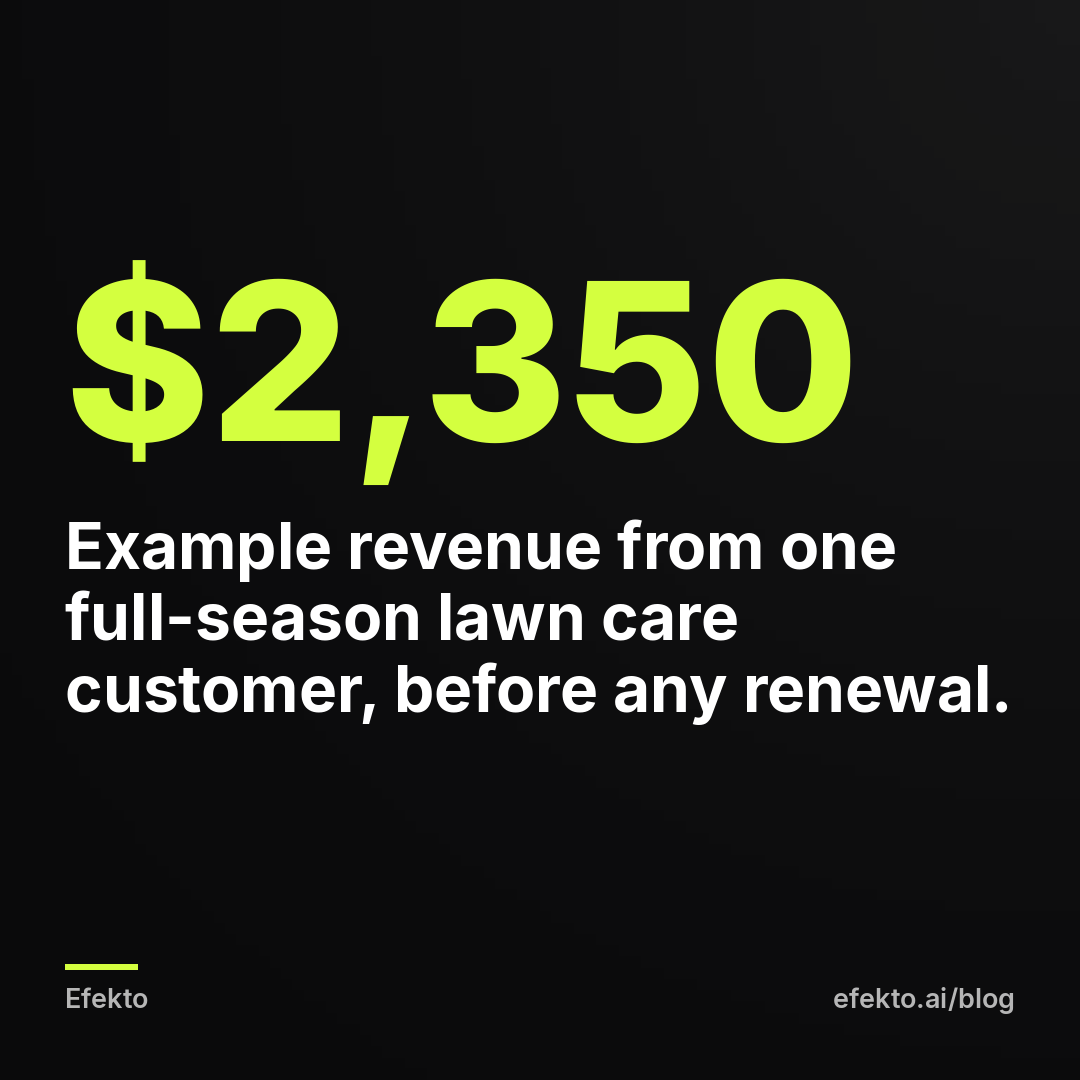
One seasonal customer is worth several times more than a one-time job, and that's why the February campaign is worth the money. Here's an example with made-up but realistic numbers. Swap in your own prices.
| Service (example) | Visits | Price per visit | Season total |
|---|---|---|---|
| Weekly mowing | 28 | $50 | $1,400 |
| Fertilization and weed control | 5 | $65 | $325 |
| Spring cleanup | 1 | $275 | $275 |
| Fall leaf cleanup | 1 | $350 | $350 |
| One seasonal customer | $2,350 |
Now the ad side, also as an example. Say you spend $30 a day for 45 days, from February 1 to mid-March. That's $1,350. Meta reports 50 form submissions, so Meta shows a cost per lead of $27. That's the cost of a form before anyone has checked it.
Then you call. Some numbers are wrong, some addresses are outside your ZIP codes, and some people only wanted a quote for one mow. Say 30 leads are real homeowners in your area who want recurring service. Your cost per verified lead is $1,350 / 30 = $45, not $27. Plan around the $45, because that's what you actually pay for a conversation worth having.
If you sign 1 in 3 of those 30, that's 10 season contracts. Your ad cost per contract is $135. Revenue is 10 x $2,350 = $23,500. If crew time, fuel and materials take 60% of revenue, each customer leaves about $940 in the first season. After the $135 ad cost, that's around $805.
The second season is where it really pays. If 7 of the 10 renew, that's $16,450 in revenue with zero ad spend. Compare that to a one-time spring cleanup at $275. Spending the same $135 to win it leaves almost nothing once you pay the crew.
The calculation does NOT hold if you price mowing so low that crew costs eat 85% of revenue. No ad campaign fixes a route that loses money per stop.
9. When Facebook ads are the wrong tool for a lawn business
We make money from ads on Facebook and Instagram, so weigh this with that in mind: the team behind Efekto has managed more than $1M in ad spend for more than 300 clients. Even so, there are lawn businesses where we'd tell you not to run them:
- Your route is full from renewals. Spend February raising prices on your least profitable stops, not buying new ones.
- You chase commercial contracts. HOA, office park and municipal work runs on bids and relationships. Pick up the phone and walk the property instead.
- Nobody can answer the phone. A solo operator who mows all day and only returns calls at 9 pm will waste half the leads. Fix the follow-up first, then advertise.
- You only compete on price. If your pitch is the cheapest mow in town, Facebook will deliver the customers most likely to leave for someone $5 cheaper next year.
Efekto doesn't make sense in these cases either. It brings leads, and if you can't serve or answer them, more leads only make the problem bigger.
Summary: the pre-season plan at a glance
| Step | When | What to do | Skip it if |
|---|---|---|---|
| Launch | Late January | Season contract ad goes live | You mow year-round or renewals fill the route |
| Offer | February to mid-March | Monthly season price with an early-bird deadline | You sell design-build, not maintenance |
| Photos | Before launch | 10 to 15 real lawns from last season | Never skip; take them weekly this year |
| Form | Before launch | Address, lot size, services, start date, current provider | Commercial clients; use bids instead |
| Targeting | Before launch | ZIP codes with existing stops plus neighbors | You're entering a new suburb on purpose |
| Message switch | Mid-March to April | Spring cleanup and mulch at a lower budget | Route is already full |
| Follow-up | Every weekend | Auto text plus callback within hours | No one can answer; fix that first |
| Fall push | August to September | Aeration, overseeding, leaf cleanup | Crews are booked through October |
FAQ
When should a lawn care company start advertising for spring?
In the last week of January or the first week of February. Homeowners choose a lawn service in the weeks before the first mow, and in February your ad competes with far fewer offers. By mid-April the best customers have already signed.
Should I show prices in my lawn care Facebook ads?
Show a monthly starting price for the season contract, such as "from $195 a month," and give the final quote after you know the lot size. A visible price filters out people looking for a $30 mow. It also makes the form feel less like a sales trap.
Do Facebook ads work for commercial landscaping contracts?
Rarely. Property managers and HOA boards buy through bids, referrals and site walks, not lead forms. Facebook works for residential maintenance and design-build homeowners, so keep commercial sales on the phone and in person.
What should I do with leads that come in after my route is full?
Tell them honestly that you're full and offer a spot on a waitlist for openings or for next season. Save their details for your January list. A homeowner who was turned away politely in April is a warm lead the next February.
If you want a pre-season contract campaign running by February without learning Ads Manager, you can set one up on efekto.ai.
- Jakub Zwoliński
Founder, Lemon Agency · Efekto · October 28, 2026