Facebook Ads for Home Remodeling: Reaching Homeowners Months Before They Hire
How to run Facebook ads for a remodeling business: a local cost guide as the offer, before-and-after creative, budget questions in the form, and follow-up that lasts months.

Most homeowners who will sign a five-figure kitchen, bathroom or basement remodel next year are already scrolling Facebook, but they are not ready to book an estimate. To reach them early, you need three things. Offer something useful at the research stage, usually a local cost guide. Collect their budget and timeline in the lead form. Then keep showing them your before-and-after work until they are ready to hire.
Ads that only say "free estimate" catch the few people who have already decided and miss everyone still planning. Below is the setup we'd use, in order, with a note on when each step does not make sense.
1. Why should a remodeler offer a cost guide instead of a free estimate?
A cost guide gives the planning homeowner a reason to raise their hand without committing to a sales visit. The person thinking about a bathroom remodel in eight months will not book an estimate today. That same person will gladly download "What a Bathroom Remodel Costs in [Your County] in 2026".
What goes in the guide (4 to 8 pages is enough):
- Three price tiers for one project type, for example a cosmetic refresh, a mid-range remodel and a full gut with layout changes, each with a real range from your own closed jobs.
- What moves the price: moving plumbing, structural walls, tile choice, permits, old wiring.
- A realistic timeline from first meeting to final walkthrough, including permit wait.
- Five questions to ask any contractor before signing, including yours.
- One finished project with photos and the final price range.
Make one guide per project type you actually want: kitchen, bathroom, basement, addition. A homeowner planning a kitchen does not care about basements, and the guide they pick tells you what they want before you call.
Our position: the prices in the guide have to be real. A "cost guide" that says "every project is unique, call us for a quote" is bait. People spot it, and the trust you were building flips into suspicion. If you are afraid that showing a range will scare away cheaper leads, good. That is the point.
When it makes sense: projects over roughly $15,000, where people compare contractors and save money for months.
When it does not: small jobs, repairs and anything urgent. A leaking shower valve needs a plumber this week, not a PDF. For those, run direct call or estimate ads.
2. What before-and-after photos work best in remodeling ads?
Your own before-and-after photos, with specifics in the caption, beat every other creative for a remodeler. Showroom renders and stock kitchens look like every other ad in the feed. A dated 1970s bathroom turned into something clean and bright, in a house that looks like the viewer's house, makes them stop.
Formats we'd use:
- Side-by-side single image. Same angle, same lighting if possible. Shoot the "before" from the doorway, because you will want that angle again at the end.
- Carousel of 3 to 5 cards. Before, demolition, rough-in, finished. This shows the work behind the result, and the work is what people are actually paying for.
- 20 to 40 second phone video walkthrough of a finished space, with the before shown for 3 seconds at the start.
The caption does the selling. For example: "Hall bath in a 1960s ranch. Tub out, walk-in shower in, new vanity and floor. 11 working days. Similar projects run $24,000-$32,000." A size, a timeline and a range answer the three questions people ask in their head before they ever call you.
Get written permission from the homeowner before using photos of their home, and never show house numbers or street views. If you have reviews from the same client, they can go next to the photos, within the limits described in our post on using customer reviews in Facebook ads.
When it makes sense: always, as soon as you have two or three finished jobs photographed.
When it does not: if the only photos you have are from manufacturers or from a previous company you worked for. Do not use them. Start with in-progress photos of your current job and build the portfolio over the next few projects.
3. What questions should a remodeling lead form ask?
Ask for project type, budget range, timeline, homeownership and zip code, all as multiple choice. Five questions sounds like a lot, but each one either filters out a lead you cannot serve or tells you how to follow up.
| Question | Answer options (example) | What it tells you |
|---|---|---|
| What are you planning? | Kitchen / Bathroom / Basement / Addition / Other | Which guide to send, which crew lead to call |
| What budget are you working with? | Under $15,000 / $15,000-$40,000 / $40,000-$80,000 / $80,000+ / Not sure yet | Whether the project fits your minimum |
| When do you want to start? | Within 3 months / 3-6 months / 6-12 months / Just researching | Hot lane or nurture lane |
| Do you own the home? | Yes / No, I rent / Buying soon | Renters rarely sign remodels |
| Zip code of the project | Short answer | Whether you serve that area |
In Meta's instant form, we'd choose the higher intent form type, which adds a review screen before submitting. It lowers volume a little and removes many accidental taps. If you are deciding between an instant form and your own page, we compare both in Facebook lead form vs landing page.
Many people say "never ask budget, it kills conversion". We disagree for remodeling. Without the budget question, your estimator drives across town to meet someone who wants a full kitchen for $9,000. One wasted afternoon costs more than the leads you lose to the question.
The number Meta reports as cost per lead is the cost of a submitted form, before anyone has read it. Your real cost is higher. For example: Meta shows $14 per lead. You remove 40% of leads because the budget is under your minimum, the zip code is outside your area or they rent. That leaves 60% of leads, so the cost per lead you can actually work is $14 / 0.6 = $23.33. Track both numbers every month, because the second one is the one that pays your bills.
When it makes sense: whenever your minimum project size is clear.
When it does not: if you take any job size and your daily budget is near the minimum. In that case, keep project type, zip code and timeline, and drop the budget question until volume is steady.
4. How should a remodeler target homeowners on Facebook?
Target a radius around your service area, adults roughly 30 and up, and let the ad and the form do the filtering. Narrow interest stacks like "interior design + home improvement + HGTV" shrink the audience and make delivery more expensive. They rarely bring better people than a broad local audience shown a specific ad.
The creative is your targeting. An ad showing a $70,000 kitchen gut with a price range in the caption speaks to people with that budget and quietly turns away people without it. That works better than any interest box. If cheap leads are still a problem, our post on why Facebook ads attract price shoppers covers the offer side.
Settings we'd start with:
- Location: your service area as a radius or list of zip codes, set to people who live there (not "recently in").
- Age: 30-65+.
- Detailed targeting: off, or one broad interest at most.
- Placements: Facebook and Instagram feeds and Reels.
One rule check: if your ads mention financing, monthly payments or credit, they may fall under a special ad category with limited targeting options. Read Meta's current rules before you launch financing ads.
When narrow targeting makes sense: high-end work concentrated in a handful of zip codes. List only those zip codes.
When it does not: almost everywhere else, especially on budgets under $50 a day, where narrow audiences stop the campaign from learning.
5. How do you follow up with remodeling leads over several months?
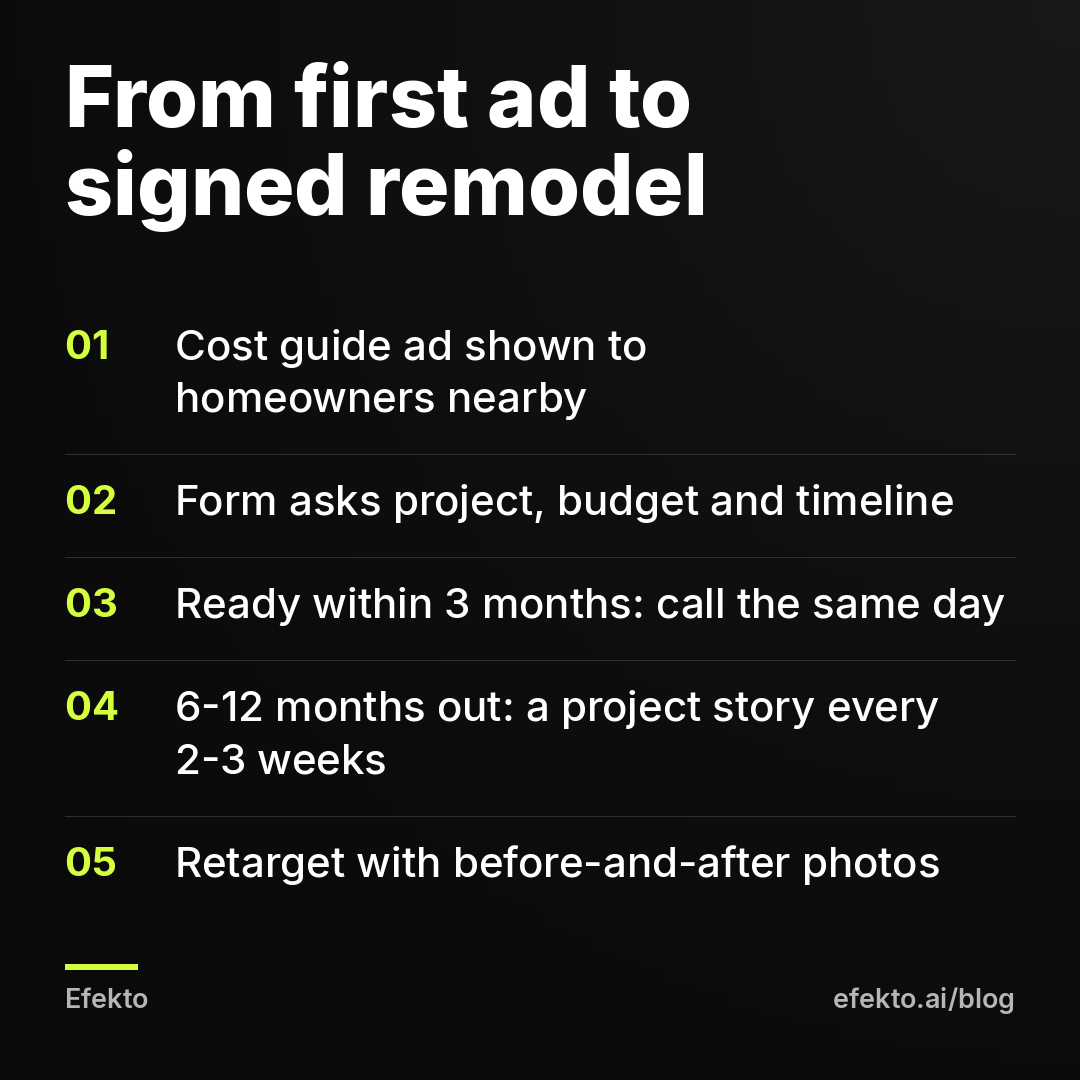
Split leads into two lanes on the day they come in: hot leads get a call the same day, and everyone else gets a steady, useful message every 2 to 3 weeks until they are ready. Remodeling leads are rarely lost to a competitor's ad. They are usually lost because nobody followed up after the first call.
Hot lane: timeline within 3 months, budget fits, owns the home. Call within the hour during working hours. Text right away if you cannot call.
Nurture lane: 3 to 12 months or "just researching". Send the guide immediately, then a sequence by email or text:
- Week 1: one finished project like theirs, photos plus price range.
- Week 3: "what happens in the first two weeks of a bathroom remodel".
- Week 6: how permits work in their town.
- Every 3 weeks after: one new project story, with an offer to book a design consultation.
Set a reminder in your CRM to call each nurture lead at the start of the window they chose. A homeowner who said "6 to 12 months" in March gets a call in September.
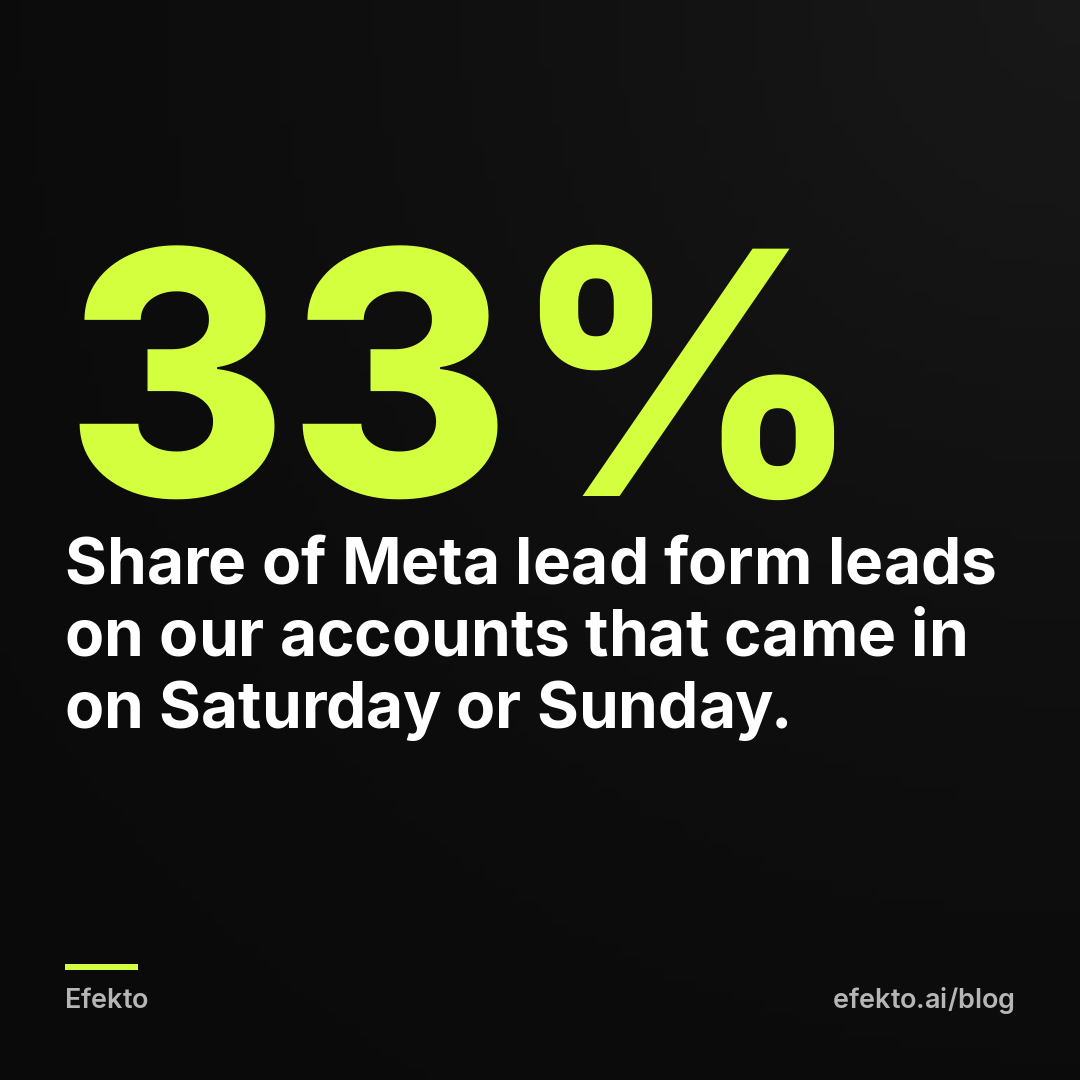
From our accounts: of 3,490 Meta lead form leads collected in the 90 days to Nov 1, 2026 on the accounts we run, the most came in on Sunday (19.2%), the fewest on Monday (12.5%), and Saturday plus Sunday brought 33% of all leads. Those accounts cover many industries, not just remodeling. Still, the pattern fits how people plan home projects: on the weekend, at home, looking at the room they want to change.
From our accounts: on Efekto users' accounts in English-speaking markets (mostly the US) (8 brands, 126 leads in the 180 days to Nov 1, 2026), 17% of leads came in after 6 pm, only 27% on weekdays between 8 am and 4 pm, and 35% on weekends. That is a small sample, but it points the same way. About three out of four leads arrive when your office is closed.
What this means for a remodeler: set up an automatic text that goes out within minutes of every lead, day or night, with the guide link and a line like "We'll call you Monday morning, or reply with a better time." Then make Monday morning the first block of the week for calls. A lead that came in Sunday afternoon and hears nothing until Wednesday has already moved on.
When it makes sense: always. This is where most of the money in remodeling ads is made or lost.
When it does not: there is no case where skipping follow-up makes sense. If nobody on your team can do it, fix that before spending on ads.
6. How do you retarget homeowners who downloaded your guide?
Run a second, smaller ad set that shows people who already engaged a different message: the next step, usually a design consultation, backed by before-and-after photos. Someone who downloaded your kitchen guide in February does not need the guide ad again. They need to see your work and a reason to book.
Audiences to build:
- People who opened or submitted your lead form in the last 180 days.
- People who watched at least 50% of your walkthrough videos.
- People who engaged with your Facebook page or Instagram profile.
- An uploaded list of guide downloaders and past estimates (homeowners who got a quote but did not sign).
Creative for this ad set: a finished project close to what they asked about, a short client quote if you have permission, and a clear next step. For example: "Planning a kitchen for spring? We book design consultations 6 to 8 weeks out. Pick a slot."
We'd put 20% to 30% of the budget here once the audiences have a few thousand people in them.
When it makes sense: after the guide campaign has run for a month or two and has built up an engaged audience.
When it does not: in the first weeks, or if your page and site get very little traffic. The retargeting ad set will barely spend, and splitting a small budget slows the main campaign down.
7. When during the year should remodeling ads run hardest?
Run the planning offer hardest in the months before your busy season and the booking offer during it, and never switch ads off completely in slow months. Because of the long cycle, the leads you collect in a quiet month are the projects you build three to nine months later.
The calendar we'd use for a typical spring-and-summer remodeling business (adjust to your market):
- December to February: cost guides. People plan around the new year and tax season.
- February to May: design consultation offers to warm audiences, guides still running.
- June to August: "finished before the holidays" kitchen and guest bath angle.
- September to November: basement and interior projects, and guides again for next spring.
When it makes sense: if your schedule has clear busy and slow seasons.
When it does not: if you are booked solid for 6 months or more. Lower the budget to the minimum that keeps the account learning and keep the nurture lane going, instead of paying for leads you cannot serve this year.
8. What does the math look like for a remodeling campaign?
At a moderate budget, a cost guide campaign can pay for itself with one or two signed projects. The catch is that the money arrives months after you spend it. Here is a worked example. Every number is an assumption for illustration, not a result from our accounts.
For example: say you spend $40 a day, about $1,200 a month.
- Meta reports $12 per guide download, so 100 leads in a month.
- 35% pass your filters (budget fits, owns home, in your area): 35 leads.
- 10 of them are in the hot lane; 25 go to nurture.
- 5 hot leads book a consultation this month; 1 signs.
- Over the next 6 months, 2 nurture leads sign.
- Average project: $45,000. Three projects: $135,000 in revenue from one month of ads.
Your cost per lead you can actually work in this example is $1,200 / 35 = $34.29. Your cost per signed project is $400.
Another example, with the same budget on a pure "free estimate" ad. You might get 15 estimate requests at $80 each. Maybe 1 signs this month, and the other 14 either hired someone else or were never serious. The cost per lead looks worse, but more importantly, there is no group of planning homeowners left to sign over the next year.
Track results by the month the lead came in, not the month the contract was signed. Otherwise March looks like a disaster and September looks brilliant, and you'll cut the budget at exactly the wrong time.
When this math holds: average projects over $20,000 and a follow-up process that runs for months.
When it does not: if your average job is $3,000. One sale cannot carry a long nurture, so go with direct offers.
9. When are Facebook ads the wrong choice for a remodeler?
Facebook ads are the wrong choice if you cannot follow up, have nothing to show, or already have more work than you can take. We make money when businesses run ads on Meta, so take this section as us arguing against our own interest.
Skip Facebook, or wait, if:
- You have no photos of your own finished work. Shoot your next two jobs properly first.
- You are booked 6+ months out from referrals. Ads will add frustration, not profit.
- Nobody answers leads within a day. You will pay for leads and lose them on Monday.
- Your jobs are mostly small repairs. People searching "handyman near me" on Google are a better match.
- You can't afford to wait. If you need signed contracts within 30 days to make payroll, a long-cycle campaign will not save the quarter. Work your past estimate list by phone first.
Summary: what to set up for remodeling ads
| Step | What to set up | Skip it if |
|---|---|---|
| 1. Cost guide | One PDF per project type, real price ranges | Jobs are small or urgent |
| 2. Before-and-after | Own photos, caption with size, days, price range | You only have stock or manufacturer photos |
| 3. Form questions | Project, budget, timeline, ownership, zip | Budget near minimum: drop the budget question for now |
| 4. Targeting | Broad local radius, 30-65+, creative does the filtering | High-end work in a few zip codes |
| 5. Follow-up | Instant text, hot lane same day, nurture every 2-3 weeks | Never |
| 6. Retargeting | Consultation offer to engaged audiences, 20-30% of budget | Audience still small |
| 7. Seasonality | Guides before busy season, consultations during | Booked 6+ months out |
| 8. Math | Track by month of lead, cost per signed project | Average job under a few thousand dollars |
If you want the ads part handled without learning Ads Manager, this is where how Efekto works comes in. Efekto creates ads from your website, publishes them, and optimizes them every day: it turns off the ones that don't bring results and scales the ones that do. You approve the first batch (at least 5 ads) before anything runs. The minimum daily budget is $15, but for remodeling we'd start closer to $40.
Efekto does not write your cost guide, take your before-and-after photos or call your leads on Monday morning. That part stays with you, and it decides whether the campaign pays. The Starter plan is $149 a month, with 7 days free counted from the launch of your first campaign and no card needed at sign-up.
FAQ
How long does it take a Facebook remodeling lead to become a signed project?
It depends on the timeline they chose in the form. Hot leads can sign within weeks, while "6 to 12 months" leads sign when they said they would, if you are still in touch. Plan your cash flow as if most of the revenue from a month of ads arrives three to nine months later.
Should I put prices in my remodeling ads?
Yes, as ranges from your own jobs. A range filters out people who cannot afford you before they cost you an estimate visit, and it makes the ad more believable. "Starting at" prices that nobody actually pays do the opposite.
How much should a remodeling company spend on Facebook ads per day?
We'd start around $30 to $50 a day for one project type and one area, then adjust once you know your cost per lead you can actually work. Below that, the campaign collects too few leads in a month to show you which ads work.
Do lead magnets like cost guides bring low-quality leads?
They bring earlier leads, which can look like low quality if you treat them like estimate requests. With budget and timeline questions in the form and a nurture sequence, the planning homeowners become your pipeline for next season instead of a pile of people who "never picked up".
If you want your before-and-after photos turned into running ads while you focus on follow-up, you can launch your first campaign at efekto.ai.
- Jakub Zwoliński
Founder, Lemon Agency · Efekto · November 6, 2026