How to Test Two Facebook Ads Against Each Other on a $20-a-Day Budget
How to A/B test two Facebook ads on $20 a day: split the budget evenly, change one thing, run full weeks, and wait for about 20 leads before picking a winner.

To test two Facebook ads on $20 a day, put each ad in its own ad set at $10 a day. Give both ad sets identical audience, location, placement and form settings, and change only one thing between the two ads. Let both run for at least 7 full days and until the test has about 20 leads in total. Pick a winner only if one ad has roughly twice the leads of the other at similar spend. Anything closer is a tie on this budget, which is why a $20-a-day test should compare two big ideas, such as two different offers, and not two button colors.
In short:
- On $20 a day you can only spot big differences between ads, so test offers and opening images, not small wording tweaks.
- Split the budget evenly yourself, because two ads sharing one ad set almost never get equal spend.
- Wait for full weeks and around 20 leads in total before choosing a winner, and treat close results as a tie.
Can you really A/B test Facebook ads on $20 a day?
Yes, but only for large differences, and only if you accept that each test takes one to three weeks. Most "test everything" advice you read online assumes budgets ten times bigger than yours. If you follow it on $20 a day, you spend a month learning nothing, because the differences you're testing are smaller than the random swings in your results.
Here is the problem in plain terms. On $20 a day, a local service business might get somewhere between zero and two leads a day. If you ran the exact same ad twice, side by side, a 12-to-8 split in leads after a few weeks wouldn't surprise us at all. Luck alone produces gaps like that. So a test on this budget can tell you "offer B is clearly better than offer A". It cannot tell you "headline B is 15% better than headline A". Knowing which kind of question you're asking saves you from declaring fake winners.
Our position is simple: on a small budget, test fewer things and make each test count. One clear answer a month is worth more than ten half-answers.
What should you test first when the budget is small?
Test the things that can double or halve your results, in this order:
- The offer. "Free roof inspection" against "$99 gutter cleaning with any inspection". "Book a consultation" against "Get a price in 24 hours". The offer changes who raises their hand, so it moves results the most.
- The opening image or the first 3 seconds of video. A before-and-after photo against a photo of your truck and crew. A finished job against a person talking to the camera. People decide whether to stop scrolling based on this.
- The angle of the first line of text. Price-focused ("No surprise fees") against speed-focused ("Same-week installs") against trust-focused ("Family-owned since...").
What not to test on $20 a day: button text, emojis, one word in the headline, blue against green backgrounds. These may matter a little. You will never have enough leads to see it, so the test only burns budget.
How do you set up the test in Ads Manager, step by step?
You need two ad sets with $10 a day each, identical settings, and two ads that differ in one element. Here is the order we'd do it in.
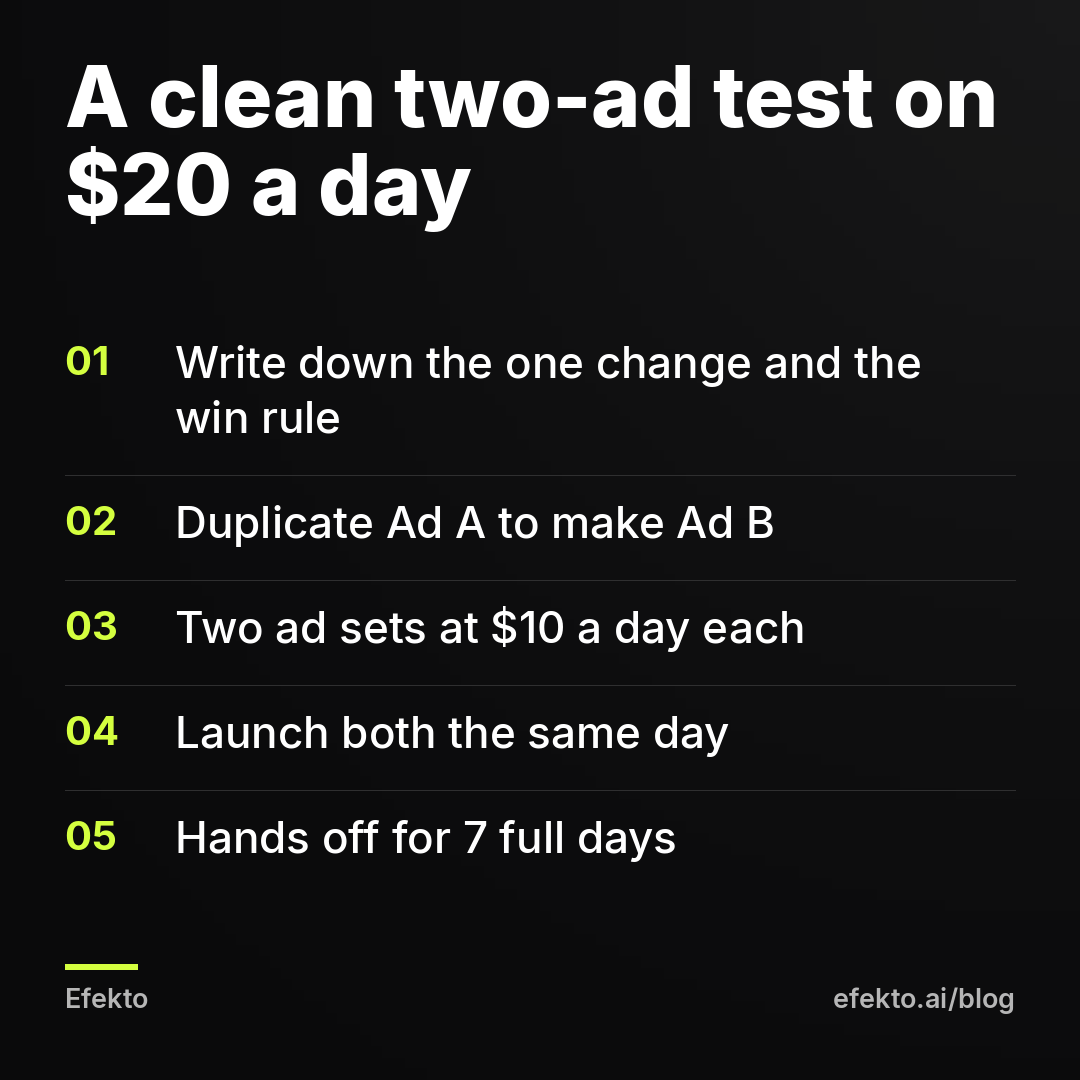
Step 1: Write down what you're testing and what counts as a win
Before you open Ads Manager, write one sentence: "Ad A uses offer X, Ad B uses offer Y, everything else is the same. The winner is the ad with the lower cost per lead after 7 days and at least 20 leads total, if the gap is about 2x." Writing it down stops you from moving the goalposts on day 4 when one ad looks good.
Step 2: Build Ad A, then duplicate it to make Ad B
Create your first ad completely: image or video, text, headline, button, lead form or website link. Then use "Duplicate" and change only the one element you're testing. Building Ad B from scratch is how small accidental differences sneak in, like a different form or a missing phone number.
Step 3: Give each ad its own ad set at $10 a day
Set the budget at the ad set level, not the campaign level, so each ad set gets exactly $10 a day. Put Ad A in ad set 1 and Ad B in ad set 2. If you prefer, Meta's built-in A/B test feature can do the split for you. It shows each version to a separate group of people. Either way, the goal is that both ads get the same money.
Step 4: Lock every other setting
Same location and radius, same age range, same placements, same optimization goal (leads), same lead form questions, same schedule. If your location settings are sloppy, both ads waste budget equally, and the test still works. But if one ad set targets 15 miles and the other 25, you're testing the radius, not the ad.
Step 5: Launch both on the same day, ideally a Monday or Tuesday
Starting both at the same moment means both see the same days of the week, the same weather and the same local events. Starting one on Monday and the other on Friday ruins the test before it begins (the next sections show why).
Step 6: Don't touch anything for 7 days
No budget changes, no text edits, no pausing "to see what happens". Every edit can send an ad set back into Meta's learning period. On small budgets, ad sets often sit in that state anyway. Our guide on what "Learning Limited" means on a small budget explains why that's normal and not a reason to panic.
Why not just put both ads in the same ad set?
Because Meta will not split the money evenly, and the ad that gets more spend will look like the winner whether it is or not. Inside one ad set, Meta's delivery system shifts budget toward whichever ad it predicts will perform better. It often does that in the first day or two, before either ad has a single lead. You end up with one ad spending $17 a day and the other $3, and you learn nothing about the $3 one.
We earn our living running ads on Meta for more than 300 clients, so this isn't a complaint from outside. The delivery system is built to spend your budget where it expects results, not to run fair experiments for you. That's fine for everyday running. It's useless for a test.
| Setup | How the $20 gets split | Fair test? | Our take on $20 a day |
|---|---|---|---|
| Two ads in one ad set | Meta decides, often 80/20 or worse within days | No | Fine for running ads, not for testing |
| Two ad sets at $10 a day each | $10 and $10, set by you | Yes, if all settings match | What we'd use |
| Meta's built-in A/B test | Even split, separate audiences | Yes | Also good, a bit more setup |
Why does it matter that you change only one thing at a time?
If two things change, you can't tell which one made the difference, and your next test may build on the wrong lesson.
For example: say Ad A shows a photo of your crew with the line "Free estimate". Ad B shows a before-and-after photo with the line "$50 off any job booked this month". After three weeks, Ad B has 14 leads and Ad A has 6. Ad B wins. But why? Maybe the before-and-after photo did all the work and the discount added nothing except lower-margin jobs. Maybe the discount did all the work and the photo didn't matter. You don't know. So in the next round you keep both the photo and the discount, and you may be giving away $50 per job for no reason.
Now run it one variable at a time. Test 1: same "Free estimate" line, crew photo against before-and-after photo. Test 2: winning photo, "Free estimate" against "$50 off". It takes twice as long. But at the end you know exactly what each change is worth, and you only pay for the discount if it actually brings more customers.
The one exception: if you're comparing two completely different ad concepts on purpose ("price ad" against "trust ad"), it's fine to change several elements together. Just be honest that you're testing the concept, not any single piece of it.
Which days of the week should a Facebook ad test cover?
A test should always cover whole weeks, starting and ending on the same weekday, because leads don't arrive evenly across the week.
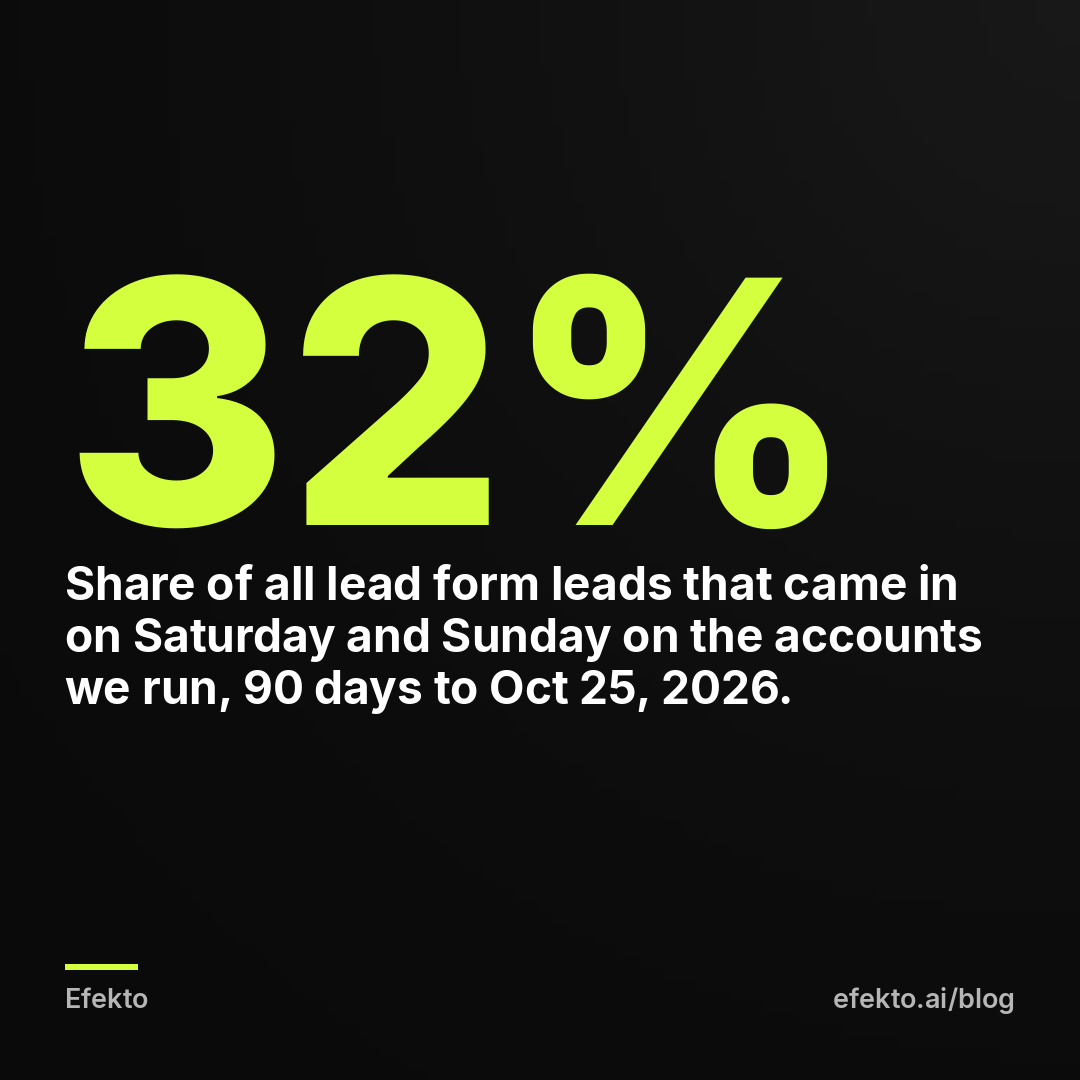
From our accounts: Of 3,184 Meta lead form leads collected in the 90 days to Oct 25, 2026 on the accounts we run, the most came in on Sunday (19.1%), the fewest on Monday (12.8%), and Saturday plus Sunday brought 32% of all leads.
What this means for your test: if you run Ad A from Monday to Thursday and then switch to Ad B from Friday to Monday, Ad B gets the weekend. It will probably look better even if it's the weaker ad. Even running both at once, a test that stops on a Friday misses the two days that, on our accounts, carried almost a third of all leads. Seven days is the minimum. Fourteen or twenty-one days are better on $20 a day, as long as the end date falls on the same weekday as the start.
It also changes how you read early results. If both ads look dead on Tuesday and Wednesday, that's not a verdict. Wait for the weekend before judging anything.
How much spend and how many leads do you need before picking a winner?
As a rule of thumb, we'd wait for about 20 leads across both ads and at least 7 full days. On $20 a day, how long that takes depends entirely on your cost per lead.
For example: say your leads cost about $15 each. At $20 a day, the test brings roughly 1.3 leads a day across both ads. Reaching 20 leads takes about $300 of spend, which is around 15 days. If after those 15 days Ad A has 13 leads and Ad B has 7, Ad A has nearly twice as many at the same spend. That's a gap we'd act on. If it's 11 against 9, that's a tie. Pick either one and move to a bigger test.
The same math at other example costs per lead (these are illustrations, not typical results for any industry):
| Example cost per lead | Spend to reach 20 leads | Days at $20 a day | Is a clean test practical? |
|---|---|---|---|
| $10 | $200 | 10 | Yes |
| $15 | $300 | 15 | Yes |
| $25 | $500 | 25 | Slow, but workable |
| $40 | $800 | 40 | Not really, see below |
If you don't yet know your cost per lead or what a reasonable one looks like, start with our explainer on what cost per lead on Facebook means and what counts as good.
For reference, some lead form campaigns do land in the cheap rows. Over the 30 days to Oct 25, 2026, Meta lead form campaigns for legal services in Poland on the accounts we run spent about $302 and collected 44 leads, an average of about $6.86 per lead. That's Poland, not the US, and US local services usually pay more. The point is only that tests in the top rows of the table exist in practice.
One early-stop rule: if an ad has spent three times your acceptable cost per lead with zero leads, you can stop it before the test ends. If you'd happily pay $25 a lead, an ad at $75 spent and no leads has told you enough.
How do you read the results and pick the winner?
Compare cost per lead first, then check whether the leads were real people who picked up the phone. The number in Ads Manager is the cost of a form submission before anyone has checked it.
Work through it in this order:
- Check that spend was roughly even. If one ad set spent $140 and the other $110, compare cost per lead, not lead count.
- Apply your written rule. About 20 leads total, at least 7 full days, a gap of about 2x. If it isn't met, it's a tie.
- Call or text every lead from both ads. Count how many answered, how many were in your service area, how many booked. An ad with cheap leads that never pick up is the losing ad.
- Declare the winner and write down the lesson. "Before-and-after photo beat crew photo, 13 to 7, same text." That line is the real output of the test.
The winner becomes your new Ad A. Build a new challenger that differs in one element and repeat. Expect even a winning ad to wear out after a few weeks as the same people see it again and again, so the testing never fully stops.
What if neither ad works?
If both ads have spent three times your acceptable cost per lead with few or no leads, the problem usually isn't the difference between them. It's something they share: the offer, the location settings, the form or your follow-up. Stop the test and fix the shared element first. Testing two versions of a bad offer just tells you which bad offer is slightly less bad.
When does testing two ads by hand not make sense?
When your cost per lead is high relative to your budget. At an example $40 per lead, a clean test on $20 a day needs about 40 days. By then the season has changed, and the ads may be wearing out. In that situation you have three honest options. Raise the budget for the test period. Test only one dramatic difference per quarter. Or stop running controlled tests and let a system rotate several ads and keep the ones that bring leads, accepting that you'll know less about why something works.
That third option is how Efekto works. Efekto creates ads from your website, publishes them, and optimizes them every day: it turns off the ones that don't bring results and scales the ones that do. You approve the first batch, with at least 5 approved ads before the campaign starts, and the minimum daily budget is $15. You can see the full flow on the how Efekto works page. It is not a clean two-ad experiment, though. If what you need is a definite answer to "does offer A beat offer B", set up the manual test above.
What are the most common mistakes in a two-ad test?
- Calling a winner on day 3. Early leads are mostly luck. Wait for the full week and the weekend.
- Both ads in one ad set. Meta splits the spend unevenly and the test is over before it starts.
- Changing three things at once. You get a winner but no lesson you can reuse.
- Testing tiny details. On $20 a day, button text and emojis will never show a measurable difference.
- Editing mid-test. A "small fix" to Ad B on day 4 restarts its learning and breaks the comparison.
- Judging only by Ads Manager. Cheaper leads that don't answer the phone are more expensive than they look.
- Never deciding. A tie is a result. Keep either ad and test a bigger idea next.
What we'd do on $20 a day: one test at a time, offer first, two ad sets at $10, full weeks only, and a written win rule before launch. Anything less structured than that is just running two ads and guessing.
FAQ
How long should a Facebook A/B test run?
At least 7 full days, starting and ending on the same weekday, and until both ads together have about 20 leads. On $20 a day that's usually one to three weeks, depending on your cost per lead.
Should I use Meta's built-in A/B test tool on a small budget?
You can. It splits the budget evenly and shows each version to separate people, which is what makes a test fair. Two ad sets at $10 a day each does the same job with less setup, so use whichever you find easier.
Can I test more than two ads at once on $20 a day?
We wouldn't. Three ads on $20 a day means under $7 each, and reaching a meaningful number of leads per ad takes so long that the results stop being useful. Two at a time is the practical limit.
Should I pick the winner by click-through rate instead of leads?
Clicks arrive faster, so they're tempting, but an ad that gets many clicks can still bring fewer or worse leads. Use clicks to spot an ad that's clearly dead early, and use leads that actually answer the phone to pick the winner.
If you'd rather have the daily testing and optimizing done for you, you can try it on Efekto.
- Jakub Zwoliński
Founder, Lemon Agency · Efekto · October 26, 2026