Facebook Ads for Plumbers: Getting Planned Jobs, Not Only Emergency Calls
Facebook ads won't bring burst-pipe calls, but they can fill a plumber's schedule with water heaters, repiping, inspections and maintenance plans. Offers, creatives, forms and the math.

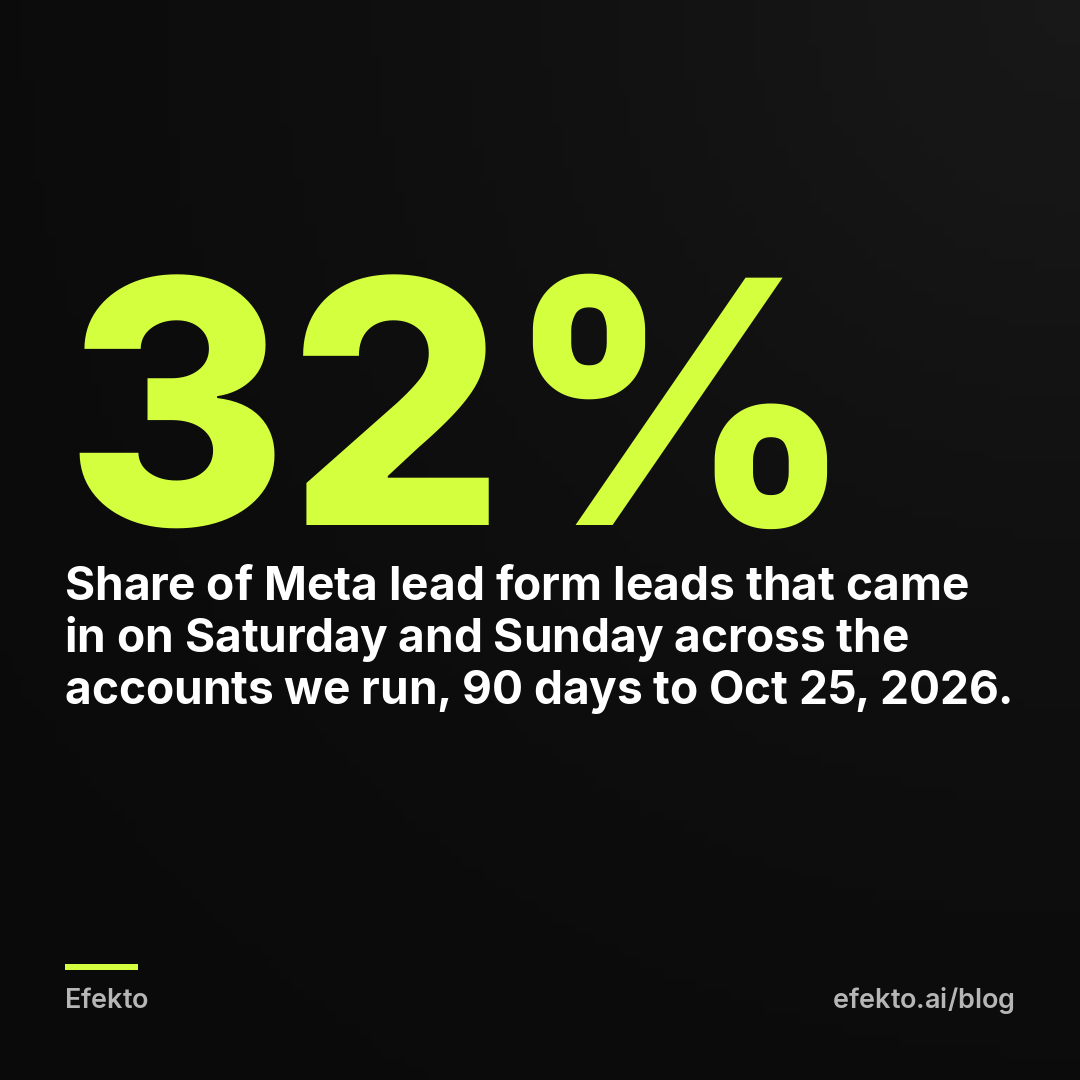
From our accounts: We looked at 3,184 Meta lead form leads collected in the 90 days to Oct 25, 2026, across the accounts we run. Sunday brought the most leads (19.1%) and Monday the fewest (12.8%). Saturday and Sunday together brought 32% of all leads. Nobody's pipe bursts more often on a Sunday. People fill out forms on weekends because that's when they have time to think about their house.
We read that as a statement about what Facebook is good for. People scroll on the couch, see an ad about something they've been putting off, and say yes when they have 30 quiet seconds. A homeowner standing in an inch of water doesn't scroll. That person picks up the phone and searches.
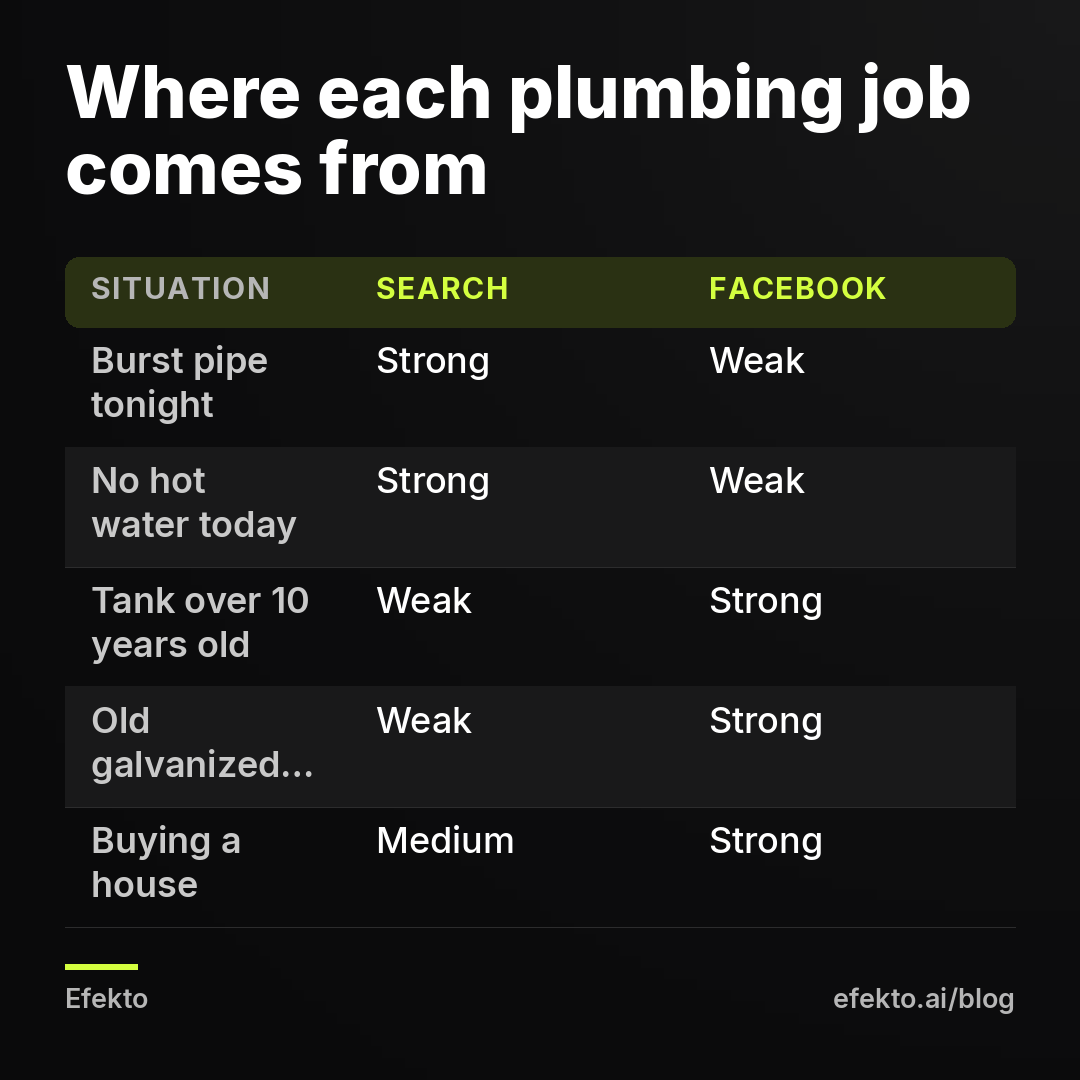
So here's the direct answer: Facebook ads for plumbers work for planned jobs, not for emergencies. Water heater replacements, repiping, sewer and plumbing inspections, and maintenance plans can be sold in a feed. That's because the homeowner decides over days or weeks, and the ad can reach them during that window. Emergency calls come from search, Google Local Services Ads, Google Maps and referrals. If an agency or tool promises you emergency calls from Facebook, they are selling you the wrong channel.
Emergency calls belong to search, not the feed
An emergency has two features that Facebook can't match. It's urgent, and it's rare for any single household. Facebook shows ads to people based on who they are, not what is happening in their kitchen right now. To get an emergency call from a feed ad, you'd need to reach the one homeowner whose water heater split that hour. You'd also need them to be scrolling instead of calling. The odds are tiny, and you pay for every impression in between.
Search works the other way around. The person types "emergency plumber near me" and tells you exactly what they need and when. You pay to be in front of someone who already has the problem. That's why we'd put emergency budget into Google search, Local Services Ads and a well-kept Google Business Profile. Facebook gets the planned work.
We make money running ads on Meta, so we have a reason to say Facebook works for everything. It doesn't. Over 300 clients in four years taught us that the fastest way to burn a plumber's budget is to run "24/7 emergency service" ads in a feed. They get likes from people who don't have a leak and calls from nobody who does.
Four planned jobs that sell well in a feed
The jobs that work on Facebook have three things in common. The homeowner can see or guess the problem before it's a disaster. The ticket is big enough to justify a lead. And the decision takes long enough that an ad can start it. Here's how we'd approach each one. All dollar amounts in this table are examples to adapt, not market rates.
| Job | Example offer | Creative that fits | Form questions |
|---|---|---|---|
| Water heater replacement | Free replacement quote plus $100 off install this month | Phone photo of a rusty 12-year-old tank next to a new install | Tank or tankless? Gas or electric? Roughly how old? ZIP code |
| Repiping | Free pipe assessment with photos of what we find | Cut section of corroded galvanized pipe, 20-second video walk-through | Year home was built? Pipe material if known? Number of bathrooms? Do you own the home? |
| Sewer or plumbing inspection | Camera sewer inspection for home buyers, $199 flat | Screen recording of camera footage showing a root intrusion | Buying, selling or own? Closing date? Home age? |
| Maintenance plan | $15/month: yearly water heater flush, inspection, priority scheduling | Technician flushing a tank, checklist of what's included | Home age? Last time water heater was serviced? ZIP code |
One job per campaign, at least at the start. A campaign that advertises "water heaters, repiping and drain cleaning" sends Meta mixed signals and gives the homeowner no clear reason to act.
Water heater ads should reach people before the tank fails
Water heaters are the easiest planned job to sell on Facebook. Almost every homeowner has one, almost nobody knows how old theirs is, and the failure is expensive and messy. The ad's job is to make someone walk to the garage and look at the label.
The angle that works best is a question, not a discount: "Is your water heater more than 10 years old?" Under it, two or three lines on what happens when an old tank lets go, then the offer. For the creative, use your own phone photos. A corroded tank bottom, a puddle under an old unit, or a clean new tankless install on a wall will beat stock images. If you don't have photos, take five on your next three jobs. Our guide on writing an offer people actually click covers the wording in more detail.
Seasonality: demand for replacements usually climbs when incoming water gets cold and tanks work harder. We'd raise the budget going into fall and winter and run tankless upgrade offers in the quieter months. That's when a homeowner is more open to a planned project than a forced one.
Repiping ads need proof, not a discount
Repiping is a large ticket, and people are scared of it. They imagine their walls torn open for weeks. A coupon doesn't fix that fear. Evidence does.
The creative that does the work is a short video: your hand holding a cut section of old galvanized pipe, closed up with rust, next to a new PEX or copper line. Add a second ad showing a finished wall patch so the homeowner sees the house after the job, not just during it. The offer should be a free assessment that ends with photos of what you found. That gives the homeowner something useful even if they don't hire you this year.
Target neighborhoods where the housing stock is older, using ZIP codes in your service area. The questions about build year and pipe material in the form do half your qualifying. A house built in 2015 is not a repipe lead, no matter how nice the person is on the phone. For more on reaching the right houses, see how to target homeowners in your service area.
Inspections work as a low-cost first step
A flat-price inspection is the easiest thing for a stranger to say yes to. It's small, clearly priced and has a deadline, especially for home buyers with a closing date. It also puts you inside the house, where you can see the water heater, the pipes and the drain line. Done honestly, an inspection is the start of the relationship, not the end of it.
Two audiences work here. Home buyers want a sewer scope before closing, and the ad can say exactly that: "Buying an older home? See inside the sewer line before you sign." Current homeowners with mature trees respond to root intrusion footage. Use real camera footage from your own jobs. It looks strange to a regular person, and strange stops the scroll.
Spring and early summer usually bring more home sales in most markets, so that's when we'd push the buyer version. Don't pretend the inspection is free if it isn't. A $199 flat price is clearer than a "free inspection" that turns into a sales visit, and homeowners notice the difference.
Maintenance plans turn one visit into a yearly customer
A maintenance plan is the only plumbing product that pays you again next year without another ad. It's hard to sell cold, so we'd rarely run it as the first campaign. It works far better as a second campaign aimed at people who already know you: past customers, people who filled out a form, and website visitors. See retargeting on a small local budget for how to set that up.
Spell out what's included, because a vague plan sounds like a subscription trap. A yearly water heater flush, a whole-house leak check, priority scheduling and a fixed discount on repairs. Put the monthly price in the ad. Fall is the natural time to sell it, before freezing weather, framed as "get the house checked before winter."
The lead form should filter, not just collect
An instant form with two questions brings more leads and worse leads. For plumbing, we'd set up the form with:
- Higher intent form type, so the person reviews their answers before sending.
- Two or three multiple-choice questions from the table above, tailored to the job.
- ZIP code as a required field, so out-of-area leads are obvious at a glance.
- A thank-you screen that says when you'll call and shows a "Call now" button for anyone in a hurry.
Every extra question lowers the number of form submissions and raises the share that are real. That trade is worth it for a $1,800 job. Our full walk-through of setting up instant forms for real customers covers the settings screen by screen.
One more thing on numbers. The cost per lead Meta shows you is the cost of a form submission before anyone has checked it. Some of those people gave a wrong number, live outside your area or rent. Your real cost per verified lead is always higher than what Meta reports. That's the number to judge a campaign by.
Your best leads come in when the office is closed
From our accounts: On Efekto users' accounts in Poland (4 brands, 128 leads in the 180 days to Oct 25, 2026), 43% of leads came in after 6 pm. Only 27% came in on weekdays between 8 am and 4 pm, and 28% came in on weekends. It's a small sample from a different market, but it points the same way as the 3,184 leads at the top of this post. People fill out forms when they're off work.
For a plumber this is a scheduling problem, not an ad problem. If your office answers 8 to 4 and nobody looks at leads until Monday, a third of your planned work waits two days for a callback. By then the homeowner may have called someone else. The fix is cheap: an instant text reply, a short evening check of new leads, and a Monday morning slot blocked for weekend callbacks. We wrote about this in detail in following up on Facebook leads fast enough to book the job.
The math on a small budget, as an example
The numbers below are an example to show the mechanism, not a result from our accounts. Plug in your own.
| Step | Example number |
|---|---|
| Daily budget | $30 |
| Monthly spend | $900 |
| Form submissions (Meta's count) | 20, at $45 each |
| Verified leads after the first call | 13, at about $69 each |
| Booked water heater replacements | 5, at $180 each in ad spend |
| Average ticket | $1,800 |
| Revenue | $9,000 |
| Gross profit at 40% margin | $3,600 |
| After ad spend | $2,700 |
The line that matters most is "verified leads." If you judge the campaign on Meta's $45 and ignore the 7 junk submissions, you'll think it's better than it is. If you judge it on revenue without counting the follow-up time, you'll think it's worse. Also note what's missing: the maintenance plan you could offer to all 5 customers on install day, which costs nothing extra in ads.
Now run the same math with half the budget. At $15 a day and the same example $45 per submission, you'd get about one form every three days. That's enough to learn something in a month, but too slow to judge an ad after a week. Small budgets need patience, not more ads.
The first campaign needs one service, one area, one form
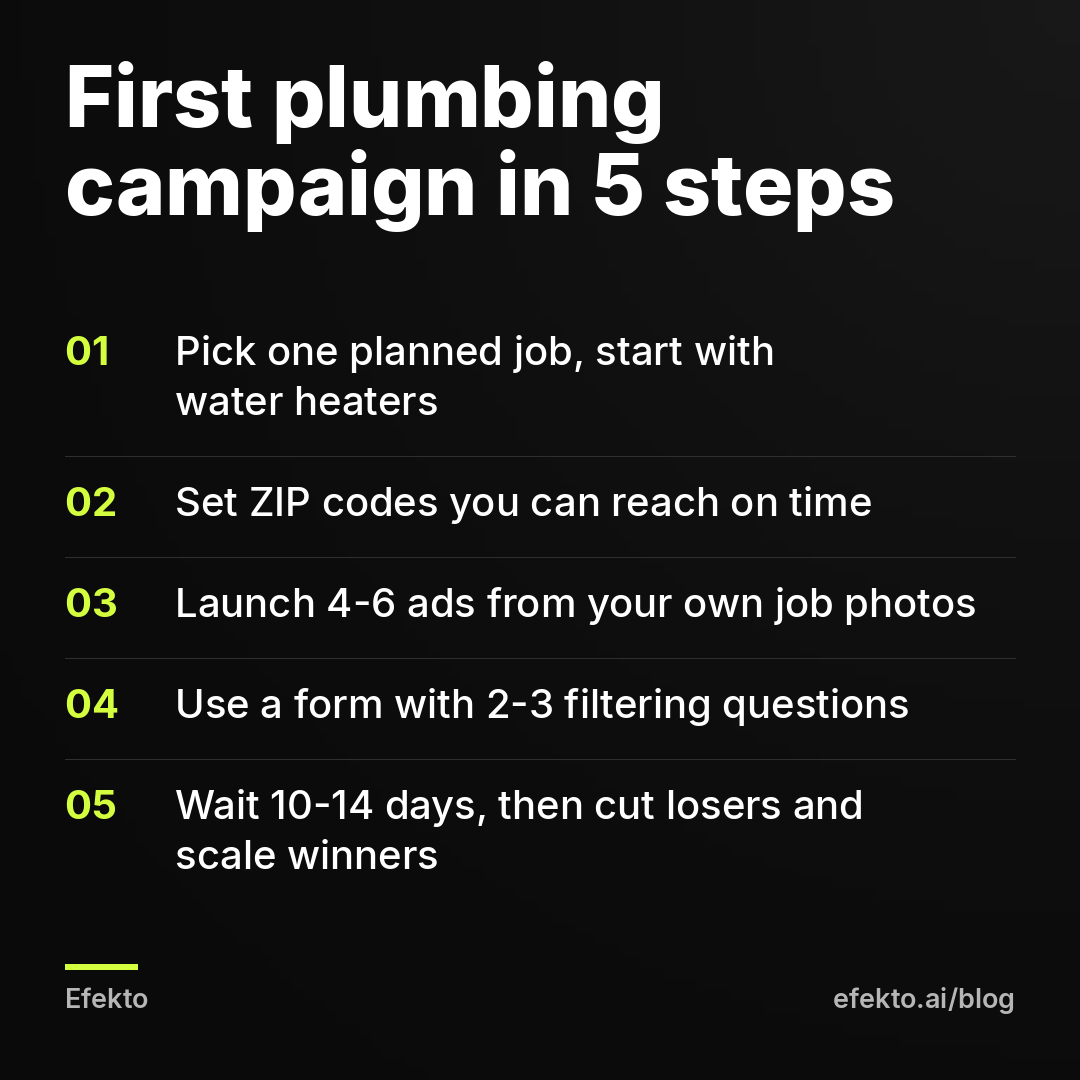
Here's how we'd set up a plumber's first Facebook campaign:
- Pick one job. Water heater replacement, unless you have a strong reason to start elsewhere.
- Set the area by ZIP codes you actually serve and can reach on time, not a 40-mile radius around the shop.
- Upload 4 to 6 ads built from your own job photos and one short video. Vary the angle (age question, before/after, price), not just the color.
- Use an instant form with the filtering questions above.
- Leave it running for 10 to 14 days before you change anything big. Then turn off the ads that brought no verified leads and give their budget to the ones that did.
If you don't want to do the daily part yourself, this is what Efekto is built for. Efekto creates ads from your website, publishes them, and optimizes them every day: it turns off the ones that don't bring results and scales the ones that do. You approve the first batch (at least 5 ads) before anything goes live, and it runs on your own Facebook ad account or an Efekto ad account. Here's how it works in more detail.
On cost: the Starter plan is $149 a month for one campaign. The minimum ad budget is $15 a day, and the 7-day free trial counts from the launch of your first campaign, with no card needed at sign-up. If you'd rather run the five steps above in Ads Manager yourself, that works too.
When Facebook ads are the wrong tool for a plumber
Skip Facebook, or put it second, in these situations:
- You only want emergency work. Put the money into search and Local Services Ads. Facebook won't fill that need, as explained above.
- Your schedule is already full for three weeks. Ads will create leads you can't serve, and slow callbacks waste them. Fix capacity first.
- You can't spend at least $15 a day for a month. Below that, you won't get enough leads to tell a good ad from a lucky one. Referrals and your Google profile are better uses of a small budget.
- Nobody can call leads back the same day. Planned work is less urgent than a leak, but a lead that waits three days goes cold.
- Your service area is a handful of streets. Meta needs enough people to show ads to. Very small areas tend to get expensive fast.
What to take from this
- Stop running "24/7 emergency" ads on Facebook. Move that budget to search and Local Services Ads, and use Facebook for water heaters, repiping, inspections and maintenance plans.
- Start with one planned job, usually water heater replacement, with an ad built around a question the homeowner can answer by looking at their tank.
- Add two or three qualifying questions and a ZIP code to the form. Judge the campaign on verified leads, not on Meta's cost per form.
- Plan for weekend and evening leads. Our data shows 32% arriving on Saturday and Sunday, so set up an instant reply and a Monday callback block.
- Sell maintenance plans to people who already know you, not to strangers in your first campaign.
If you want to see what a planned-job campaign built from your own website would look like, you can start at efekto.ai.
- Jakub Zwoliński
Founder, Lemon Agency · Efekto · October 27, 2026