What Is a Lookalike Audience, and Does It Still Work for Local Businesses?
A lookalike audience is a group Meta builds to resemble your customers. Here is what to build it from, why small towns hit size limits, and how it compares with broad targeting.

A lookalike audience is a group of people Meta builds to resemble a list you give it, usually your customers or leads, so your ads reach strangers who share their traits and behavior. It still exists and still works. For a local service business in a small market, though, it is rarely the first thing we would set up. Your service area cuts it down to a few thousand people, and broad targeting now finds most of the same buyers on its own.
How does a lookalike audience work?
You upload a source list (Meta calls it a seed). Meta matches it to Facebook and Instagram profiles, finds the common patterns, and builds a new audience of people who look similar. You pick the size as a percentage of a country's population, from 1% to 10%. At 1% you get the closest match. At 10% you get a much bigger, looser group.
Three rules matter for a local business:
- A list of 100 works, but it gives the algorithm very little to learn from.
- Lookalikes are built at the country level, not the city level. A 1% US lookalike is millions of people spread across the whole country. You then add your service area as location targeting, and only the overlap gets your ads.
- With Advantage+ audience turned on, your lookalike becomes a suggestion. Meta can go beyond it when it finds people more likely to convert. We cover that setting in what Advantage+ on Facebook does and whether to turn it on.
Meta has not removed lookalikes. What has changed is how much of the targeting work the algorithm now does without them.
What should a local business build a lookalike from?
Build it from people who paid you, not from everyone who filled out a form. A lead list includes tire-kickers, wrong numbers and people outside your area. Meta will happily find more people like them. Here is how we would set it up:
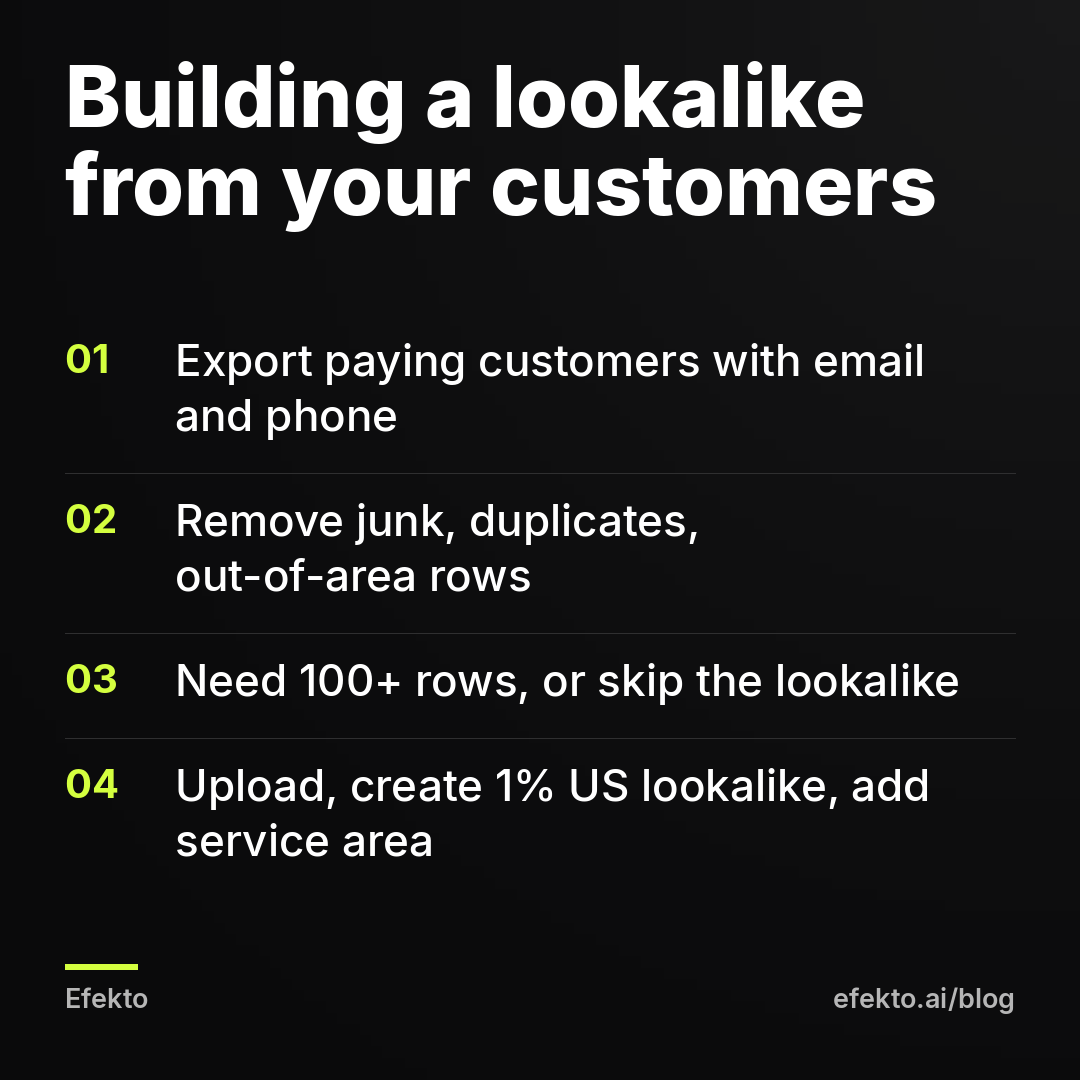
- Export paying customers from your CRM, invoicing tool or booking system. Include first name, last name, email, phone, city, state and ZIP. More fields mean a higher match rate.
- Remove junk and one-off outliers. That means test entries, duplicates, out-of-area addresses, and anyone who never became a customer.
- Check the count. If fewer than 100 rows remain, stop here. You are not ready for a lookalike yet, so go to the broad option below.
- Upload it in Ads Manager under Audiences > Create audience > Custom audience > Customer list. Meta hashes the data before matching. Wait until the custom audience shows a size.
- Create the lookalike from that custom audience. Choose United States and 1%. Then build the ad set with your real service area as the location.
- Exclude your current customers with the same custom audience, so you don't pay to show an "first visit" offer to people who already booked.
If you only have leads, use leads who were qualified on the phone. A list of 150 qualified leads is a better seed than 600 raw form fills.
Is a small town too small for a lookalike audience?
Often, yes. The lookalike is national, so only a thin slice of it lives in your service area.
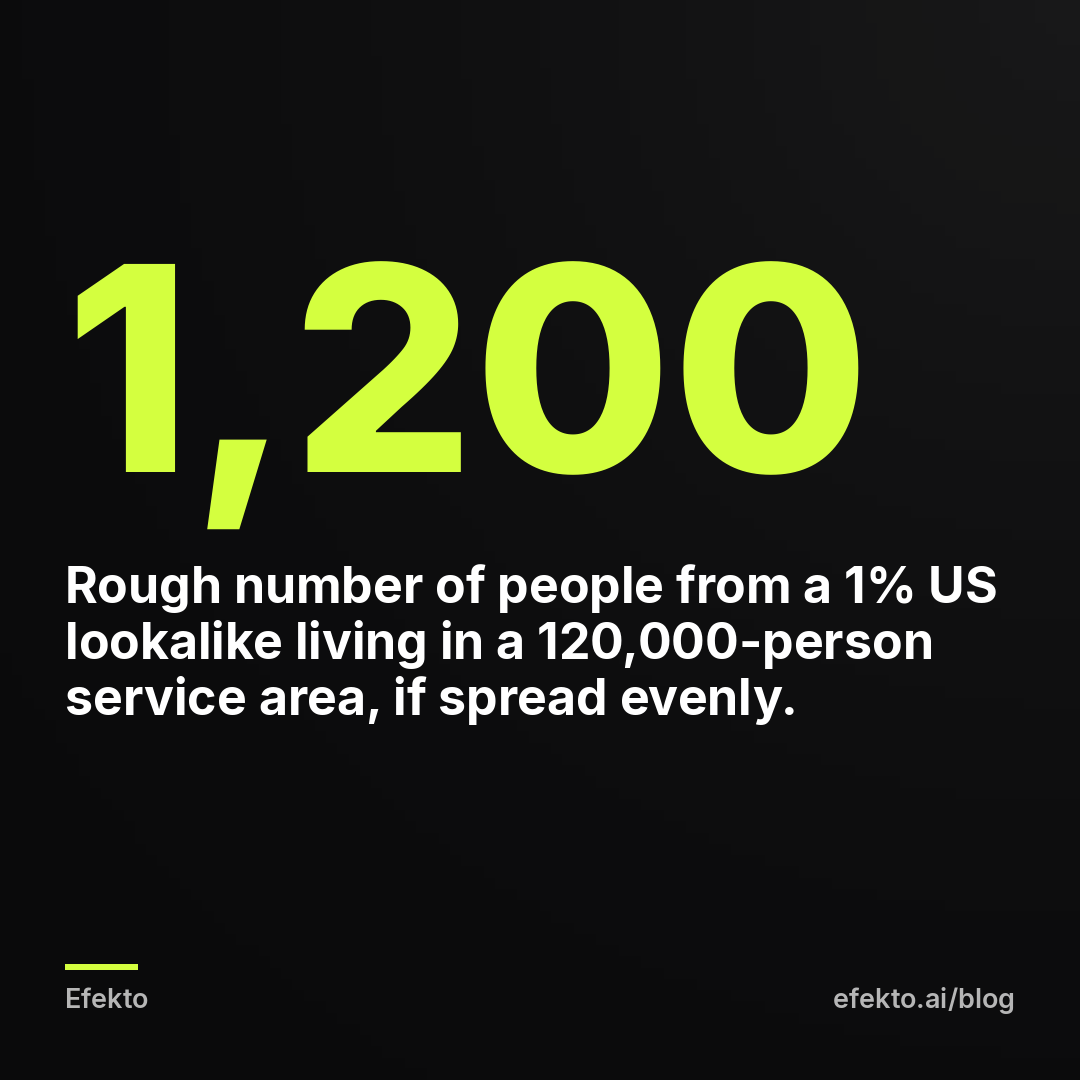
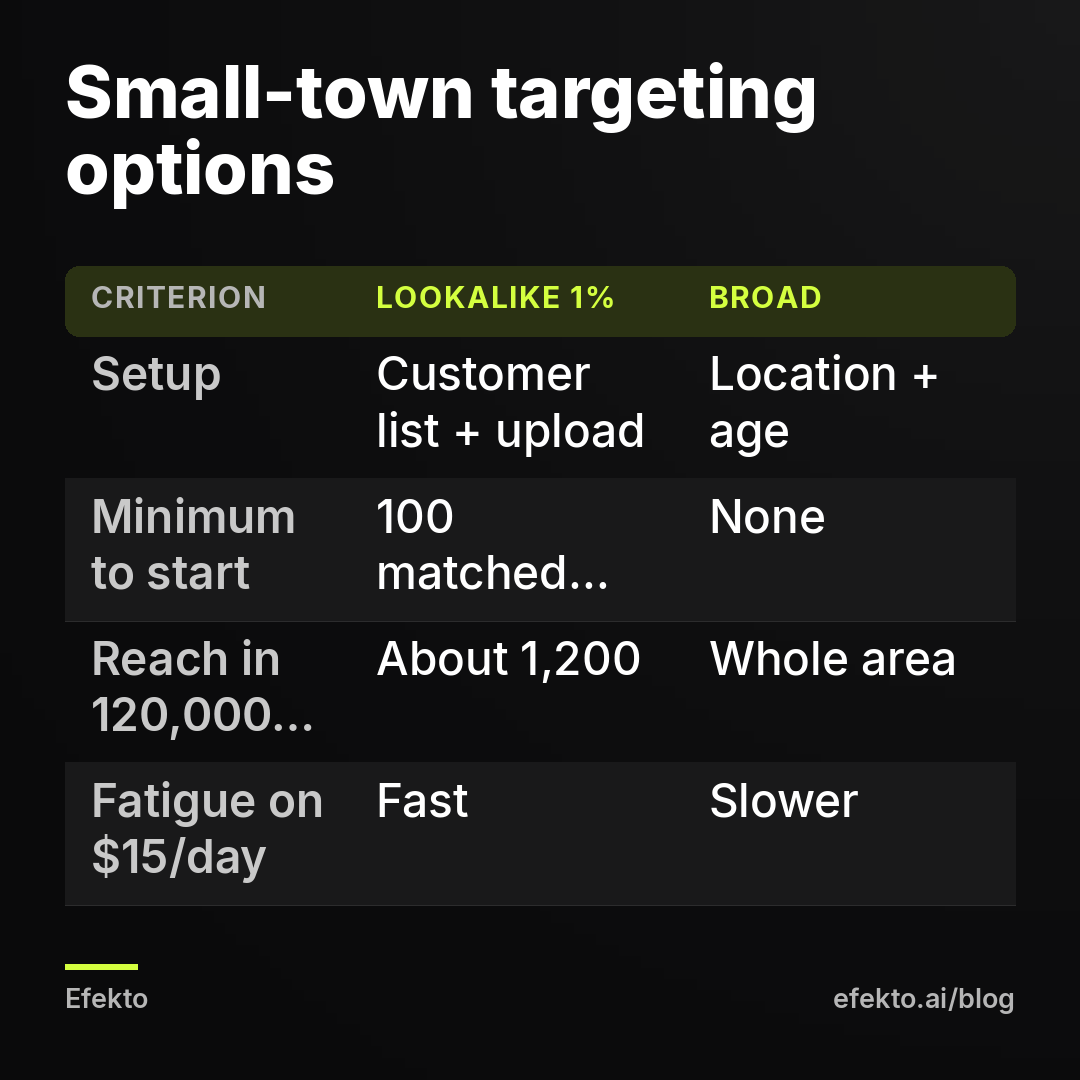
For example: say you run an HVAC company in a town of 40,000. Your 20-mile service area holds 120,000 people. A 1% US lookalike covers roughly 1% of the country. If its members were spread evenly, about 1,200 of them would live in your area. Say they cluster near your existing customers and the real number is three times higher. That still leaves about 3,600 people. At $15 a day, the same few thousand people see your ad over and over, and costs climb within weeks. That is the ad fatigue problem, and it hits sooner with a smaller audience.
The obvious fix is to widen the lookalike to 10%. Then your slice becomes roughly 12,000 people or more, a large share of the adults in your area who would ever need HVAC. At that point you have mostly rebuilt broad targeting, with extra setup steps.
In a metro area with 2 million people inside your radius, the math changes. A 1% lookalike leaves tens of thousands of people, enough for it to behave like a real audience.
Lookalike vs broad targeting: which works better for a local business today?
For most small local businesses, we would start broad: your service area, an age range if it matters, and nothing else. Then let the ad and the offer do the filtering. Our reason is simple. Meta's delivery system already learns from who clicks, fills out the form and converts. On a small local audience, a lookalike mainly narrows the pool that system can learn from. We are not saying a lookalike will lose. We are saying that in a small town it usually can't win by much, because both options end up reaching nearly the same people. We earn money running ads on Meta, so we have no reason to steer you away from any targeting option. We just don't want you spending two weeks building an audience that the location filter shrinks to a few thousand people.
A business at that pace would need about three months of leads to reach Meta's 100-person minimum. It would need even longer to get 100 who actually became customers. Separately, of the 13 brands that launched a campaign in Efekto in the same 180 days, 8 have already received a lead. The median time from launch to the first lead was 5.8 hours, and 7 of them got one within 24 hours. In practice, a new local account starts producing leads long before it has a seed list worth copying. Waiting for a lookalike means waiting for nothing.
Broad does put more weight on your creative and your form. If the ad is vague, broad wastes money on curious scrollers. Your offer, your photos and a qualifying question or two in the form are your real targeting. For the location side, see how to target homeowners in your service area without wasting budget.
When does a lookalike make sense, and when doesn't it?
It makes sense when all three of these are true:
- You have at least several hundred paying customers on file, ideally 1,000 or more.
- Your service area holds hundreds of thousands of people, or you serve a whole region or several states.
- You already have a broad campaign running, so you can test the lookalike against it in a second ad set with the same ads and budget.
It doesn't make sense when your customer list is under 100, when you serve one small town, or when you are spending $15 to $30 a day. At that budget, splitting money across two audiences leaves each ad set too little to learn. Put that effort into a sharper offer and new creative every few weeks.
If you don't want to manage audiences and creative at all, Efekto is one option. Efekto creates ads from your website, publishes them, and optimizes them every day: it turns off the ones that don't bring results and scales the ones that do. The minimum budget is $15 per day. There is a 7-day free trial counted from the launch of your first campaign, and the Starter plan costs $149 per month. The details are on how Efekto works.
Our own approach for a new local account: launch broad in the service area this week, collect leads, mark which ones became paying jobs, and only build a lookalike once that list passes a few hundred names. If you'd rather have an app run that first campaign for you, you can start at efekto.ai.
- Jakub Zwoliński
Founder, Lemon Agency · Efekto · October 27, 2026