What Is the Meta Ad Library, and How to Use It to Check Local Competitors' Ads
The Meta Ad Library shows every active Facebook and Instagram ad. Here is how to find local competitors in it and read their offers, formats and run time.

From our accounts: Of the 49 brands that launched a campaign in Efekto in the 180 days to Nov 8, 2026, 28 have already received a lead. The median time from launch to the first lead was 9.7 hours, and 22 of them got one within 24 hours.
That number changed how we read other people's ads. When an ad produces its first lead within hours, one good day proves almost nothing about whether it pays. The ads that tell you something are the ones an advertiser keeps paying for week after week. So when we check competitors before a launch, we skip brand-new ads and focus on the ones that have been running for a long time.
The Meta Ad Library is a free, public database of every ad currently running on Facebook, Instagram, Messenger and Meta's Audience Network. Anyone can search it without logging in and without an ad account. For a local service business, it is the fastest way to see which offers your competitors are paying to promote right now, which formats they use, and how long each ad has been live.
The library shows every active ad, not just the big brands
If a roofer two towns over is running a $20-a-day ad, it is in the library. Meta does not set a size threshold. The library lives at facebook.com/ads/library, and every Facebook Page also links to it: open the Page, find "Page transparency" and click through to see the Page's ads.
For each ad you get:
- the ad itself (image, video or carousel) with its text and headline,
- the date it started running,
- the platforms it runs on (Facebook, Instagram, Messenger, Audience Network),
- a note if the ad has several versions, meaning the advertiser is testing different images or text under one ad,
- the call-to-action button and, after a click, the landing page or form.
If a competitor shows no results, they are not advertising on Meta right now. That is useful too. It means the feed in your area may be less crowded than you assumed.
Finding local competitors takes three searches
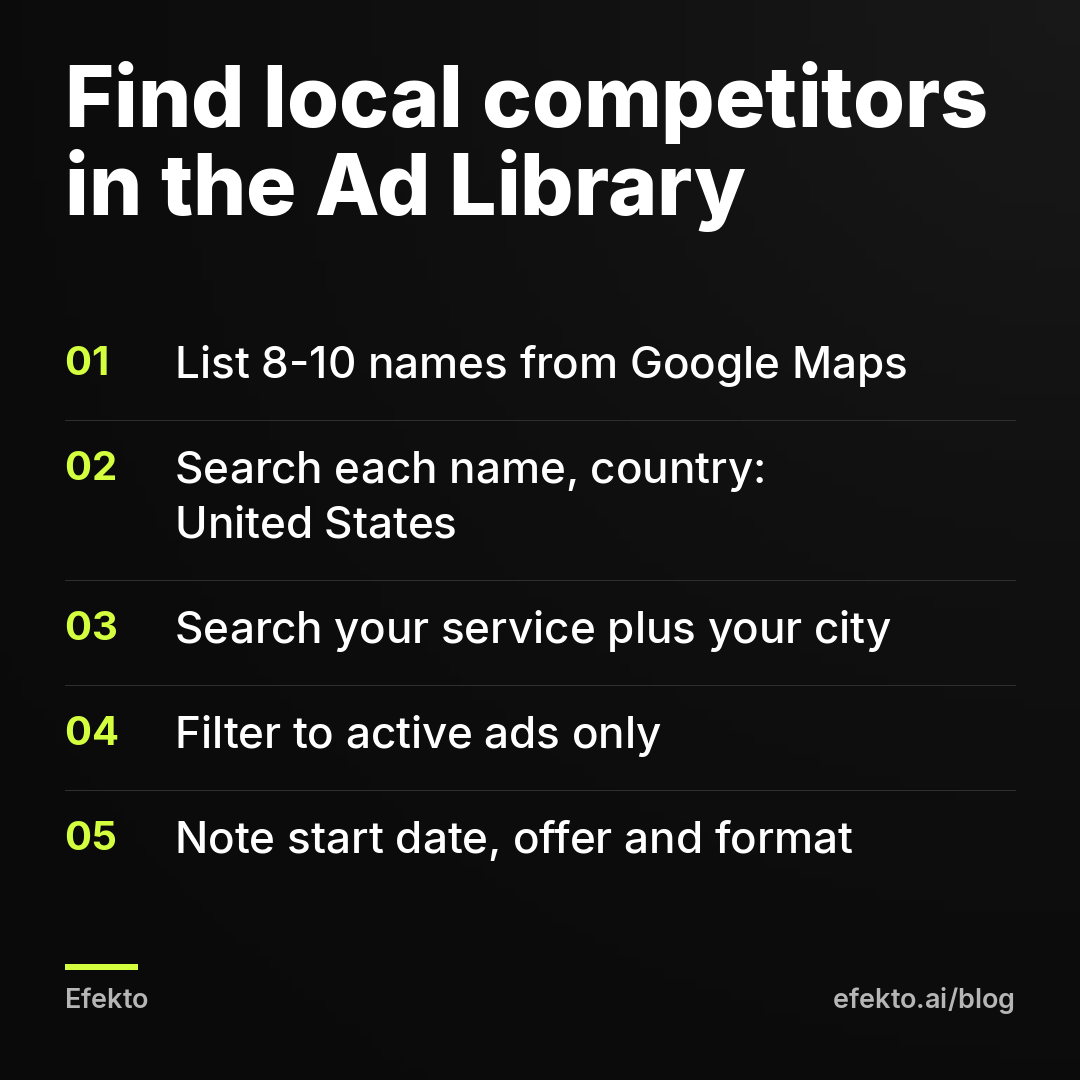
The library has no filter for city or ZIP code. Set the country to United States, set the category to "All ads" and then search in three ways.
- By name. Open Google Maps, search your service in your town and write down the 8 to 10 businesses that show up. Type each name into the library. This is the most reliable search, because the keyword search below only scans ad text.
- By keyword plus city. Search phrases like "roof replacement Tampa" or "AC tune-up Mesa". Local advertisers often put the town name in the ad text, so this catches businesses you did not know about.
- By offer words. Search "free estimate", "free inspection" or "$ off" with your service name. You will see national players too, but you will also see which offers dominate your trade.
Then use the filters: active ads only, media type (images or videos) and platform. Twenty minutes is enough for a first pass.
The start date is the most useful number on the page
A local business owner does not keep paying for an ad that brings nothing. So an ad that started 90 days ago and is still active is a strong hint that it brings in jobs. An ad that started 3 days ago is a guess the competitor is still testing. The first leads show up within hours, as our numbers above show, so a week of running tells you the owner is not yet unhappy, while three months tells you they keep finding it worth the money.
Two cautions. First, some owners leave ads running out of neglect, not success. If every ad on a Page is old and nothing new ever appears, that is a business that set and forgot, not a winner. Second, an ad marked with several versions is usually a test in progress. Look at what stays constant across versions: that is the part the advertiser is sure about.
| What you see | What it most likely means | What to do with it |
|---|---|---|
| Ad running 60+ days, several new ads added recently | The old ad works, they keep testing around it | Study its offer and angle closely |
| All ads started in the last 7 days | Fresh test or seasonal push | Check again in a month |
| Only old ads, nothing new in months | Running on autopilot | Do not treat it as proof of anything |
| No active ads | Not on Meta right now | Less competition in the feed |
| Same image, 4-5 text versions | Testing the message, not the picture | Note which claim appears in every version |
Offers tell you what your market already sees every day
The offer is the part worth writing down. If four HVAC companies in your area all advertise a $79 tune-up, your customers have seen $79 tune-ups for months. Launching the same offer at $89 puts you last in a comparison you did not need to enter.
We would rather see you compete on something the others do not say: same-day service, a named technician, financing, a warranty in years, a guarantee on arrival time. Price-led offers fill your phone with people comparing prices, and we have written about why Facebook ads attract price shoppers and how to avoid it.
While you are in each ad, click the button and look at where it goes. A lead form with two questions and a form with seven questions are two different strategies. The first collects many cheap, cold contacts. The second collects fewer, more serious ones.
Formats show what competitors can produce, not what works
If every competitor runs a stock photo of a smiling family, that tells you nobody in your area has real job photos in their ads. That is your opening, not a trend to follow. Real before-and-after shots, a 20-second phone video of a crew on a roof, a photo of your own truck: these stand out precisely because nobody else bothers. Our guide on the best Facebook ad formats for local service businesses covers when each one fits.
Take format counts with a grain of salt. A competitor running only images may simply have no one to shoot video. It is a production limit, not evidence that video fails.
Spend and targeting stay hidden for commercial ads
The library does not show how much a plumber, dentist or roofer spends on an ad. For US commercial ads you will not see the budget, the number of people reached or who the ad targets. Spend ranges are published for ads about social issues, elections or politics, not for a $99 drain cleaning. Any tool or person claiming to read a local competitor's exact budget from the library is guessing.
We have an interest here: we make money from ads on Meta, and we would happily take the spend data if Meta published it. It does not, so do not build your budget on a competitor's imagined numbers. Build it on the number of jobs you need.
The library also cannot show when an ad brings leads. From our accounts: On Efekto users' accounts in English-speaking markets (mostly the US) (10 brands, 138 leads in the 180 days to Nov 8, 2026), 18% of leads came in after 6 pm, only 27% on weekdays between 8 am and 4 pm, and 34% on weekends. If you see competitors' ads and assume they only matter during business hours, you will miss most of the action. Most leads arrive when you are off the clock, so the real question is how fast someone answers them.
Copying a competitor's ad backfires
Do not download a competitor's photo or paste their text into your ad. Their photos and copy are their work, and using them can earn you a copyright complaint and a removed ad. It also fails as marketing: a homeowner who saw the original yesterday sees yours today and remembers the other company.
The line is simple. Ideas are fair game: "they lead with a warranty, so we should say ours is longer." Assets are not: their image, their wording, their video. Write your own offer, shoot your own jobs. If you use before-and-after shots, check our notes on using before-and-after photos without getting rejected, because Meta reviews them more strictly.
A worked example: a roofer's 20-minute check
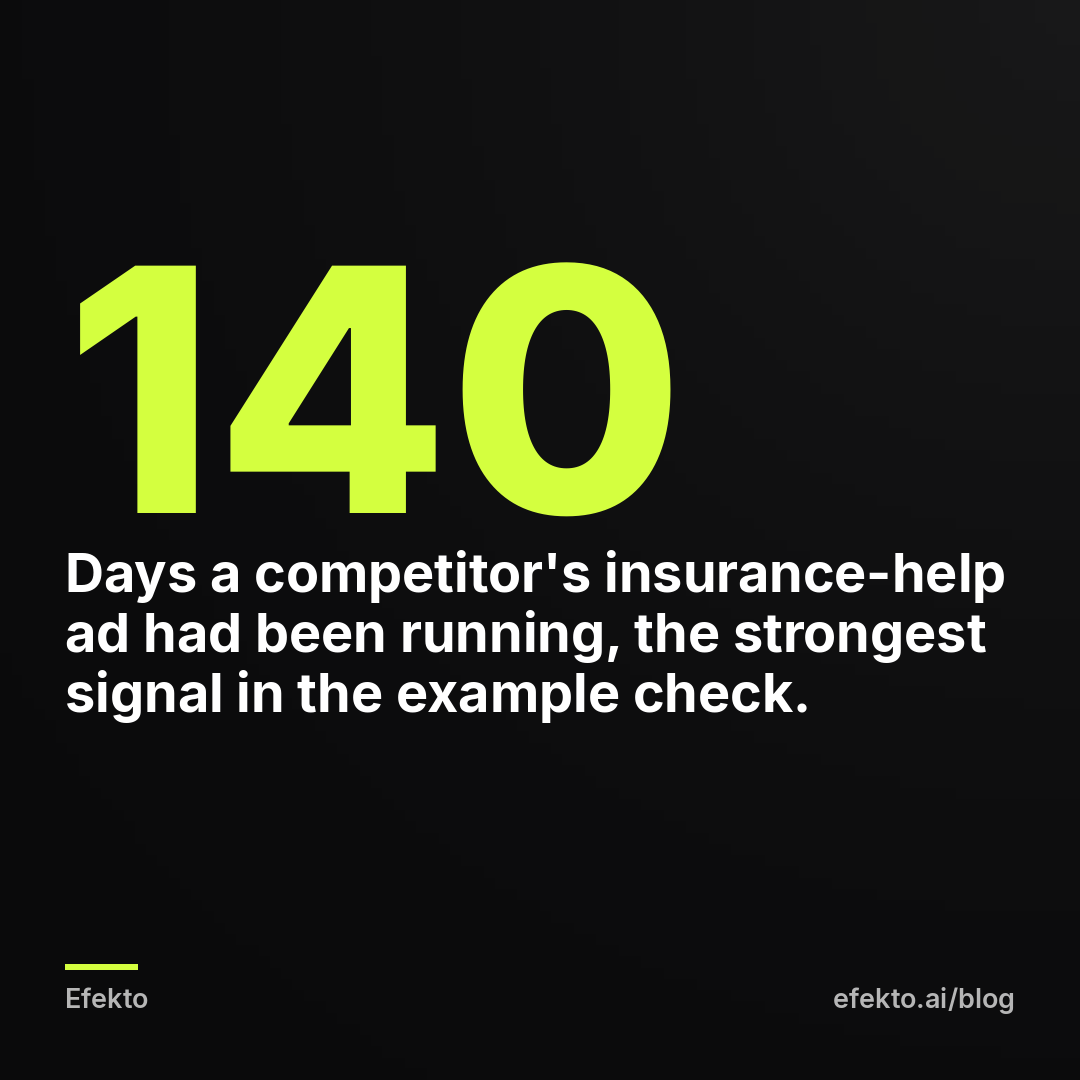
For example, say you run a roofing company and search 9 local names from Google Maps. Three are advertising. One has an ad that started 140 days ago: a photo of their own crew, "Free roof inspection and help with your insurance claim", 3 text versions, all mentioning insurance. Another started 5 days ago with "$1,000 off a full replacement". The third has two stock-photo ads from last year.
What you take from it: insurance help is the proven angle in your area, the $1,000 discount is an untested bet, and the third company is not a real factor. You decide to lead with a 10-year workmanship warranty plus insurance help, using photos from your last 5 jobs.
Now the math, again as an example. Say you spend $30 a day, or about $900 a month, and leads cost $45. That is 20 leads. If 1 in 4 becomes an inspection, you do 5 inspections. If 1 in 5 inspections signs a $12,000 roof, that is one roof a month from $900. The competitor check did not change these ratios by itself. It kept you from launching the same offer as everyone else, which is what pushes the cost per lead up. If roofing is your trade, see how we approach Facebook ads for roofing companies.
When checking competitors is a waste of time
Skip the deep research if nobody in your area advertises on Meta, or if you have not launched your own first campaign yet and are using research as a reason to wait. Your own data after two weeks beats anything you can read from someone else's ads. Also skip it if your competitors are national franchises: their offers are set at headquarters for 300 markets, not for your town.
Efekto handles the part after the research. Efekto creates ads from your website, publishes them, and optimizes them every day: it turns off the ones that don't bring results and scales the ones that do. You approve at least 5 ads before the campaign starts, so your offer and your photos stay yours. It does not make sense if you cannot spend at least $15 a day on ads, or if you have no way to answer leads within a few hours. In that case, fix the follow-up first.
What to take from this
- Search 8 to 10 local competitors by name, not only by keyword, and filter to active ads.
- Trust ads that have run for 60+ days with new ads added around them. Ignore anything under a week old.
- Write down offers and angles, then pick one your competitors do not use.
- Do not copy images or text, and do not believe anyone who says they can see a local competitor's budget in the library.
- Repeat the check once a month. It takes 20 minutes and shows you who just entered the feed.
If you want your own ads running from your website without learning Ads Manager, you can start a 7-day free trial at efekto.ai.
- Jakub Zwoliński
Founder, Lemon Agency · Efekto · November 13, 2026