Why Is My Facebook Cost per Lead Going Up Every Month?
Facebook cost per lead creeping up month after month? Five causes in order of how often we see them, how to check each in Ads Manager, and how to fix it.

Each one leaves a different trace in Ads Manager, so you can find yours in about 20 minutes instead of guessing and changing everything at once.
In short:
- A cost per lead that rises slowly over several months almost always points to tired ads or a used-up audience, not to Facebook "throttling" you.
- A cost per lead that jumps in a single week usually comes from something that changed: an edit you made, a busy auction season, or a new competitor offer.
- Fix one cause at a time and wait 7 days between changes, or you will never know what worked.
How do I know if my cost per lead is really going up?
Compare the same length of time and the same campaign. Do not compare yesterday with last Tuesday. On a small budget, daily cost per lead jumps around because a few leads more or less change the average a lot. A business getting 2 leads a day can see $12 one day and $35 the next with nothing wrong.
We'd check it like this:
- In Ads Manager, open the campaign and set the date range to the last 30 days.
- Click "Compare" and pick the previous 30 days.
- Look at four columns side by side: amount spent, leads, cost per lead, and CPM (cost per 1,000 impressions).
If you have fewer than 20 leads in each period, treat any difference under 30% as noise. If cost per lead went up and CPM went up by about the same amount, the auction got more expensive (see the seasonality section). If cost per lead went up but CPM stayed flat, the problem is inside your account: ads, audience, edits or offer.
One more check before you panic. The number Meta shows is the cost of a filled form, before anyone called the person back. If your Meta cost per lead is flat but fewer leads pick up the phone, your real cost is rising anyway. For example: 40 form leads at $20 each is $800. If only 25 of them are reachable, you are paying $32 per lead you can actually talk to. Track both numbers every month.
Are my Facebook ads suffering from creative fatigue?
When a local audience sees the same 2 or 3 ads for weeks, people stop reacting. Fewer clicks for the same money means each lead costs more. It happens faster for local businesses than for online stores, because a 15-mile radius has far fewer people than a whole country.
How to check it:
- Go to the Ads tab, not the campaign tab. Fatigue shows up ad by ad.
- Add these columns: frequency, CTR (link click-through rate), CPM, cost per lead.
- Set the date range to the last 14 days, then compare with the first 14 days the ad ran.
The pattern of fatigue: frequency climbing, CTR falling, CPM roughly the same. On a local audience we start worrying when 30-day frequency passes 3 and CTR has dropped by a third or more from the ad's first two weeks. That is our working rule, not a Meta threshold.
How to fix it:
- Add new ads every 2 to 4 weeks, before the old ones die completely.
- Make the new ad actually different. A new angle (a before-and-after photo instead of a team photo, a price instead of a discount, a customer question instead of a slogan), not the same image with a different color.
- Keep 3 to 5 active ads in an ad set so Meta has options. More than that on a small budget just spreads the money too thin.
- Turn off ads whose cost per lead is clearly worse after they have spent at least 2 to 3 times your target cost per lead.
If you're not sure which of two new ads to keep, here is how to test two Facebook ads against each other on a $20-a-day budget without burning the month.
Is my Facebook audience too small for my budget?
If your ad set targets a small area with stacked interests and exclusions, you run out of new people. Meta then shows ads to the people least likely to respond, at a higher price. The cost per lead rises steadily even if you swap ads.
How to check it:
- Open the ad set and look at the estimated audience size on the right side of the edit screen.
- Compare reach with audience size over the last 30 days. If you've reached a large share of your audience and frequency keeps climbing despite new ads, the audience is the bottleneck.
- Look for warnings in the delivery column, like "Learning limited". On small budgets it often means the ad set can't get enough results from the people it is allowed to reach. We explain what to do in our post on an ad set stuck in Learning Limited on a small budget.
How to fix it:
- Widen the radius to the whole area you actually serve, not only the town where your shop is.
- Remove interest targeting. For local services, location plus age is usually enough, and Meta finds the buyers itself.
- Remove old exclusions you no longer remember adding (past leads, page fans, custom audiences).
- Merge two or three small ad sets into one. One ad set with all the budget learns faster than three that each get a few dollars a day.
The audience was used up in week six.
From our accounts: what do three industries pay per lead in the same 30 days?
From our accounts: we pulled lead form campaigns from ad accounts we run in Poland for the 30 days to Oct 25, 2026. Same platform, same month, same type of campaign. The results were very different by industry.
| Industry (Poland) | Spend | Leads | Average cost per lead |
|---|---|---|---|
| Solar panels | about $1,202 | 97 | about $12.39 |
| Legal services | about $302 | 44 | about $6.86 |
| Carports | about $661 | 200 | about $3.31 |
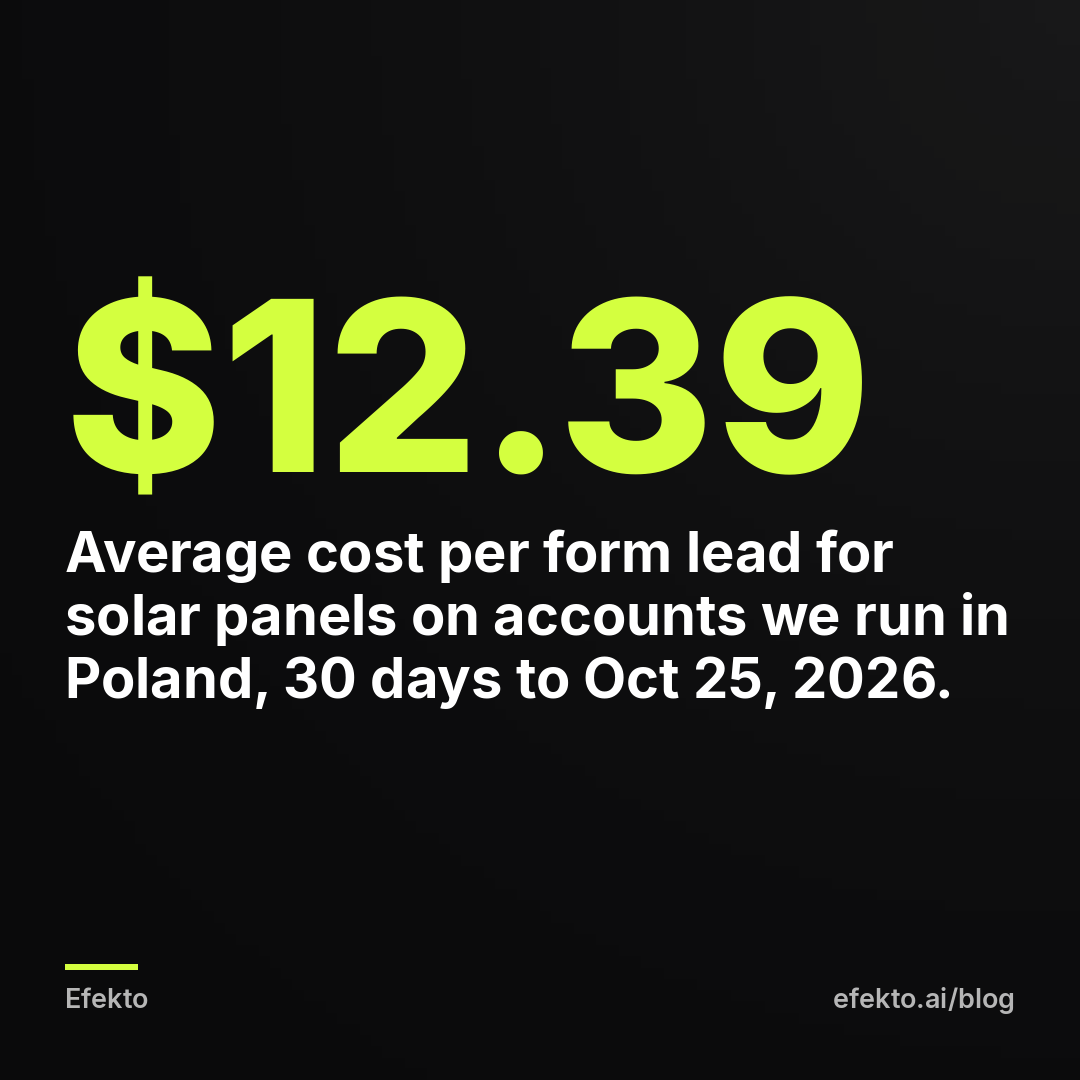
These are Polish markets, so don't treat them as a price list for your US business. What they show is the gap. Solar leads cost almost four times more than carport leads in the same month on the same platform. A solar company looking at a carport company's cost per lead would think its own campaign is broken. It isn't.
What follows for you: the only baseline that matters is your own account, measured over the same 30-day window. If your cost per lead went from $25 to $40 over three months, that rise means something. Comparing your $40 to a number someone posted in a Facebook group for a different industry tells you nothing. And all of these are form leads as Meta counts them, before anyone called them back. The cost per verified lead is always higher.
Why do Facebook leads get more expensive in November and December?
Because you're in the same auction as every retailer spending for Black Friday and the holidays. Meta sells ad space in an auction. When big advertisers raise budgets in Q4, the price of reaching anyone goes up, including the homeowners you want to reach. Your ads didn't get worse. The seats got more expensive.
The mechanism is simple enough to calculate. For example, say you spend $30 a day, 1% of people who see the ad click, and 10% of those who click fill the form:
- At a CPM of $15, $30 buys 2,000 impressions, 20 clicks and 2 leads. That is $15 per lead.
- At a CPM of $22, $30 buys about 1,364 impressions, about 14 clicks and about 1.36 leads. That is about $22 per lead.
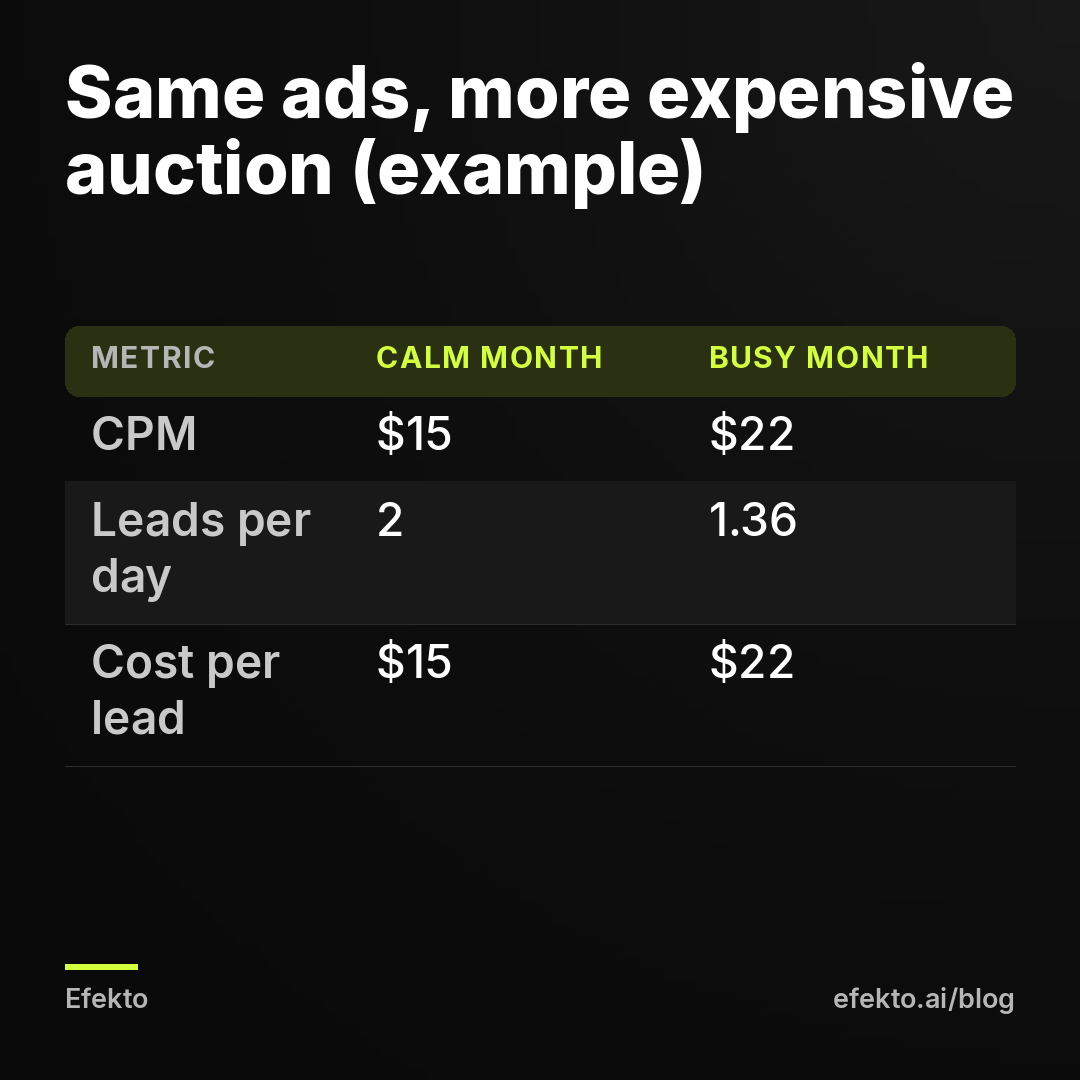
If nothing else changes, cost per lead moves almost one to one with CPM.
How to check it: compare CPM month over month. If CPM rose about as much as cost per lead while CTR and form completion stayed the same, it's the auction.
How to fix it: you can't fix the auction, only decide how to respond.
- If your jobs are profitable even at the higher cost, keep running. Leads still come, just fewer per dollar.
- If they're not, lower the budget for those weeks rather than turning everything off. Stopping and restarting forces the campaign to learn again.
- Use the slower weeks to prepare new ads for January, when the retail spending drops and prices usually come back down.
- Seasonal businesses have their own demand cycle on top of this. An HVAC company in April and a roofer after a storm season face a different auction than in their peak weeks.
Did my own changes to the campaign raise the cost per lead?
Often, yes. Every significant edit (new targeting, a different optimization goal, a big budget jump, adding or removing many ads) can send an ad set back into the learning phase. During learning, results are less stable and usually more expensive. An owner who edits the campaign every few days because results look bad keeps it in learning permanently, and then the results really are bad.
How to check it:
- Select the campaign or ad set and open its history (the clock icon or "View history" in the side panel).
- Write down the dates of every change in the last 60 days.
- Lay them next to your daily cost per lead. If spikes start a day or two after edits, you've found it.
How to fix it:
- Make changes once a week, on a fixed day, and only one thing at a time.
- Raise budget in small steps rather than doubling overnight. We'd move by about a fifth at a time and wait several days before the next step.
- Add new ads to the existing ad set instead of building a new campaign every time you want to try something.
- Don't switch the optimization goal back and forth between leads, traffic and messages. Pick the one that matches how you want customers to contact you and keep it.
Is my offer the reason leads cost more?
Sometimes the ads, audience and auction are fine and the offer simply stopped working. A "free estimate" that was rare in your area a year ago is now in every competitor's ad. People scroll past it because they have seen it ten times this week.
How to check it:
- CTR holds up, but fewer people who open the form finish it. In Ads Manager, compare link clicks or form opens with leads.
- Leads still arrive, but more of them are price shoppers, wrong area, or never pick up. Your Meta cost per lead looks okay, your cost per real conversation doesn't.
- Look at your competitors' ads in the Meta Ad Library (search their page name). If five businesses near you run the same offer, yours is no longer an offer, it's background.
How to fix it:
- Make the offer specific: a starting price ("full interior detail from $189"), a time promise ("inspection within 48 hours"), or a concrete bonus tied to the job.
- Name who it's for: "for homeowners with roofs older than 15 years" filters out bad leads and raises the share of good ones.
- Use a deadline only if it's real. Fake countdowns get comments and hurt trust.
We wrote a separate guide on how to write a Facebook ad offer for a local service business that people click, with examples by industry.
In what order should I check the causes?
From the cheapest check to the most expensive. Most cost increases are found in the first two steps, so don't rewrite your offer before you've looked at frequency.
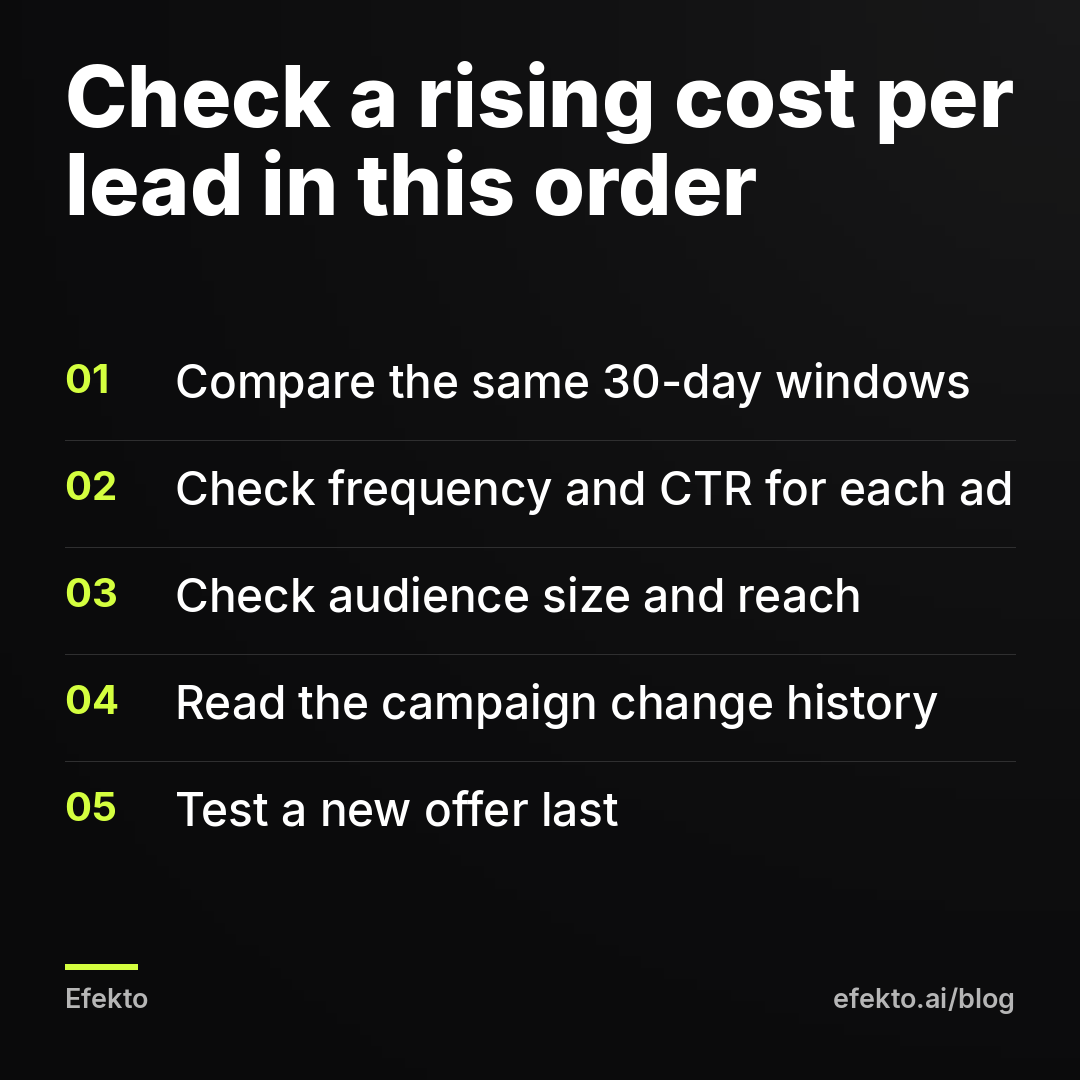
| Cause | What you see in Ads Manager | First thing to do |
|---|---|---|
| Creative fatigue | Frequency up, CTR down, CPM flat | Add 2 to 3 new ads with a new angle |
| Audience too small | High reach share, Learning limited, fatigue returns fast | Widen radius, remove interests, merge ad sets |
| Expensive auction | CPM up about as much as cost per lead | Keep running if profitable, lower budget if not |
| Your own edits | Spikes a day or two after changes | One change per week, small budget steps |
| Weak offer | CTR ok, form completion or lead quality down | Make the offer specific and name the customer |
Two causes often stack. A small audience makes creative fatigue arrive twice as fast, and Q4 prices make both hurt more. If you fix the ads and costs drop for two weeks and then climb again, look at the audience next.
When won't fixing the ads bring the cost down?
When the problem is after the lead, not before it. If you call back the next day, many leads have already booked someone else, and your cost per booked job rises no matter how cheap the form leads are. If you serve a very small area, say one small town, there may simply not be enough people for a steady flow every month, and you'll get better value combining Facebook with Google or referrals. And if your average job is worth less than a few leads, paid ads may not make sense at your current price.
We have an interest here and we'll say it plainly: we make money when businesses run ads on Meta, and the team behind Lemon Agency has managed more than $1M in ad spend for clients. That's exactly why we'd rather you find the real cause than raise your budget to cover a broken setup.
If you'd rather not do these weekly checks yourself, Efekto does this part of the work. Efekto creates ads from your website, publishes them, and optimizes them every day: it turns off the ones that don't bring results and scales the ones that do. New ads come into rotation, so fatigue is handled before it shows up as a higher monthly cost. You can see how Efekto works step by step. It won't fix a slow callback or an offer nobody wants, so the last two checks above stay with you.
Our own rule after years of watching these curves: we never change more than one thing a week, and we add new ads before the old ones die, not after.
FAQ
Does Facebook raise the cost per lead on purpose for long-running campaigns?
There's no evidence that Meta penalizes older campaigns. What happens is that the audience has seen your ads many times and responds less, so you pay more for each result. New ads in the same campaign usually bring the cost back down.
Should I start a new campaign when my cost per lead gets too high?
Usually not as a first step. A new campaign starts learning from zero, and its first week is often more expensive. Add new ads and check the audience first; build a new campaign only when you change the goal or the offer completely.
How long should I wait after a change before judging the results?
At least 7 days, and ideally until the ad set has collected around 20 leads after the change. On a small budget, a few days is not enough data to tell a real improvement from luck.
Is a higher cost per lead always bad?
No. If a $45 lead books jobs twice as often as a $25 lead, the more expensive one is cheaper per booked job. Judge cost per lead together with how many leads you reach and how many of them become paying customers.
If you want your ads created, rotated and optimized every day without opening Ads Manager, you can start at efekto.ai.
- Jakub Zwoliński
Founder, Lemon Agency · Efekto · November 2, 2026