Negative Comments on Your Facebook Ads: Hide, Delete or Reply?
When to hide, delete or answer negative comments on Facebook ads: a decision guide for spam, complaints and price questions, plus replies you can copy.

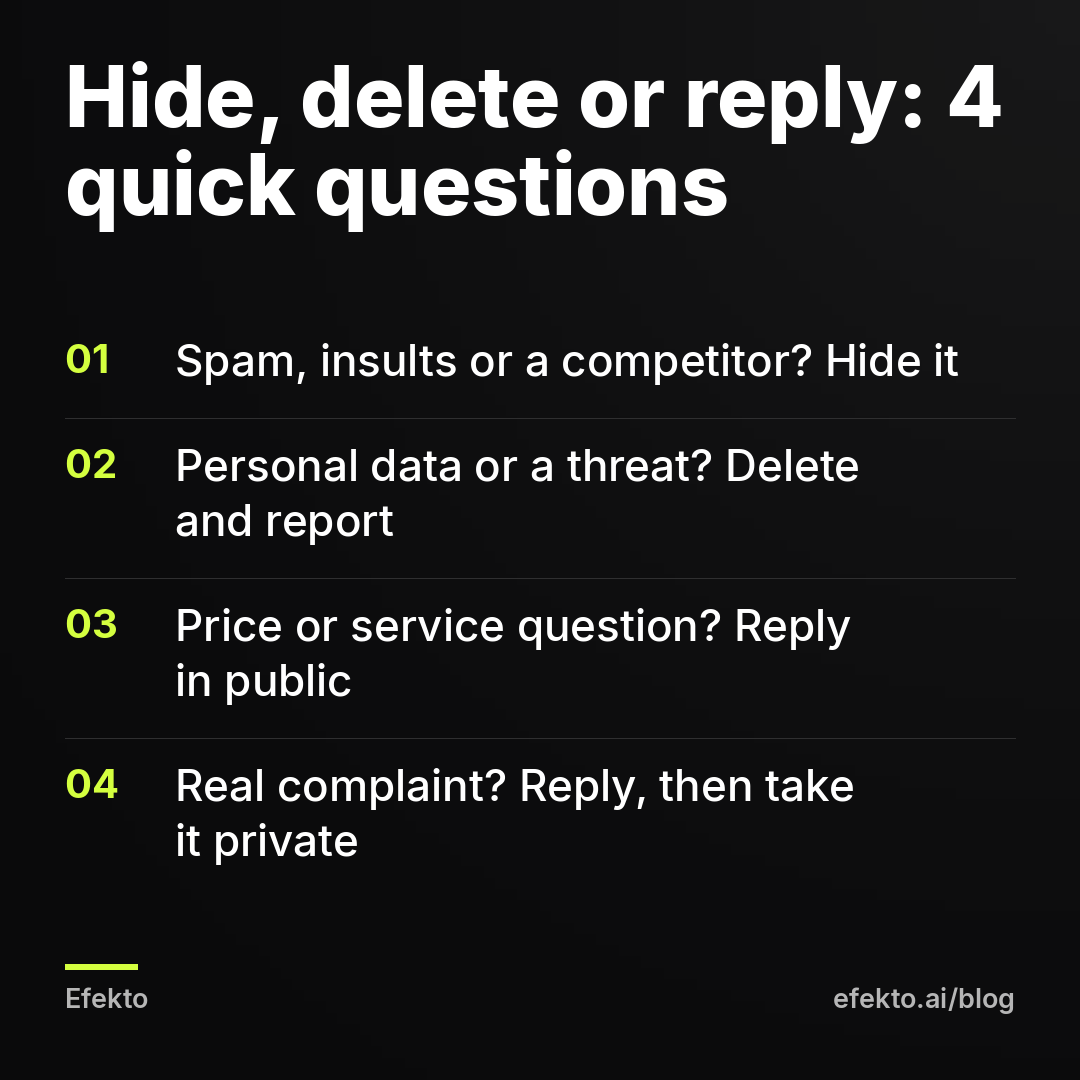
Reply in public to real complaints and price questions. Hide spam, trolling and abuse. Delete only what no stranger should ever read: scam links, someone's phone number or address, threats. A hidden comment stays visible to the person who wrote it and to their friends. The troll doesn't notice anything, while everyone else sees a clean thread. Deleting every negative comment backfires for three reasons: the author sees their comment is gone, the complaint moves to Google reviews where you can't remove it, and the people reading your ad never see how you handle a problem.
In short:
- Hide spam and abuse, because a hidden comment stays visible only to its author and their friends.
- Answer price questions and real complaints in public, because everyone the ad reaches reads your reply, not just the person who asked.
- Don't pause a working ad over a few angry comments. Judge it on cost per lead once it has spent enough to tell you something.
What is the difference between hiding, deleting and replying to a Facebook ad comment?
Hiding makes a comment invisible to everyone except the author and their friends. Deleting removes it for everyone, the author included. Replying keeps it public and adds your answer underneath. Each one fits a different kind of comment, so the first step is knowing what each action actually does.
| Action | Who still sees the comment | Does the author notice? | Use it for |
|---|---|---|---|
| Hide | The author and their friends | Usually not | Spam, scam links, profanity, competitor jabs, trolling |
| Delete | Nobody | Yes, it disappears for them too | Personal data, threats, illegal content |
| Reply | Everyone | Yes, they get a notification | Price questions, real complaints, misunderstandings |
| Ban the profile | Past comments stay unless you hide them | Not told directly | Accounts that keep posting spam after you hid it |
Hiding is the tool most owners underuse. It solves the problem (strangers stop seeing the junk) without starting a second one (an angry person who now has a reason to post again). Deleting is a signal to the author. Use it when you want them to get that signal, or when the content is dangerous enough that even the author's friends shouldn't see it.
On Instagram, comments on an ad work the same way: you can hide, delete or restrict. Check both platforms, because comments on the Instagram version of your ad don't show up under the Facebook version.
Which comments should you hide, delete or answer?
Sort every comment by one question: would a potential customer learn something useful from your public reply? If yes, reply. If the comment is junk, hide it. If it is dangerous, delete it. Here is the full guide, with the comment types you are most likely to see on a local service ad.
| Comment type | Example | What to do |
|---|---|---|
| Bot spam or scam link | "Earn $500 a day from home, message me on WhatsApp" | Hide. Ban the profile if it comes back |
| Price question | "How much?" or just "$$$?" | Reply in public the same day |
| Real complaint from a customer | "You showed up two hours late and nobody called" | Reply in public, then move it to a call or DM |
| Complaint about a different company | "You guys ruined my neighbor's roof" (you didn't) | Reply once and politely clarify |
| "Scam" or "fake ad" accusation | "This is a scam, nobody charges that" | Reply once with proof: address, license, reviews |
| Insults, profanity, personal attacks | Name-calling with no actual complaint | Hide |
| Competitor jab | "Call us instead, we're cheaper" | Hide |
| Political or off-topic arguments | Threads that have nothing to do with your service | Hide |
| Personal data or threats | A customer's address, a threat against staff | Delete, and report threats |
Two things stand out in that table. First, only one row says delete. Second, price questions and complaints, the comments owners most often want gone, are the ones worth the most in public.
Why does deleting every negative comment backfire?
Deleting a fair complaint looks like pretending it never happened, and readers can tell. Here is what tends to happen next.
- The author notices. A deleted comment disappears for its author too. The most common reaction is a second, angrier comment, often with "they deleted my last comment" added. Now you have a worse comment and a story about censorship.
- The complaint moves somewhere you can't control. Google reviews, Yelp, local Facebook groups, Nextdoor. On those, you can only reply, not remove.
- You lose the audience for your answer. A complaint under an ad gets read by far more people than the author. A calm, specific reply to a real problem is one of the most convincing things a local business can publish, because it shows what happens when something goes wrong. Most ads only show what happens when everything goes right.
- You delete leads. "How much?" with no greeting can read as rude. It is still a person interested enough to ask. Delete it and you've thrown away a lead you already paid for.
A thread with 40 likes and not a single question or complaint also looks odd to people who are used to seeing real conversations under ads. You don't need negative comments. But you shouldn't manufacture a spotless thread either.
How should you answer "how much?" under a Facebook ad?
Give a number or a range in public, then invite them to the next step. "DM us for pricing" is the weakest reply you can post. Ten other people reading the thread had the same question, and none of them will message you to find out.
If you truly can't quote without seeing the job, say why in one sentence and offer the fastest way to get a real number. Replies you can copy and adjust:
- Car detailing: "Hi Sarah, a full interior and exterior detail starts at $[X] for a sedan and $[Y] for an SUV. The final price depends mostly on pet hair and stains. Send us a photo in Messenger and we'll give you an exact number today."
- HVAC: "An AC tune-up is $[X] flat. For repairs, the diagnostic visit is $[Y], and it goes toward the repair if you book it with us. You can grab a slot here: [link]"
- Roofing: "Every roof is different, so we won't guess in a comment. The inspection and written estimate are free and take about 45 minutes. Want us to call you this week?"
- Med spa: "It depends on the area and the number of units, so we price it at a consultation. The consult is $[X] and goes toward your treatment. Message us and we'll check this week's openings."
- Dental: "A new patient exam with X-rays is $[X] without insurance. We take most PPO plans, so message us your provider and we'll check your coverage before you book."
The numbers are the point. People who see "starts at $189" and still message you have already accepted the price. People who were looking for $49 stop asking, and that saves you a call.
For example: say your ad gets 10 price questions in a week. You answer 8 of them the same day, 3 turn into a conversation, and 1 books a $300 detail. That is $300 of work from a thread some owners clean out because the comments looked rude. Treat price questions with the same speed rules you use when you follow up on Facebook leads fast enough to book the job: same day at the latest, within a few hours if you can.
How do you reply to a real complaint in public?
Acknowledge the specific problem, take ownership of your part, give a named person and a direct way to reach them, then come back to the thread once it's resolved. Four sentences, no arguing over details in public.
Template:
Hi Mike, you're right that we were two hours late on Tuesday, and nobody called you. That's on us. I'm Dana, the office manager. Please call me directly at [number] or send us a message, and I'll make it right this week.
And once it's sorted:
Update: we spoke with Mike, and our tech is going back out Friday at no charge. Thanks for flagging it.
What not to do:
- Don't argue facts in the comments. Even if the customer is wrong about half of it, a public back-and-forth makes you look worse than any complaint does. Fix the facts on the phone.
- Don't post job details. No addresses, invoice amounts, or "as you'll recall, you refused the upgrade."
- Don't offer a refund in the thread. Others will read it as the price of complaining. Offer it privately if it's deserved.
- Dental, med spa and other healthcare businesses: don't confirm in public that the commenter is a patient, and don't mention any treatment they had. Keep the reply general ("please call our office manager at...") and check your replies with whoever handles your patient privacy.
If the complaint is fair and you've fixed it, ask the customer whether they'd be willing to update their comment or leave a review. Many will. If you want to use that kind of feedback in future ads, read how to use customer reviews in Facebook ads without breaking Meta's rules first.
What if the person commenting was never your customer?
Reply once, politely and with something they can check. If they come back with the same thing, hide it. Your audience is the readers, not the commenter.
- Wrong company: "We're sorry that happened to you. Just to clarify, we're [Business Name], based in [town], and we haven't worked at that address. If we have, send us the date and we'll look into it right away."
- "Scam" or "fake ad": "Fair question with so many fake ads around. We're a licensed contractor, license #[number], at [address], and you can see our Google reviews here: [link]."
- "This is an AI picture": "The before-and-after photos are from our own jobs, and we're happy to show more in person." Only say that if it's true. If the image is generated, don't claim otherwise. A short "The image shows the kind of result we deliver. Here are photos from real jobs: [link]" is honest and enough.
The "scam" comment deserves a reply more than almost any other, because local service ads compete with plenty of scams. The people reading it are asking themselves the same question.
Should you turn off an ad because it gets negative comments?
No, unless the comments show that the ad promises something untrue. Comments are a few loud people. Cost per lead is everyone who saw the ad. We run ads on Meta for a living, with over 300 clients at Lemon Agency, so we have an interest in you keeping ads on. Keep that in mind, and look at the math below.
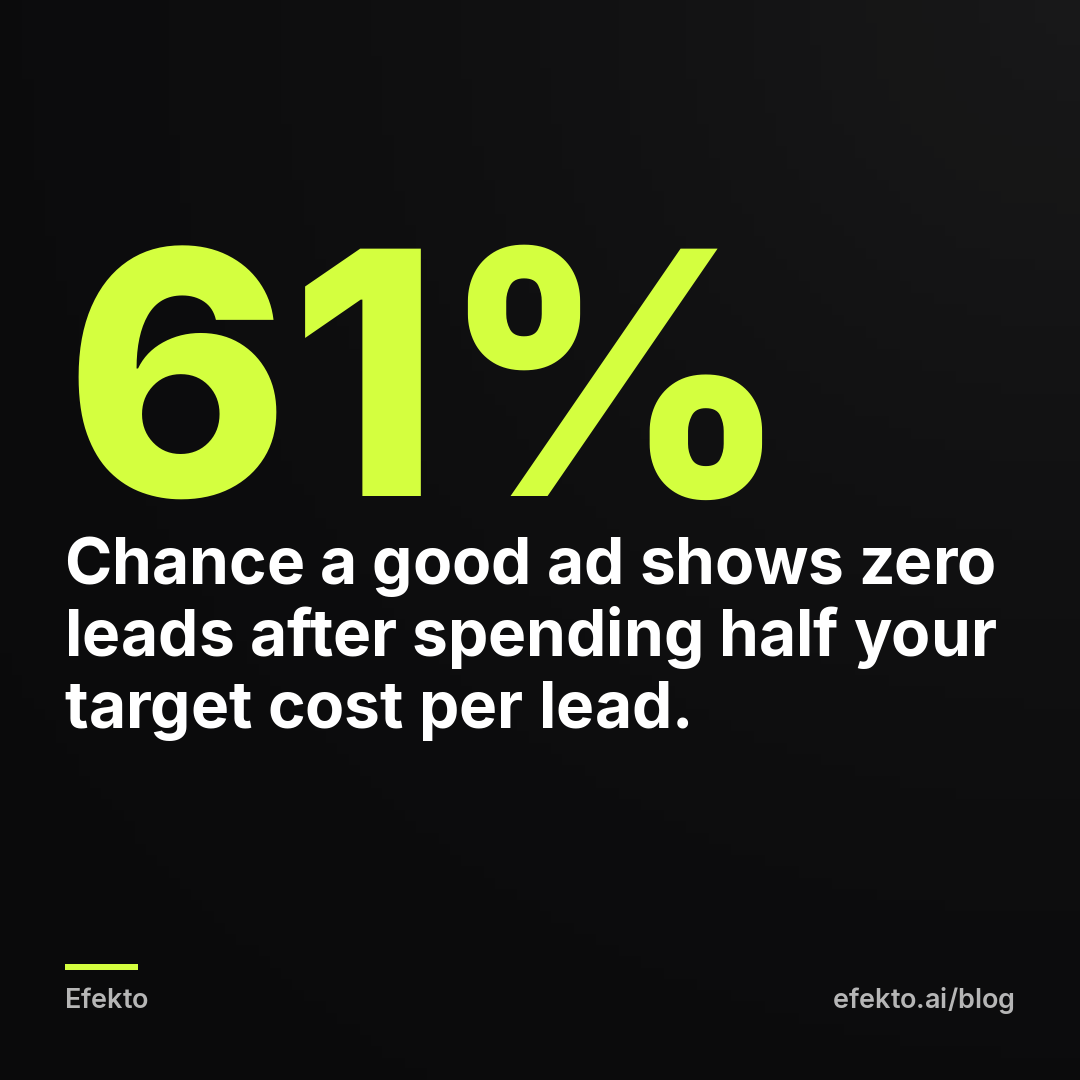
From our accounts: an ad that truly brings leads exactly at your target cost has a 61% chance of showing zero leads after spending half that cost, 13.5% after spending twice it, and 5% after three times. That is why we never judge an ad on its first few dollars. For example: if your target is $40 per lead, a good ad that has spent $20 with no leads and three angry comments has given you almost no information. After $80 with no leads, there's a 13.5% chance it's still a good ad. After $120, it's 5%, and that's when you turn it off, comments or no comments.
From our accounts: a client rejected 8 of 14 proposed ads before launch, mostly for how they looked. Since then we ask owners to reject only ads with an untrue promise and let cost per lead settle the rest. Comments deserve the same rule. "Ugly ad," "another contractor ad," "nobody wants this" tell you nothing about whether the ad brings customers.
What does deserve action: three or more comments saying the same factual thing. "That price doesn't exist," "you don't actually serve my area," "the offer ended last month." That's not trolling, that's the ad being wrong. Fix the ad or turn it off today, regardless of its numbers. To know what a reasonable target is in the first place, see what counts as a good cost per lead on Facebook for a local business.
How do you set up moderation so spam doesn't pile up?
Assign one person, check twice a day, and let keyword filters catch the obvious junk before anyone sees it. Here's how we'd set it up:
- Pick one owner of comments. If everyone is responsible, nobody answers. Office manager, front desk, or you.
- Use the Meta Business Suite inbox. Comments on your ads show up there next to Messenger and Instagram messages, so you don't have to hunt for each ad. Check it at a fixed time, for example 9 a.m. and 3 p.m.
- Add blocked keywords on your Page. In the Page's moderation settings, add words that show up in spam under your ads. Starting list: WhatsApp, Telegram, crypto, bitcoin, "DM me", "inbox me", "earn from home", plus the names of competitors who keep dropping their number. Comments containing these get hidden automatically.
- Turn on the profanity filter in the same settings.
- On Instagram, turn on hidden words in the account's privacy settings and add the same keyword list.
- Save your price reply as a saved reply so answering takes 20 seconds, not five minutes.
- Once a week, look at what you hid. Filters sometimes catch a real question. Unhide it and answer.
Facebook doesn't offer a simple switch to turn off comments on ads, and we wouldn't use it if it did. The questions are worth more than the trouble the junk causes.
When does replying in public not make sense?
Skip the public reply when it could hurt someone or when the conversation is no longer for readers.
- Threats against you or your staff: delete, report, and keep a screenshot.
- An active legal dispute or chargeback: one line ("We're handling this directly with the customer"), then nothing more in public. Talk to your attorney before you write anything else.
- Someone baiting a fight on their third comment: you've answered once. Hide the rest.
- Health details: as above, keep it general and move it to a phone call.
One more limit, about the tools. Efekto creates ads from your website, publishes them, and optimizes them every day: it turns off the ones that don't bring results and scales the ones that do. It doesn't reply to comments for you. You still need someone answering "how much?" under the ads. If you want one service to handle ads and also run your Page's comments and messages, a freelancer or an agency with community management is a better fit. If you want the ads handled and will answer comments yourself, see how Efekto works.
Our own rule from here: we judge ads on cost per lead after they've spent enough to tell, we reject ads only for untrue promises, and we treat a comment under an ad the same way. If it points to something false in the ad, we fix the ad. If it's someone asking or complaining, we answer. Everything else gets hidden.
FAQ
Does hiding a comment on a Facebook ad notify the person?
No. A hidden comment stays visible to its author and their friends, so most people never realize it was hidden. That's why hiding works better than deleting for spam and trolls.
Can I turn off comments on my Facebook ads?
Facebook doesn't give you a simple off switch for comments on ads. You can filter them with blocked keywords and the profanity filter, ban specific profiles, and hide individual comments. On Instagram, you have more control through hidden words and comment settings.
Do negative comments make my Facebook ad perform worse?
Meta doesn't say that comments on their own lower delivery. What matters more is whether people hide or report the ad and whether it brings leads at a cost you can live with. Watch cost per lead, not the mood of the thread.
Should I answer price questions in the comments or in DMs?
Put at least a starting price or a range in the public reply, then invite the person to message you for an exact quote. Everyone else reading the thread had the same question, and most of them won't message you to ask it.
If you'd rather spend your time answering those comments than building and tuning the ads underneath them, you can start at efekto.ai.
- Jakub Zwoliński
Founder, Lemon Agency · Efekto · October 26, 2026