What Is Frequency in Facebook Ads, and How High Is Too High for a Local Audience?
Frequency is how many times one person saw your Facebook ad on average. Where to find it, why it climbs fast in small local markets, and what ranges to watch.

Frequency in Facebook Ads is the average number of times one person saw your ad in a chosen period, calculated as impressions divided by reach. For a local service business it climbs faster than for almost anyone else, because your audience is small and fixed. We treat a 7-day frequency of about 1.5 to 3 as a normal working range for a town-sized audience. We start acting when it stays above 4 to 5 and cost per lead rises with it. That is a range we use to read accounts, not a rule Meta publishes.
The common advice to "keep frequency under 2" comes from brands selling nationwide to millions of people. Applied to a roofer covering a 20-mile radius, it is wrong. That roofer either spends too little to matter or gets frightened off by a normal number. A disclosure: we make money from ads on Meta, and the team behind Lemon Agency has run campaigns for 300+ clients. Even so, our advice below includes spending less when the numbers say so.
Where do you find frequency in Facebook Ads Manager?
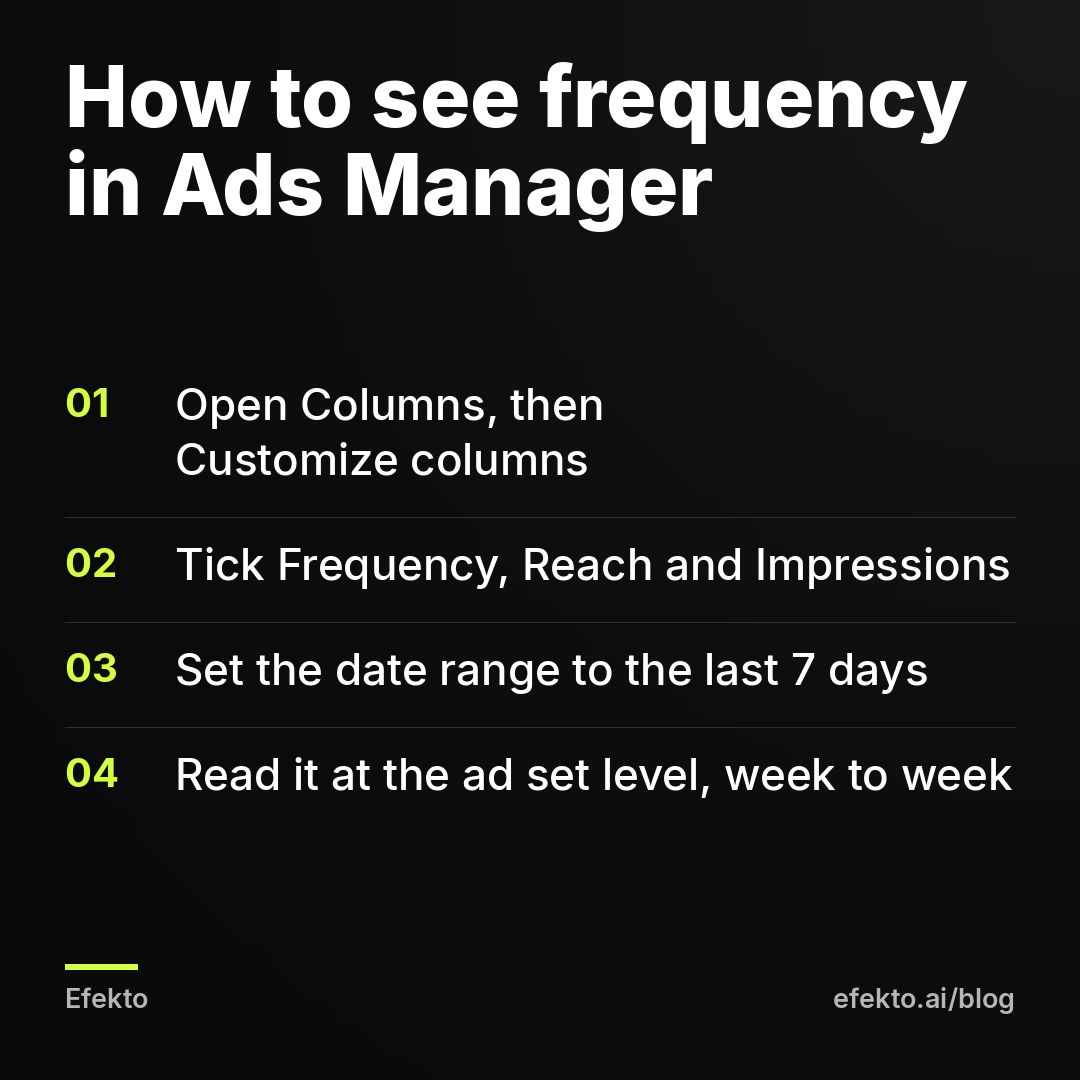
Frequency is a column in Ads Manager, shown at campaign, ad set and ad level. In some column presets it isn't visible by default. To add it, open Columns, choose Customize columns, type "Frequency" in the search box, tick it, and do the same for Reach and Impressions. Save it as a preset so you don't repeat this every time.
The date range matters more than most people expect. Reach counts each person once across the whole window, while impressions keep adding up. Frequency for "Last 30 days" will therefore almost always look higher than for "Last 7 days" on the same campaign. Pick one window, we use the last 7 days, and compare like with like from week to week.
Read it at the ad set level. That is where the audience lives. Two ad sets targeting the same town will each show their own frequency, but the same people may be seeing both. The real number per person can be higher than either column shows.
Frequency is also an average. A frequency of 3 can mean everyone saw your ad three times. It can also mean most people saw it once and a smaller group saw it ten times. The column won't tell you which, so judge it together with cost per lead and the comments on your ads.
Why does frequency climb so fast for a local business?
A local audience has a ceiling, and budget pushes you into it. Once Meta has shown your ad to most of the people it can reach in your radius, extra spend can only go to the same people again.
For example, say a roofing company targets a radius that holds about 30,000 adults on Facebook and Instagram. It spends $40 a day, and the CPM (cost per 1,000 impressions) is $20. That buys 2,000 impressions a day:
- After 7 days: 14,000 impressions. If Meta reached 7,000 people, frequency is 2.0.
- After 30 days: 60,000 impressions. If reach grew to 18,000, frequency is 3.3.
The same $40 a day in a metro area of 2 million would keep finding new people, and frequency would sit near 1.2 for months. The business is the same and so are the ads. The only difference is the size of the pool. This is also why reach looks so low in small towns and rural areas. The audience you can buy is smaller than the population on the map.
How high is too high for a local audience?
Frequency is too high when it rises and your results get worse at the same time. A high number with a steady cost per lead is not a problem. It means people in your area keep seeing a business they may need. A storm season for a roofer or a heat wave for an HVAC company can justify a frequency that would look excessive in a slow month.
This is how we'd read a 7-day frequency on a local campaign:
| 7-day frequency (ad set) | What it usually means locally | What we'd do |
|---|---|---|
| Under 1.5 | New campaign, or audience large compared to budget | Nothing to fix. Room to raise budget if leads are good |
| 1.5 to 3 | Normal for a town-sized audience | Check cost per lead once a week |
| 3 to 5 | Most of the audience sees you several times a week | Fine if cost per lead is stable. If it rises 2 weeks in a row, add new ads or widen the radius |
| Above 5 | Budget is bigger than the audience can absorb | Lower the budget or widen the area before anything else |
| Retargeting (site visitors, customer list) | Tiny audience, high numbers are expected | Ignore the number, judge only by leads and booked jobs |
Treat these as working ranges, not thresholds. The warning sign is the combination of rising frequency, a falling CTR and a rising cost per lead, held for more than a week. Any of the three alone means little. If you aren't sure what your click-through rate is telling you, our explainer on CTR for local businesses covers it.
What should you do when frequency gets too high?
Fix the budget-to-audience ratio first and the ads second. Most owners do it the other way around. They swap the creative while still paying to show it to the same 8,000 people.
Start by confirming that results actually got worse. Compare cost per lead for the last 7 days with the 7 days before. If it held, leave the campaign alone. Editing a working ad set can reset its learning and costs you more than a high frequency number.
If results did slip, widen the radius to areas you actually serve, or add Instagram placements if they're switched off. Both make the pool bigger. If you can't widen, lower the daily budget until frequency drops back toward 3. Spending $25 a day on people who haven't tired of you is better than $40 a day on people who have. Our guide to setting a daily budget from the jobs you need shows how to find that number. Only after that, add 2 or 3 new ads with a different photo or offer, so the people who see you again see something new.
One fix we advise against is cutting the schedule to business hours to "control" frequency.
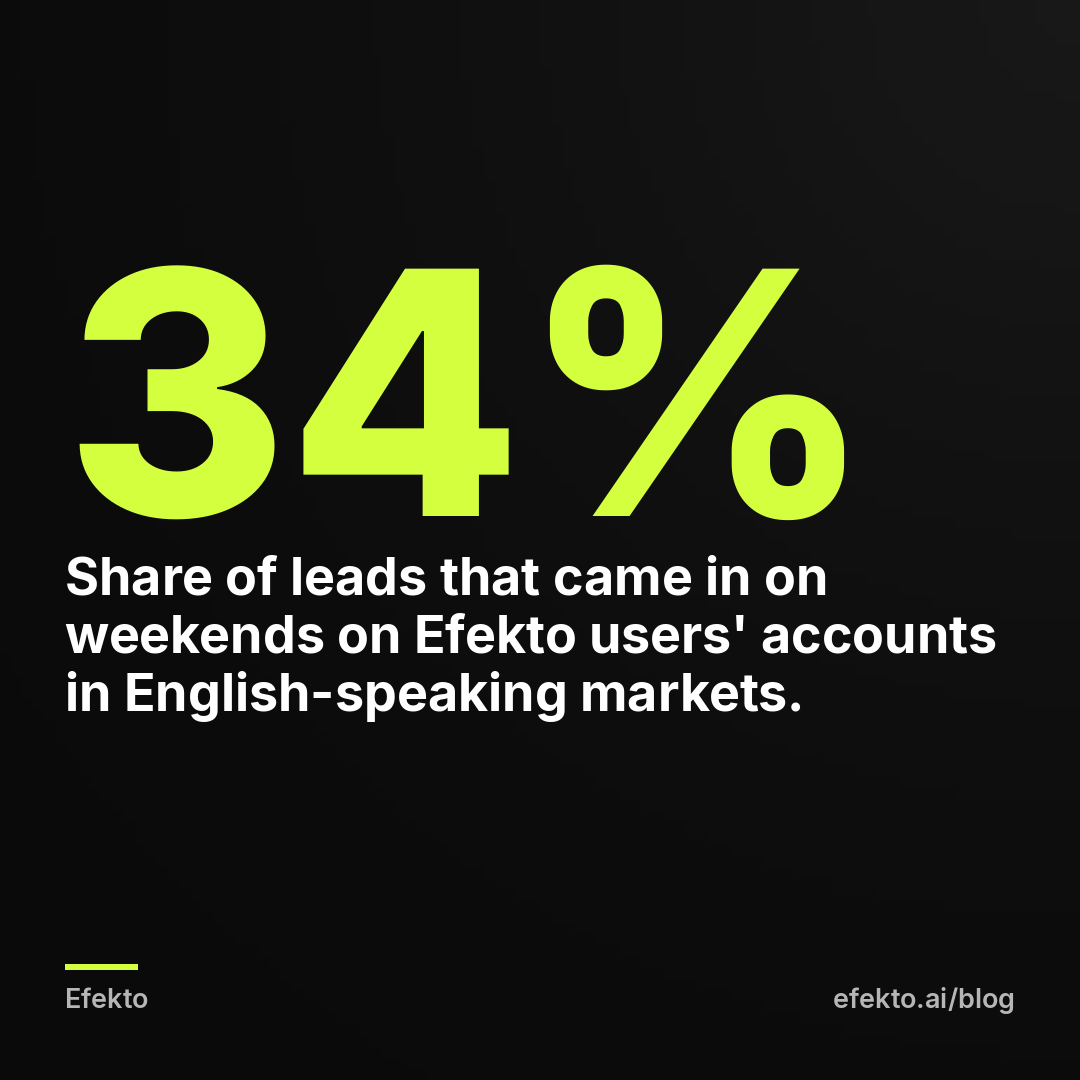
From our accounts: On Efekto users' accounts in English-speaking markets (mostly the US), we looked at 10 brands and 138 leads in the 180 days to Nov 8, 2026. 18% of leads came in after 6 pm, only 27% on weekdays between 8 am and 4 pm, and 34% on weekends. Limiting ads to office hours pushes the same budget into fewer hours aimed at the same small audience, which concentrates impressions on the same people. It also cuts out the evenings and weekends that delivered most of those leads. If frequency is too high, lower the budget and keep the schedule. There is more on timing in our post on the best times and days to run Facebook ads.
There is also a case where none of this helps. If your radius holds only a few thousand people, Facebook alone will not fill your calendar at any frequency. Run a small, steady budget there, and put the rest into Google, referrals and repeat customers.
If you don't want to watch these columns yourself, Efekto creates ads from your website, publishes them, and optimizes them every day: it turns off the ones that don't bring results and scales the ones that do. New ads come from your own site, so you aren't stuck with one tired image in a small market. The minimum daily ad budget is $15 per day, which matters when your audience can't absorb much more. How Efekto works explains the setup.
When we see frequency climbing on a local account, we check cost per lead first, the budget second and the ads last. We never shorten the schedule to make the number look better. If you'd rather have that check done every day without opening Ads Manager, you can try it on efekto.ai.
- Jakub Zwoliński
Founder, Lemon Agency · Efekto · November 14, 2026